
Envudeucitinib Shows Promising Results as Oral TYK2 Inhibitor for Psoriasis
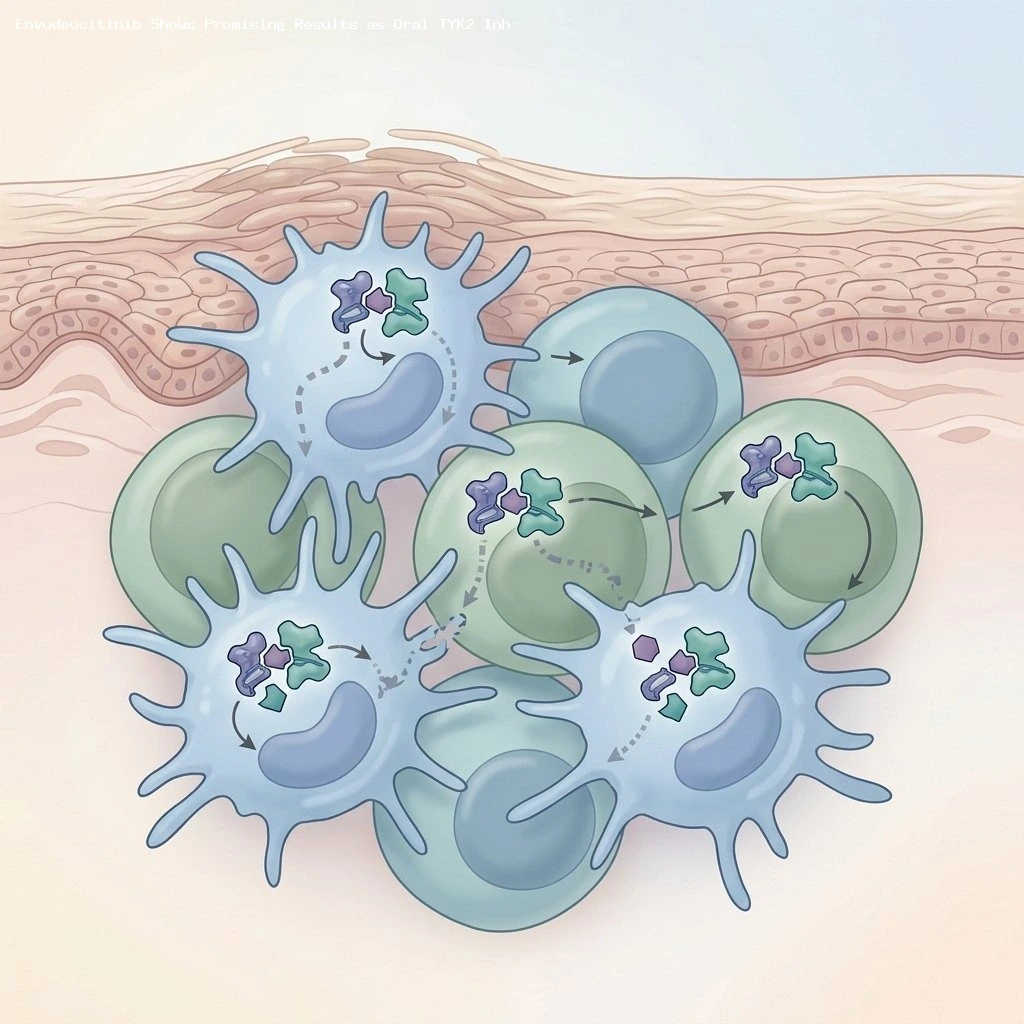
Envudeucitinib: a next-generation oral TYK2 inhibitor shows strong phase 3 results in plaque psoriasis
Late-breaking data presented at the 2026 American Academy of Dermatology Annual Meeting highlighted promising phase 3 results for envudeucitinib, an oral, next‑generation TYK2 inhibitor, in adults with moderate to severe plaque psoriasis (Source: AAD 2026 presentation, Blauvelt; Source: Alumis press release).
What is envudeucitinib and how does it work?
Envudeucitinib is a mechanistically optimized member of the TYK2 inhibitor class, designed to provide sustained pathway inhibition across a 24‑hour dosing window (Source: AAD 2026 presentation, Blauvelt).
TYK2 is an intracellular signaling protein involved in cytokine pathways important to psoriasis inflammation, and targeting it aims to modulate immune signals that drive skin plaques without broadly suppressing the immune system (Source: AAD 2026 presentation, Blauvelt).
Trial design: ONWARD 1 and ONWARD 2
The phase 3 program consisted of two randomized, double‑blind, placebo‑ and active comparator‑controlled trials named ONWARD 1 (NCT06586112) and ONWARD 2 (NCT06588738), enrolling adults with moderate to severe plaque psoriasis (Source: ClinicalTrials.gov, NCT06586112; NCT06588738).
Both trials used co‑primary efficacy end points assessed at week 16: the Psoriasis Area and Severity Index (PASI) 75 and the Physician’s Global Assessment (PGA) 0/1, comparing envudeucitinib to placebo and to the oral comparator apremilast (Source: AAD 2026 presentation, Blauvelt; Source: Alumis press release).
Efficacy: meaningful improvement at weeks 16 and 24
At the week 16 primary analysis, envudeucitinib met all primary end points and separated clinically from both placebo and apremilast, with approximately 75% of patients achieving PASI 75 (Source: AAD 2026 presentation, Blauvelt; Source: Alumis press release).
Responses continued to deepen through week 24, consistent with the pattern sometimes seen with therapies that modulate the IL‑23 axis, and by week 24 observed responses reached about 80% for PASI 75, roughly 65% for PASI 90, and close to 40% for PASI 100—meaning complete skin clearance for a substantial subgroup of patients (Source: AAD 2026 presentation, Blauvelt; Source: Alumis press release).
Those higher levels of skin clearance place envudeucitinib in a range approaching the efficacy often seen with biologic therapies, which is notable because envudeucitinib is an oral medication (Source: AAD 2026 presentation, Blauvelt; Source: Alumis press release).
Safety profile: generally favorable in these studies
The safety data reported from ONWARD 1 and ONWARD 2 were reassuring overall, with no new or unexpected safety signals identified in the 24‑week data set (Source: AAD 2026 presentation, Blauvelt; Source: Alumis press release).
The most commonly reported adverse events were nasopharyngitis and upper respiratory tract infections, and investigators did not observe signals for serious events that have been a concern with some immune modulators, including major adverse cardiovascular events, tuberculosis reactivation, or consistent laboratory abnormalities such as lipid elevations (Source: AAD 2026 presentation, Blauvelt; Source: Alumis press release).
Blauvelt characterized the overall tolerability as very good, noting that the drug “looked very safe” across the patients studied to date (Source: AAD 2026 presentation, Blauvelt).
Practical considerations: dosing and formulation plans
In the ONWARD trials envudeucitinib was dosed at 40 mg twice daily, a regimen chosen to maintain the optimized, sustained TYK2 inhibition profile developers aimed for (Source: AAD 2026 presentation, Blauvelt; Source: Alumis press release).
The company is already working on formulation improvements, including a planned long‑release tablet to move toward a once‑daily dosing option, which could simplify treatment for patients if approved (Source: AAD 2026 presentation, Blauvelt; Source: Alumis press release).
Regulatory timing and next steps
Based on typical timelines for dermatology drugs whose late‑stage data are presented at the AAD meeting, regulatory filings and potential approval could follow within the year after these results were disclosed, though final timing depends on submission completeness and regulatory review (Source: AAD 2026 presentation, Blauvelt).
Planned future work includes broader population studies and pediatric trials to evaluate safety and efficacy across more patient groups, aligning with the company’s development plan for a full label if approvals proceed (Source: AAD 2026 presentation, Blauvelt; Source: Alumis press release).
What these results mean for people with psoriasis
For patients and clinicians, the ONWARD program positions envudeucitinib as a potential high‑efficacy oral option that may offer deep skin clearance—PASI 90 and PASI 100 results—that in some measures approach biologic therapies, while maintaining a favorable short‑term safety profile in the trial population (Source: AAD 2026 presentation, Blauvelt; Source: Alumis press release).
As always, longer term safety and comparative effectiveness versus established biologic agents will be important to define in ongoing and future studies, and individual treatment decisions should factor in disease severity, comorbidities, prior treatment history, and patient preference (Source: AAD 2026 presentation, Blauvelt).
Sources
- American Academy of Dermatology 2026 Annual Meeting presentation: Blauvelt A. Envudeucitinib (ESK‑001) in moderate‑to‑severe plaque psoriasis: 24‑week results from the randomized, double‑blind, active comparator‑ and placebo‑controlled, phase 3 ONWARD 1 and 2 studies (Source: AAD 2026 presentation, Blauvelt).
- Alumis (company) press release: “Alumis’ envudeucitinib delivers early and robust improvements in skin clearance, quality of life, and psoriasis symptoms in two phase 3 trials,” March 2026. Available at: https://investors.alumis.com/news-releases/news-release-details/alumis-envudeucitinib-delivers-early-and-robust-improvements (Source: Alumis press release).
- ClinicalTrials.gov entries for the ONWARD studies: ONWARD 1 (NCT06586112) and ONWARD 2 (NCT06588738) (Source: ClinicalTrials.gov).