
How Perimenopause Affects Your Skin and What Your Doctor Can Do About It
When skin, hair, and blood vessels change in midlife: look beyond “just aging”
More dermatology clinics are seeing midlife women who notice sudden changes in their skin, hair, or facial flushing that don’t fit the usual patterns we expect with aging and are often brushed off as “normal.” (Source: Zouboulis CC & Makrantonaki E, Clinical aspects and molecular diagnostics of skin aging).
Those abrupt changes frequently mark the biologic shift known as perimenopause, a transitional phase before menopause defined by hormone fluctuations and a gradual fall in circulating estrogen</strong). (Source: Thornton MJ, Estrogens and aging skin).
Because people commonly seek dermatologic care first for appearance-related concerns, dermatology clinicians are uniquely placed to recognize perimenopausal signs and guide appropriate treatment or referral rather than dismissing symptoms as inevitable aging. (Source: Zouboulis CC & Makrantonaki E, Clinical aspects and molecular diagnostics of skin aging).
How falling estrogen affects the skin
Estrogen receptors are present throughout the skin, and estrogen helps control key functions such as collagen synthesis, epidermal thickness, hydration, wound healing, and immune balance in the skin. When estrogen levels fall, these processes change in measurable ways. (Source: Thornton MJ, Estrogens and aging skin).
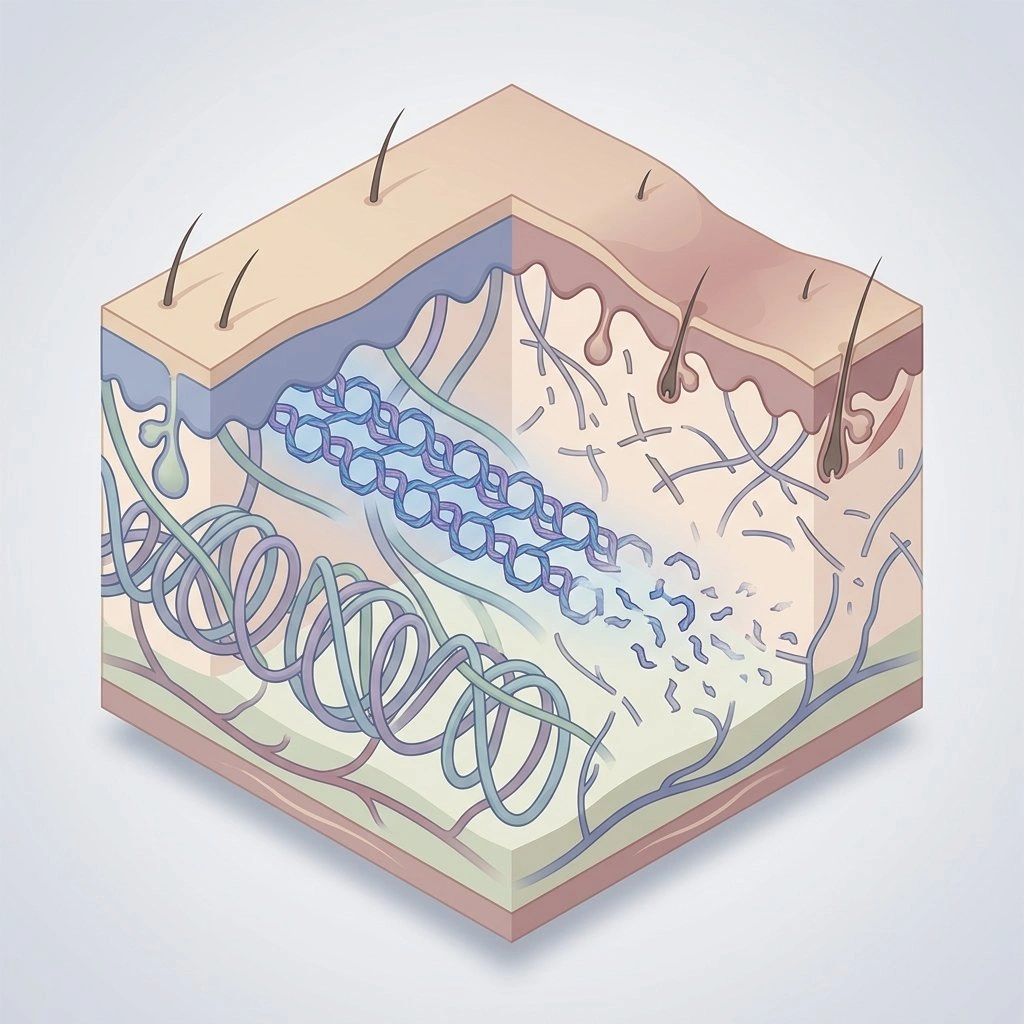
After menopause, levels of type I and III collagen in the dermis drop quickly; some studies estimate as much as a 30% reduction in the first five years, which contributes to thinner, less elastic skin and a weaker skin barrier. (Source: Baumann L., Skin ageing and its treatment).
Barrier breakdown: dryness, sensitivity, and eczema-like patterns
One of the most noticeable changes for many women is barrier dysfunction. The outermost layer of skin, the stratum corneum, shows changes in its lipids (including ceramides) after menopause, increasing transepidermal water loss and making skin more vulnerable to irritants and eczematous reactions. (Source: Kendall AC & Nicolaou A, Bioactive lipid mediators in skin inflammation and immunity).
Clinically, patients report new persistent dryness, itching (pruritus), and stinging when using products that were previously well tolerated. These complaints are common and are a biological effect of reduced estrogen-mediated lipid and barrier support rather than simply “looking older.” (Source: Kendall AC & Nicolaou A, Bioactive lipid mediators in skin inflammation and immunity).
Acne and hormonal shifts in midlife
Even when measured androgen levels are within lab reference ranges, the drop in estrogens can produce a relative androgen predominance, increasing sebaceous gland activity and driving follicular inflammation and acne. (Source: Thiboutot D., Acne: hormonal concepts and therapy).
Perimenopausal acne often appears along the jawline and lower face and can be inflammatory without many comedones, which distinguishes it from classic teenage acne. For this pattern, evidence supports prioritizing topical treatments and hormonal approaches over long courses of systemic antibiotics. (Source: Khunger N & Kumar C, Menopausal acne – challenges and solutions; Thiboutot D., Acne: hormonal concepts and therapy).
Rosacea, flushing, and vascular sensitivity
Vasomotor instability that starts in perimenopause can make facial flushing worse or unmask rosacea and persistent facial erythema. Some patients notice a sudden onset of ongoing redness, burning, or increased heat sensitivity in the face. (Source: Wilkin JK., Pathophysiology and treatment of rosacea).
Understanding the overlap between systemic vasomotor symptoms (hot flashes, flushing) and inflammatory facial skin conditions helps clinicians provide realistic counseling and coordinate care with primary care or gynecology when appropriate. (Source: Wilkin JK., Pathophysiology and treatment of rosacea).
Hair changes — why it matters emotionally and clinically
Hair complaints are among the most distressing issues for midlife women. Female pattern hair loss becomes much more common after menopause, with some studies reporting prevalence rates above 50% in postmenopausal groups. (Source: Chaikittisilpa S. et al., Prevalence of female pattern hair loss in postmenopausal women).
Careful evaluation should separate patterned thinning from telogen effluvium (diffuse shedding) or inflammatory causes of hair loss, since the treatments differ. Evidence-based options, such as topical minoxidil, are foundational for female pattern hair loss. (Source: Olsen EA., Female pattern hair loss).
Vulvovaginal symptoms: often misread as infection
Many women experience new vulvar or vaginal burning, dryness, and irritation during perimenopause and after menopause. These symptoms are frequently misinterpreted as recurrent infections when they may represent genitourinary syndrome of menopause (GSM), a hypoestrogenic condition affecting vulvovaginal tissues. (Source: The NAMS 2020 GSM Position Statement Editorial Panel).
Dermatology clinicians can play a key role by performing a careful dermatologic exam, excluding inflammatory dermatoses, and coordinating with gynecology or primary care to ensure appropriate hormonal or nonhormonal therapy. Early recognition improves comfort and prevents unnecessary antimicrobial treatments. (Source: Phillips NA & Bachmann GA., The genitourinary syndrome of menopause; The NAMS 2020 GSM Position Statement Editorial Panel).
Practical management strategies in dermatology clinics
First-line care focuses on barrier restoration and simplifying skincare routines so the skin can recover. Gentle cleansers, fragrance-free emollients rich in ceramides or other barrier lipids, and avoiding unnecessary or irritating actives are sensible starting points. (Source: Kendall AC & Nicolaou A, Bioactive lipid mediators in skin inflammation and immunity).
When reintroducing active ingredients (retinoids, exfoliants, acids), a cautious, stepwise approach helps prevent flares of sensitivity. For acne, favor topical therapies and consider hormonal modulation when appropriate rather than extended antibiotic courses. (Source: Khunger N & Kumar C, Menopausal acne – challenges and solutions; Thiboutot D., Acne: hormonal concepts and therapy).
Rosacea care includes identifying and minimizing triggers (thermal, alcoholic beverages, spicy foods, and certain skin care products), using topical or oral anti-inflammatory therapies when needed, and recognizing that some flushing may relate to systemic vasomotor symptoms rather than skin-only disease. (Source: Wilkin JK., Pathophysiology and treatment of rosacea).
For hair loss, management is guided by the diagnosis: topical minoxidil for female pattern hair loss, plus evaluation for reversible causes if the history suggests telogen effluvium. (Source: Olsen EA., Female pattern hair loss; Chaikittisilpa S. et al., Prevalence of female pattern hair loss in postmenopausal women).
When to collaborate or refer
Refer or co-manage with primary care, gynecology, or menopause specialists for moderate to severe vasomotor symptoms, significant sleep disruption, or bothersome GSM, because guideline-supported hormonal and nonhormonal therapies can markedly improve quality of life. (Source: The NAMS 2020 GSM Position Statement Editorial Panel; The 2023 nonhormone therapy position statement of the North American Menopause Society).
Coordination also reduces the risk of overtreatment with topical or systemic agents and ensures patients receive evidence-based options for symptoms that overlap skin and systemic menopausal changes. (Source: The NAMS 2020 GSM Position Statement Editorial Panel; The 2023 nonhormone therapy position statement of the North American Menopause Society).
Why recognizing perimenopause matters in dermatology
Perimenopause itself is not a dermatologic diagnosis, but its cutaneous and hair-related manifestations are biologically real and clinically actionable; identifying the transition helps clinicians tailor care and avoid unnecessary or ineffective therapies. (Source: Thornton MJ, Estrogens and aging skin; Baumann L., Skin ageing and its treatment).
Validation is also important: many women feel dismissed when their new symptoms are written off as “just aging.” A dermatology visit that acknowledges the biologic basis of these changes can reduce anxiety and direct patients toward treatments that restore function and comfort. (Source: Zouboulis CC & Makrantonaki E, Clinical aspects and molecular diagnostics of skin aging).
When dermatologists, primary care, and gynecology work together using evidence-based strategies—barrier repair, appropriate topical and hormonal options, and targeted hair therapies—patients get better outcomes and clearer explanations at a time of confusing physical change. (Source: The NAMS 2020 GSM Position Statement Editorial Panel; The 2023 nonhormone therapy position statement of the North American Menopause Society).
Author
Amanda Caldwell, MSN, APRN-C, is a dermatology nurse practitioner and serves as president of the Society of Dermatology Nurse Practitioners. Her clinical experience underscores the importance of recognizing perimenopausal changes in dermatologic practice.
Sources
- Thornton MJ. Estrogens and aging skin. (Source: Thornton MJ. Estrogens and aging skin).
- Zouboulis CC, Makrantonaki E. Clinical aspects and molecular diagnostics of skin aging. (Source: Zouboulis CC & Makrantonaki E, Clinical aspects and molecular diagnostics of skin aging).
- Baumann L. Skin ageing and its treatment. (Source: Baumann L., Skin ageing and its treatment).
- Kendall AC, Nicolaou A. Bioactive lipid mediators in skin inflammation and immunity. (Source: Kendall AC & Nicolaou A, Bioactive lipid mediators in skin inflammation and immunity).
- Khunger N, Kumar C. Menopausal acne – challenges and solutions. (Source: Khunger N & Kumar C, Menopausal acne – challenges and solutions).
- Thiboutot D. Acne: hormonal concepts and therapy. (Source: Thiboutot D., Acne: hormonal concepts and therapy).
- Wilkin JK. Pathophysiology and treatment of rosacea. (Source: Wilkin JK., Pathophysiology and treatment of rosacea).
- Chaikittisilpa S, Rattanasirisin N, Panchaprateep R, et al. Prevalence of female pattern hair loss in postmenopausal women: a cross-sectional study. (Source: Chaikittisilpa S. et al., Prevalence of female pattern hair loss in postmenopausal women).
- Olsen EA. Female pattern hair loss. (Source: Olsen EA., Female pattern hair loss).
- The NAMS 2020 GSM Position Statement Editorial Panel. The 2020 genitourinary syndrome of menopause position statement of the North American Menopause Society. (Source: The NAMS 2020 GSM Position Statement Editorial Panel).
- Phillips NA, Bachmann GA. The genitourinary syndrome of menopause. (Source: Phillips NA & Bachmann GA., The genitourinary syndrome of menopause).
- The 2023 nonhormone therapy position statement of the North American Menopause Society. (Source: The 2023 nonhormone therapy position statement of the North American Menopause Society).