
New Study Shows 2 Years Needed for Best Ruxolitinib Vitiligo Results
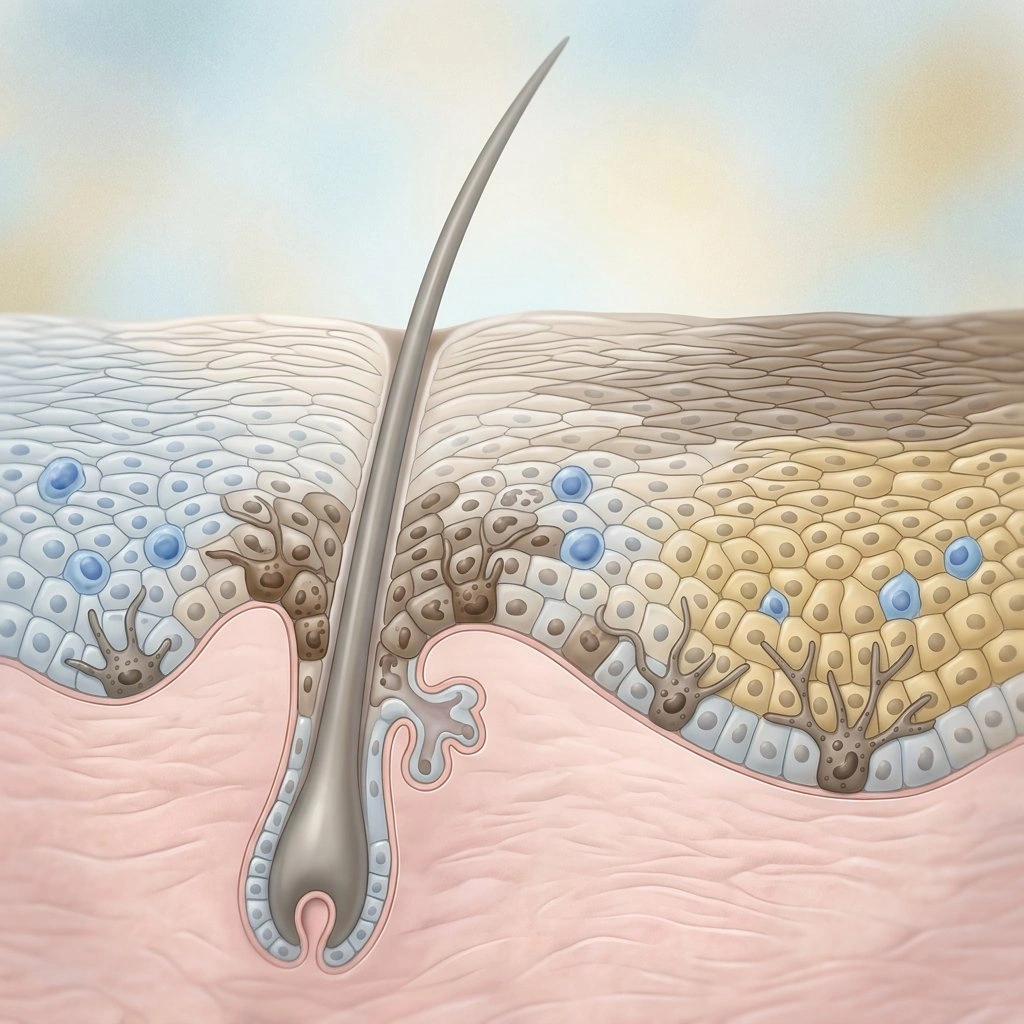
Why patience pays off: two‑year results for ruxolitinib cream in vitiligo
Talking with patients who have vitiligo about treatment can be one of the hardest parts of clinical care — especially when months of therapy produce little visible change.
New long‑term data from the TRuE‑V extension study give clinicians something concrete to say when patients are discouraged: many people who see little or no repigmentation at six months go on to show meaningful improvement by two years if they stay on treatment. (Source: J Eur Acad Dermatol Venereol, Wolkerstorfer et al., TRuE‑V long‑term extension)
Background
Vitiligo is a chronic condition in which patchy loss of skin pigment can be emotionally and socially burdensome for patients.
Until 2022 there were no treatments specifically approved by the U.S. Food and Drug Administration for repigmentation in vitiligo; that changed when ruxolitinib cream (Opzelura), a topical JAK1/JAK2 inhibitor, received approval for nonsegmental vitiligo in patients aged 12 and older. (Source: U.S. Food and Drug Administration, ruxolitinib cream approval)
The approval was supported by the phase 3 TRuE‑V1 and TRuE‑V2 trials, which showed significant repigmentation and acceptable tolerability through 52 weeks. (Source: TRuE‑V1 and TRuE‑V2 phase 3 trials, Incyte)
Following those studies, the TRuE‑V long‑term extension (LTE) tracked patients through 104 weeks and reported ongoing improvement for many participants. The new analysis focuses on those who had little or no response at the six‑month checkpoint to see whether longer treatment changed outcomes. (Source: J Eur Acad Dermatol Venereol, Wolkerstorfer et al., TRuE‑V long‑term extension)
Study design and who was included
This analysis looked specifically at patients from TRuE‑V1 and TRuE‑V2 who were originally randomized to twice‑daily ruxolitinib cream 1.5% and who had failed to reach a predefined early response at 24 weeks.
Early response was defined as at least a 25% improvement in either facial or total body repigmentation scores by 24 weeks, using the validated scoring tools F‑VASI (Facial Vitiligo Area Scoring Index) and T‑VASI (Total Vitiligo Area Scoring Index). (Source: J Eur Acad Dermatol Venereol, Wolkerstorfer et al., TRuE‑V long‑term extension)
Eligible patients continued to apply the cream twice daily and were followed through weeks 52, 80, and 104, with outcomes assessed at those time points. The analysis included 127 patients with no or limited facial repigmentation at six months and 193 with no or limited total body repigmentation at the same time point. (Source: J Eur Acad Dermatol Venereol, Wolkerstorfer et al., TRuE‑V long‑term extension)
Key findings
The central message is straightforward: early nonresponse did not reliably predict long‑term failure when treatment continued.
For patients with no or limited facial repigmentation at week 24, the proportion showing any improvement in F‑VASI rose from about 72% at week 52 to over 90% by week 104. Remarkably, among those who had shown no facial repigmentation at all at six months, 97% had measurable improvement by two years. (Source: J Eur Acad Dermatol Venereol, Wolkerstorfer et al., TRuE‑V long‑term extension)
The higher bar of clinically meaningful facial repigmentation — defined as F‑VASI75 (75% or greater improvement) — was reached by only 13% of this subgroup at one year but climbed steadily to nearly 55% by week 104. This highlights the slow, cumulative nature of repigmentation for many patients. (Source: J Eur Acad Dermatol Venereol, Wolkerstorfer et al., TRuE‑V long‑term extension)
Total body outcomes followed a similar pattern. Among patients with limited early body response, roughly 85% demonstrated some improvement in T‑VASI by two years, and about half reached the T‑VASI50 threshold (50% or greater reduction in total body disease burden) by the end of the study. (Source: J Eur Acad Dermatol Venereol, Wolkerstorfer et al., TRuE‑V long‑term extension)
Clinical implications
These results matter for everyday clinical conversations: repigmentation with topical ruxolitinib can be slow, and stopping therapy at six months risks missing late but meaningful responses.
The authors suggest that for some patients a full therapeutic trial may extend to 24 months of continuous treatment to assess the medication’s true benefit — especially for those who tolerate therapy and can adhere to the regimen. (Source: J Eur Acad Dermatol Venereol, Wolkerstorfer et al., TRuE‑V long‑term extension)
When discussing treatment plans, clinicians should combine this evidence with each patient’s circumstances — including disease extent, cosmetic and functional impact, tolerance of therapy, and personal preferences — to reach a shared decision about continuing therapy. (Source: Dermatol Pract Concept, Seneschal & Boniface)
It’s also worth remembering that the phase 3 TRuE‑V trials reported favorable tolerability through 52 weeks, which helped support approval; however, longer‑term safety monitoring remains important during extended use. (Source: TRuE‑V1 and TRuE‑V2 phase 3 trials, Incyte)
Limitations to keep in mind
No study is without caveats: the LTE results may be influenced by attrition bias, because patients who improve are more likely to remain on treatment and in follow‑up, while those who do not benefit may drop out. This can make later time‑point results appear more optimistic. (Source: J Eur Acad Dermatol Venereol, Wolkerstorfer et al., TRuE‑V long‑term extension)
The numbers of patients with available data at weeks 80 and 104 were smaller than at week 52, so confidence intervals widen and subgroup estimates are less precise at those later visits. Clinicians should interpret long‑term response rates with this context in mind. (Source: J Eur Acad Dermatol Venereol, Wolkerstorfer et al., TRuE‑V long‑term extension)
Practical advice for clinicians and patients
Below are practical steps clinicians can take when caring for patients who show limited improvement at six months:
-
Counsel patients that repigmentation can continue for up to 24 months and that persistence with therapy may yield late benefit. (Source: J Eur Acad Dermatol Venereol, Wolkerstorfer et al., TRuE‑V long‑term extension)
-
Set measurable expectations using F‑VASI and T‑VASI so both clinician and patient can track incremental change over time. (Source: J Eur Acad Dermatol Venereol, Wolkerstorfer et al., TRuE‑V long‑term extension)
-
Assess adherence, application technique, and barriers to twice‑daily use; sometimes failures reflect inconsistent use rather than lack of drug effect. (Source: Narrative review, Monteiro et al.)
-
Discuss tolerability and treatment burden openly; if side effects or lifestyle impact are unacceptable, consider alternative management strategies or shared decisions to stop. (Source: Dermatol Pract Concept, Seneschal & Boniface)
-
If there is truly no response and the burden of continued treatment is high, plan a structured reassessment and discuss other options, including clinical trials when appropriate. (Source: J Eur Acad Dermatol Venereol, Wolkerstorfer et al., TRuE‑V long‑term extension)
Conclusion
The TRuE‑V long‑term extension data offer encouraging news: many patients who appear to be early nonresponders to ruxolitinib cream may still achieve meaningful repigmentation by two years if they continue therapy.
For clinicians, the practical takeaways are to set realistic timelines, use objective scoring tools to monitor progress, and engage in shared decision‑making that balances the possibility of late improvement against each patient’s preferences and life circumstances. (Source: J Eur Acad Dermatol Venereol, Wolkerstorfer et al., TRuE‑V long‑term extension)
Ongoing research and real‑world experience will continue to refine who benefits most and for how long treatment should be continued, but for now a 24‑month horizon may be the most informative benchmark for slower responders. (Source: Narrative review, Monteiro et al.; Dermatol Pract Concept, Seneschal & Boniface)
Sources
- Wolkerstorfer A, Gooderham MJ, Sebastian M, et al. Prolonged ruxolitinib cream treatment for vitiligo among patients with no or limited response in the first 6 months. J Eur Acad Dermatol Venereol. Published online March 7, 2026. (Source: J Eur Acad Dermatol Venereol, Wolkerstorfer et al., TRuE‑V long‑term extension)
- U.S. Food and Drug Administration. Approval of ruxolitinib cream (Opzelura) for nonsegmental vitiligo in patients aged 12 and older. 2022. (Source: U.S. Food and Drug Administration, ruxolitinib cream approval)
- TRuE‑V1 and TRuE‑V2 Phase 3 trials. Incyte Corporation. Data supporting approval of topical ruxolitinib for vitiligo; phase 3 results through 52 weeks. (Source: TRuE‑V1 and TRuE‑V2 phase 3 trials, Incyte)
- Seneschal J, Boniface K. Vitiligo: Current therapies and future treatments. Dermatol Pract Concept. 2023;13(4S2):e2023313S. (Source: Dermatol Pract Concept, Seneschal & Boniface)
- Monteiro E Silva G, Mohamed A, Ferreira C, Torres T. Treatment of vitiligo with topical ruxolitinib: a narrative review. Published Sep 15, 2025. (Source: Narrative review, Monteiro et al.)