
Topical Ivermectin Boosts KTP Laser Results for Rosacea Redness and Lesions
Introduction
This article reviews a recent randomized, evaluator-blinded split-face clinical trial that looked at whether adding once-daily topical ivermectin 1% cream to KTP 532 nm laser treatments improves outcomes for facial redness in people with rosacea (Source: Heidemeyer K et al., Treatment of redness in rosacea with potassium‑titanyl‑phosphate (KTP) 532 nm laser with and without topical 1% ivermectin cream).
Background
Rosacea commonly causes persistent facial redness (erythema) and visible small blood vessels (telangiectasia), and these vascular signs are often treated with lasers that target blood vessels, such as the KTP 532 nm laser (Source: Heidemeyer K et al., Treatment of redness in rosacea with potassium‑titanyl‑phosphate (KTP) 532 nm laser with and without topical 1% ivermectin cream).
Because rosacea is a chronic, relapsing condition, clinicians and patients aim to get the most benefit from treatments while minimizing the number of laser sessions needed and the downtime that can come with them.
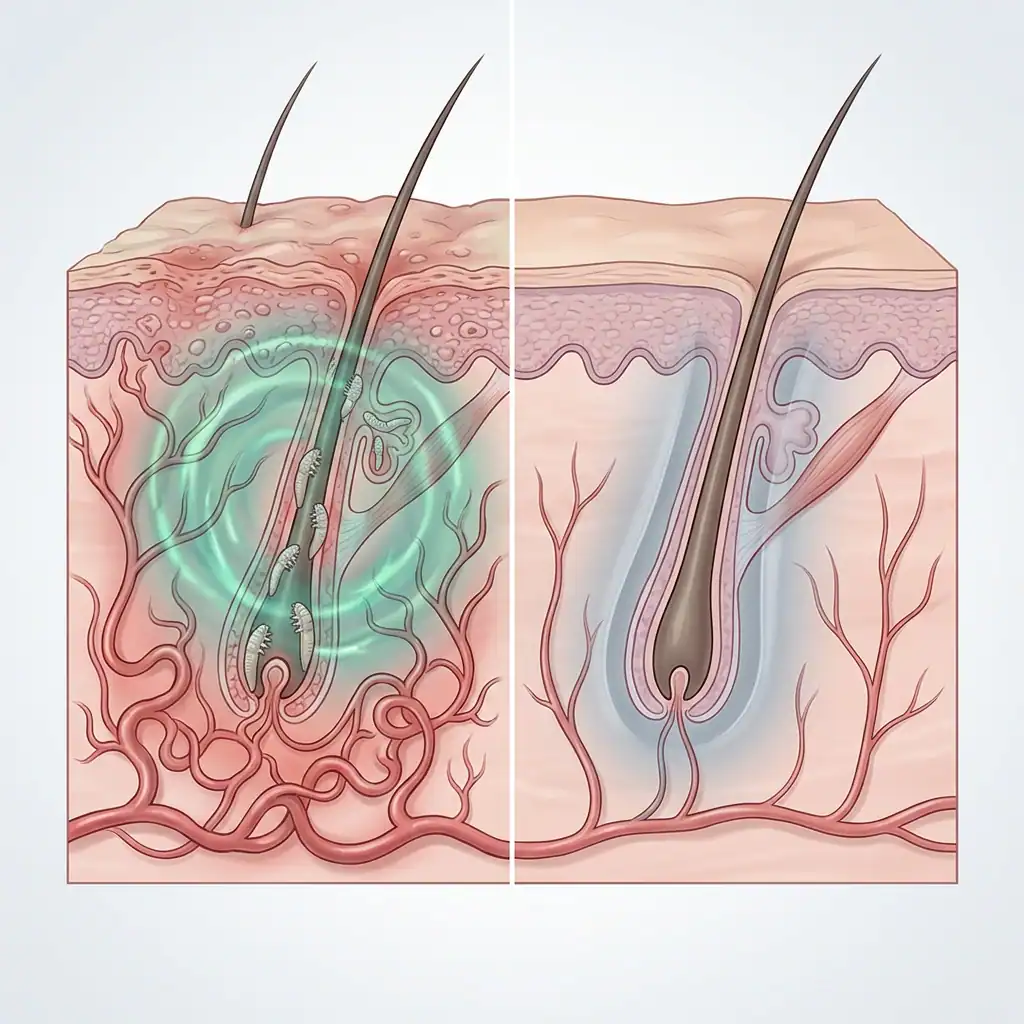
Topical ivermectin is an anti-parasitic medication that is used in rosacea partly because it targets Demodex mites, which are found at higher densities on the skin of many people with rosacea and may contribute to inflammation (Source: Chen C et al., Exploring the Pathogenesis and Mechanism‑Targeted Treatments of Rosacea).
Beyond its effect on mites, ivermectin has been shown in laboratory studies to reduce expression of several proinflammatory mediators involved in rosacea, including IL‑8, LL‑37, and TNF‑α, which gives a plausible biological rationale for combining it with laser therapy (Source: Chen C et al., Exploring the Pathogenesis and Mechanism‑Targeted Treatments of Rosacea).
Study design
Overview
The trial was a single‑site, randomized, evaluator‑blinded, split‑face study (ClinicalTrials.gov identifier: NCT06033352) that enrolled adults with primarily erythematous rosacea or mild papulopustular rosacea and Fitzpatrick skin types I–IV (Source: ClinicalTrials.gov, NCT06033352; Heidemeyer K et al.).
Participants
A total of 24 participants were enrolled in the study, providing a within‑subject comparison because each person received different treatments on each side of the face, which helps control for individual factors like skin type and baseline disease severity (Source: Heidemeyer K et al.).
Treatment protocol
All participants received four sessions of KTP 532 nm laser therapy spaced four weeks apart, with a final study evaluation at week 16 to assess outcomes after the treatment course (Source: Heidemeyer K et al.).
Using the split‑face design, one side of each participant’s face received laser therapy alone while the opposite side received laser plus once‑daily topical ivermectin 1% cream applied between laser sessions, allowing direct comparison of the added effect of topical therapy (Source: Heidemeyer K et al.).
Endpoints and assessments
The trial’s primary endpoint was the change in the Normalized Erythema Index (NEI), an objective redness metric derived from standardized digital image analysis, meant to quantify facial erythema in a reproducible way (Source: Heidemeyer K et al.).
Secondary endpoints included the Skin Redness Index (SRI), the Clinical Erythema Assessment (CEA), Physician Global Assessment (PGA), telangiectasia severity scores, counts of papules and pustules, patient satisfaction measures, and safety outcomes (Source: Heidemeyer K et al.).
Results
Baseline characteristics
At the start of the study, the two sides of each participant’s face were similar with respect to objective erythema indices, telangiectasia severity, and inflammatory lesion counts, supporting a fair intra‑subject comparison (Source: Heidemeyer K et al.).
Primary outcome: objective redness (NEI)
By week 16, both the laser‑only and the combination (laser + topical ivermectin) sides showed significant improvement in erythema and overall disease severity compared with baseline (Source: Heidemeyer K et al.).
The side treated with both KTP 532 nm laser and topical ivermectin 1% cream showed a significantly greater reduction in the primary objective measure, the NEI, than the laser‑only side: the median relative NEI reduction was 16.6% for the combination side versus 5.3% for laser alone (p = 0.04) (Source: Heidemeyer K et al.).
Secondary outcomes and clinical scores
Despite the difference seen in the NEI, many other erythema-related clinical assessments—such as the SRI, CEA scores, telangiectasia severity ratings, PGA results, and patient satisfaction—did not show statistically significant differences between the two treatment sides at the primary endpoint (Source: Heidemeyer K et al.).
This means that while an objective image‑based measurement favored the combination, standard clinical scales and patient‑reported satisfaction were broadly similar whether ivermectin was added or not in this sample and time frame (Source: Heidemeyer K et al.).
Mixed‑model analysis across visits
When researchers analyzed outcomes across all study visits using mixed statistical models, the combination of laser plus topical ivermectin showed a statistically significant overall improvement in NEI compared with laser alone, supporting an added objective benefit when data from all time points are considered (Source: Heidemeyer K et al.).
Impact on inflammatory lesions
One of the clearest additional benefits observed with adjunctive topical ivermectin was a greater reduction in inflammatory lesions: across all visits, the combination side had a significantly greater decrease in counts of papules and pustules compared with laser alone (p = 0.02) (Source: Heidemeyer K et al.).
Both treatment approaches reduced inflammatory lesion counts over time, but the improvement was more pronounced when ivermectin was used alongside laser therapy, consistent with the drug’s antiparasitic and anti‑inflammatory actions (Source: Heidemeyer K et al.; Chen C et al.).
Safety and tolerability
Both treatment strategies were well tolerated and had favorable safety profiles in this study population; no serious adverse events were reported during the trial period (Source: Heidemeyer K et al.).
Transient post‑treatment effects commonly seen after vascular laser—such as temporary redness, swelling (edema), and purpura—occurred at similar rates on both sides of the face, and adding topical ivermectin did not significantly increase downtime after laser sessions (Source: Heidemeyer K et al.).
Overall adherence to the once‑daily topical regimen was high, and participants generally tolerated the combined approach well (Source: Heidemeyer K et al.).
Limitations
Several limitations should be kept in mind when interpreting these findings, beginning with the relatively small sample size of 24 participants, which limits statistical power and the ability to detect small but clinically meaningful differences (Source: Heidemeyer K et al.).
The split‑face design, while useful for controlling for between‑person variability, introduces the possibility of crossover effects if any systemic absorption of topical ivermectin occurs, potentially diluting differences between sides (Source: Heidemeyer K et al.).
Participants in this study generally had low baseline inflammatory activity, which may have reduced the ability to detect larger differences in erythema‑related clinical scores and inflammatory lesion outcomes in some subgroups (Source: Heidemeyer K et al.).
Variable flushing patterns among participants can also affect photographic redness measurements and introduce noise to objective indices like the NEI, which may partly explain why some clinical scales did not mirror the NEI results (Source: Heidemeyer K et al.).
Interpretation and practical takeaways
This trial supports that KTP 532 nm laser therapy is effective at improving the vascular signs of rosacea, including erythema and telangiectasia, and also reduces inflammatory lesions over a treatment course (Source: Heidemeyer K et al.).
Adding topical ivermectin 1% cream once daily to laser therapy provided an additional objective reduction in redness as measured by NEI and a clearer benefit in reducing papules and pustules, suggesting a complementary role that combines laser’s vascular effects with ivermectin’s anti‑parasitic and anti‑inflammatory properties (Source: Heidemeyer K et al.; Chen C et al.).
Clinicians and patients considering combination therapy should balance the modest objective improvement in NEI and the stronger effect on inflammatory lesions against study limitations, and recognize that patient‑reported satisfaction and many clinical redness scales were similar between the two approaches in this trial population (Source: Heidemeyer K et al.).
Further research with larger samples, longer follow‑up, and participants with a wider range of inflammatory activity would help clarify which patients are most likely to gain clinically meaningful additional benefit from adding topical ivermectin to laser therapy.
Conclusions
In this randomized split‑face trial, combining once‑daily topical ivermectin 1% cream with KTP 532 nm laser therapy was safe, well tolerated, and produced a greater objective reduction in redness by NEI as well as a superior decrease in inflammatory lesions compared with laser alone (Source: Heidemeyer K et al.).
While many clinical redness measures and patient satisfaction scores were similar between the two sides, the mixed‑model analyses and the clearer effect on papules and pustules suggest that topical ivermectin can be a useful adjunct to laser when the clinical goal includes reducing inflammatory lesions as well as vascular redness (Source: Heidemeyer K et al.; Chen C et al.).
Sources
- Heidemeyer K, Cazzaniga S, Junge A, et al. Treatment of redness in rosacea with potassium‑titanyl‑phosphate (KTP) 532 nm laser with and without topical 1% ivermectin cream: a randomized split‑face trial. J Dermatolog Treat. doi:10.1080/09546634.2026.2635882 (Source: Heidemeyer K et al., Treatment of redness in rosacea with potassium‑titanyl‑phosphate (KTP) 532 nm laser with and without topical 1% ivermectin cream).
- ClinicalTrials.gov. NCT06033352: Treatment of redness in rosacea with potassium‑titanyl‑phosphate (KTP) 532 nm laser with and without topical 1% ivermectin cream. (Source: ClinicalTrials.gov, NCT06033352).
- Chen C, Wang P, Zhang L, et al. Exploring the Pathogenesis and Mechanism‑Targeted Treatments of Rosacea: Previous Understanding and Updates. Biomedicines. Published 2023 Jul 31. doi:10.3390/biomedicines11082153 (Source: Chen C et al., Exploring the Pathogenesis and Mechanism‑Targeted Treatments of Rosacea).