
Transdermal Botulinum Toxin Cuts Acne-Related Oil Production by 40%
Introduction
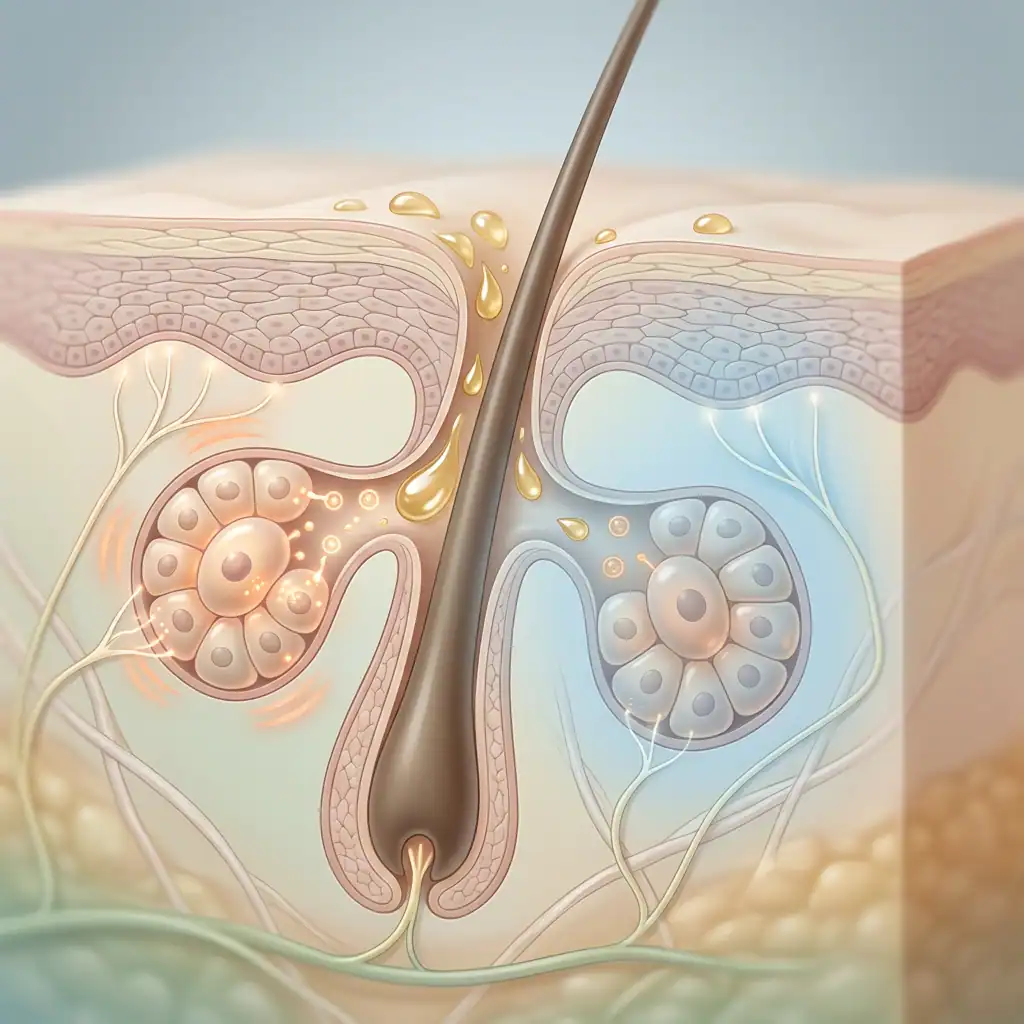
In recent years, botulinum toxin type A has moved beyond wrinkle reduction and become a tool in treating oily and acne-prone skin by lowering sebum output and improving texture through intradermal injections (Source: Schulz & Lamprecht, J Cosmet Dermatol).
Although injections can be effective, they come with potential downsides such as discomfort, short-lived erythema, bruising, swelling, and rare diffusion-related muscle effects that some patients prefer to avoid (Source: Schulz & Lamprecht, J Cosmet Dermatol).
That has driven interest in delivery methods that avoid needles but still put active agents into the superficial skin layers — approaches that aim to keep benefit while improving safety and patient experience (Source: Schulz & Lamprecht, J Cosmet Dermatol).
What the new study tested
The study evaluated needle-free, transdermal application of botulinum toxin type A using a device called DERMADROP MED, which applies a standardized protocol (BIOBOTOX) to people with clinically oily or acne-prone skin (Source: Schulz & Lamprecht, J Cosmet Dermatol).
The toxin used in the trial was a 25 IU preparation of a 150 kDa formulation delivered across facial areas in a single treatment session, and outcomes were tracked over four weeks (Source: Schulz & Lamprecht, J Cosmet Dermatol).
TDA technology: how the delivery works
The transdermal approach in this trial relies on a technology the authors call Transdermal Application (TDA), which pairs oxygen-assisted microjet propulsion with a specialized carrier matrix (LP3) designed to be both lipophilic and hydrophilic (Source: Schulz & Lamprecht, J Cosmet Dermatol).
Mechanically, the device generates a high-velocity microjet that helps move the active solution across the epidermis without needles, while the carrier transiently modifies lipid packing in the stratum corneum to create temporary diffusion pathways (Source: Schulz & Lamprecht, J Cosmet Dermatol).
This combined action — oxygen-driven microconvective transport plus a dual-nature carrier — is intended to push active molecules into the superficial dermis and follicular structures without tearing or otherwise disrupting skin integrity (Source: Schulz & Lamprecht, J Cosmet Dermatol).
The concept of altering barrier lipids or using carriers to enhance topical delivery is supported by prior research on formulation strategies for increased penetration, including work on biodegradable nanoparticles and carrier-driven enhancement (Source: Alvarez-Román et al., Pharm Res 2004).
Study design and participant profile
This was a single-center, observational study performed in Barcelona with 19 adult participants aged 20 to 50 years, including 15 women and 4 men, all presenting with signs of seborrheic or acne-prone skin such as excess sebum, enlarged pores, and recurrent acneiform lesions (Source: Schulz & Lamprecht, J Cosmet Dermatol).
Before treatment, skin was prepared using a standardized regimen: cleansing, a brief acclimatization period, antiseptic preparation, and a gentle microdermabrasion step to remove surface keratin and sebum and improve subsequent transdermal uptake (Source: Schulz & Lamprecht, J Cosmet Dermatol).
Treatment procedure
The study team applied the botulinum toxin formulation with the DERMADROP MED device for roughly 12 minutes, treating multiple facial zones including the forehead, cheeks, periorbital areas, nasal dorsum, and chin (Source: Schulz & Lamprecht, J Cosmet Dermatol).
After the transdermal delivery, a hydrating mask was applied and participants received standardized posttreatment care instructions to support recovery and skin barrier restoration (Source: Schulz & Lamprecht, J Cosmet Dermatol).
How outcomes were measured
Objective sebum output was assessed using a Sebumeter, and changes in topography and skin surface features were recorded with standardized 2D and 3D imaging tools at baseline, two weeks, and four weeks after treatment (Source: Schulz & Lamprecht, J Cosmet Dermatol).
Patient experience and perceived change in oiliness were captured with two validated instruments: the Oily Skin Impact Scale (OSIS), which focuses on psychosocial burden, and the Oily Skin Self-Assessment Scale (OSSAS), which measures visual, tactile, and sensory perceptions (Source: Schulz & Lamprecht, J Cosmet Dermatol).
Objective results: sebum reduction
Across measured facial areas the study reported reductions in surface oil as recorded by the Sebumeter, with the most robust change on the forehead where mean sebum fell from 166.75 mg/cm² to 100.19 mg/cm² at two weeks — a roughly 39.9% reduction that reached statistical significance (p < 0.001) (Source: Schulz & Lamprecht, J Cosmet Dermatol).
Other regions including cheeks, chin, and nose showed reductions in the range of about 25.9% to 34.1%, although those regional changes did not all meet statistical significance in this small cohort (Source: Schulz & Lamprecht, J Cosmet Dermatol).
Patient-reported outcomes and perceived benefits
Subjective measures showed meaningful improvements: on the OSIS, participants reported a roughly 58% drop in scores tied to “Annoyance” and a 54% improvement in the “Self-Image” domain, with frustration and annoyance each falling by more than 3 points on a 10-point scale (Source: Schulz & Lamprecht, J Cosmet Dermatol).
The OSSAS likewise showed large perceived improvements: visual assessments of oiliness decreased by 48%, sensory perception scores by 57%, and tactile scores by 49%, indicating that participants noticed less shine, oil feel, and slickness on touch (Source: Schulz & Lamprecht, J Cosmet Dermatol).
In a blotting-paper style assessment focusing on the forehead, average scores improved by 3.44 points, while overall perceived oiliness fell by nearly four points on average, reinforcing the objective sebum reductions (Source: Schulz & Lamprecht, J Cosmet Dermatol).
Tolerability and safety
Treatment tolerance was reported as excellent: participants generally described the procedure as painless and comfortable, with no procedure-related erythema, edema, or bruising noted during the study follow-up (Source: Schulz & Lamprecht, J Cosmet Dermatol).
No adverse events were reported in this observational cohort, and patient satisfaction metrics were high, with many subjects describing smoother texture and improved skin luminosity as secondary benefits (Source: Schulz & Lamprecht, J Cosmet Dermatol).
Exploratory observations
Investigators noted some anecdotal or exploratory improvements in hyperpigmentation irregularities and periorbital darkness in a subset of participants, but these effects were not predefined endpoints and require targeted study to validate (Source: Schulz & Lamprecht, J Cosmet Dermatol).
Discussion: what this means and limitations
The findings suggest that needle-free, oxygen-assisted transdermal delivery can deposit a botulinum toxin formulation into superficial skin layers and produce measurable reductions in sebum production and perceived oiliness, at least in the short term (Source: Schulz & Lamprecht, J Cosmet Dermatol).
Mechanistically, the study supports the idea that combining a carrier that transiently alters stratum corneum lipid organization with a convective microjet can enhance transport into hair follicles and the superficial dermis, a concept aligned with prior formulation research on penetration enhancement (Source: Schulz & Lamprecht, J Cosmet Dermatol; Alvarez-Román et al., Pharm Res 2004).
However, the authors emphasize several important limitations: the small sample size, the single-center and observational design, and the relatively short follow-up of four weeks, all of which constrain how widely the results can be generalized (Source: Schulz & Lamprecht, J Cosmet Dermatol).
Key questions remain that larger, randomized controlled trials should address, including optimal dosing, treatment intervals, long-term durability of effect, and more detailed characterization of the exact cutaneous distribution and mechanism of action of transdermally delivered botulinum preparations (Source: Schulz & Lamprecht, J Cosmet Dermatol).
Conclusion
This preliminary study provides early evidence that TDA technology delivered via the DERMADROP MED device may offer a safe, well-tolerated, noninvasive alternative to intradermal injection for reducing sebum production and improving skin quality in people with oily or acne-prone skin (Source: Schulz & Lamprecht, J Cosmet Dermatol).
While encouraging, these results should be viewed as hypothesis-generating — further randomized trials with larger populations and longer follow-up are needed to confirm efficacy, refine protocols, and fully understand safety and mechanisms (Source: Schulz & Lamprecht, J Cosmet Dermatol).
Sources
- Schulz S, Lamprecht S. Transdermal Delivery of Botulinum Toxin for the Management of Oily and Acne-Prone Skin Using TDA Technology. J Cosmet Dermatol. doi:10.1111/jocd.70656 (Source: Schulz & Lamprecht, J Cosmet Dermatol).
- Alvarez-Román R, Naik A, Kalia YN, Guy RH, Fessi H. Enhancement of topical delivery from biodegradable nanoparticles. Pharm Res. 2004;21(10):1818-1825. doi:10.1023/b:pham.0000045235.86197.ef (Source: Alvarez-Román et al., Pharm Res 2004).