
Expanding Photodynamic Therapy for Effective Treatment of Superficial BCC
Superficial basal cell carcinoma: treatment flexibility and why it matters
Superficial basal cell carcinoma (sBCC) is a common, usually lower-risk subtype of basal cell skin cancer that often appears on the trunk and other sites where cosmetic outcome matters. Because of its behavior and location, clinicians have more room to choose among treatments that are not strictly surgical, which can be a big advantage for certain patients.
When surgery isn’t the best option—because of bleeding risks, medical comorbidities, difficulty coming into clinic, or strong concern about scars—non-surgical therapies become particularly useful. Those options include topical agents, cryotherapy, targeted small-molecule drugs, and photodynamic therapy (PDT), each with pros and cons clinicians weigh with patients (Source: American Academy of Dermatology, Basal cell carcinoma patient resources).
Why sBCC allows more therapeutic choice
sBCC tends to grow superficially rather than deeply invading tissue, which often makes it amenable to treatments that treat the surface and the immediately surrounding skin rather than removing tissue with wide margins. That clinical pattern is why multidisciplinary strategies are realistic for many people with sBCC (Source: NCCN Clinical Practice Guidelines in Oncology: Basal Cell Skin Cancer).
Photodynamic therapy: a versatile non-surgical option
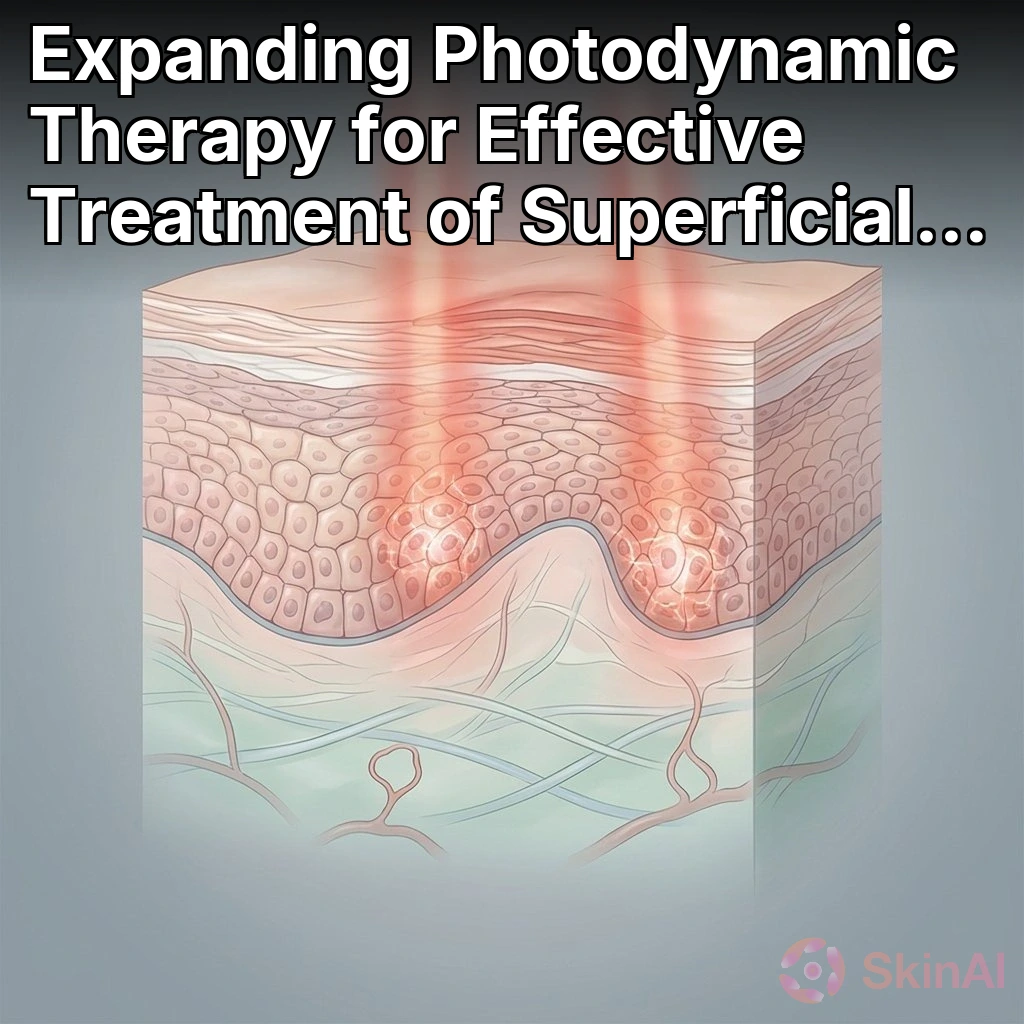
Photodynamic therapy (PDT) uses a topical photosensitizer applied to the skin, which is converted inside abnormal cells to a light-sensitive compound. Exposing the area to a specific light wavelength then activates that compound and destroys abnormal cells while sparing deeper structures. This targeted, skin-directed mechanism is one reason PDT can be attractive for sBCC and for treating the surrounding sun-damaged skin (Source: Cochrane Database of Systematic Reviews, Photodynamic therapy for basal cell carcinoma).
PDT is supported by clinical studies showing good efficacy for superficial lesions and favorable cosmetic outcomes compared with some surgical approaches or destructive therapies. Both methyl aminolevulinate and aminolevulinic acid–based PDT preparations are used in practice, and regulatory-approved products exist for these indications (Source: Galderma, Metvix product information; Source: Biofrontera, Ameluz prescribing information).
Blue versus red light: practical differences
Two common light sources for PDT are blue light and red light. Blue light penetrates more superficially and can be effective for very superficial lesions, while red light penetrates deeper and may be chosen for slightly thicker sBCC or when you want a broader depth of effect. Choice of light can depend on lesion thickness, location, and the clinic’s equipment (Source: Cochrane Database of Systematic Reviews, Photodynamic therapy for basal cell carcinoma).
Other non-surgical and adjunctive options
Beyond PDT, clinicians commonly use topical therapies (such as imiquimod or fluorouracil), cryotherapy, and—where appropriate—systemic targeted drugs called hedgehog pathway inhibitors. Each approach has different indications, side effects, and monitoring needs (Source: NCCN Clinical Practice Guidelines in Oncology: Basal Cell Skin Cancer).
Hedgehog inhibitors like vismodegib and sonidegib are oral agents used for locally advanced or metastatic BCC or for patients with genetic syndromes that create many tumors (for example, Gorlin syndrome). These drugs can dramatically reduce tumor burden but require careful discussion about side effects and long-term management (Source: U.S. Food and Drug Administration, Erivedge (vismodegib) approval; Source: U.S. Food and Drug Administration, Odomzo (sonidegib) approval).
Who benefits most from hedgehog inhibitors
Patients with Gorlin syndrome (also called nevoid basal cell carcinoma syndrome) often develop numerous BCCs over their lifetime and may be candidates for hedgehog inhibitors when surgery would be impractical or disfiguring. These agents are also considered for high tumor burden or locally advanced disease not amenable to safe surgical clearance (Source: NIH Genetic and Rare Diseases Information Center, Gorlin syndrome).
When scarring drives treatment choices
Fear of scars is one of the most common reasons people hesitate to have surgery for skin cancer. Prior history of problematic scarring (including keloids), tumors on cosmetically sensitive sites, and anxiety about wound healing are frequent concerns raised in clinic.
Rather than forcing a binary choice—surgery or no surgery—many dermatologists take a combined or sequenced approach. For example, starting with a non-surgical modality such as PDT to reduce tumor size (or to treat surrounding field cancerization) can sometimes allow a smaller, less invasive surgical procedure later, reducing scar size and complexity.
This “and” strategy—combining modalities in sequence or as adjuncts—lets clinicians tailor care to both oncologic control and the patient’s cosmetic priorities. Discussing expectations, possible outcomes, and trade-offs helps patients choose an individualized plan (Source: American Academy of Dermatology, Basal cell carcinoma patient resources).
PDT as a field-directed therapy
One of PDT’s strongest advantages is its ability to act not only on a visible tumor but on the nearby sun-damaged skin that harbors precancerous changes, such as actinic keratoses, and may be the source of future tumors. Treating this broader area is sometimes called field therapy or field-directed treatment.
By addressing both the lesion and the surrounding photodamaged skin, PDT can reduce the immediate tumor burden and potentially lower the risk of new superficial BCCs or other actinic lesions developing in that field. Clinicians often describe this as treating the tumor plus the carcinogenic environment rather than treating a lesion in isolation (Source: Cochrane Database of Systematic Reviews, Photodynamic therapy for basal cell carcinoma).
Integration with other treatments
PDT can be used alongside other treatments. Examples include:
-
Pre-surgical use to shrink lesions before a smaller excision or Mohs micrographic surgery,
-
Adjunctive use after surgery to treat residual field change or small foci,
-
Combination with systemic hedgehog inhibitors in select complex patients to lower tumor burden and simplify local therapy.
These flexible combinations allow tailored plans for people whose disease or comorbidities make single-modality treatment less attractive (Source: NCCN Clinical Practice Guidelines in Oncology: Basal Cell Skin Cancer).
Practical considerations for clinicians and patients
When discussing PDT or other non-surgical options, clinicians should cover:
-
Expected efficacy for superficial lesions vs deeper BCC types,
-
Cosmetic outcomes and scar trade-offs,
-
Procedure-related sensations such as temporary pain or photosensitivity, and post-treatment care,
-
Follow-up schedule and the need for surveillance for recurrence or new lesions.
Patient selection matters: PDT works best for superficial lesions and for patients who can follow photoprotection and post-procedure instructions. For thicker or infiltrative BCCs, surgical excision or Mohs surgery often remains the gold standard (Source: NCCN Clinical Practice Guidelines in Oncology: Basal Cell Skin Cancer; Source: American Academy of Dermatology, Basal cell carcinoma patient resources).
The bottom line
For many cases of photoaging, photodamage, actinic keratoses, and superficial basal cell carcinomas, photodynamic therapy is a valuable tool worth considering. Its field-directed action, favorable cosmetic outcomes, and compatibility with other therapies make it a mainstay in the treatment toolbox.
Rather than seeing treatment as an either/or decision between surgery and non-surgical care, a combined, patient-centered approach—using PDT when appropriate, sequencing treatments, and integrating systemic options for complex cases—often produces the best balance of cancer control and cosmetic result (Source: NCCN Clinical Practice Guidelines in Oncology: Basal Cell Skin Cancer).
Sources
- American Academy of Dermatology, Basal cell carcinoma patient resources (Source: American Academy of Dermatology, Basal cell carcinoma patient resources).
- NCCN Clinical Practice Guidelines in Oncology: Basal Cell Skin Cancer (Source: NCCN Clinical Practice Guidelines in Oncology: Basal Cell Skin Cancer).
- Cochrane Database of Systematic Reviews, Photodynamic therapy for basal cell carcinoma (Source: Cochrane Database of Systematic Reviews, Photodynamic therapy for basal cell carcinoma).
- Biofrontera, Ameluz prescribing information (Source: Biofrontera, Ameluz prescribing information).
- Galderma, Metvix product information (Source: Galderma, Metvix product information).
- U.S. Food and Drug Administration, Erivedge (vismodegib) approval (Source: U.S. Food and Drug Administration, Erivedge (vismodegib) approval).
- U.S. Food and Drug Administration, Odomzo (sonidegib) approval (Source: U.S. Food and Drug Administration, Odomzo (sonidegib) approval).
- National Institutes of Health — Genetic and Rare Diseases Information Center, Gorlin syndrome (Source: NIH Genetic and Rare Diseases Information Center, Gorlin syndrome).
- Expert commentary: Neal Bhatia, MD — clinical perspectives on integrating photodynamic therapy in practice (Source: Interview with Neal Bhatia, MD).