
Delgocitinib Cream Effective for Moderate to Severe Chronic Hand Eczema
New analysis: delgocitinib cream shows benefit for people with chronic hand eczema regardless of prior systemic treatment
Fresh data presented at the 2026 American Academy of Dermatology Annual Meeting in Denver add to the evidence that delgocitinib cream 20 mg/g (Anzupgo; LEO Pharma) produces clinically meaningful improvements in adults with moderate to severe chronic hand eczema (CHE), whether they had previously received systemic therapy or not (Source: AAD 2026 poster; DELTA 1 and DELTA 2 trials).
Background and rationale
Chronic hand eczema is a persistent inflammatory skin condition that can cause itching, pain, visible skin damage, and marked disruption of daily activities and work function (Source: DELTA 1 and DELTA 2 trials).
For many patients, first-line treatment is topical corticosteroids (TCS), but a sizeable group either does not respond adequately or cannot use TCS long-term because of side effects or limited benefit (Source: DELTA 1 and DELTA 2 trials).
Historically, the next step for refractory cases has often been systemic therapies such as oral retinoids, systemic corticosteroids, methotrexate, or cyclosporine — agents that can work but carry tolerability and safety concerns with prolonged use (Source: DELTA 1 and DELTA 2 trials).
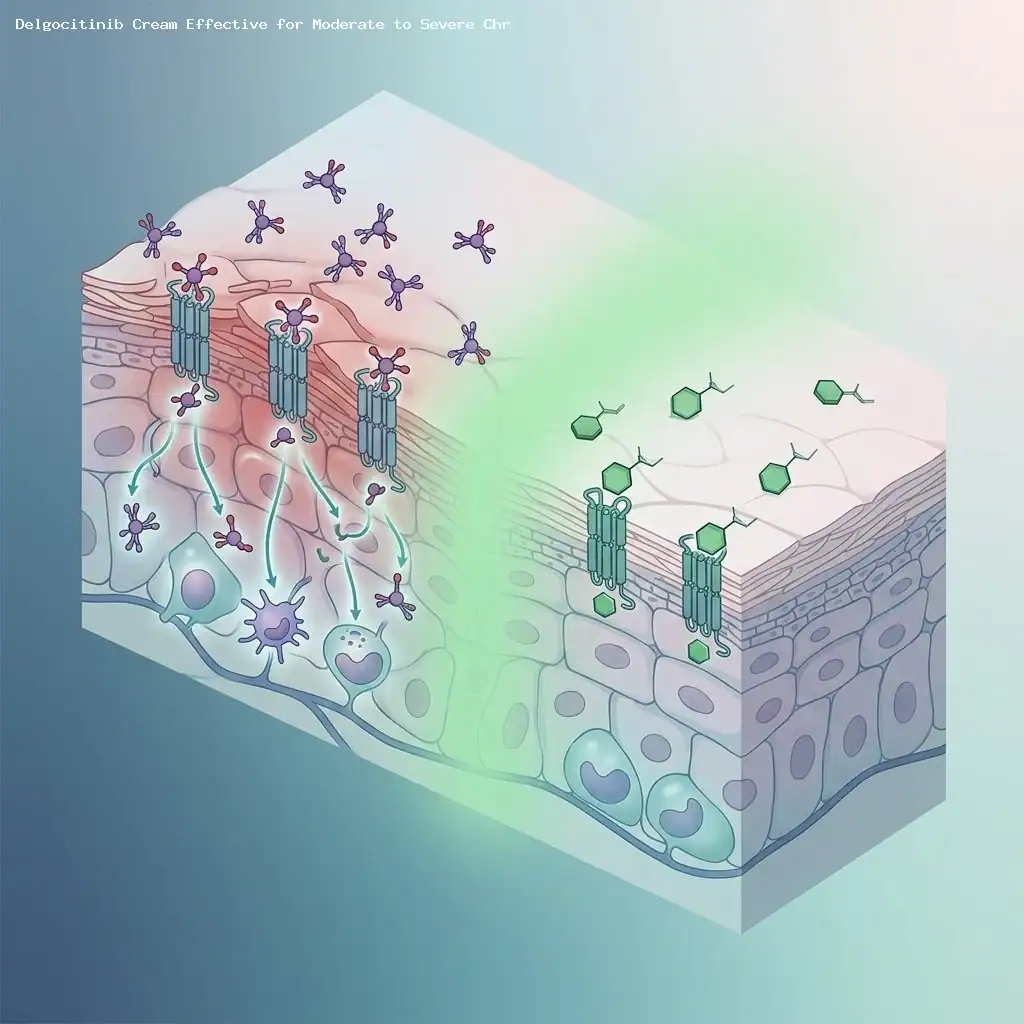
Delgocitinib cream is a non-steroidal, topical pan–JAK inhibitor that has received regulatory approval in the United States and Europe for adults with moderate to severe CHE for whom TCS are inadequate or inappropriate (Source: LEO Pharma press release; DELTA 1 and DELTA 2 trials).
Study design — what the pooled analysis looked at
The new findings come from a post hoc pooled analysis of the two randomized, double-blind, phase 3 trials known as DELTA 1 and DELTA 2, focusing on outcomes through week 16 (Source: DELTA 1 and DELTA 2 trials).
Investigators grouped patients by whether they had prior systemic therapy exposure: systemic‑naïve patients (no prior systemic therapy) and systemic‑experienced patients (those who had received systemic treatment for more than 28 days before entering the study) (Source: AAD 2026 poster).
Efficacy was assessed at week 16 using four prespecified measures: an Investigator Global Assessment for CHE (IGA‑CHE) treatment success, a ≥75% reduction in the Hand Eczema Severity Index (HECSI‑75), and at least a 4‑point improvement in the Hand Eczema Symptom Diary (HESD) itch and pain scores (Source: AAD 2026 poster; DELTA trials).
Who was in the analysis
A total of 960 adults were included in the pooled dataset from the two trials (Source: AAD 2026 poster).
Among patients with no prior systemic therapy, 444 received delgocitinib cream and 233 received the cream vehicle comparator; among those with prior systemic exposure, 195 received delgocitinib and 88 received vehicle (Source: AAD 2026 poster).
The most commonly reported prior systemic medications across both groups were oral retinoids and systemic corticosteroids, reflecting typical real‑world prescribing before trial enrollment (Source: AAD 2026 poster).
Importantly, the pooled dataset showed a baseline imbalance in the systemic‑experienced group: a larger share of patients randomized to delgocitinib had severe disease at baseline compared with those randomized to vehicle (34.9% vs 25.0%), a factor that needs to be considered when comparing outcomes in that subgroup (Source: AAD 2026 poster).
What the trials measured and why it matters
The IGA‑CHE treatment success is a clinician‑rated global measure of disease clearance or near‑clearance and is commonly used in CHE trials to reflect meaningful clinical improvement (Source: DELTA 1 and DELTA 2 trials).
The HECSI‑75 quantifies signs such as redness, scaling, and fissuring on the hands; a 75% reduction is a stringent threshold indicating substantial symptom and sign reduction (Source: DELTA 1 and DELTA 2 trials).
The HESD itch and pain items are patient‑reported outcomes; a 4‑point improvement on these scales reflects an important relief in the symptoms that most affect day‑to‑day comfort and function (Source: AAD 2026 poster).
Primary efficacy results at week 16
Across all four efficacy endpoints assessed at week 16, delgocitinib cream outperformed vehicle in both the systemic‑naïve and systemic‑experienced subgroups, with statistically significant differences (all P<0.05 or better) (Source: AAD 2026 poster).
Improvement with delgocitinib was seen early in treatment and continued through week 16, with response rates favoring the active drug from early timepoints (Source: AAD 2026 poster).
Overall, responses tended to be more pronounced in the systemic‑naïve group, a pattern the authors report as consistent over the entire 16‑week observation period (Source: AAD 2026 poster).
The pooled week‑16 forest plot of responder differences showed consistent advantage for delgocitinib over vehicle across endpoints and subgroups, with estimates never crossing into the range that would favor vehicle (Source: AAD 2026 poster).
Statistical testing yielded strong signals: all P‑values were at or below 0.002, which supports the robustness of the observed treatment effects despite the smaller and more heterogeneous systemic‑experienced cohort (Source: AAD 2026 poster).
How to interpret the subgroup differences
The greater magnitude of benefit in systemic‑naïve patients raises practical questions about where topical delgocitinib might fit into treatment sequences — whether as a bridge to systemic therapy or as an alternative that could delay or replace the need for systemic agents in some patients (Source: AAD 2026 poster).
At the same time, the analysis shows that prior systemic exposure did not eliminate the possibility of benefit: patients who had previously tried systemic treatments still experienced statistically significant improvement with delgocitinib compared with vehicle (Source: AAD 2026 poster).
Because the systemic‑experienced subgroup included more patients with severe disease at baseline in the delgocitinib arm, direct comparisons within that subgroup should be interpreted cautiously — baseline severity can influence both absolute and relative response rates (Source: AAD 2026 poster).
Clinical implications for practice
If topical delgocitinib reliably delivers meaningful improvement in patients who are systemic‑naïve, clinicians may have a new, non‑systemic option to try before escalating to oral treatments that carry higher systemic risk (Source: DELTA 1 and DELTA 2 trials; AAD 2026 poster).
For patients who arrive in clinic with prior systemic therapy and incomplete control, the data suggest delgocitinib can still offer benefit, making it a viable addition to the therapeutic toolbox even after systemic treatment attempts (Source: AAD 2026 poster).
These findings may shift how dermatologists think about step‑up strategies for CHE, by offering a targeted topical option that avoids some of the long‑term safety trade‑offs associated with systemic immunomodulators (Source: DELTA 1 and DELTA 2 trials).
Limitations and caveats
This analysis is a pooled, post hoc subgroup assessment rather than a prospectively powered, randomized comparison by prior systemic exposure, which limits the strength of causal claims about treatment‑by‑subgroup interactions (Source: AAD 2026 poster).
The numerical imbalance in baseline disease severity in the systemic‑experienced subgroup (more severe patients in the delgocitinib arm) is a specific concern that could bias subgroup comparisons and should temper overinterpretation of subgroup effect size differences (Source: AAD 2026 poster).
Safety and tolerability considerations are important when placing any new agent into practice; clinicians should consult the product labeling and primary trial publications for detailed adverse event data and recommended monitoring (Source: DELTA 1 and DELTA 2 trials; LEO Pharma product information).
Bottom line
The pooled post hoc analysis of the DELTA 1 and DELTA 2 phase 3 trials presented at AAD 2026 shows that delgocitinib cream 20 mg/g led to statistically and clinically meaningful improvements in adults with moderate to severe chronic hand eczema, both in patients who had never received systemic therapy and in those who had (Source: AAD 2026 poster; DELTA trials).
While the results support delgocitinib’s role as an effective topical option and raise the possibility of using it earlier in the care pathway, clinicians should weigh subgroup imbalances and the post hoc nature of this analysis when applying the findings to individual patients (Source: AAD 2026 poster).
Sources
- Bissonnette R, Schliemann S, Worm M, et al. Delgocitinib cream 20 mg/g for moderate to severe Chronic Hand Eczema: outcomes over 16 weeks by prior systemic therapy exposure. Poster presented at the 2026 American Academy of Dermatology Annual Meeting. (Source: AAD 2026 poster) https://eposters.aad.org/s3/AM2026/poster/72824/Delgocitinib+cream+20+mgg+for+moderate+to+severe+Chronic+Hand+Eczema+outcomes+over+16+weeks+by+prior+systemic+therapy+exposure.pdf
- Bissonnette R, Warren RB, Pinter A, et al. Efficacy and safety of delgocitinib cream in adults with moderate to severe chronic hand eczema (DELTA 1 and DELTA 2): results from multicentre, randomised, controlled, double‑blind, phase 3 trials. Lancet. 2024;404(10451):461-473. doi:10.1016/S0140-6736(24)01027-4 (Source: DELTA 1 and DELTA 2 trials)
- LEO Pharma. Product information and regulatory approvals for Anzupgo (delgocitinib cream 20 mg/g) for moderate to severe chronic hand eczema in adults. (Source: LEO Pharma press release and product documentation)