
Red Light and LED Therapy Devices: Separating Skin Care Facts from Fiction
Social Media Mythbusters: At-Home Red Light Therapy — What’s Real and What’s Hype?
Social media is changing the questions patients bring into the clinic, from viral hacks to new gadget trends that promise big skin wins in the bathroom instead of the doctor’s office.
In this new weekly series, Social Media Mythbusters, we take a close, practical look at the skincare trends clinicians are actually hearing from patients—what the proposed science is, what the studies show (or don’t), and how to talk to patients about what they’re seeing online.
If you’ve seen a trend you want us to investigate, email our editorial team at DTEditor@mmhgroup.com and tell us what patients are asking about.
The Trend
At-home red light therapy and near-infrared (NIR) LED masks have moved from niche clinical tools to widely marketed consumer devices.
Brands such as CurrentBody, Omnilux, and Therabody sell home-use masks and panels in the roughly $150–$600 range, with advertising that spans claims about collagen stimulation, wrinkle reduction, acne improvement, hair regrowth, and even broad “healing” effects.
Survey data suggest social media is the primary information source: a recent study reported that 60.4% of respondents learned about red light devices through social platforms, and about 90% were open to buying one for at-home use (Source: Ilyas EN et al., J Clin Aesthet Dermatol).
The real question clinicians face is less “does this biology work?” and more “do consumer devices deliver the right dose and wavelength to produce the clinical effects seen in research?”
The Mechanism
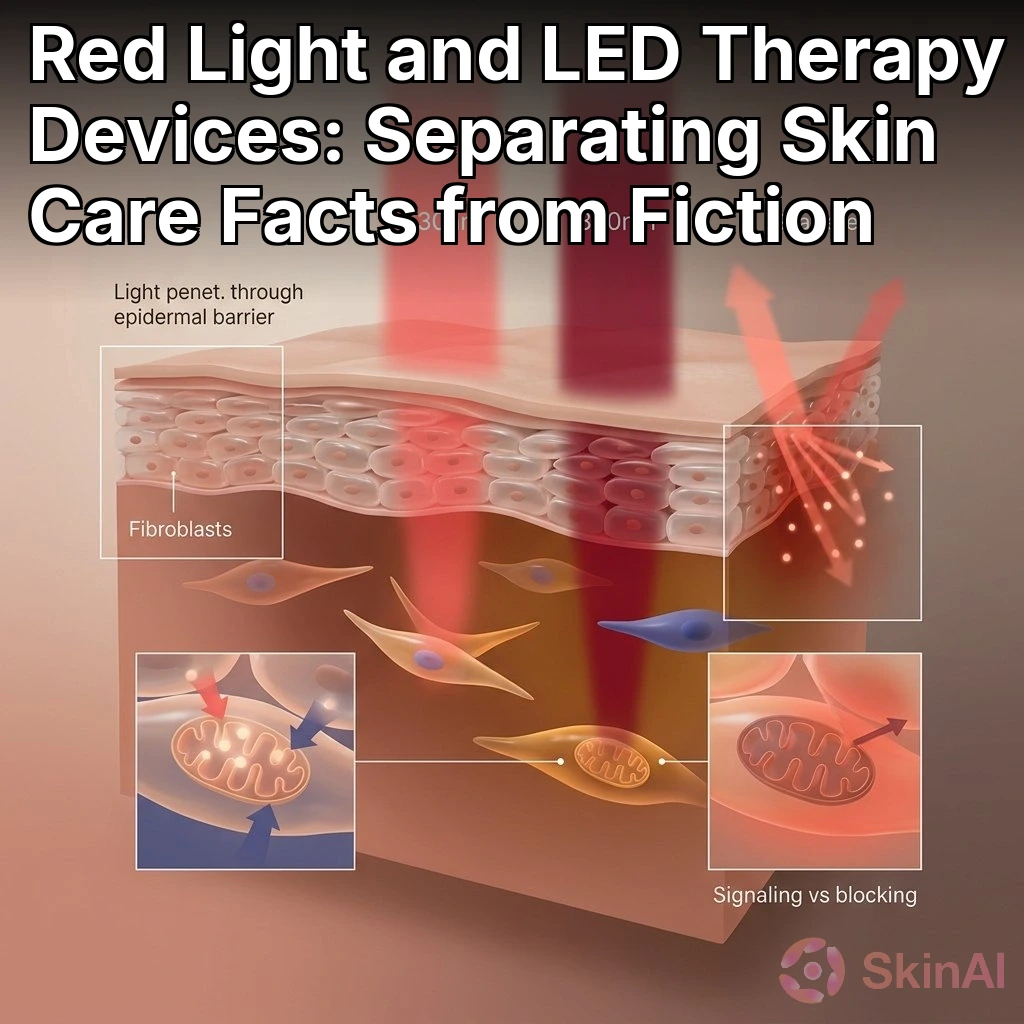
The science behind these devices is called photobiomodulation (PBM), which uses non-thermal red (≈620–700 nm) and near-infrared (≈700–1440 nm) light to trigger cellular responses.
The primary molecular target appears to be cytochrome c oxidase in mitochondria; when photons are absorbed here, cells often increase ATP production, release nitric oxide, and change levels of reactive oxygen species (ROS), which together alter gene expression, collagen synthesis, and inflammatory pathways.
Two wavelengths are most commonly studied clinically: about 660 nm (visible red, which affects more superficial dermis) and about 830 nm (near-infrared, which penetrates deeper into tissue). The mechanism is well-characterized in lab and clinical settings (Source: Maghfour J et al., J Am Acad Dermatol).
So the biological premise of PBM is real; the debate centers on whether consumer-grade devices deliver sufficient and accurate light energy to reproduce those effects at home.
The Evidence
The strongest clinical support for home-use PBM devices is in skin rejuvenation and photoaging, where repeated, properly dosed light can modestly improve fine lines, texture, and dermal density.
A multi-center, randomized, double-blind, sham-controlled trial that evaluated a home-use LED/IRED mask for crow’s feet over 12 weeks reported statistically significant improvements in wrinkle depth and periorbital texture with consistent daily use (Source: Park SH et al., Medicine [Baltimore]).
Earlier, industry-funded but carefully designed trials also found measurable reductions in wrinkle depth as early as 28 days, with improvements continuing through 84 days and increases in dermal density used as a proxy for collagen stimulation (Source: Park SH et al., Medicine [Baltimore]).
For other conditions the evidence is more mixed. The data supporting PBM for acne are limited; some protocols that combine 633 nm and 415 nm light show promise, but results depend heavily on device design and treatment parameters (Source: Maghfour J et al., J Am Acad Dermatol).
A 2025 consensus review in the Journal of the American Academy of Dermatology endorsed PBM for several clinical uses, including androgenic alopecia, wound ulcers of various causes, decubitus ulcers, peripheral neuropathy, and acute radiation dermatitis—primarily in controlled clinical settings rather than consumer use (Source: Maghfour J et al., J Am Acad Dermatol).
However, a pilot study that directly measured consumer devices found substantial heterogeneity in actual wavelength output, power stability, and irradiance, concluding that manufacturer dosing instructions were often inconsistent with real dose delivery (Source: Cronshaw M et al., Dent J).
Why Device Specs Matter
Two technical parameters determine biological effect: irradiance (mW/cm²) and total fluence (J/cm²).
Clinical PBM systems typically operate at higher irradiance levels (often in the 100+ mW/cm² range), whereas many at-home LED masks function around roughly 20–40 mW/cm², depending on design (Source: Cronshaw M et al., Dent J; Maghfour J et al., J Am Acad Dermatol).
Beam divergence, which describes how widely light spreads from the LEDs, further reduces real-world energy delivery to the skin; one study measured divergence angles around 74°, meaning the delivered energy at skin level can be much lower than the label suggests (Source: Cronshaw M et al., Dent J).
Many consumer devices do not disclose irradiance at all, so it’s impossible for clinicians or users to verify whether a therapeutic dose is being reached without independent testing (Source: Cronshaw M et al., Dent J).
Importantly, using a device for longer than recommended does not necessarily speed results and in some cases may reduce benefit by moving the dose out of the effective therapeutic window.
The Verdict
Is the social media hype true or false? The correct answer is nuanced: the underlying biology of PBM is real, but not all devices are created equal.
For photoaging (fine lines, texture, collagen stimulation) and alopecia, clinical evidence supports that consistent use of sufficiently powered home LED devices can yield modest, measurable improvements (Source: Park SH et al., Medicine [Baltimore]; Maghfour J et al., J Am Acad Dermatol).
For many other targets that people hope to treat—such as melasma, broad hyperpigmentation, and some acne presentations—the at-home evidence is either limited or inconclusive (Source: Maghfour J et al., J Am Acad Dermatol).
The critical limitation is the device, not the light itself: consumer masks vary widely in actual irradiance, wavelength accuracy, and dose delivery, and many cannot demonstrate the parameters needed to reproduce results from clinical trials (Source: Cronshaw M et al., Dent J).
Therefore, the blanket claim that at-home masks are equivalent to in-office clinical treatment is false, but the statement that they’re entirely useless is also false. The truth depends on the specific device, its verified output, and the user’s consistency.
How to Talk to Patients About These Devices
When a patient asks whether to buy an LED mask, start with clear scientific context: explain that red and near-infrared light can stimulate collagen production and alter inflammation in meaningful, safe ways, but that many home devices do not deliver the required irradiance or total fluence to reliably produce those changes.
Set realistic expectations: let patients know results—if they occur—are usually modest and gradual, often requiring consistent daily use for weeks to months, and may not benefit all skin types or conditions.
Warn patients to be skeptical of dramatic marketing claims, overprocessed “before-and-after” photos, and vague language like “clinically proven” when no study or device parameters are cited (Source: Cronshaw M et al., Dent J).
If you are comfortable recommending specific products, share any FDA-cleared or well-studied devices you trust and explain what clearance or peer-reviewed evidence means in practical terms for efficacy and safety (Source: Park SH et al., Medicine [Baltimore]; Maghfour J et al., J Am Acad Dermatol).
Emphasize that at-home LED therapy is an adjunct, not a replacement: it’s most effective when combined with a complete, safe skincare routine including daily sunscreen, gentle cleansers, and evidence-based topical agents as appropriate.
Practical Tips for Patients
-
Check for device specifications: look for disclosed wavelengths, irradiance (mW/cm²), and recommended fluence (J/cm²); lack of these details is a red flag (Source: Cronshaw M et al., Dent J).
-
Favor devices with peer-reviewed studies or independent lab verification rather than only manufacturer claims (Source: Park SH et al., Medicine [Baltimore]; Cronshaw M et al., Dent J).
-
Use devices as instructed—more time or more frequent sessions do not always mean better results and may push energy delivery outside the therapeutic window (Source: Maghfour J et al., J Am Acad Dermatol).
-
Combine PBM with sun protection and other medically recommended treatments rather than relying on it as a standalone cure for complex conditions.
Final Takeaway
At-home red and near-infrared light therapy are not a one-size-fits-all miracle, but they are not snake oil either.
When devices are properly designed and deliver verified doses at the correct wavelengths, consistent home use can produce modest improvements for photoaging and certain clinically supported indications like androgenic alopecia.
The main problem today is the gap between what some consumer products promise and what they actually deliver, which makes it important for clinicians to guide patients toward realistic expectations and evidence-backed choices (Source: Cronshaw M et al., Dent J; Park SH et al., Medicine [Baltimore]; Maghfour J et al., J Am Acad Dermatol).
Sources
- Ilyas EN, Barna AJ, Arza A, Giordano C. Experiences of Social Media Users with Over the Counter Red Light Therapy Devices. J Clin Aesthet Dermatol. (Survey on social media exposure and consumer intent to purchase).
- Park SH, Park SO, Jung JA. Clinical study to evaluate the efficacy and safety of home-used LED and IRED mask for crow’s feet: A multi-center, randomized, double-blind, sham-controlled study. Medicine (Baltimore). doi:10.1097/MD.0000000000041596 (Randomized controlled trial of a home-use LED/IRED mask for periorbital wrinkles).
- Maghfour J, Mineroff J, Ozog DM, et al. Evidence-based consensus on the clinical application of photobiomodulation. Journal of the American Academy of Dermatology. doi:10.1016/j.jaad.2025.04.031 (Consensus review on clinical PBM indications including alopecia and wound care).
- Cronshaw M, Parker S, Hamadah O, Arnabat-Dominguez J, Grootveld M. Photobiomodulation LED Devices for Home Use: Design, Function and Potential: A Pilot Study. Dent J (Basel). Published 2025 Feb 10. doi:10.3390/dj13020076 (Pilot study measuring wavelength output, irradiance, and device variability across consumer devices).