
The 60-Second Consult: A Linear Eruption That Followed the Vaccination Site — for 2 Years
A 15-year-old male presented with a 2-year history of pruritic, erythematous, and scaly plaques confined to the right upper extremity. He reported that the lesions first appeared on his right arm and had since spread in an increasingly distal pattern, eventually extending along the lateral arm, medial forearm, and dorsal hand.
Despite pursuing multiple topical treatments over the course of 2 years, he had achieved no meaningful improvement and had been seen by several providers without a definitive diagnosis before being referred to a tertiary dermatology center.1 The patient denied any history of fever, myalgia, muscle weakness, arthralgia, or photosensitivity.
He reported no prior COVID-19 infection. Family history was unremarkable, and he denied any medication use. On physical examination, linear erythematous and scaly plaques were present along the lateral arm, ulnar forearm, and proximal and distal interphalangeal joints of the right hand.
Focal areas of cutaneous atrophy and localized hair loss were noted within the affected distribution; sweating was preserved, and no sensory or neural deficits were detected. Musculoskeletal examination was normal.
No nail involvement or lymphadenopathy was identified. Laboratory evaluation was comprehensive, including CBC, ANA, anti-dsDNA, anti-Ro, anti-La, complement levels (C3, C4, CH50), renal function, and urinalysis.
No significant abnormalities were detected across any parameters. Skin biopsy was performed to differentiate among blaschkitis, linear psoriasis, linear lichen planus, and a less common entity in the differential.
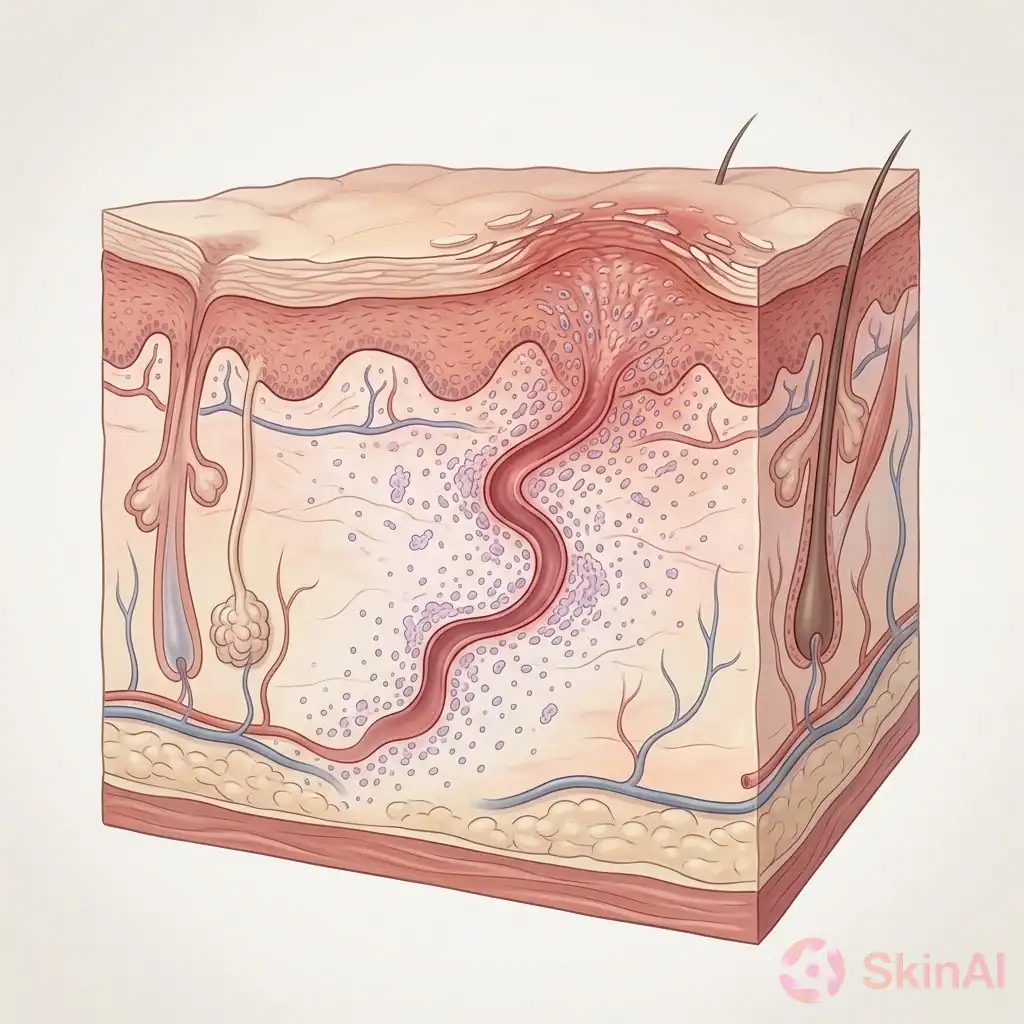
Histopathological analysis revealed lichenoid interface dermatitis with epidermal acanthosis, follicular plugging, basal vacuolar degeneration with Civatte bodies, a deep periadnexal lymphoplasmacytic infiltrate, and one finding that effectively narrowed the diagnosis.
One detail from the history — elicited only on careful review — pointed directly to the trigger: the initial lesion had appeared specifically at the site of his second COVID-19 vaccination dose, approximately one month after administration.
Diagnosis: Linear Cutaneous Discoid Lupus Erythematosus (LCDLE) Following COVID-19 Vaccination The key histopathological differentiator in this case was prominent dermal mucin deposition — a feature characteristically absent in linear lichen planus, blaschkitis, and lichen striatus, and essential for establishing the diagnosis of LCDLE.2 The unilateral, distally progressive distribution along the lines of Blaschko, originating at the vaccination site, further supported the diagnosis.
Comprehensive serologic workup was negative, consistent with the known behavior of LCDLE, which does not progress to systemic lupus erythematosus and is characteristically seronegative. This case — reported as the first documented instance of LCDLE following COVID-19 vaccination — highlights proposed mechanisms including molecular mimicry between SARS-CoV-2 proteins and self-antigens, type 1 interferon-driven autoantibody production, and epitope spreading.
The patient was initiated on hydroxychloroquine 200 mg twice daily with topical clobetasol and tacrolimus; lesions persisted without complete resolution at 1-year follow-up. For clinicians, the practical imperative is clear: in any patient presenting with a unilateral linear eruption following a defined anatomical course — particularly with an onset temporally linked to vaccination — LCDLE warrants serious consideration, and biopsy with attention to mucin deposition is essential to secure the diagnosis.
References Saberi F, Ghanadan A, Razavi Z, Azhari VS, Akhdar M, Al-Zahawi S. The first case of linear cutaneous lupus erythematosus following covid-19 vaccination: a case report. Published 2026 May 11.
doi:10.1002/ccr3.72703 Mehta N, Khaitan BK, Ramam M, Bhari N, Sethuraman G, Singh MK. Clinical and histopathological characteristics of acquired inflammatory Blaschko-linear disorders. Indian Dermatol Online J.
Published 2024 Dec 11. doi:10.4103/idoj.idoj_312_24