
FDA Reviews Biofrontera’s Photodynamic Therapy for Superficial BCC
Biofrontera’s Progress in Treating Superficial Basal Cell Carcinoma
This week, Biofrontera made a significant announcement regarding its aminolevulinic acid hydrochloride topical gel (branded as Ameluz). The U.S. Food and Drug Administration (FDA) has accepted its supplemental New Drug Application (sNDA) for review. This application aims to broaden the use of Ameluz, in conjunction with the RhodoLED red-light lamp series, to include the treatment of superficial basal cell carcinoma (sBCC).
The FDA has confirmed that there are no filing deficiencies with the application and has assigned a target action date under the Prescription Drug User Fee Act (PDUFA) of September 28, 2026. This acceptance indicates that the FDA has found the application complete enough to warrant a thorough review.
While this does not guarantee approval, the lack of filing deficiencies suggests that the clinical and manufacturing data provided meets the initial regulatory standards. The FDA’s upcoming review will focus on whether the therapy’s established photodynamic platform can be expanded beyond its current approval for actinic keratosis (AK) to also include a specific type of non-melanoma skin cancer. It is noteworthy that basal cell carcinoma is the most prevalent malignancy in the United States, with an estimated 3.6 million cases diagnosed each year.
Understanding Superficial Basal Cell Carcinoma
Estimates suggest that between 10% to 25% of these cases are classified as the superficial subtype. Typical presentations of superficial BCC include erythematous, scaly plaques that have well-defined borders, primarily located on the trunk and extremities, although they can appear in other areas as well.
Although superficial BCC rarely metastasizes, it can lead to substantial local tissue damage if not treated appropriately. The conventional treatment approach for sBCC typically involves surgical methods, such as excision and Mohs micrographic surgery, both of which demonstrate high cure rates.
In addition to surgical options, various destructive techniques are employed, including curettage and electrodessication, cryotherapy, and, in select cases, topical therapies like imiquimod or 5-fluorouracil. The choice of treatment is influenced by several factors including lesion size, location, histological subtype, patient comorbidities, cosmetic considerations, and patient preferences.
Non-Invasive Alternatives
While surgical intervention remains the gold standard for many patients, non-invasive alternatives are often explored when cosmetic outcomes, field cancerization, medical comorbidities, or patient reluctance towards surgery are significant considerations. Photodynamic therapy (PDT) has established its role in dermatology, particularly in the treatment of actinic keratoses and specific superficial non-melanoma skin cancers outside the United States.
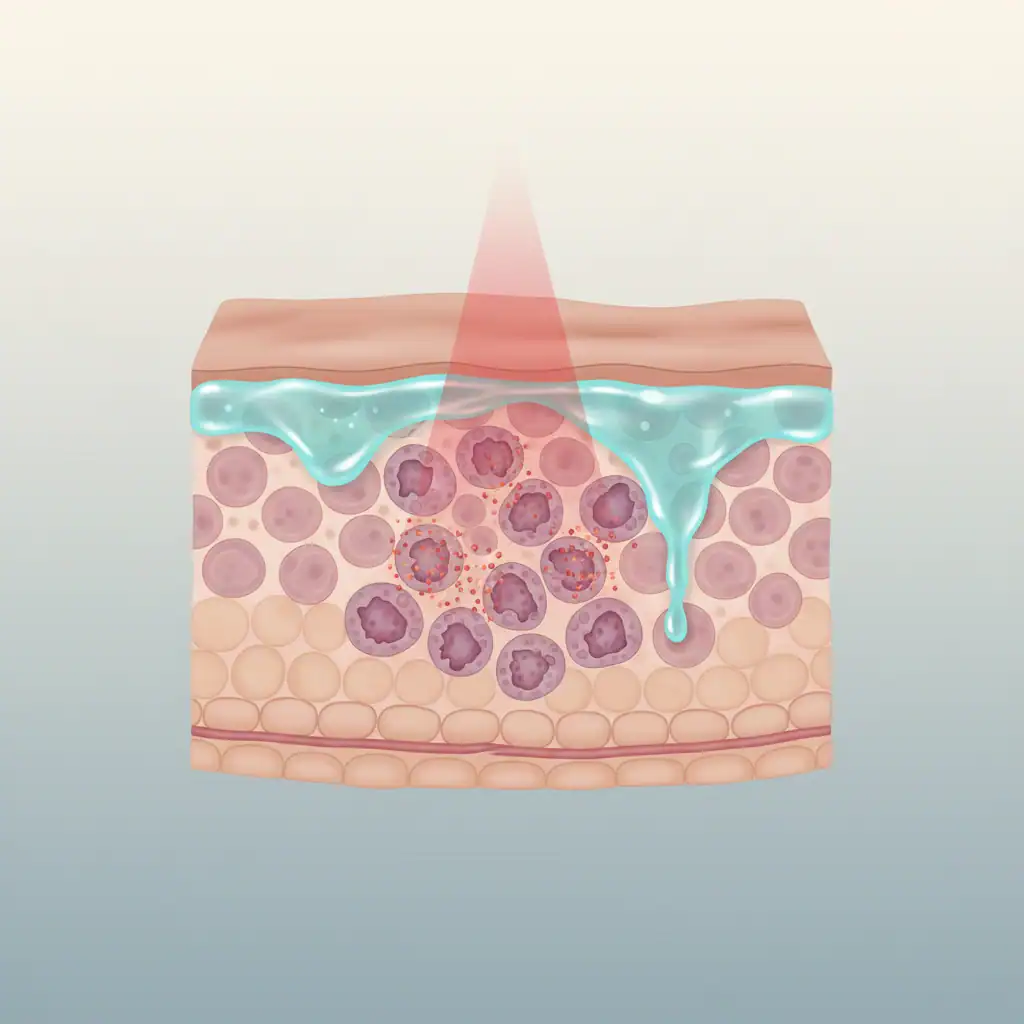
This therapeutic approach combines a topical photosensitizing agent with exposure to visible light, leading to the generation of reactive oxygen species that selectively destroy targeted cells. Biofrontera’s formulation is a nanoemulsion of aminolevulinic acid (ALA), designed to enhance penetration into the epidermis and potentially into the more superficial dermal layers.
After applying the topical agent and allowing for incubation, exposure to the red light emitted by the RhodoLED lamp activates the accumulated protoporphyrin IX within dysplastic or neoplastic cells, resulting in cytotoxic effects. A notable characteristic of this platform is its employment of red light, which penetrates deeper into tissues compared to shorter wavelengths like blue or green light.
Theoretically, this characteristic may support the treatment of lesions that extend beyond the most superficial epidermal layers, a crucial aspect in managing sBCC, where tumor nests can infiltrate the superficial dermis. Whether this theoretical advantage will result in clinically significant differences in clearance rates, recurrence risk, or cosmetic outcomes in the U.S. population will be a key focus of the FDA’s review.
Implications for Clinical Practice
If approved for the treatment of sBCC, this combination therapy would significantly broaden the labeled use of Ameluz. Currently, it holds approval in the U.S. only for the treatment of actinic keratosis, and the drug-device combination is already recognized by many dermatology practices.
An additional indication for superficial BCC could provide clinicians with a non-surgical option within an already established procedural framework. This is particularly relevant for patients who present with multiple lesions, those located in cosmetically sensitive areas, or individuals deemed poor candidates for surgical procedures.
However, clinicians will need to consider various factors. Key benchmarks include clearance rates and long-term recurrence data in comparison to surgical standards. Treatment tolerability—encompassing aspects like procedural pain, erythema, crusting, and post-inflammatory pigmentary changes—will also play a crucial role in patient selection and counseling.
Furthermore, reimbursement logistics and in-office workflow requirements may influence the adoption of this new therapeutic option. Biofrontera has positioned the sNDA submission as part of a broader strategy aimed at expanding the clinical utility of its PDT platform, including ongoing research in non-melanoma skin cancers and moderate to severe acne.
From a clinical perspective, the expansion into treating sBCC could lead to a modest shift in the therapeutic landscape, especially for carefully selected low-risk lesions. The FDA’s target action date of September 28, 2026, establishes the timeline for regulatory decision-making.
Until that time, clinicians will be looking forward to detailed efficacy and safety data to determine where this modality fits best within the established treatment algorithms for sBCC.
Sources
- Biofrontera announces FDA filing acceptance of supplemental new drug application for Ameluz® PDT in superficial basal cell carcinoma. Published February 11, 2026. Accessed February 12, 2026. https://www.biospace.com/press-releases/biofrontera-announces-fda-filing-acceptance-of-supplemental-new-drug-application-for-ameluz-pdt-in-superficial-basal-cell-carcinoma
- FDA approves use of up to three tubes of Biofrontera Inc.’s Ameluz (aminolevulinic acid HCI) topical gel, 10% in one treatment. Published October 7, 2024. Accessed February 12, 2026. https://www.globenewswire.com/en/news-release/2024/10/07/2958931/0/en/FDA-Approves-Use-of-Up-To-Three-Tubes-of-Biofrontera-Inc-s-Ameluz-aminolevulinic-acid-HCI-Topical-Gel-10-In-One-Treatment.html
- Ran Zhu T, Islam Z, Chahine A, Manning J, Ciocon D. Medical and surgical management of multifocal superficial basal cell carcinoma. doi:10.36849/JDD.8543