
How Gene Expression Profiling Guides Sentinel Node Biopsies in Early Melanoma
Why this matters
If you’ve been diagnosed with early-stage melanoma, you may hear your doctor talk about tests and decisions that feel confusing. One tool that’s becoming more common is gene expression profile (GEP) testing. A recent virtual case-based roundtable of dermatology clinicians discussed how GEP tests are being used in everyday care to help decide who needs extra surgery or closer follow-up.
What is GEP testing and why use it?
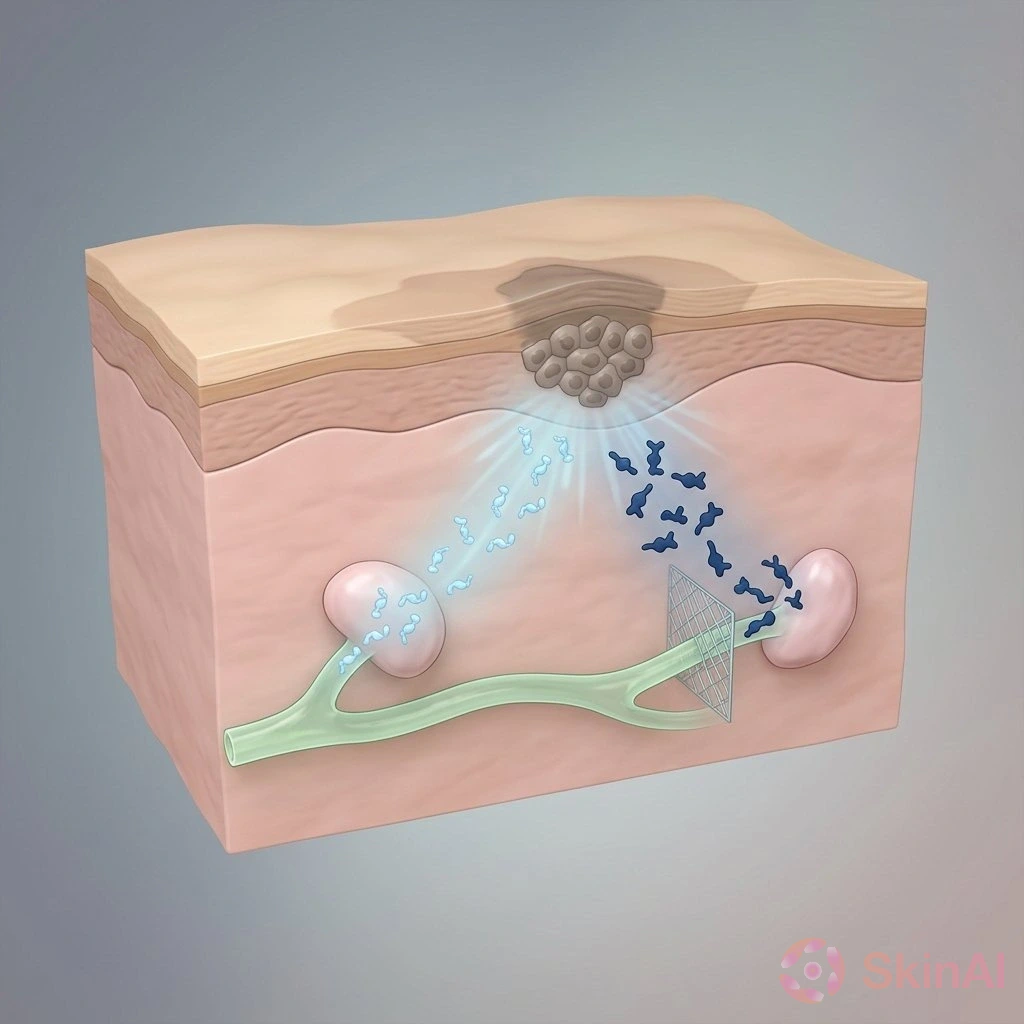
Gene expression profile (GEP) testing looks at patterns of activity inside the melanoma tumor to estimate how likely the cancer is to come back or to show up in nearby lymph nodes. It doesn’t replace traditional staging (which uses things like thickness and whether the tumor is ulcerated), but it can add information about the tumor’s biology.
One commercially used GEP mentioned at the meeting is the i31‑GEP. Results are often reported as low risk (for example, Class 1A) or high risk (for example, Class 2B), along with numbers that estimate things like the chance of a positive sentinel lymph node biopsy or the percent likelihood of staying cancer-free over time.
How this fits with current guidance
The National Comprehensive Cancer Network (NCCN) gives recommendations that help decide when to offer a sentinel lymph node biopsy (SLNB). SLNB is a procedure that checks the first lymph node(s) a melanoma might spread to. For very thin melanomas, SLNB is usually not recommended. For some thin-but-not-too-thin cases, SLNB falls into a “discuss and consider” zone where the decision depends on individual risk and patient values.
At the meeting, clinicians agreed that GEP testing is particularly useful in that gray zone (mostly T1 and T2 tumors) to personalize the discussion about whether to do SLNB and how closely to follow the patient afterward.
Quick note on common terms
- Breslow depth: how thick the melanoma is, measured in millimeters.
- Ulceration: whether the skin over the melanoma is broken or eroded; ulceration usually means higher risk.
- Mitotic rate: how fast the tumor cells are dividing; higher numbers suggest more active tumor growth.
- RFS (recurrence-free survival): percent of people who remain free of the cancer coming back at a given time point.
Real cases the clinicians discussed
Case 1: Thin plantar melanoma that felt uncertain
A 45-year-old woman had a melanoma on the sole of her foot (plantar melanoma). The tumor was 0.6 mm thick, not ulcerated, and had a low mitotic rate. Based on standard staging, this was pT1a (stage IA), and under NCCN guidance she would not routinely get SLNB.
Some clinicians worried about acral melanomas (those on palms, soles, under nails), which can behave differently than melanomas in other locations and may not be perfectly captured by current staging rules. The team decided to do an i31‑GEP test. It returned a low‑risk (Class 1A) result with the following estimates:
- Predicted SLNB positivity: 4.7%
- Recurrence-free survival: 91.3%
- Distant metastasis–free survival: 94.6%
- Melanoma-specific survival: 97.8%
These numbers lined up with her stage IA status. The clinicians agreed that wide local excision (removing the tumor with a margin of normal skin) and routine dermatology follow-up were appropriate, without SLNB or extra imaging. In several practices, an RFS above 90% is considered low enough to stick with standard surveillance.
Case 2: The “discuss and consider” T1b decision
A 63-year-old man had a back melanoma that was 0.8 mm thick, not ulcerated, with a mitotic rate of 2. This falls into pT1b, where the NCCN says SLNB should be discussed and considered.
This is one of the trickiest decisions in early melanoma care. At the roundtable, clinicians said that the balance of risks and benefits and the GEP result tended to be the deciding factors more than access to surgery or oncology.
The panel referenced ongoing research (MERLIN_001, NCT04759781) and an NCCN 2026 footnote that acknowledges a predictive GEP may be used in selected T1b–T2a patients to help shared decision-making when the true nodal risk is under 10%.
In this specific case, a clinicopathologic GEP returned a low‑risk result. The patient, who was caring for his wife and wanted to avoid surgery, chose to skip SLNB and have wide local excision alone. He agreed to close dermatologic and nodal exams every three months.
Case 3: When the GEP shows higher biological risk
A 58-year-old outdoor worker had a forearm melanoma 1.0 mm thick, not ulcerated, with a mitotic rate of 1 (pT1b). Many panelists suggested both SLNB and GEP testing.
The i31‑GEP came back high‑risk (Class 2B), estimating a 13.1% chance of a positive SLNB and an RFS of 84%. Here the molecular test and the traditional staging did not agree: the tumor looked borderline by staging but more worrying by biology.
About 40% of attendees said they would prioritize the GEP result if other clinical features matched. Most recommended involving a multidisciplinary team, including surgical and medical oncology, for making the plan.
The group’s consensus for cases like this was:
- Proceed with SLNB.
- If SLNB is negative but the GEP is high risk, use that result to trigger closer surveillance (more frequent skin and lymph node exams and, in many clinics, baseline or periodic imaging).
- Involve medical oncology early, even if the patient’s formal stage is I, because a high‑risk GEP suggests the tumor may behave more aggressively.
What the clinicians agreed on
Breslow depth and ulceration remain central to staging and decisions. But GEP testing is increasingly used as a practical way to personalize risk assessment, help decide about SLNB, and set how closely to follow a patient after surgery—especially for T1 and T2 tumors where SLNB is discretionary.
Most panelists already use at least one commercially available GEP assay in their practice. They said clearer guidance from organizations like the NCCN and the American Academy of Dermatology, plus formal algorithms, would make it easier to standardize how these tests are used.
Tumor boards and medical oncologists are still important for turning a GEP result into a long-term management plan.
Tracking visible changes
It can help to keep a simple record of a mole or lesion that your doctor is watching. Notes or photos taken over time may make it easier to spot changes you should report to your clinician.
When to see a doctor
If a mole or spot is changing quickly, bleeding, painful, infected, growing fast, or you feel unsure about it, seek professional medical advice promptly. Decisions about SLNB, further imaging, or more frequent follow-up should be discussed with your dermatologist, surgical oncologist, or medical oncologist.
Disclaimer
This article summarizes a virtual case-based roundtable of dermatology clinicians. It is educational and not medical advice. Treatment decisions depend on individual facts and should be discussed with your health care team.
Sources
- Dermatology Times case-based roundtable discussion (virtual meeting) moderated by Brent Moody, MD.
- MERLIN_001 trial (ClinicalTrials.gov identifier NCT04759781).
- National Comprehensive Cancer Network (NCCN) guidance, 2026 (Version 1) footnote referenced during the roundtable.
- i31‑GEP test (commercial gene expression profile assay) as reported in the roundtable cases.