
Delgocitinib Eases Symptoms and Improves Daily Life in Chronic Hand Eczema
Understanding the real toll of chronic hand eczema
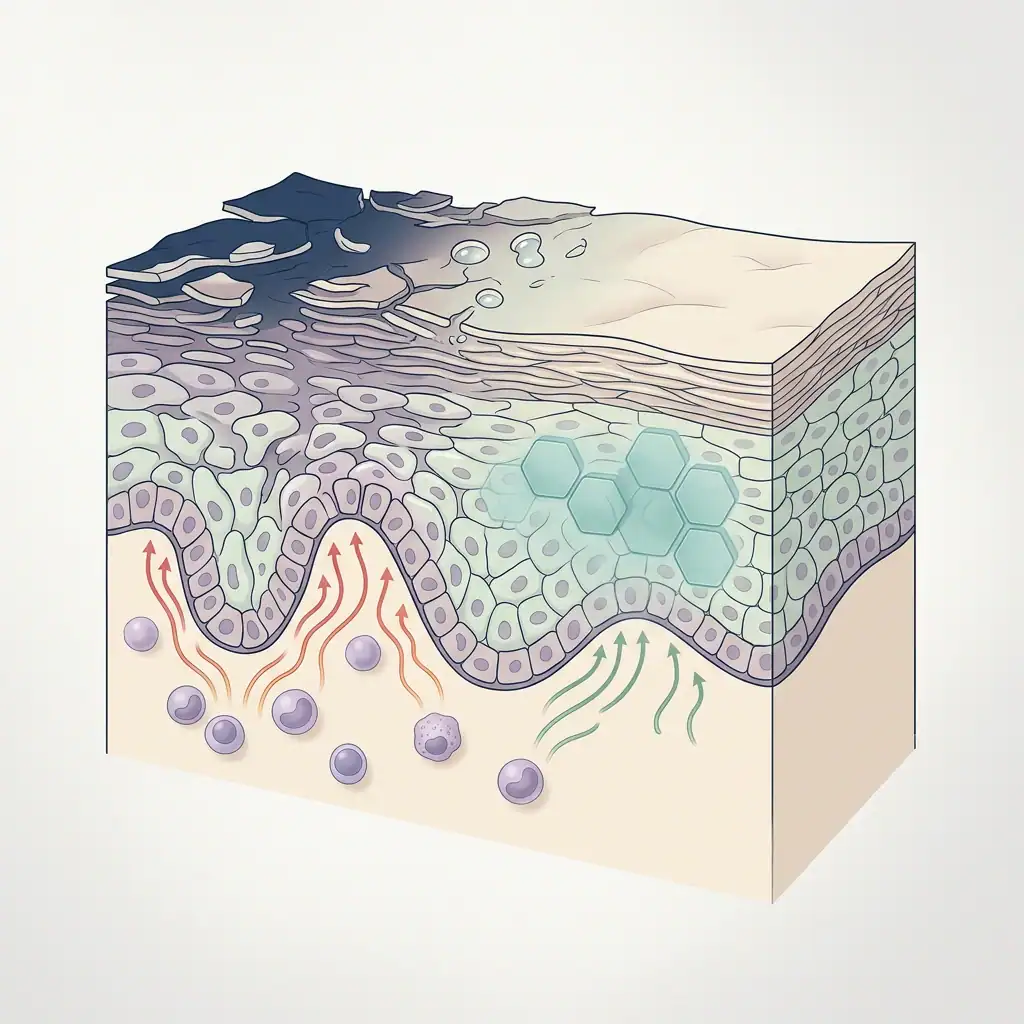
When doctors describe chronic hand eczema (CHE), they often point to visible skin changes such as erythema, scaling, vesicles, hyperkeratosis, and fissures.
For the people who live with the condition, however, CHE is much more than skin signs: it commonly causes relentless itch and pain, interruptions to sleep, trouble gripping or handling objects, and social embarrassment from visible lesions.
Those daily problems can bleed into work and personal life, sometimes leaving people unable to carry out routine tasks or maintain employment — a quality-of-life burden that studies show can match what is seen with psoriasis and atopic dermatitis (Source: Buhl et al., Phase 2b trial analysis, 2025).
Why better topical treatments are needed
Current first-line care for CHE typically relies on high-potency topical corticosteroids, which are effective but not ideal for long-term use because of risks like skin atrophy and barrier damage with chronic use (Source: Ghezzi et al., narrative review).
For severe, treatment-resistant CHE, systemic therapy such as oral alitretinoin is approved in some regions, but it carries its own burdens — routine lab monitoring and strict pregnancy prevention measures are required (Source: Ghezzi et al., narrative review).
Given those limitations, researchers have been looking for topical alternatives that combine strong efficacy with better tolerability and safety for long-term use (Source: DELTA 1 and DELTA 2 pooled analysis, Bauer et al., 2026).
DELTA 1 and DELTA 2: study design and who enrolled
The DELTA 1 and DELTA 2 studies were two identically designed, randomized, double-blind, vehicle-controlled, multicenter phase 3 trials testing a topical JAK inhibitor for adults with moderate to severe CHE (Source: DELTA 1 and DELTA 2 pooled analysis, Bauer et al., 2026).
Participants had either moderate (IGA‑CHE 3) or severe (IGA‑CHE 4) disease and had not responded adequately to topical corticosteroids or had reasons that made continued corticosteroid use inadvisable (Source: DELTA 1 and DELTA 2 pooled analysis, Bauer et al., 2026).
Patients were randomized 2:1 to receive either delgocitinib cream 20 mg/g applied twice daily or the cream vehicle for 16 weeks, with investigators and patients blinded to treatment assignment (Source: DELTA 1 and DELTA 2 pooled analysis, Bauer et al., 2026).
Across both trials, 639 people received delgocitinib and 321 received vehicle. The study population was predominantly female (64%) and White (90%), and participants had a mean disease duration of about 10 years, reflecting a chronically affected group (Source: DELTA 1 and DELTA 2 pooled analysis, Bauer et al., 2026).
Baseline quality-of-life burden
Patient-reported outcome measures collected at baseline highlighted how disruptive CHE can be. The average EQ-5D index score was 0.65, a value in line with other generalized inflammatory skin diseases and indicative of substantial health-related impact (Source: Buhl et al., Phase 2b trial analysis, 2025).
The mean Dermatology Life Quality Index (DLQI) was 12.4 at baseline, a score that translates to a “very large” effect on quality of life and underscores the broad reach of CHE into daily functioning and wellbeing (Source: DELTA 1 and DELTA 2 pooled analysis, Bauer et al., 2026).
Researchers used three complementary tools to capture impact: the generic health-status measure EQ-5D-5L, the dermatology-focused DLQI, and the CHE-specific Hand Eczema Impact Scale (HEIS), which includes Proximal Daily Activity Limitations (PDAL) and Embarrassment domains to reflect hand-specific functional and psychosocial burdens (Source: DELTA 1 and DELTA 2 pooled analysis, Bauer et al., 2026).
How delgocitinib affected overall health status
Improvements in health-related quality of life were apparent early in the delgocitinib group and increased over time.
On the EQ-5D index, statistical separation from vehicle was detected as early as week 1 (p = 0.022), and the gap widened through week 16 (Source: DELTA 1 and DELTA 2 pooled analysis, Bauer et al., 2026).
By week 16, the least-squares mean change from baseline in EQ-5D was +0.17 for delgocitinib versus +0.06 for vehicle — a treatment difference of 0.11 (95% CI 0.08–0.13; p < 0.001) — with gains seen across all five EQ-5D domains, including pain/discomfort and anxiety/depression (Source: DELTA 1 and DELTA 2 pooled analysis, Bauer et al., 2026).
Gains in the mobility dimension were smaller, which is expected for a disease centered on the hands, but the overall pattern points to meaningful improvement in patients’ perceived health status (Source: DELTA 1 and DELTA 2 pooled analysis, Bauer et al., 2026).
Dermatology-specific benefits measured by DLQI
Changes on the DLQI were both statistically significant and clinically meaningful in favor of delgocitinib.
At week 16, the mean reduction from baseline in DLQI score was −7.3 for delgocitinib versus −3.5 for vehicle, yielding a treatment difference of −3.8 (95% CI −4.5 to −3.0; p < 0.001) (Source: DELTA 1 and DELTA 2 pooled analysis, Bauer et al., 2026).
Using a ≥4-point reduction as a benchmark for clinically meaningful change, 73.3% of patients treated with delgocitinib reached that threshold versus 47.8% of those on vehicle (p < 0.001).
Delgocitinib also worked faster: the median time to DLQI response was 21 days versus 30 days with vehicle, and patients on active drug spent more days in a response state over the 16 weeks (80.5 days vs 53.2 days; p < 0.001) (Source: DELTA 1 and DELTA 2 pooled analysis, Bauer et al., 2026).
Improvements were seen across all 10 DLQI items, with especially large benefits in domains that matter in daily life — work and study, daily activities, leisure, and feelings of embarrassment or self-consciousness (Source: DELTA 1 and DELTA 2 pooled analysis, Bauer et al., 2026).
HAND eczema–specific effects captured by HEIS
Because CHE affects tasks that depend on hands, the Hand Eczema Impact Scale (HEIS) provides a fine-grained look at treatment impact. Delgocitinib showed clear advantages on this measure.
By week 16, mean HEIS improvement was −1.46 with delgocitinib versus −0.73 with vehicle (treatment difference −0.72; p < 0.001) (Source: DELTA 1 and DELTA 2 pooled analysis, Bauer et al., 2026).
A clinically meaningful HEIS response, defined as a ≥1.3-point reduction, occurred in 62.3% of delgocitinib-treated patients compared with 33.0% of vehicle-treated patients (p < 0.001).
Median time to HEIS response was notably faster with delgocitinib (21 days) than with vehicle (84 days), and patients given delgocitinib spent significantly more days in response over 16 weeks (61.9 days vs 33.4 days; p < 0.001) (Source: DELTA 1 and DELTA 2 pooled analysis, Bauer et al., 2026).
Benefits were also evident in the HEIS PDAL domain, which reflects limits on activities such as washing and housework, and in the Embarrassment domain; for embarrassment, the median time to response was 31 days with delgocitinib versus 163 days with vehicle (Source: DELTA 1 and DELTA 2 pooled analysis, Bauer et al., 2026).
Interpreting the results: what they mean for patients and clinicians
One important observation is that many patients in the vehicle group also experienced clinically meaningful improvements — nearly half achieved a DLQI response by week 16. That likely reflects the benefits of the specially formulated vehicle, plus the effects of close follow-up and structured care during a clinical trial (Source: DELTA 1 and DELTA 2 pooled analysis, Bauer et al., 2026).
Despite those vehicle-related gains, the magnitude, speed, and durability of improvement consistently favored delgocitinib across generic, dermatology-specific, and CHE-specific measures (Source: DELTA 1 and DELTA 2 pooled analysis, Bauer et al., 2026).
Another notable finding was that patient-reported improvements sometimes occurred even when the Investigator’s Global Assessment (IGA‑CHE) did not change, highlighting that clinician-rated skin scores and patient experience can diverge — and that PROs (patient-reported outcomes) are essential to understanding treatment benefit in CHE (Source: DELTA 1 and DELTA 2 pooled analysis, Bauer et al., 2026).
Limitations and next steps
These pooled results are encouraging, but they have limitations to keep in mind. The study population was predominantly White, which may limit how generalizable the findings are to broader, more diverse populations (Source: DELTA 1 and DELTA 2 pooled analysis, Bauer et al., 2026).
In addition, the analysis covers a 16-week treatment window; longer-term efficacy, safety, and the durability of benefit over months or years will need data from extension studies and real-world experience (Source: DELTA 1 and DELTA 2 pooled analysis, Bauer et al., 2026).
Ongoing extension trials are expected to provide more information about sustained benefit and longer-term tolerability for topical JAK inhibition in CHE (Source: DELTA 1 and DELTA 2 pooled analysis, Bauer et al., 2026).
What this means in practice
The pooled DELTA 1 and DELTA 2 data show that twice-daily delgocitinib cream 20 mg/g can produce rapid, clinically meaningful, and sustained improvements in overall health status, dermatology-specific quality of life, and hand-eczema–specific functioning and embarrassment in adults with moderate to severe CHE (Source: DELTA 1 and DELTA 2 pooled analysis, Bauer et al., 2026).
For clinicians, the findings reinforce two key points: first, CHE is a multidimensional disease that seriously impairs daily function and emotional wellbeing; and second, targeted topical JAK inhibition appears capable of addressing both visible signs and the important patient-centered impacts of the disease (Source: DELTA 1 and DELTA 2 pooled analysis, Bauer et al., 2026).
Patients and clinicians will benefit from longer-term and more diverse data, but these results add an important new option to the conversation about how to relieve the heavy burden of chronic hand eczema.
Sources
- Bauer A, Guenther L, Woolf R, et al. Effect of delgocitinib cream on health-related quality of life in patients with moderate to severe chronic hand eczema: pooled analysis of DELTA 1 and DELTA 2. Published online March 3, 2026. (Source: DELTA 1 and DELTA 2 pooled analysis, Bauer et al., 2026).
- Buhl T, Bauer A, Ehst BD, et al. Health-related quality of life in chronic hand eczema in a phase 2b trial of delgocitinib cream. Dermatol Ther (Heidelb). 2025;15(5):1181-1193. (Source: Buhl et al., Phase 2b trial analysis, 2025).
- Ghezzi G, Falcidia C, Paolino G, et al. Chronic hand eczema (CHE): A narrative review. Dermatol Ther (Heidelb). (Source: Ghezzi et al., narrative review).