
New Cream Shows Promise in Reducing Acne and Hyperpigmentation in Skin of Color
Introduction: Acne in darker skin and why pigment matters
Acne vulgaris is one of the most common skin conditions worldwide, and it frequently brings people with darker skin tones into dermatology clinics for care (Source: Pathmarajah P et al., Acne vulgaris in skin of color: a systematic review).
Although the basic biological processes that cause acne—like clogged pores, bacteria, and inflammation—are similar across skin types, people with skin of color (SOC) often experience different visible outcomes and treatment priorities than those with lighter skin (Source: Pathmarajah P et al., Acne vulgaris in skin of color: a systematic review).
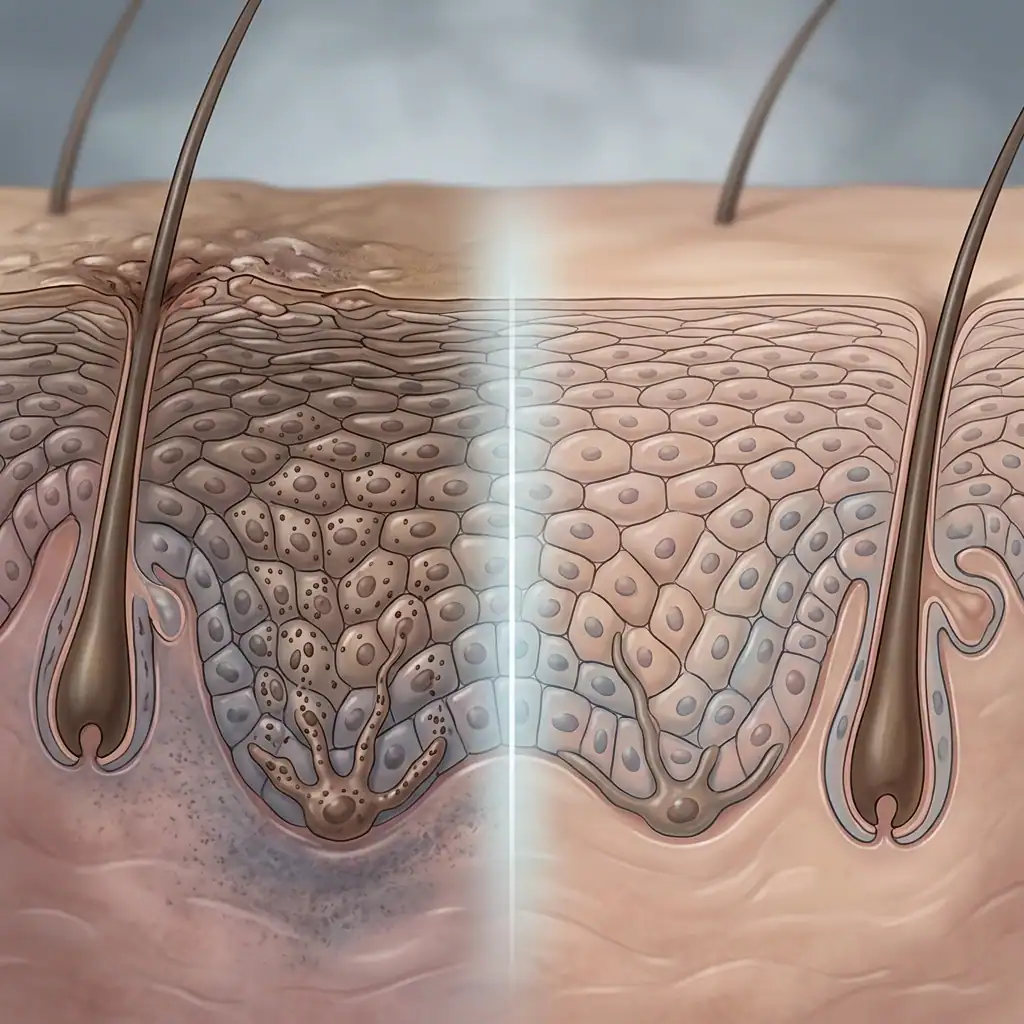
One major concern for patients with darker phototypes (Fitzpatrick IV–VI) is post-inflammatory pigmentary change, especially acne-induced hyperpigmentation (AIH), which may be more distressing to patients than the pimples themselves (Source: Auffret N et al., Acne-induced post-inflammatory hyperpigmentation).
Reported rates of AIH in SOC range widely but are substantial—about 45% to 87% in some series—meaning pigment after acne is a frequent and sometimes long-lasting problem (Source: Auffret N et al., Acne-induced post-inflammatory hyperpigmentation).
Why this matters for quality of life and treatment choices
AIH can last for months or even years after inflammation settles, and if acne is not well controlled, persistent inflammation may increase the chance of permanent scarring as well as sustained pigmentation (Source: Auffret N et al., Acne-induced post-inflammatory hyperpigmentation).
Those pigmentary changes have real-world consequences: they can affect self-esteem, social interactions, and overall quality of life, making the pigment often as important a treatment target as active acne lesions (Source: Pathmarajah P et al., Acne vulgaris in skin of color: a systematic review).
Because of this, clinicians treating patients with SOC often favor gentle, well-tolerated products that address both inflammation and pigment without causing irritation that can worsen discoloration.
Dermocosmetics as supportive therapy
Dermocosmetics—over-the-counter formulations designed to support skin health—are frequently recommended for mild to moderate acne because they can help with oil control, exfoliation, and soothing inflammation while being easy to tolerate alongside prescription drugs (Source: Pathmarajah P et al., Acne vulgaris in skin of color: a systematic review).
However, despite their practical use in clinics, there is limited clinical data specifically studying how dermocosmetic products perform in darker phototypes, especially when the goal is to improve both acne lesions and the resulting post-acne hyperpigmentation.
About the exploratory split-face clinical study
To address this gap, researchers conducted an exploratory, randomized, intra-individual split-face trial to measure the speed and degree of improvement from a multi-targeted dermocosmetic cream in adults with darker skin and mild to moderate acne (Source: Queille-Roussel C et al., Rapid, strong, and visible efficacy of a dermocosmetic in acne patients with dark skin phototypes).
This single-center study followed participants for 57 days and compared one hemiface treated with the cream to the opposite untreated hemiface, allowing each person to serve as their own control (Source: Queille-Roussel C et al., Rapid, strong, and visible efficacy of a dermocosmetic in acne patients with dark skin phototypes).
Who took part
Sixteen adults with Fitzpatrick phototypes IV to VI enrolled in the trial; most were classified as having mild acne according to the Global Acne Evaluation (GEA) scale, while the remainder had moderate disease (Source: Queille-Roussel C et al., Rapid, strong, and visible efficacy of a dermocosmetic in acne patients with dark skin phototypes).
Product, regimen, and co-interventions
Participants applied the dermocosmetic cream twice daily to the assigned hemiface after cleansing with a neutral cleanser, for a total of 57 days (Source: Queille-Roussel C et al., Rapid, strong, and visible efficacy of a dermocosmetic in acne patients with dark skin phototypes).
The formulation combined several actives commonly used in acne care, including salicylic acid, niacinamide, zinc gluconate, Punica granatum (pomegranate) pericarp extract, and Aqua Posae Filiformis (Source: Queille-Roussel C et al., Rapid, strong, and visible efficacy of a dermocosmetic in acne patients with dark skin phototypes).
All participants were asked to apply sunscreen each morning to limit ultraviolet-driven pigment darkening, an important step when monitoring hyperpigmentation outcomes.
How progress was measured
Clinical evaluations were frequent: daily during the first week, twice weekly for the next three weeks, and weekly afterward, giving a detailed picture of when changes began and how they progressed (Source: Queille-Roussel C et al., Rapid, strong, and visible efficacy of a dermocosmetic in acne patients with dark skin phototypes).
Investigators recorded multiple endpoints, including total lesion counts, separate counts for inflammatory and non-inflammatory lesions, counts of AIH lesions, intensity of hyperpigmentation, and the post-acne hyperpigmentation index (PAHPI).
Local tolerability and patient-reported outcomes such as itching, burning, skin comfort, and cosmetic acceptability were also documented.
Key findings: lesion reduction and timing
The treated hemiface showed a rapid early improvement: total acne lesion counts dropped significantly by day 5, with about a 17% reduction from baseline—an encouraging early signal for a non-prescription product (Source: Queille-Roussel C et al., Rapid, strong, and visible efficacy of a dermocosmetic in acne patients with dark skin phototypes).
Progress continued throughout the study, and by day 57 the treated side had a 44.9% decrease in total lesions compared with baseline (Source: Queille-Roussel C et al., Rapid, strong, and visible efficacy of a dermocosmetic in acne patients with dark skin phototypes).
In contrast, the untreated hemiface did not begin to show noticeable improvement until around day 11, indicating the treated side’s faster onset of effect.
Inflammatory and non-inflammatory lesion trends
Inflammatory lesions mirrored the overall pattern: significant reductions on the treated side were seen beginning at day 11 and continued through day 57, culminating in a 42.7% decrease from baseline (Source: Queille-Roussel C et al., Rapid, strong, and visible efficacy of a dermocosmetic in acne patients with dark skin phototypes).
Improvements on the untreated side for inflammatory lesions were not statistically significant, reinforcing the treatment effect on inflammation.
For non-inflammatory lesions (such as comedones), the treated hemiface showed significant decreases starting at day 11 and reached a 46.4% reduction by day 57, although differences between treated and untreated sides were not statistically significant for this specific lesion type in this small sample (Source: Queille-Roussel C et al., Rapid, strong, and visible efficacy of a dermocosmetic in acne patients with dark skin phototypes).
Impact on post-inflammatory hyperpigmentation
Although the number of AIH lesions did not change markedly over the 57 days, the intensity of hyperpigmentation improved substantially on the treated side, suggesting color lightening even if lesion counts stayed similar (Source: Queille-Roussel C et al., Rapid, strong, and visible efficacy of a dermocosmetic in acne patients with dark skin phototypes).
A significant reduction in AIH intensity was already measurable by day 11, with progressive benefits reaching a 38.5% reduction in intensity by day 57 on the treated hemiface (Source: Queille-Roussel C et al., Rapid, strong, and visible efficacy of a dermocosmetic in acne patients with dark skin phototypes).
Consistent with these intensity findings, PAHPI scores—a composite measure of post-acne hyperpigmentation severity—fell significantly from day 18 onward on the treated side, while the untreated hemiface showed no comparable improvement.
Tolerability and patient experience
Tolerability was favorable overall: investigators reported minimal local irritation, and most participants experienced no significant erythema, dryness, or desquamation related to the product (Source: Queille-Roussel C et al., Rapid, strong, and visible efficacy of a dermocosmetic in acne patients with dark skin phototypes).
Patient-reported symptoms such as itching or burning were uncommon, and respondents rated the product highly for cosmetic feel, noting better skin comfort, softness, and a more pleasing overall appearance.
The combination of early visible results and good tolerability could help patients stick with a regimen—an important factor because consistency is often what determines long-term acne improvement.
What might explain these effects?
The product’s multi-targeted formulation likely contributed to both anti-acne and anti-pigment effects: salicylic acid acts as a chemical exfoliant and pore-clearer, niacinamide has anti-inflammatory and pigment-reducing properties, and zinc gluconate supports sebum regulation and inflammation control (Source: Queille-Roussel C et al., Rapid, strong, and visible efficacy of a dermocosmetic in acne patients with dark skin phototypes).
Botanical extracts like Punica granatum pericarp and ingredients such as Aqua Posae Filiformis may add antioxidant or microbiome-supporting benefits, though the exact contribution of each ingredient requires further controlled study (Source: Queille-Roussel C et al., Rapid, strong, and visible efficacy of a dermocosmetic in acne patients with dark skin phototypes).
Importantly, the formulation reduced hyperpigmentation intensity without altering the skin’s baseline tone, which is a key consideration when treating darker phototypes where over-bleaching or uneven lightening is undesirable.
Limitations and next steps
The study was exploratory and small—16 participants at a single center—so the findings should be seen as preliminary rather than definitive (Source: Queille-Roussel C et al., Rapid, strong, and visible efficacy of a dermocosmetic in acne patients with dark skin phototypes).
Larger, multicenter, and longer-duration trials are needed to confirm these early results, to compare dermocosmetics directly with active prescription therapies, and to better define which combinations of ingredients are most effective for both acne lesions and post-inflammatory pigmentation in SOC populations (Source: Pathmarajah P et al., Acne vulgaris in skin of color: a systematic review).
Clinical implications
For clinicians and patients managing acne in darker skin, this study offers encouraging evidence that a well-formulated dermocosmetic can produce relatively rapid reductions in lesion counts and meaningful lightening of post-acne hyperpigmentation while remaining gentle on the skin (Source: Queille-Roussel C et al., Rapid, strong, and visible efficacy of a dermocosmetic in acne patients with dark skin phototypes).
Using tolerable supportive products alongside standard therapies—and combining those measures with sun protection to prevent UV-driven pigment darkening—may help address the two top concerns for many patients with SOC: inflammation and lingering pigment.
Conclusion
Acne in skin of color carries special challenges because of the high risk and impact of post-inflammatory hyperpigmentation. This exploratory split-face study suggests that a multi-targeted dermocosmetic cream can deliver early and progressive improvement in acne lesions and a meaningful reduction in the intensity of AIH, with good tolerability (Source: Queille-Roussel C et al., Rapid, strong, and visible efficacy of a dermocosmetic in acne patients with dark skin phototypes).
While the results are promising, they are preliminary; larger, well-controlled trials are needed to confirm benefits and to clarify the role of dermocosmetics as an adjunct to pharmacologic acne treatments in SOC populations (Source: Pathmarajah P et al., Acne vulgaris in skin of color: a systematic review).
Sources
- Pathmarajah P, Peterknecht E, Cheung K, Elyoussfi S, Muralidharan V, Bewley A. Acne vulgaris in skin of color: a systematic review of the effectiveness and tolerability of current treatments. (Source: Pathmarajah P et al., Acne vulgaris in skin of color: a systematic review).
- Auffret N, Leccia MT, Ballanger F, Claudel JP, Dahan S, Dréno B. Acne-induced post-inflammatory hyperpigmentation: from grading to treatment. Published 2025 Apr 22. (Source: Auffret N et al., Acne-induced post-inflammatory hyperpigmentation).
- Queille-Roussel C, Odeimi J, Broallier M, Kerob D, Tan J. Rapid, strong, and visible efficacy of a dermocosmetic in acne patients with dark skin phototypes: results of a randomized split-face study. (Source: Queille-Roussel C et al., Rapid, strong, and visible efficacy of a dermocosmetic in acne patients with dark skin phototypes).