
New Microneedle Patch Shows Promising Tumor Clearance in Basal Cell Carcinoma Trial
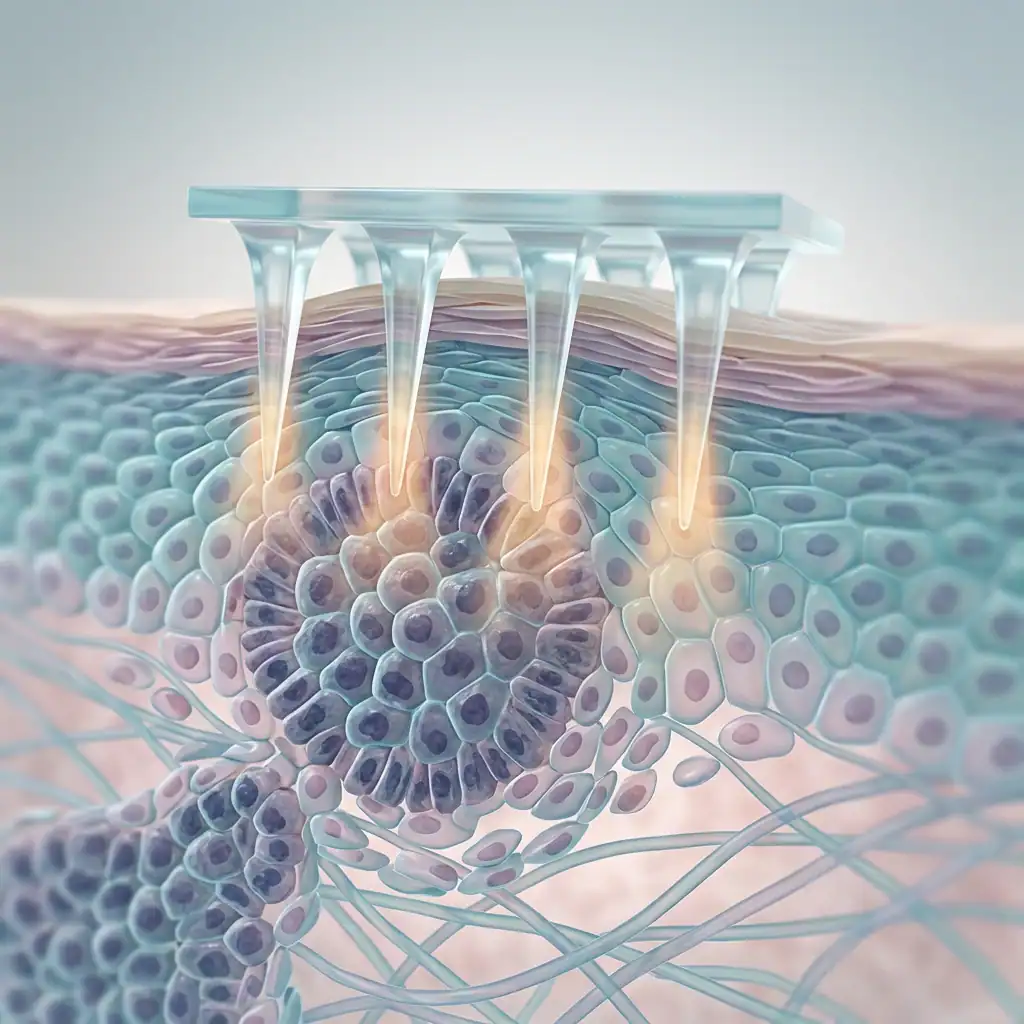
Basal cell carcinoma and the search for tissue-sparing options
Basal cell carcinoma (BCC) is the most commonly diagnosed skin cancer worldwide and is often treated successfully with surgery, but many patients and clinicians are interested in less invasive approaches for selected cases (Source: Sutrisno CSN et al, systematic review).
Most small, nodular BCCs are cured with standard surgical methods such as excision or Mohs micrographic surgery, which provide high cure rates and tissue margin control (Source: Sutrisno CSN et al, systematic review).
Despite excellent outcomes with surgery, noninvasive or tissue-sparing therapies remain appealing for people with cosmetically sensitive locations, multiple tumors, medical reasons that make surgery risky, or those who prefer nonsurgical care (Source: Sutrisno CSN et al, systematic review).
The SKNJCT-003 trial: a new way to deliver chemotherapy into the skin
What Medicus Pharma tested
Medicus Pharma reported topline results from a phase 2 study, SKNJCT-003, testing a dissolvable microneedle array (D-MNA) that delivers the chemotherapy drug doxorubicin directly into nodular BCCs (Source: Medicus Pharma press release, SKNJCT-003).
The concept behind a dissolvable microneedle patch is to place tiny needles into the tumor that dissolve and release drug locally, concentrating treatment at the lesion while limiting systemic exposure (Source: Medicus Pharma press release, SKNJCT-003).
How the study was designed
SKNJCT-003 was a randomized, double-blind, placebo-controlled, multicenter phase 2 trial that enrolled 90 patients with nodular BCC and randomized them 1:1:1 to receive either 100 μg doxorubicin D-MNA, 200 μg doxorubicin D-MNA, or a placebo microneedle array (Source: Medicus Pharma press release, SKNJCT-003).
The trial used a composite primary end point that required both clinical (visual) clearance and histological clearance on biopsy at a prespecified post-treatment visit, aligning visible tumor response with pathologic confirmation (Source: Medicus Pharma press release, SKNJCT-003).
Participants were assessed at two different time points after treatment: some at day 29 and others at day 57, a split that both complicates interpretation and offers early signals about whether responses increase over time (Source: Medicus Pharma press release, SKNJCT-003).
What the trial found: numbers and patterns
Results at day 29
At the earlier assessment point (day 29), response rates were modest across groups, and both clinical and histologic clearance remained limited (Source: Medicus Pharma press release, SKNJCT-003).
In the placebo arm (n = 15) clinical clearance was seen in 33% of lesions and histological clearance in 20% (Source: Medicus Pharma press release, SKNJCT-003).
In the 100 μg D-MNA group (n = 17) clinical clearance was 47% and histological clearance 24% (Source: Medicus Pharma press release, SKNJCT-003).
In the 200 μg D-MNA group (n = 15) clinical clearance was 40% and histological clearance 27% (Source: Medicus Pharma press release, SKNJCT-003).
Results at day 57
By day 57, separation between groups became more evident, suggesting a time-dependent increase in response, especially at the higher dose (Source: Medicus Pharma press release, SKNJCT-003).
The placebo group at day 57 (n = 16) showed clinical clearance of 38% and histological clearance of 38% (Source: Medicus Pharma press release, SKNJCT-003).
The 100 μg D-MNA cohort (n = 12) had clinical clearance of 42% and histological clearance of 33% (Source: Medicus Pharma press release, SKNJCT-003).
The most notable signal came from the 200 μg D-MNA arm (n = 15), which demonstrated 73% clinical clearance and 40% histological clearance at day 57 (Source: Medicus Pharma press release, SKNJCT-003).
Overall, the topline data indicate increasing clinical responses over time at the higher dose, with a more modest rise in histologic complete responses by the later visit (Source: Medicus Pharma press release, SKNJCT-003).
How to interpret the placebo response
A striking and important feature of the dataset is the relatively high clearance rates seen in the placebo arm, particularly the 38% histologic clearance at day 57, which raises questions about what drove those results (Source: Medicus Pharma press release, SKNJCT-003).
Possible explanations include sampling variability because group sizes were small, mechanical effects of inserting microneedles into the tumor (which might disrupt tumor architecture), biopsy-related debulking done before or during enrollment, or rare spontaneous regression of some lesions (Source: Medicus Pharma press release, SKNJCT-003).
Without the full clinical study report—including procedural details, biopsy technique, and safety data—it’s not possible to fully resolve why placebo responses were higher than expected; those details are anticipated in the company’s forthcoming report (Source: Medicus Pharma press release, SKNJCT-003).
Clinical context: Where might D-MNA fit into BCC care?
For skin cancer specialists and surgeons, the key question is whether a noninvasive, local therapy can match the high rates of durable clearance achieved with excision or Mohs micrographic surgery while offering better cosmetic outcomes or less morbidity in certain patients (Source: Sutrisno CSN et al, systematic review).
The trial’s composite primary endpoint that includes histologic confirmation is a strength because it avoids overcalling cosmetic or superficial improvements as complete responses without pathologic proof (Source: Medicus Pharma press release, SKNJCT-003).
However, the 40% histologic clearance at day 57 in the 200 μg arm remains substantially lower than the cure rates expected from standard surgical approaches, meaning D-MNA would likely be considered for a different niche rather than as a direct replacement for surgery (Source: Medicus Pharma press release, SKNJCT-003).
Potential niches include patients with multiple BCCs, those with nevoid basal cell carcinoma (Gorlin) syndrome, or patients who cannot tolerate surgery for medical or personal reasons, where a tissue-sparing but only moderately effective option might still provide meaningful benefit (Source: Medicus Pharma press release, SKNJCT-003).
Broader development landscape and company plans
SKNJCT-003 builds on earlier safety and tolerability data from a phase 1 study (SKNJCT-001), which the company reported showed acceptable safety and some histologic complete responses (Source: Medicus Pharma press release, SKNJCT-003).
Medicus Pharma has also launched SKNJCT-004 in the United Arab Emirates and expanded regulatory approvals to allow SKNJCT-003 activities in the United Kingdom, indicating the company is advancing its clinical program internationally (Source: Medicus Pharma press release, SKNJCT-003).
In addition, Medicus has announced a collaboration with the Gorlin Syndrome Alliance to explore expanded access pathways for people with nevoid BCC syndrome — a group that may particularly value nonsurgical alternatives because of their tendency to develop many tumors over a lifetime (Source: Medicus Pharma press release, SKNJCT-003).
Safety, durability, and what still needs to be learned
Topline phase 2 results focus on efficacy signals; the full clinical study report, expected in Q2 2026, should provide detailed safety data, procedural descriptions, and more granular outcome measures that are essential for judging the therapy’s risks and benefits (Source: Medicus Pharma press release, SKNJCT-003).
Key unanswered questions include the long-term recurrence rate after D-MNA treatment, how treated areas look cosmetically over months to years, and how patients feel about the treatment experience and outcomes — all factors that matter when weighing a nonsurgical option against excision or Mohs surgery (Source: Medicus Pharma press release, SKNJCT-003).
Because SKNJCT-003 was not designed or powered to support regulatory approval on its own, the company has indicated plans for an end-of-phase 2 meeting with the U.S. Food and Drug Administration (FDA) in the first half of 2026 to discuss next steps and requirements for further development (Source: Medicus Pharma press release, SKNJCT-003).
Bottom line for clinicians and patients
SKNJCT-003 offers an intriguing proof of concept that a dissolvable microneedle patch can deliver chemotherapy into nodular BCC and produce dose- and time-dependent responses, with the 200 μg dose showing the strongest clinical signal at day 57 (73% clinical clearance) and a modest rate of histologic clearance (40%) (Source: Medicus Pharma press release, SKNJCT-003).
Those numbers are not yet comparable to standard surgical cure rates, so D-MNA would most likely complement existing options rather than replace them, at least until larger, longer-term trials demonstrate durable histologic clearance and acceptable safety (Source: Medicus Pharma press release, SKNJCT-003; Sutrisno CSN et al, systematic review).
Clinicians who manage BCC should watch for the full study report and additional trials to better define which patients could benefit, how to integrate D-MNA into practice if approved, and how the therapy compares with current noninvasive options (Source: Medicus Pharma press release, SKNJCT-003).
Sources
- Medicus Pharma press release, “Medicus Pharma reports positive phase 2 SKNJCT-003 topline data observing 73% clinical clearance and 40% histological clearance (CR) at day 57 in 200μg cohort.” Accessed March 5, 2026. (Source: Medicus Pharma press release, SKNJCT-003)
- Sutrisno CSN, Pramita DH, Dewi IP. Curative or conservative approaches: a systematic review of surgical and nonsurgical treatments for basal cell carcinoma. Cureus. doi:10.7759/cureus.95556. (Source: Sutrisno CSN et al, systematic review)