Hidradenitis Suppurativa (ICD-10: L73) 🚨
Hidradenitis Suppurativa: A Chronic Inflammatory Disease of the Hair Follicle
Hidradenitis suppurativa (HS), also called acne inversa, is a chronic, recurrent inflammatory skin disease that begins in the terminal hair follicle. It produces painful deep-seated nodules, abscesses and, over time, interconnected tunnels under the skin that drain fluid and leave rope-like scars. Despite the older name, it is not primarily a disease of the sweat glands, and despite the appearance of the lesions it is not an infection caught from anyone or anywhere.
HS affects skin where hair follicles sit alongside apocrine glands and where skin rubs against skin: the armpits, the groin, the inner thighs, the skin under the breasts, the buttocks and the perianal area. Lesions in these folds are the single most recognisable feature of the disease.
Estimates of prevalence vary with how studies are designed, but most place it around 0.4–1% of the population. Onset is usually after puberty, most often in the twenties and thirties, and in European and North American cohorts women are affected roughly three times as often as men. HS rarely begins before puberty or after middle age.
One fact matters more than any other for people living with it: on average, patients wait several years — in many studies seven to ten — between their first lesion and a correct diagnosis. During that time the lesions are frequently treated as ordinary boils, drained repeatedly, and allowed to scar. Recognising the pattern early is the most valuable thing a reader can take from this page.
Predisposing Factors: Why Hidradenitis Suppurativa Develops
HS arises when the terminal hair follicle becomes occluded, dilates and ruptures, spilling keratin and bacteria into the surrounding dermis and triggering an intense immune response. Why that happens in some people and not others is not fully settled, but several contributors are well established.
- Genetic predisposition: Around a third of patients report an affected relative. A minority of families carry mutations in the gamma-secretase complex genes, but most cases are polygenic and no genetic test is used in routine diagnosis.
- Smoking: The most consistently reported modifiable association. Current smokers are substantially over-represented among patients, and smoking is linked to more severe disease and poorer treatment response.
- Excess body weight: Associated both with developing HS and with greater severity, partly through increased skin-on-skin friction and partly through metabolic inflammation. Weight loss improves severity in many patients but does not cure the disease.
- Hormonal influence: Flares around menstruation and improvement during some pregnancies are commonly reported, and onset after puberty is near-universal. HS is also more common in people with polycystic ovary syndrome.
- Mechanical friction: Tight clothing, waistbands and prolonged rubbing in the folds aggravate existing disease.
- Associated conditions: HS occurs more often alongside inflammatory bowel disease (particularly Crohn’s disease), spondyloarthritis, metabolic syndrome and depression. These associations are part of why a diagnosis is worth pursuing properly rather than treating each abscess in isolation.
Two beliefs should be set aside explicitly, because they cause real harm. HS is not caused by poor hygiene, and it is not contagious. Washing more aggressively does not help and frequently irritates the affected skin further.
Diagnostics: How Hidradenitis Suppurativa Is Diagnosed
The diagnosis is clinical and rests on three criteria considered together: typical lesions (deep painful nodules, abscesses, draining tunnels, double-headed comedones), typical sites (the skin folds listed above) and recurrence — conventionally at least two episodes in six months. No blood test or imaging study confirms HS.
Bacterial swabs are sometimes taken, but they are used to guide antibiotic choice in a superinfected lesion rather than to make the diagnosis; cultures are often sterile or grow ordinary skin flora. Ultrasound can map the extent of tunnels before surgery. Biopsy is reserved for cases where another diagnosis is genuinely in question.
Severity is usually recorded with the Hurley stage: stage I is isolated nodules or abscesses without tunnels or scarring; stage II is recurrent lesions with tunnels and scarring, separated by normal skin; stage III is diffuse involvement of an entire area with multiple interconnected tunnels. The stage guides the treatment choice, alongside how inflamed the disease is, where the lesions are, how much pain and scarring there is, other conditions, what has already been tried and what the patient wants — stage alone does not decide management. This is why a dermatologist will look at the whole affected region rather than only the lesion that hurts today.
Symptoms: What Hidradenitis Suppurativa Looks Like
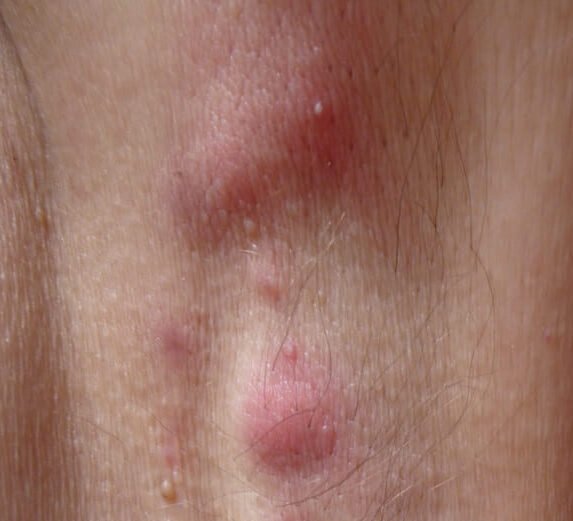
- Deep painful nodules: Firm, tender lumps that sit under the skin rather than on it, often appearing days before anything is visible on the surface. Patients frequently describe a burning or stinging warning sensation.
- Abscesses: Nodules that enlarge, become fluctuant and may rupture, releasing pus or blood-stained fluid with a strong odour.
- Sinus tracts (tunnels): Channels that form under the skin between lesions and drain intermittently. Their presence marks the transition from Hurley stage I to stage II.
- Double-headed comedones: Paired blackheads sharing a base, a characteristic sign in previously inflamed skin.
- Scarring: Thick, rope-like or bridged scars that can restrict movement when they cross the armpit or groin.
- Pain and drainage: Often the dominant complaint. Persistent discharge requires dressings and can make work and intimacy difficult.
Lesions are usually bilateral and recur in the same places. The course is fluctuating: periods of relative quiet alternate with flares that may be triggered by friction, heat, stress or the menstrual cycle.
Differential Diagnosis: Ruling Out Other Conditions
- Furuncles and carbuncles: Ordinary boils are usually single, resolve with drainage and antibiotics, and do not recur in the same folds for years.
- Epidermoid and pilar cysts: Mobile, well-defined, often with a central punctum, and not inflamed unless ruptured.
- Acne vulgaris: Affects the face, chest and back — sebum-rich areas rather than skin folds — and does not form tunnels.
- Cutaneous Crohn’s disease: Perianal fistulas may look identical; bowel symptoms and endoscopy separate them, and the two conditions can coexist.
- Pilonidal sinus: Confined to the natal cleft, though it may accompany HS.
- Deep fungal infection, actinomycosis, lymphogranuloma venereum: Rare, but considered in atypical or treatment-resistant cases.
Risks: Why Hidradenitis Suppurativa Should Be Treated
HS is not a self-limiting nuisance. Untreated disease scars, and scarring is irreversible: tunnels that have formed do not close with medication alone, and contractures across the armpit or groin can permanently restrict movement. Extensive disease can cause lymphoedema of the affected limb.
The burden on quality of life is among the highest measured in dermatology. Chronic pain, malodorous drainage and lesions in intimate areas are strongly associated with depression, anxiety and social withdrawal, and these should be raised with a clinician rather than endured.
Long-standing, severe perianal or gluteal disease carries a small but real risk of squamous cell carcinoma developing within the chronically inflamed tissue. It is uncommon but can be aggressive, and it is easily missed in skin that is already scarred and draining. A new ulcer that will not heal, a lump that is growing quickly, bleeding that is new, pain that keeps increasing or a change in the character of the discharge should be assessed promptly. This is one reason decades-long disease should stay under specialist review rather than being self-managed.
Tactics: When and How to Seek Treatment
See a dermatologist if any of the following apply:
- Painful lumps recur in the armpits, groin, buttocks or under the breasts.
- You have been treated for “recurrent boils” more than once in the same place.
- A lesion drains fluid, or a channel has formed between two lesions.
- Scarring is developing, or movement in the affected fold is becoming restricted.
- The condition is affecting your mood, sleep, work or relationships.
Repeated incision and drainage deserves a specific warning. It relieves pressure in an acute abscess and is sometimes necessary, but it does not alter the disease, recurrence at the same site is common, and each episode adds to the scarring. Draining lesions at home carries a risk of deeper infection and worse scarring, and should not be attempted.
Treatment: Modern Strategies for Hidradenitis Suppurativa
Treatment is chosen by Hurley stage and by how active the disease is, and it usually combines several approaches at once.
- General measures: Stopping smoking and reducing excess weight are both recommended and can reduce the burden of disease, although the size of the benefit varies between people and neither reliably improves the response to every treatment. Gentle cleansing, loose clothing and management of friction help, as does treating pain properly rather than tolerating it.
- Topical therapy: Topical clindamycin is the standard first-line option for mild, localised disease; antiseptic washes are used as adjuncts.
- Systemic therapy: Oral tetracyclines are used for more widespread mild-to-moderate disease. The combination of clindamycin with rifampicin is a well-established second-line regimen. Hormonal treatments such as combined oral contraceptives or spironolactone suit selected female patients, and metformin is used as an adjunct in some.
- Biologic therapy: Adalimumab, a TNF inhibitor, was the first biologic licensed for moderate-to-severe HS; the IL-17 inhibitors secukinumab and bimekizumab have since been approved, and further agents are in development. Which of them is licensed, and for whom, differs between countries. In suitable patients they can markedly reduce inflammatory lesions and pain, though the response is partial for many and none of them reverses tunnels and scars that have already formed.
- Procedures and surgery: Intralesional corticosteroid injection settles individual inflamed nodules. Deroofing removes the roof of a tunnel and leaves the base to heal; recurrence at the treated site is low in several series, though reported rates vary by site and study. Wide excision of an entire affected area is used for selected extensive disease. Both are options for persistent tunnels across more than one Hurley stage, and neither guarantees a cure. Laser hair removal (long-pulsed Nd:YAG) and CO2 laser are used in selected cases.
HS is a long-term condition and treatment is measured in months rather than weeks. Medication controls inflammation and prevents new damage; it does not undo tunnels and scars that have already formed, which is the strongest argument for starting early.
Prevention: Reducing Flares
- Stop smoking. The modifiable factor with the most consistent evidence behind it.
- Reduce friction: loose, breathable clothing; avoid tight waistbands and seams crossing affected folds.
- Manage weight and metabolic health, with medical support where appropriate.
- Avoid aggressive shaving or waxing of affected areas during active disease; discuss laser hair reduction with a dermatologist instead.
- Do not squeeze or lance lesions; seek treatment for a painful abscess instead.
- Keep specialist review ongoing, even during quiet periods, so that treatment can be stepped up before damage accumulates.
With early recognition, consistent treatment and attention to smoking and weight, most people with hidradenitis suppurativa can bring the disease under control and avoid the scarring that makes it disabling. The obstacle is usually delay in diagnosis, not the absence of effective treatment.