
Conexeu Sciences Develops Bio-Regenerative ECM Tech for Tissue Restoration
Why this matters: losing weight can change your face
More people are using medicines called GLP-1 receptor agonists for weight loss. These drugs can help people lose weight but sometimes cause noticeable facial changes like loss of fullness, looser skin, and a different skin texture. Some people call this “Ozempic face.”
Those visible changes aren’t just about fat shrinking. The layer that holds our skin and fat together can also break down, which may make the face look hollow or saggy even after weight is lost.
A different idea from a new company
Conexeu Sciences is developing a new kind of injectable treatment that aims to support the underlying tissue framework rather than only filling space, according to company executives Miles Harrison and Brian Pilcher (the company reports). This work sits at the meeting point of regenerative medicine and aesthetic dermatology.
Harrison has leadership experience in dermatology and aesthetics, and Pilcher is a cell and molecular biologist who has worked on wound healing and injectable treatments. Both say they were drawn to Conexeu because its approach may address a limitation of traditional aesthetic treatments: those treatments can replace lost volume but don’t always restore the tissue’s structure.
What is the extracellular matrix (ECM)?
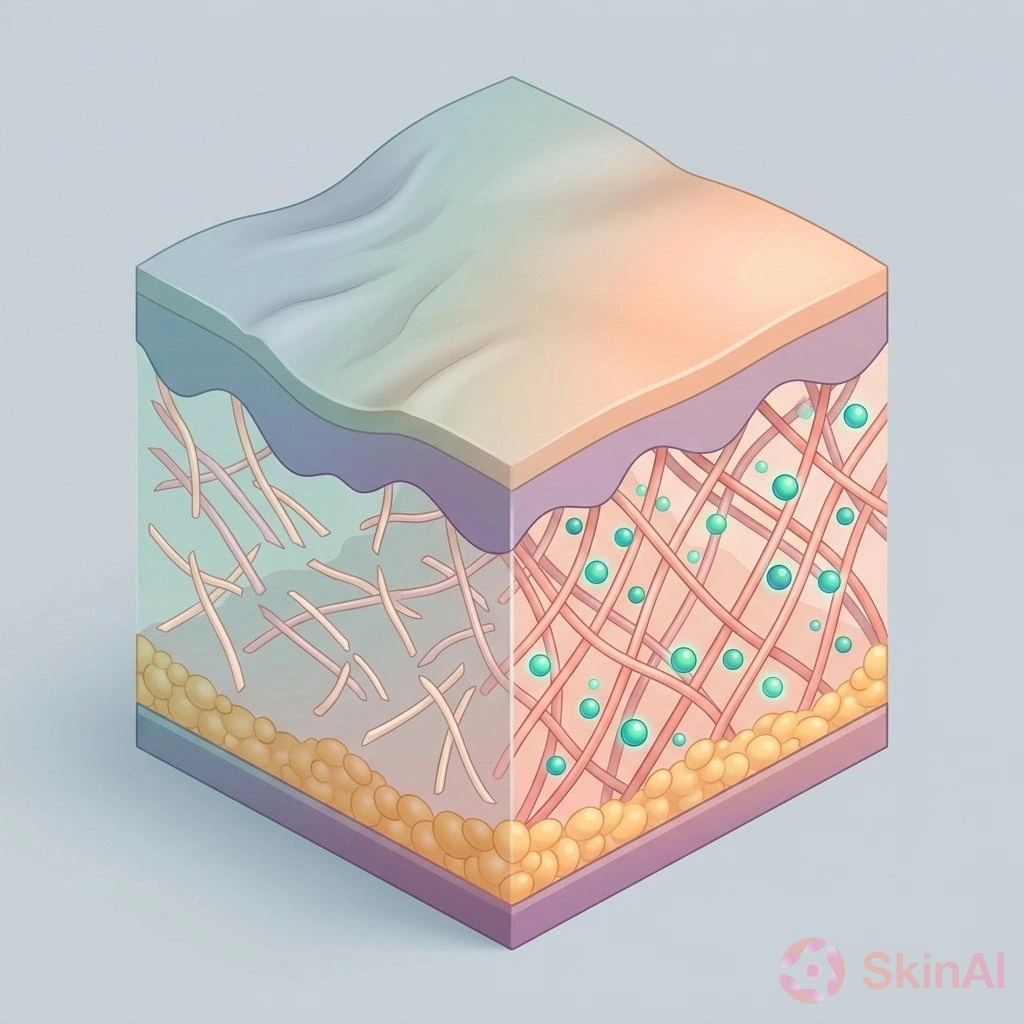
Extracellular matrix is the term for the protein-and-sugar network that sits between cells in skin and other tissues. Think of it as the scaffolding that helps skin keep its shape and strength. When this scaffolding breaks down, the skin can look thinner, looser, or less resilient.
How most fillers work — and what’s different here
Common injectable options like hyaluronic acid fillers mainly add contour and volume or stimulate some tissue response. They’re good for shaping and smoothing but they don’t replace the tissue framework itself.
Conexeu’s approach is described by the company as bio-regenerative. Instead of acting only as a volume filler, their material is meant to act as a temporary scaffold that supports the body’s own cells as they move in and remodel the area (the company reports).
How the material is used
The product the company is developing is a thermosensitive extracellular matrix material. It’s being prepared in a dried form that is mixed at the doctor’s office. At room temperature it stays liquid, which makes it easy to inject with a syringe and a fine needle.
Once the material is placed into the tissue and warms to about body temperature, it begins to gel in roughly 10 minutes. The gelled material is designed to stay in place and provide a local scaffold for cells to migrate into and for the tissue to remodel over time (the company reports).
What the early study looked at
Conexeu completed a 12-month proof-of-concept study testing the material under the skin and within the skin. Investigators looked at things such as tissue response, inflammation, how long the material persisted, whether tissue grew into it, and mechanical properties compared with established injectable fillers (the company reports).
The company says early results are encouraging, but the detailed findings have not been made public yet. Those results are being prepared for abstract submission and peer review, so full data and independent evaluation are still pending (the company reports).
Conexeu also notes that the technology builds on more than a decade of research that began at the University of British Columbia and on peer-reviewed work across regenerative medicine, wound healing, tissue engineering, transplantation, and dermatology (the company reports).
What this means for everyday people
This is an investigational approach. It’s not yet a clinically proven or widely available treatment. The company’s description suggests it may offer a different way to support tissue health after weight loss or with age-related changes, but independent studies and peer-reviewed publication are needed for a clearer picture.
If you’re concerned about facial volume loss or changes in skin quality after weight loss, a dermatologist or qualified injector can review your options. They can explain whether traditional fillers, skin-tightening procedures, or an investigational scaffold-type approach (once available and proven) might be appropriate for your situation.
Tracking visible changes
If you notice changes in your face, taking photos over time can help you and your doctor see what’s changing. Documenting differences in fullness, texture, or skin looseness can make clinical conversations more helpful and guide treatment planning.
When to see a doctor
Talk with a dermatologist or other healthcare provider if you have fast or dramatic changes in facial appearance, persistent redness, pain, open sores, signs of infection, or any new or changing skin lesions. For cosmetic questions, a dermatologist or licensed aesthetic provider can discuss options and risks.
Disclaimer
This article summarizes a company’s report about an early-stage medical technology. It is not medical advice. Treatment decisions should be made with a doctor or dermatologist. The company’s claims are preliminary and await peer-reviewed publication and broader clinical evaluation.
Sources
- Conexeu Sciences, company report and interview with Miles Harrison and Brian Pilcher (information in original article)
- Research origin noted as University of British Columbia (information in original article)