
Why Some Psoriasis Patients Respond Differently to Biologic Treatments
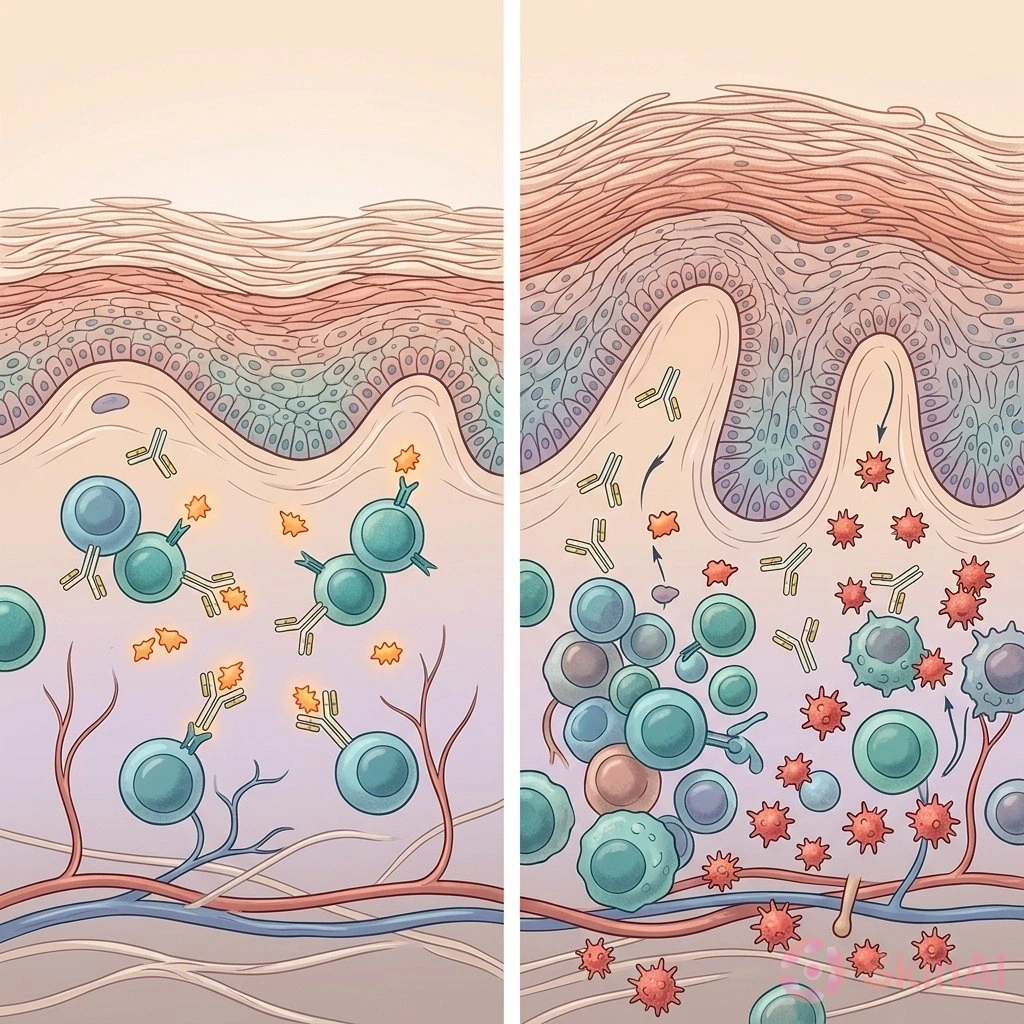
Why this matters: not all psoriasis patients respond the same
Psoriasis is a common long-term skin condition that causes red, scaly patches. New medicines called biologics that block certain immune signals have helped many people, but some still don’t get the same benefit. A recent study suggests part of the reason could be that people with psoriasis don’t all have the same kind of immune activity in their skin.
The quick summary
Researchers analyzed skin samples and blood from people with plaque psoriasis and found that some patients show both the typical “Th17” immune activity linked to psoriasis and signs of a different immune response often called Type 2 inflammation. This mixed pattern may help explain why some people respond well to current biologic drugs while others do not. The results are early and need to be confirmed in larger, more diverse groups.
How psoriasis treatment changed — and what’s still a problem
Scientists discovered years ago that a signaling pathway involving IL-23 and IL-17 molecules plays a big role in psoriasis. Drugs that block IL-17 or IL-23 have improved symptoms for many people with moderate to severe psoriasis (Source: Journal of the American Academy of Dermatology).
Still, not everyone gets the same relief. Some people never respond fully, and others lose benefit over time. That mismatch has led researchers to look for hidden differences in the immune activity inside affected skin.
What the new study looked at
The study used bulk RNA sequencing, a method that measures which genes are active in a tissue, to compare involved skin (lesional), nearby uninvolved skin (nonlesional), and healthy skin. The first group included 11 patients with plaque psoriasis, and the researchers also checked blood markers in a second group of 50 patients (Source: Journal of the American Academy of Dermatology).
What they found — a mix of immune signals
As expected, the team saw strong activation of the IL-23/Th17 pathway. That means high activity of molecules like IL-17A, IL-17C, and IL-23A, which are well-known in psoriasis.
Unexpectedly, they also found increased signs of Type 2 inflammation in some patients. Type 2 inflammation usually involves molecules like IL-4 and is more commonly linked with allergic conditions. In this study, markers such as IL-4 receptor (IL-4R), CCL17, and thymic stromal lymphopoietin (TSLP) were higher than expected. The authors describe this as a dual Th17/Type 2 transcriptomic endotype, meaning both immune programs are active in the same patients (Source: Journal of the American Academy of Dermatology).
The researchers also saw consistent activation of the IL-36 family of cytokines, with IL-36G among the most elevated inflammatory signals. At the same time, several genes that help keep the skin barrier intact were expressed at lower levels. Altogether, this suggests the immune and skin-barrier picture in psoriasis can be more complicated than previously thought.
Why this might matter for treatment
If some people with psoriasis have both Th17 and Type 2 immune activity, that could partly explain why blocking only IL-17 or IL-23 helps some patients more than others. As more targeted medicines become available, understanding a person’s specific immune pattern could eventually help doctors choose the treatment most likely to work for them (Source: Journal of the American Academy of Dermatology).
Possible biomarkers the study flagged
In exploratory analyses, the researchers pointed to three molecules that correlated with disease severity: amphiregulin (AREG), corneodesmosin (CDSN), and IL-36RN. These might become useful markers for separating different psoriasis types or predicting treatment response, but that idea is still preliminary and needs more study (Source: Journal of the American Academy of Dermatology).
Important limitations to keep in mind
The study had a small number of skin biopsy samples and was done only in Taiwanese patients. That limits how much we can apply the findings to other groups. The results are observational, meaning they show patterns but do not prove cause and effect. Larger, more diverse studies are needed before doctors can use these findings to guide treatment choices (Source: Journal of the American Academy of Dermatology).
What this means for people with psoriasis
This research doesn’t change current treatment guidelines right now. It does, however, suggest that psoriasis is not always driven by a single immune pathway. That could help explain why some people do well on existing biologic drugs and others do not.
If these findings are confirmed, testing the immune activity in a person’s skin or blood might one day help personalize treatment choices. For now, treatment decisions should continue to be made with your dermatologist based on your symptoms, treatment history, and overall health.
When to see a doctor
Talk with your dermatologist if your psoriasis is not improving, if treatments stop working, or if you develop new or worsening symptoms such as pain, bleeding, signs of infection, or rapidly changing lesions. These can be signs that your treatment plan needs reassessment.
Tracking visible changes
Keeping photos of your skin over time and noting when new treatments are started can help you and your dermatologist see whether a therapy is helping or if the appearance of your psoriasis changes.
Disclaimer
This article summarizes a recent research report and is for informational purposes only. It is not medical advice. Treatment decisions should be made with a qualified healthcare professional.
Sources
- Chen CH, Lee MS, Chang WY, et al. Uncovering a dual Th17/Type 2 transcriptomic endotype in psoriasis. 2026; S0190-9622(26)03028-8. doi:10.1016/j.jaad.2026.06.131. (Source: Journal of the American Academy of Dermatology)