
Chronic Inducible Urticaria: Remibrutinib and New Research
Chronic inducible urticaria: when everyday triggers cause hives
For some people, a scratch, cold air, exercise, or another everyday trigger can bring on itchy hives. When this happens repeatedly over a long period, it may be a condition called chronic inducible urticaria, or CIndU.
CIndU can affect more than the skin. People may spend years adjusting their routines to avoid symptoms, sometimes giving up activities they enjoy or struggling at work. The condition can also be overlooked or inadequately treated.
In a Dermatology Times Between the Lines discussion, Diego Ruiz Dasilva, MD, and Lindsey Finklea, MD, talked about the impact of CIndU, the limits of current treatments, and results from a phase 3 study of an investigational medicine called remibrutinib. Phase 3 studies are larger clinical trials used to evaluate how well a treatment works and to gather safety information. (Source: Dermatology Times Between the Lines, remIND discussion)
What is chronic inducible urticaria?
CIndU is a group of conditions in which a specific trigger causes hives, swelling beneath the skin, or both. Hives are raised, often itchy areas of skin. Swelling beneath the skin is called angioedema.
During the discussion, Finklea estimated that CIndU affects about 0.5% to 1.5% of people worldwide. She also estimated that a type called symptomatic dermatographism accounts for roughly half of cases. With this type, rubbing or scratching the skin can cause raised, itchy marks. (Source: Dermatology Times Between the Lines, remIND discussion)
Other common types include cold urticaria, which is triggered by cold, and cholinergic urticaria, which can occur with triggers such as exercise. Less common types are associated with sunlight, heat, water, vibration, contact with a trigger, or pressure that causes a delayed reaction.
How doctors identify triggers
Diagnosis usually starts with a conversation about symptoms, possible triggers, and how the condition affects daily life. Doctors may also use standardized trigger tests, sometimes called provocation tests, to see whether a particular stimulus causes a reaction.
For example, a FricTest applies controlled pressure to the skin to check for symptomatic dermatographism. Temperature testing can help assess reactions to cold. These tests may also give doctors a way to track changes during treatment.
The visible hives are only part of the picture. The experts described people whose symptoms interfered with work or kept them from taking part in recreation. Asking about those everyday effects can help doctors understand the full burden of the condition. (Source: Dermatology Times Between the Lines, remIND discussion)
Why antihistamines do not help everyone enough
Second-generation H1 antihistamines are usually the first medicines used for CIndU. These medicines block the effects of histamine, a substance involved in hives and itching.
According to Finklea, a standard dose works well enough for approximately 20% to 50% of people with CIndU. Some people still have troublesome symptoms even when their dose is increased. (Source: Dermatology Times Between the Lines, remIND discussion)
In the discussion, Finklea described gradually increasing antihistamine treatment over about two to three weeks when appropriate. She also emphasized taking treatment daily as directed to help control symptoms, rather than waiting for hives to appear.
Antihistamine dosing should be discussed with a doctor. People should not increase their dose on their own.
At the time of the discussion, there was no medication approved by the U.S. Food and Drug Administration specifically for CIndU. When higher-dose antihistamines were not enough, doctors often drew on treatment approaches used for chronic spontaneous urticaria, a different form of long-lasting hives that occurs without a specific external trigger. (Source: Dermatology Times Between the Lines, remIND discussion)
Why researchers are studying remibrutinib
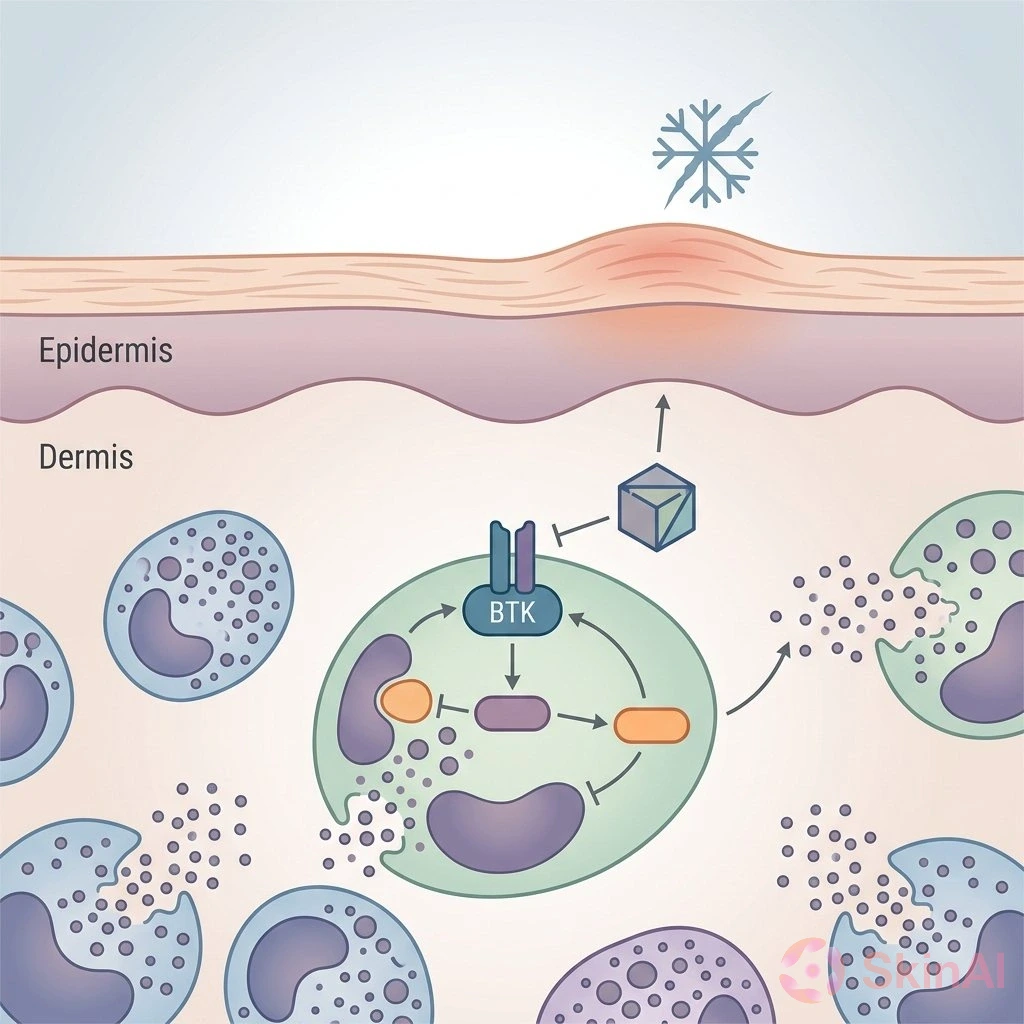
Researchers do not yet fully understand how CIndU develops. However, immune cells called mast cells appear to play an important role. When activated, these cells can release histamine and other substances that contribute to inflammation and hives.
Several signals that activate mast cells pass through a protein called Bruton tyrosine kinase, or BTK. Remibrutinib is designed to selectively block BTK. It acts at a point in the signaling process after a receptor involved in allergic responses has been activated.
By interrupting that signal, the medicine is intended to reduce the release of histamine and other inflammatory substances from mast cells. This was the reason researchers studied it in three different forms of CIndU: symptomatic dermatographism, cold urticaria, and cholinergic urticaria. (Source: Dermatology Times Between the Lines, remIND discussion)
What the remIND study looked at
The phase 3 remIND study enrolled adults with one of those three types of CIndU who still had symptoms while taking a second-generation H1 antihistamine.
Participants were randomly assigned to receive either remibrutinib, at a dose of 25 milligrams twice a day, or a placebo, an inactive treatment. They continued their background antihistamine treatment during the study. (Source: Finklea and colleagues, phase 3 remIND study, 2026)
Researchers assessed the main study result at 12 weeks. They used a different trigger test for each condition:
- Symptomatic dermatographism: the FricTest
- Cold urticaria: temperature testing
- Cholinergic urticaria: an exercise trigger test
The study used a demanding definition of a complete response. It was not enough for hives to improve: participants had to have no hives triggered by the test. (Source: Dermatology Times Between the Lines, remIND discussion)
What did the study find?
At week 12, about 29% of participants with symptomatic dermatographism and about 29% of those with cholinergic urticaria had a complete response with remibrutinib. In each group, that was approximately twice the response seen with placebo.
The largest effect was reported in people with cold urticaria. In that group, 56.3% had a complete response with remibrutinib, more than three times the placebo response. (Source: Finklea and colleagues, phase 3 remIND study, 2026)
These results need to be understood alongside the study’s strict goal. For someone with symptomatic dermatographism, a complete response meant a FricTest score of zero, with no raised hive appearing after the test. The results do not mean everyone taking the medicine became completely free of symptoms.
In symptomatic dermatographism, a significant difference between the treatment and placebo groups was already apparent by week 2 and continued through weeks 12 and 24. The experts said longer follow-up will be important to learn whether people who do not initially reach complete control might continue to improve over time. (Source: Dermatology Times Between the Lines, remIND discussion)
Improvement can matter even without complete clearance
A clinical trial needs clear ways to measure results, but treatment success in everyday life can look different from person to person.
On the FricTest, a score of zero means no hive was triggered, while a score of one reflects mild disease. Finklea said she would ideally want every patient to reach zero, but she considers a score of one a practical goal for many people, especially because symptoms can change between appointments.
Someone who does not meet a study’s strict definition of a complete response may still have meaningful improvements. Fewer symptoms, an easier time at work, or being able to return to activities can all matter when assessing how treatment is going. (Source: Dermatology Times Between the Lines, remIND discussion)
What did researchers report about safety?
The experts also discussed safety findings from the 24-week period when remibrutinib was compared with placebo. Severe unwanted medical events occurred at similar rates in the two groups. The overall findings were consistent with those reported in the larger remibrutinib research program for chronic spontaneous urticaria. (Source: Dermatology Times Between the Lines, remIND discussion)
Most reported events were mild to moderate, few participants stopped treatment, and no deaths were reported. Respiratory infections, headache, and nausea were among the events reported in at least 5% of participants, and their rates were similar in the treatment and placebo groups.
Petechiae, which are tiny spots caused by bleeding under the skin, were reported in 5.2% of people taking remibrutinib and 1.8% of those taking placebo. The experts discussed the importance of explaining what people should watch for during treatment.
They also noted that remibrutinib is designed to be selective for BTK and discussed its safety separately from older BTK inhibitors developed for blood disorders and cancer. Longer-term follow-up remains important. (Source: Dermatology Times Between the Lines, remIND discussion)
Other treatments being considered
For people whose symptoms are not adequately controlled with antihistamines, doctors may consider other treatments. In their discussion, the experts compared the emerging information on remibrutinib with evidence for omalizumab and dupilumab.
Omalizumab has the largest body of published evidence for CIndU among the treatments discussed, although it does not have an approval specifically for CIndU. The evidence for dupilumab is more limited. The experts also noted that these medicines have not been directly compared with one another in head-to-head studies for CIndU. (Source: Dermatology Times Between the Lines, remIND discussion)
Treatment decisions depend on the type of CIndU, a person’s age, other health conditions, the available evidence, and individual preferences. A doctor or dermatologist can discuss which options may be appropriate.
For Finklea, the remIND findings represent a step toward addressing a long-standing treatment gap, particularly for symptomatic dermatographism. As more long-term information becomes available, it may help shape future treatment guidelines and expectations for disease control. (Source: Dermatology Times Between the Lines, remIND discussion)
When to seek medical care
Talk with a doctor or dermatologist if hives keep returning, interfere with daily life, or are difficult to control. Seek medical advice about skin changes that are painful, bleeding, growing quickly, changing, or showing signs of infection, or if you are unsure what is causing them.
Get emergency help right away if swelling affects your tongue or throat, or if you have trouble breathing.
This article is for general information and is not a substitute for medical advice. Discuss symptoms and treatment decisions with a qualified health professional.
Sources
- Dermatology Times Between the Lines. “Efficacy and safety of remibrutinib in chronic inducible urticaria: results of phase 3 remIND study.” Accessed October 30, 2026.
- Finklea L, Metz M, Hide M, et al. “Remibrutinib in chronic inducible urticaria: results from the phase 3 remIND study.” Presented at the European Academy of Allergy and Clinical Immunology Congress, June 12–15, 2026, Istanbul, Turkey.