
FDA Approves Dupilumab for Chronic Urticaria in Kids Aged 2 to 11
FDA green-lights dupilumab for young children with stubborn hives
The US Food and Drug Administration has approved dupilumab (Dupixent) for children aged 2 to 11 years with chronic spontaneous urticaria (CSU) that remains symptomatic despite H1 antihistamine therapy, making it the first biologic authorized in the United States for this young age group (Source: Sanofi press release; Regeneron press release).
This decision extends a previous approval that covered adults and adolescents 12 years and older, opening a new option for younger children who have had limited choices beyond repeated courses of symptomatic treatments (Source: Regeneron press release).
Why this matters
Chronic spontaneous urticaria is a condition marked by regular episodes of itchy, often widespread hives that can interfere with sleep, school, and play for children and their families.
Traditional H1 antihistamines help many patients but do not always control symptoms or address the underlying inflammation that drives CSU, leaving clinicians and caregivers with few durable options (Source: Ensina et al., 2024).
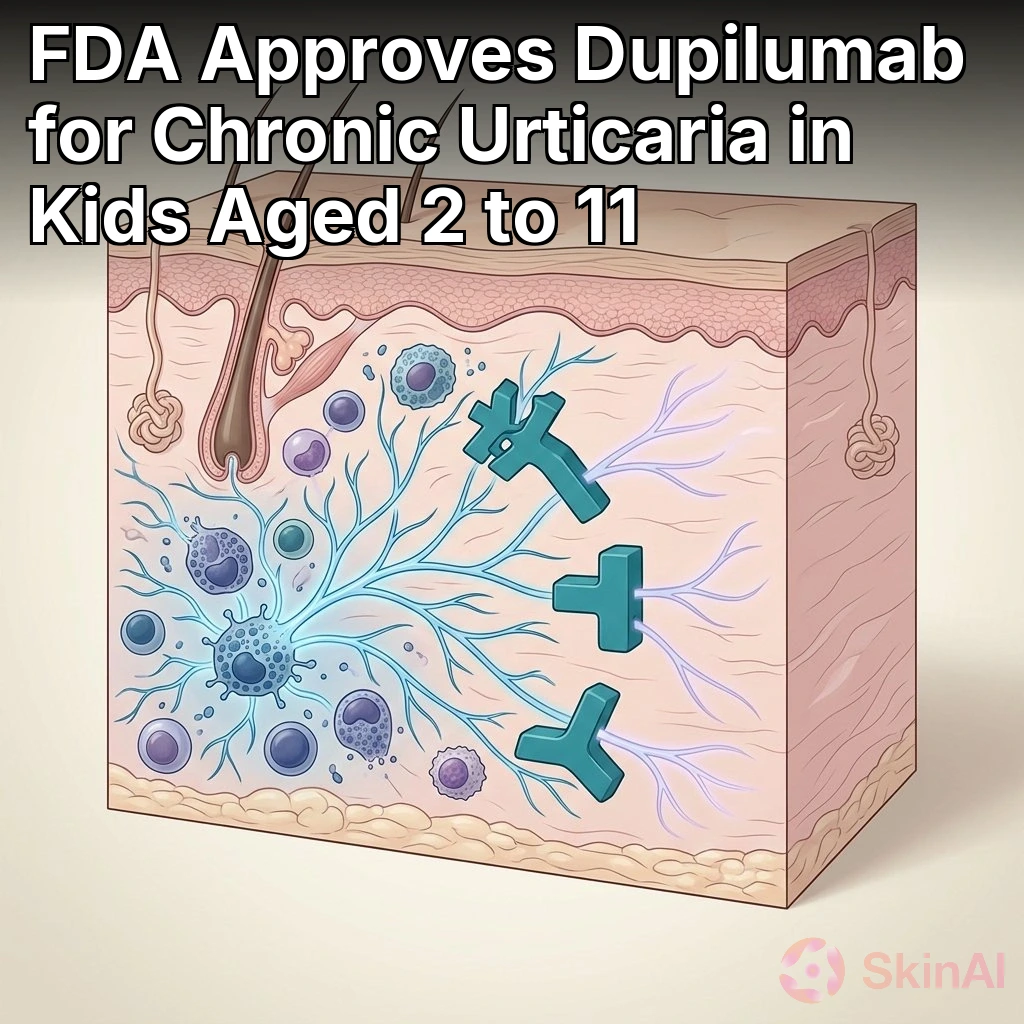
Dupilumab works differently: it blocks signaling of the cytokines IL-4 and IL-13, which are central to type 2 inflammation — the same immune pathway implicated in conditions such as atopic dermatitis and asthma. Because it acts upstream of histamine release, it targets a root inflammatory pathway rather than simply reducing itch (Source: Sanofi press release).
How the approval was built: the LIBERTY-CUPID program
The FDA’s decision is based on the phase 3 LIBERTY-CUPID clinical program, a set of four studies testing dupilumab in patients with antihistamine-refractory CSU (Source: Regeneron press release).
The program includes:
- CUPIDKids (pediatric pharmacokinetic and safety study for ages 2–11) (Source: ClinicalTrials.gov, NCT05526521).
- Study A and Study C, which were replicate, double-blind, placebo-controlled trials enrolling patients aged 6 and older who were antihistamine-refractory and had not previously received anti-IgE therapy (Source: Regeneron press release).
- Study B, which provided safety data in patients 12 and older who were inadequate responders to, or intolerant of, anti-IgE therapy (Source: Regeneron press release).
In Studies A and C, dupilumab was evaluated as an add-on therapy to standard-of-care antihistamines over 24 weeks, with dosing based on adult and adolescent schedules adapted for pediatric weights (Source: Regeneron press release).
Key efficacy findings from the adult/adolescent trials
At week 24, patients receiving dupilumab experienced significant reductions in itch severity — the trials’ primary endpoint measured by the weekly Itch Severity Score (ISS7) — and in urticaria activity measured by the UAS7 scale as a key secondary endpoint (Source: Regeneron press release).
Participants on dupilumab were also more likely to reach well-controlled disease (UAS7 ≤6) or complete response (UAS7 = 0) compared with placebo, showing clinically meaningful improvements in both symptoms and overall disease activity (Source: Regeneron press release).
The pediatric data: CUPIDKids and how children were evaluated
For the 2-to-11-year-old group, the single-arm CUPIDKids trial assessed pharmacokinetics, safety, and exploratory efficacy measures to confirm appropriate exposure and tolerability in young children (Source: ClinicalTrials.gov, NCT05526521).
Dosing in CUPIDKids was age- and weight-based, including options such as 200 mg every 2 or 4 weeks or 300 mg every 4 weeks, with or without an initial loading dose, to achieve serum concentrations comparable to those seen in older patients (Source: ClinicalTrials.gov, NCT05526521).
The trial’s primary endpoint focused on serum dupilumab concentrations (including trough levels, Ctrough) at weeks 12 and 24, with efficacy extrapolated from the adult and adolescent randomized trials — a common regulatory approach in pediatric drug development when exposure-response relationships are established (Source: Regeneron press release; ClinicalTrials.gov, NCT05526521).
Safety in this age group was also supported by pediatric experience with dupilumab across other approved indications, where the drug has an established pediatric safety database (Source: Sanofi press release).
Safety profile observed in the trials
Across the four LIBERTY-CUPID trials, the safety findings were consistent with dupilumab’s known profile from other dermatologic and allergic indications (Source: Regeneron press release).
The most commonly reported adverse event was injection site reactions, which occurred at a higher rate in dupilumab-treated patients than in placebo groups in Studies A, B, and C (Source: Regeneron press release).
No new safety signals were identified in children aged 2 to 11 during CUPIDKids, and no age-specific unexpected adverse events were reported in the available data (Source: Sanofi press release; Regeneron press release).
What this means for clinicians and families
For clinicians caring for children whose CSU does not improve with standard H1 antihistamine therapy, this approval provides a biologic option that targets the disease mechanism rather than only temporarily suppressing symptoms (Source: Sanofi press release; Regeneron press release).
Practically, this means some young patients who previously cycled through antihistamines and other symptom-focused measures may now have access to a therapy with demonstrated improvements in itch and hive activity and a well-characterized safety record in pediatric populations (Source: Regeneron press release).
Estimates suggest more than 14,000 US children in the 2–11 age range may be affected by antihistamine-refractory CSU, underscoring the potential public health impact of an approved targeted treatment option for this group (Source: Ensina et al., 2024).
As always, treatment decisions should be individualized: clinicians and families will need to weigh the potential benefits, administration route (subcutaneous injections), dosing schedule, and safety considerations when discussing dupilumab as an option for a particular child (Source: Sanofi press release).
The bigger picture: dupilumab’s expanding role
This approval represents dupilumab’s ninth indication in the US and its fifth that applies to children under 12 years old, reflecting the drug’s expanding footprint across type 2 inflammatory diseases (Source: Sanofi press release).
The pediatric CSU approval has also been implemented in the European Union and a number of other countries, making this a globally relevant change for children with difficult-to-control CSU (Source: Sanofi press release).
For families and pediatric dermatology or allergy clinics, the approval offers a new tool for a challenging condition — one that shifts treatment strategy from symptomatic control to modifying the immune pathway that sustains chronic hives in many patients (Source: Regeneron press release; Sanofi press release).
Sources
- Sanofi press release: “Sanofi and Regeneron’s Dupixent approved in the US as the first biologic medicine for young children with uncontrolled chronic spontaneous urticaria.” Published April 22, 2026. https://www.news.sanofi.us/2026-04-22-Sanofi-and-Regenerons-Dupixent-approved-in-the-US-as-the-first-biologic-medicine-for-young-children-with-uncontrolled-chronic-spontaneous-urticaria (Source: Sanofi press release).
- Regeneron investor release: “Dupixent® (dupilumab) approved in the US as the first biologic medicine for young children with uncontrolled chronic spontaneous urticaria (CSU).” Published April 22, 2026. https://investor.regeneron.com/news-releases/news-release-details/dupixentr-dupilumab-approved-us-first-biologic-medicine-young (Source: Regeneron press release).
- ClinicalTrials.gov: CUPIDKids — NCT05526521. Study of dupilumab in pediatric patients aged 2 to 11 years with chronic spontaneous urticaria (Source: ClinicalTrials.gov, LIBERTY-CUPID program).
- Ensina LF, Brandão LS, Melo ACDB, Antila M, Ben-Shoshan M, Solé D. “Chronic urticaria treatment challenges in children.” Published December 20, 2024. doi:10.1590/1984-0462/2025/43/2024107 (Source: peer-reviewed literature).