
Abrocitinib Offers Rapid Relief for Patients with Itch-Dominant AD
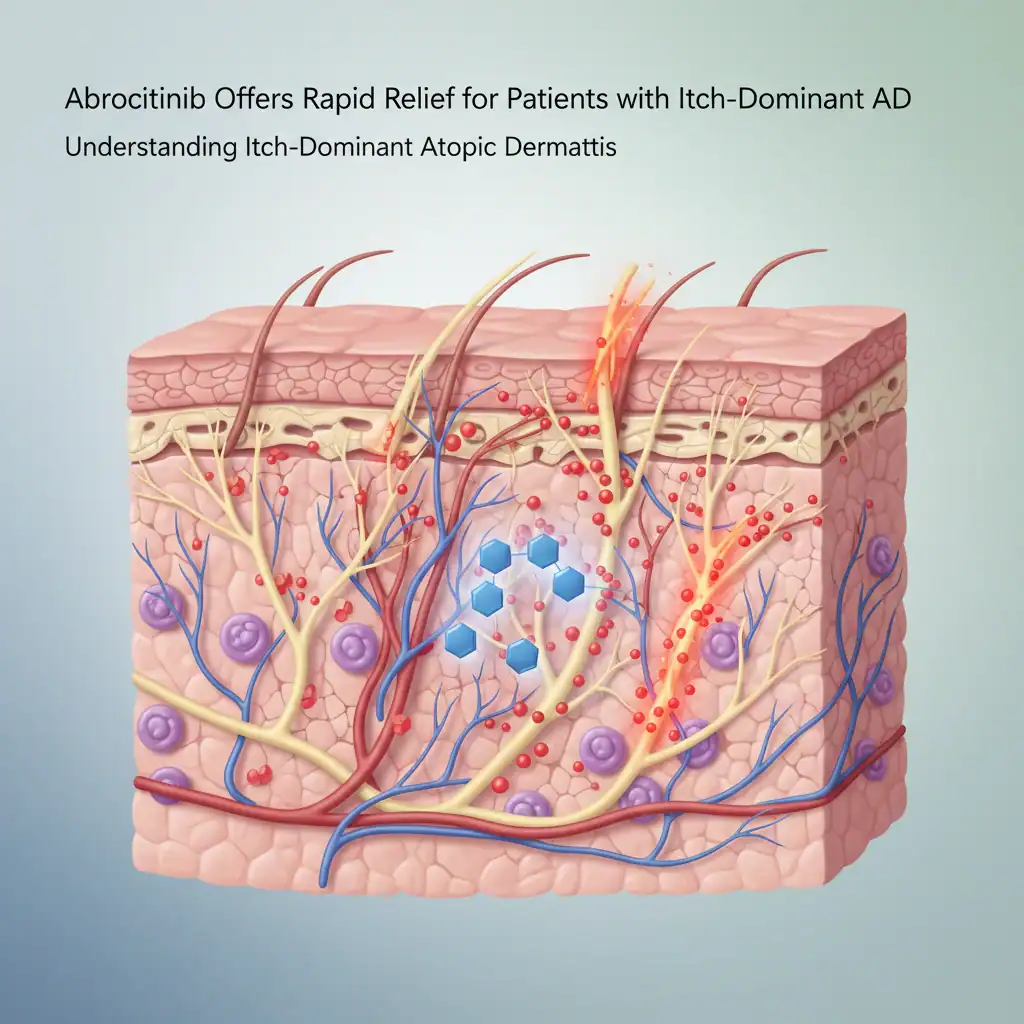
Understanding Itch-Dominant Atopic Dermatitis
While the visible manifestations of atopic dermatitis (AD) often play a significant role in determining disease severity, the most troubling symptom for many patients is the persistent itch. A specific phenotype known as “itch-dominant” AD, characterized by intense itching despite only mild to moderate skin lesions, has been observed in approximately 21% to 29% of patients. This form of AD is closely linked to considerable impairments in quality of life (QoL) (Source: Silverberg et al., 2024). Nevertheless, there has been a lack of robust evidence to guide the selection of systemic therapies for this particular subgroup.
Recent Findings from Clinical Trials
A recent post hoc analysis of the phase 3 JADE DARE and JADE COMPARE trials shed light on the comparative effectiveness of abrocitinib and dupilumab in adults grappling with itch-dominant AD (Source: Silverberg et al., 2026). This analysis focused on adults aged 18 years and older who were administered either oral abrocitinib at a dose of 200 mg once daily or subcutaneous dupilumab at 300 mg every two weeks, with both treatments supplemented by topical therapies over a span of 16 weeks.
Defining Itch-Dominant AD
Itch-dominant AD was identified using two distinct baseline criteria: an Investigator’s Global Assessment (IGA) score of 3 paired with a Peak Pruritus Numerical Rating Scale (PP-NRS) score ranging from 7 to 10, or an Eczema Area and Severity Index (EASI) score between 16 and 21 coupled with a PP-NRS score of 7 to 10. Among the 1194 patients with available data for IGA and PP-NRS, 498 patients (41.7%) met the criteria for itch-dominant AD.
When applying the EASI-based criteria, 279 out of 1190 patients (23.4%) were classified as itch-dominant. The demographic and baseline characteristics were similar across both treatment groups. Notably, the mean baseline PP-NRS scores hovered around 8, indicating severe itch, while mean Dermatology Life Quality Index (DLQI) scores averaged approximately 15, reflecting a significant decline in QoL.
Early Response to Treatment
The early response to treatment clearly distinguished the two therapies. Among patients categorized by the IGA and PP-NRS criteria, 55.7% of those treated with abrocitinib achieved a ≥4-point improvement in PP-NRS (denoted as PP-NRS4) by week 2, compared to just 30.9% of those on dupilumab.
Similar patterns were noted when itch-dominant AD was assessed using EASI criteria. By week 16, the PP-NRS4 response rates were comparable across treatment groups, with 68.1% of abrocitinib patients achieving this outcome versus 66.5% of dupilumab patients. This suggests that the key difference lay in the speed of symptom relief rather than the overall effectiveness.
Higher-Threshold Itch Outcomes
More pronounced differences emerged when evaluating complete or near-complete relief from itch. At the 2-week mark, 17.3% of patients on abrocitinib reported being itch-free (PP-NRS scores of 0 or 1), contrasted with only 2.9% of those on dupilumab.
This trend continued through week 16, where 35.3% of patients on abrocitinib achieved PP-NRS scores of 0 or 1, compared to 20.9% of dupilumab recipients. Comparable trends were also noted in the EASI-defined itch-dominant subgroup.
Quality of Life Enhancements
Improvements in quality of life aligned closely with reductions in itch severity. At week 2, 21.2% of patients receiving abrocitinib reached a DLQI score of less than 2 (indicating minimal impact of skin disease on their daily lives), while only 6.3% of those treated with dupilumab achieved similar results.
By week 16, these rates rose to 37.9% for abrocitinib and 23.8% for dupilumab. These findings remained consistent, irrespective of the criteria used to define lesion severity.
Statistical Considerations
Differences in treatment efficacy were analyzed using Cochran–Mantel–Haenszel weighting to account for variations across the JADE DARE and JADE COMPARE studies.
When evaluated separately, both trials exhibited consistent directional findings, reinforcing the robustness of the results.
Clinical Implications
In adults suffering from itch-dominant AD, the combination of abrocitinib 200 mg and topical therapy demonstrated the following advantages:
- More rapid relief of itch
- Increased likelihood of achieving an itch-free state
- Earlier and sustained improvements in quality of life
By week 16, overall PP-NRS4 response rates were similar between both treatments; however, higher-threshold itch relief and QoL outcomes consistently favored abrocitinib.
Limitations and Future Directions
As a post hoc analysis, these findings should be interpreted with caution. The definition of the itch-dominant phenotype was retrospective, and the trials were not originally designed to specifically power this subgroup.
Future prospective studies specifically targeting itch-dominant AD are essential to validate these findings and evaluate long-term safety and treatment durability. Additionally, further investigation into the mechanistic differences between JAK1 inhibition and IL-4/IL-13 pathway blockade may illuminate which patients stand to gain the most from each therapeutic approach.
Sources
- Silverberg JI, Thyssen JP, Lazariciu I, Myers DE, Güler E, Chovatiya R. Abrocitinib may improve itch and quality of life in patients with itch-dominant atopic dermatitis. Published 2024 May 5.
- Silverberg JI, de Bruin-Weller M, Ortiz de Frutos J, et al. Efficacy of abrocitinib and dupilumab in itch-dominant atopic dermatitis: An analysis of 2 trials. J Eur Acad Dermatol Venereol. Published online February 17, 2026.