
At-Home Dermarollers: Separating Skin Care Facts from Social Media Myths
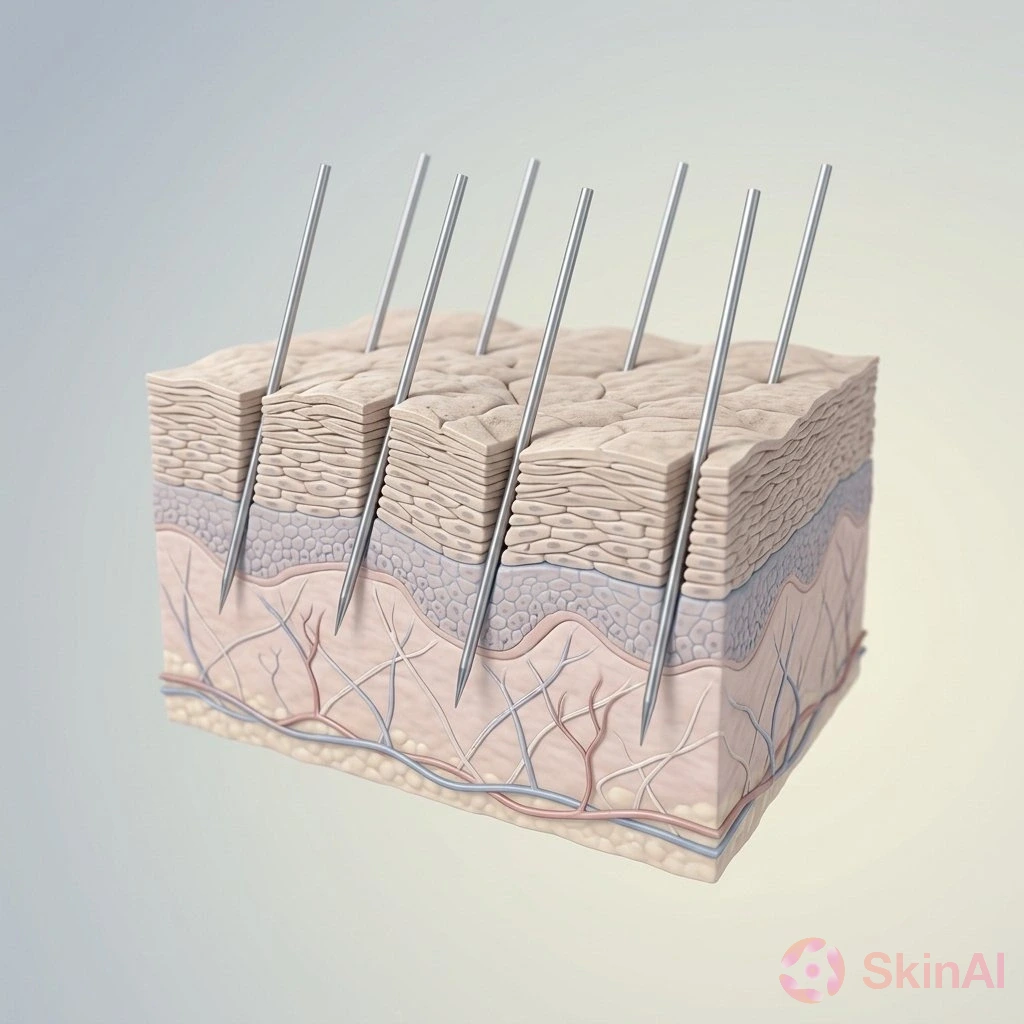
Why people are talking about at-home dermarollers
Short videos and beauty posts have turned small needle rollers into a trendy at-home skin tool. These devices, often called dermarollers, are a handheld cylinder studded with tiny needles. People post before-and-after photos and claim dermarollers can boost collagen, shrink pores, help skincare products absorb better, and soften fine lines or acne scars — all for a fraction of the price of an in-office treatment.
What microneedling actually is
Microneedling is a professional skin treatment that uses controlled tiny punctures to trigger the skin’s wound-healing process. In plain language, those micro-injuries encourage the skin to make new collagen and elastin, which can improve texture and reduce scarring over weeks to months.
That basic idea is well supported by research when the procedure is done in a clinic by trained providers using sterile technique. But there’s an important difference between what happens in a clinic and what happens with cheap home rollers.
Needle length matters
Needle depth is the single most important factor. Clinical studies that show microneedling helps acne scars and texture used needles roughly 0.5 to 3.0 millimeters long. Those lengths reach the parts of the skin where fibroblasts live — the cells that build collagen. (Source: Iosifidis C, Goutos I.)
Most home dermarollers sold online or in stores are in the 0.2 to 0.5 mm range and some are marketed as 1.0 mm or longer. Experts generally consider about 0.25 to 0.5 mm as the upper limit for safe unsupervised home use. Needles at or below that size mainly affect the outermost layer of skin and may help with very mild exfoliation or making creams soak in better, but they don’t reliably reach the deeper skin layer where collagen remodeling happens.
Also keep in mind that the number printed on the package is the maximum possible needle length. How deep the needles actually go depends on how hard you press, the angle, and the area of skin. In a clinic these things are controlled. At home, inconsistency can lead to uneven results or irritation.
What the research shows
Clinical trials and reviews show microneedling done in medical settings can improve atrophic acne scars and skin texture. For example, a systematic review of randomized trials and a more recent meta-analysis found statistically significant improvement in acne scarring with microneedling done at professional settings. (Source: Sitohang IBS et al.; Source: Shen YC et al.) A randomized trial published in JAMA Dermatology also supported the use of a needling device for acne scars. (Source: Alam M et al.)
But important point: those studies were not testing consumer-grade dermarollers or shallow home use. The evidence for clinical benefit applies to devices used at deeper needle lengths, by trained people, with proper sterilization.
Infection and safety concerns with at-home use
Puncturing the skin, even a little, creates a pathway for germs to enter. There are documented infections tied to at-home skin-penetrating devices. A published case reported a Mycobacterium abscessus infection after home use of a cosmetic device; the infection required prolonged antibiotic treatment. Other surveillance data show nontuberculous mycobacteria are increasingly linked to minor cosmetic procedures when sterilization is poor. (Source: Zeng R et al.; Source: Cutaneous Nontuberculous Mycobacteria Infections Following Cosmetic Procedures: A Retrospective Study.)
Many consumer dermarollers are reused, often not sterilized properly between sessions, and sometimes shared between people. Needle tips can retain blood and skin cells. Rinsing with tap water does not remove these risks.
So, is the at-home dermaroller the same as in-office microneedling?
The short answer is no. Microneedling as a medical treatment has solid evidence for certain uses when performed with appropriate needle depths and sterile technique. The idea that a shallow, inexpensive home roller will reproduce those same results at much lower cost and risk is not supported by the research.
Smaller home devices (about 0.25 mm or less) used occasionally to boost exfoliation or help a serum absorb may be relatively low risk. Anything that markets itself as producing true “collagen induction” or deep scar remodeling at home should be viewed with skepticism.
If you’re using or thinking about a dermaroller
- Talk with a dermatologist before starting. They can explain what results are realistic and whether an in-office treatment might be appropriate.
- Check the needle length. Needles longer than about 0.25 to 0.5 mm raise the risk of infection and uneven skin damage when used at home.
- Don’t share a dermaroller with others. Needles can carry blood and skin cells between users.
- Be careful about cleaning. Many home cleaning methods do not fully sterilize needle tips.
- Watch your skin after use. If you notice worsening redness, bumps, pus, or new dark spots, stop using the device and consult a clinician.
When to see a doctor
Contact a healthcare provider promptly if you develop spreading redness, increasing pain, swelling, pus, fever, or any unusual bumps after using a dermaroller. Also see a dermatologist if you get persistent darkening of the skin or other changes that don’t improve. These could be signs of infection or post-inflammatory pigmentation that may need treatment.
Keeping track of changes
Taking regular photos under similar lighting can help you and your dermatologist see how your skin is responding over time. This can be useful if you start a new device or treatment and later need to describe changes.
Quick summary
Professional microneedling can help with acne scarring and texture, but those benefits come from deeper, clinic-based treatments done with sterile technique. Home dermarollers are not the same. Very shallow rollers may help with mild exfoliation and product absorption. Deeper needling, poor sterilization, and inconsistent technique at home increase the chances of infection and uneven results. Talk with a dermatologist before using these devices, and seek medical care for signs of infection.
Disclaimer
This article is for general information and does not replace medical advice. Treatment choices and safety concerns should be discussed with a dermatologist or other qualified healthcare professional. If you have signs of infection or other serious symptoms, seek medical care promptly.
Sources
- Iosifidis C, Goutos I. Percutaneous collagen induction (microneedling) for the management of non-atrophic scars: literature review. 2019;5:2059513119880301. doi:10.1177/2059513119880301 (Source: Iosifidis C, Goutos I.)
- Sitohang IBS, Sirait SAP, Suryanegara J. Microneedling in the treatment of atrophic scars: A systematic review of randomised controlled trials. doi:10.1111/iwj.13559 (Source: Sitohang IBS et al.)
- Shen YC, Chiu WK, Kang YN, Chen C. Microneedling Monotherapy for Acne Scar: Systematic Review and Meta-Analysis of Randomized Controlled Trials. Aesthetic Plast Surg. 2022;46(4):1913-1922. doi:10.1007/s00266-022-02845-3 (Source: Shen YC et al.)
- Alam M, Han S, Pongprutthipan M, et al. Efficacy of a needling device for the treatment of acne scars: a randomized clinical trial. doi:10.1001/jamadermatol.2013.8687 (Source: Alam M et al.)
- Mycobacterium abscessus infection following home dermabrasion. Zeng R, Xiong J, Gao W, et al. Cutaneous Nontuberculous Mycobacteria Infections Following Cosmetic Procedures: A Retrospective Study. Published 2025 May 6. doi:10.2147/IDR.S517138 (Source: Zeng R et al.)