
Barzolvolimab Shows Promising Results in Phase 3 Trials for Chronic Spontaneous Urticaria
New trial results for an experimental drug targeting chronic hives
If you have persistent, unexplained hives (known as chronic spontaneous urticaria or CSU) or swelling under the skin (angioedema), any safe new treatment is welcome news. A drug called barzolvolimab — still experimental — recently showed strong results in two large phase 3 clinical trials, according to the company that ran the studies.
Quick summary
Barzolvolimab is a lab-made antibody that targets a cell receptor called KIT. In two global randomized trials, adults whose hives were not well controlled by standard antihistamines had much larger reductions in a standard symptom score after 12 weeks on barzolvolimab than people who got placebo. The improvements generally continued or got better through 24 weeks. These results come from a company news release and earlier research reports (see Sources).
What is barzolvolimab and how might it work?
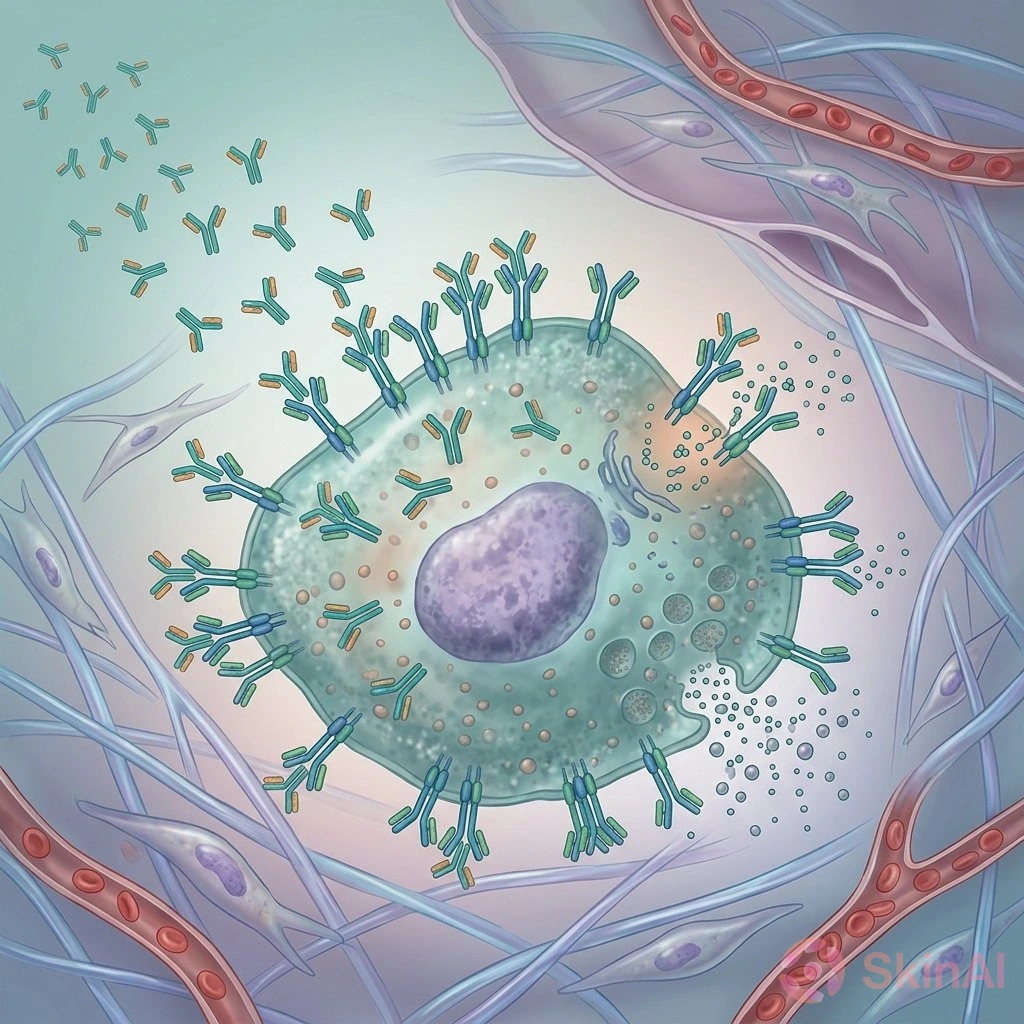
Barzolvolimab is a monoclonal antibody. That means it’s a medicine designed in the lab to attach to a specific protein. It binds to the KIT receptor, which helps mast cells survive and activate. Mast cells are immune cells that release chemicals like histamine and are central to causing hives and swelling. By targeting KIT, barzolvolimab aims to reduce mast cells directly rather than blocking a single triggering molecule. (Source: Celldex press release; Metz et al., J Allergy Clin Immunol.)
About the two phase 3 trials
The two studies are called EMBARQ‑CSU1 and EMBARQ‑CSU2. They were randomized, double-blind, and placebo-controlled — meaning people were randomly assigned to the drug or a placebo, and neither participants nor study staff knew who got which treatment during the controlled period.
Altogether the trials enrolled 1,939 adults with CSU whose symptoms were not adequately controlled by H1 antihistamines. Participants were split evenly into three groups: one group got 150 mg every 4 weeks (after a 300-mg loading dose), a second group got 300 mg every 8 weeks (after a 450-mg loading dose), and the third group got placebo. People on placebo could switch to the active drug at week 24, and active treatment continued through week 52. (Source: Celldex press release.)
How outcomes were measured
Researchers used the UAS7 score, which is a common way to measure weekly hives and itch. Higher UAS7 means worse symptoms. They also tracked how many people reached a complete response (UAS7 = 0, meaning no hives or itch on the weekly score) and whether angioedema completely resolved.
Key results
The company reports that both dose schedules produced much larger drops in average UAS7 at week 12 compared with placebo, and these benefits were sustained or increased by week 24.
In EMBARQ‑CSU1, the average change in UAS7 at week 12 was −20.2 for the 150 mg every-4-weeks group and −20.5 for the 300 mg every-8-weeks group, compared with −10.7 for placebo (P < .00001 for both doses vs placebo). In EMBARQ‑CSU2, the changes were −20.2 and −19.7 versus −11.4 for placebo (P < .00001 for both). (Source: Celldex press release.)
Complete response rates (UAS7 = 0) at week 12 were about 42–46% with barzolvolimab versus under 13% with placebo across the two studies. By week 24, complete response rates rose further — about 45–54% with active treatment versus about 15–18% with placebo. (Source: Celldex press release.)
The trials also included people whose CSU did not respond to omalizumab (an existing advanced therapy). In these omalizumab‑refractory participants, barzolvolimab still produced higher complete response rates than placebo in both studies. (Source: Celldex press release.)
For people who started the studies with angioedema, a majority of those treated with barzolvolimab had complete resolution of angioedema by week 12. Reported rates were about 63–74% with barzolvolimab versus roughly 34% with placebo (P < .00001 for these comparisons). (Source: Celldex press release.)
Safety and side effects
Celldex reports that barzolvolimab was well tolerated through the 24‑week placebo-controlled period, and that the safety profile was consistent with earlier studies. The company has not yet released detailed adverse event rates from the phase 3 program. (Source: Celldex press release.)
From an earlier phase 2 trial, the most common treatment-emergent side effects were hives (10.3%), changes in hair color (9.0%), and neutropenia (a lower white blood cell count; 7.7%). In that smaller study, neutropenia was not linked to infections. (Source: Metz et al., J Allergy Clin Immunol.)
What this might mean for people with chronic hives
These results suggest barzolvolimab may help a substantial number of people with CSU, including some whose disease did not respond to other advanced treatments. That said, the full study data are not yet published in detail, and these findings come from the company that conducted the trials. Celldex plans to present the full phase 3 data at a medical meeting and to submit a Biologics License Application to the U.S. Food and Drug Administration (FDA) in 2027. (Source: Celldex press release.)
If you have CSU and are interested in new treatments, talk with your dermatologist or allergy specialist. They can help you understand whether clinical trials or future approvals might be relevant for you.
When to see a doctor
-
Talk to a clinician if hives or swelling are frequent, last for weeks, or affect your daily life.
-
Seek immediate care for swelling that affects breathing, the throat, or causes dizziness — these can be emergency signs.
-
Ask your provider about treatment options if standard antihistamines don’t control symptoms.
If you keep track of how your hives or swelling change over time, bring that information to appointments — it can help your doctor decide on the best next steps.
Disclaimer
This article summarizes trial results reported by the company and a published phase 2 study. It is not medical advice. Treatment decisions should be made with your doctor or dermatologist. For sudden or severe symptoms, seek urgent medical care.
Sources
- Celldex announces positive results from phase 3 EMBARQ‑CSU1 and EMBARQ‑CSU2 studies of barzolvolimab which met primary and all key secondary endpoints. Accessed September 22, 2026. (Source: Celldex press release)
- Metz M, Mitha E, Leflein J, et al. Randomized dose‑finding study of anti‑KIT barzolvolimab in patients with chronic spontaneous urticaria. J Allergy Clin Immunol. Published online February 24, 2026. doi:10.1016/j.jaci.2026.02.018 (Source: J Allergy Clin Immunol)