
Upadacitinib Shows Promising Repigmentation Results in Vitiligo Phase 3 Trials
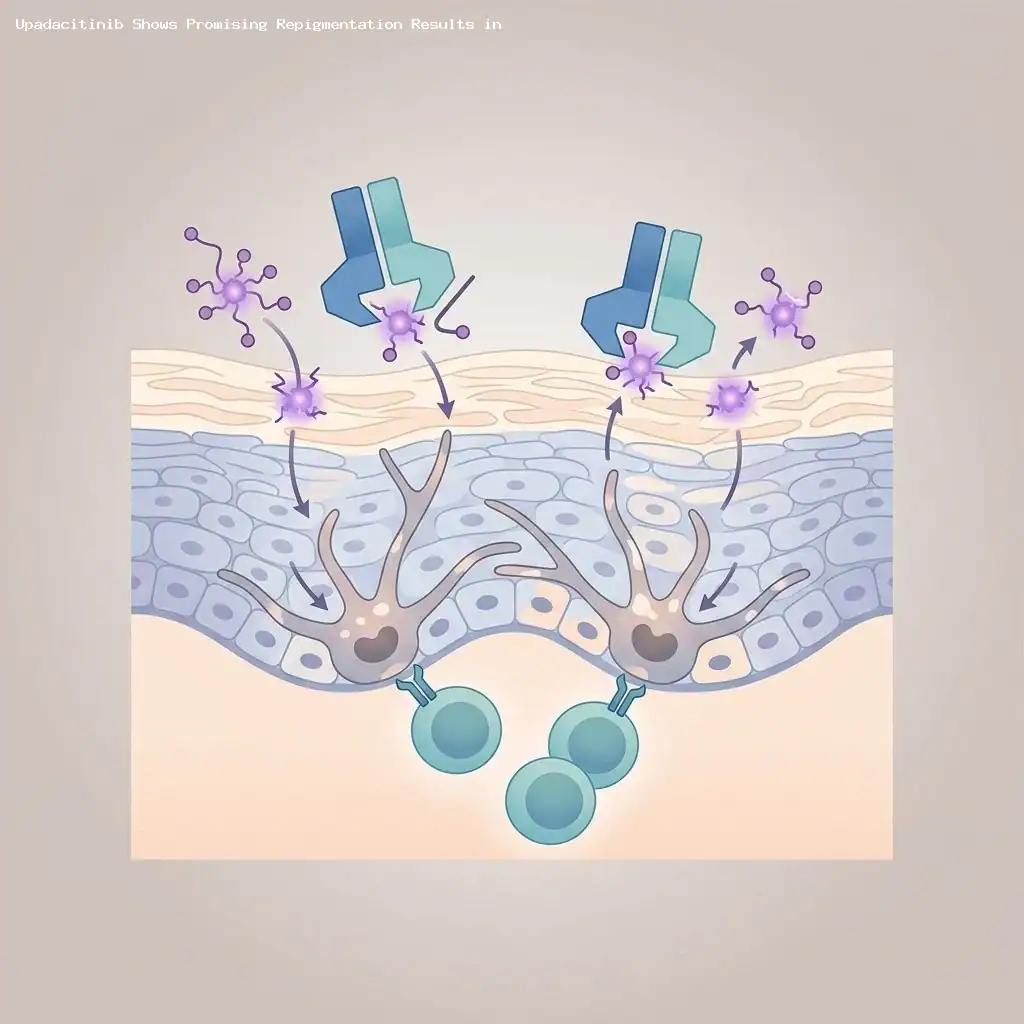
New Phase 3 Data: Upadacitinib Shows Benefit in Non‑Segmental Vitiligo
At the 2026 American Academy of Dermatology Annual Meeting in Denver, investigators unveiled new late‑breaking results from two large phase 3 trials testing upadacitinib (brand name Rinvoq, AbbVie) for non‑segmental vitiligo (NSV). (Source: American Academy of Dermatology, Passeron et al presentation)
Why these trials mattered
Although vitiligo can profoundly affect quality of life, there are currently no approved systemic oral therapies specifically for NSV, leaving a major treatment gap for people with extensive or progressive disease. (Source: American Academy of Dermatology, Passeron et al presentation)
The twin trials—named Viti‑Up‑1 and Viti‑Up‑2—were designed to address that gap by testing whether daily oral JAK1 inhibition with upadacitinib could reverse depigmentation and control disease activity. (Source: ClinicalTrials.gov, NCT06118411)
Who was studied and how the trials were run
Combined, the two studies enrolled 614 participants: adolescents and adults aged 12 years and older, treated at 134 sites across 18 countries. (Source: ClinicalTrials.gov, NCT06118411)
Participants were randomized in a 2:1 ratio to receive upadacitinib 15 mg once daily or placebo for a 48‑week double‑blind period, followed by a planned 112‑week open‑label extension to evaluate longer‑term effects. (Source: ClinicalTrials.gov, NCT06118411)
Primary and secondary results
Co‑primary endpoints met with statistical significance
The studies used two co‑primary measures: a 50% improvement in total body vitiligo area (T‑VASI 50) and a 75% improvement in facial vitiligo (F‑VASI 75) at week 48.
In Viti‑Up‑1, T‑VASI 50 was achieved by 19.4% of patients on upadacitinib versus 5.9% on placebo (P ≤ 0.001). The facial endpoint, F‑VASI 75, was reached by 25.2% of upadacitinib‑treated patients versus 5.9% on placebo (P ≤ 0.001). (Source: American Academy of Dermatology, Passeron et al presentation)
Viti‑Up‑2 produced nearly identical outcomes: T‑VASI 50 in 21.5% of upadacitinib patients versus 5.9% placebo, and F‑VASI 75 in 23.4% versus 6.9% (both P ≤ 0.001). (Source: American Academy of Dermatology, Passeron et al presentation)
Responses continued to deepen over time
Investigators emphasized that responses did not plateau by week 48; instead, improvements continued to accrue across the observation period, a clinically meaningful finding for a condition that often requires prolonged therapy. (Source: American Academy of Dermatology, Passeron et al presentation)
Secondary facial outcomes
Secondary endpoints reinforced facial benefit: roughly 48% of patients on upadacitinib achieved F‑VASI 50 at week 48 across both trials. (Source: American Academy of Dermatology, Passeron et al presentation)
A smaller subset—about 12% to 15%—reached the more stringent F‑VASI 90 threshold by week 48, indicating substantial repigmentation for some participants. (Source: American Academy of Dermatology, Passeron et al presentation)
Effect on active, progressing disease
The trials also looked specifically at patients who had signs of actively spreading vitiligo at baseline—features such as confetti‑like depigmentation, koebnerization, or trichrome patterns.
In that subgroup, upadacitinib demonstrated a meaningful ability to halt further spread: about 76% of treated patients showed no increase in T‑VASI at weeks 8 and 12, compared with roughly 61% on placebo. These differences reached statistical significance (P = 0.025 in Viti‑Up‑1; P = 0.042 in Viti‑Up‑2). (Source: American Academy of Dermatology, Passeron et al presentation)
Safety findings through 48 weeks
Safety through week 48 was consistent with the established safety profile of upadacitinib used in other dermatologic and rheumatologic conditions. (Source: AbbVie, upadacitinib prescribing information)
The most commonly reported treatment‑emergent adverse events included upper respiratory tract infection, acne, nasopharyngitis, and headache. (Source: American Academy of Dermatology, Passeron et al presentation)
Importantly, there were no reported cases of adjudicated major adverse cardiovascular events (MACE), venous thromboembolic events (VTE), gastrointestinal perforation, active tuberculosis, lymphoma, or non‑melanoma skin cancer in either study through 48 weeks. (Source: American Academy of Dermatology, Passeron et al presentation)
Reports of herpes zoster were uncommon but present: 2.0% and 1.5% of upadacitinib‑treated patients across the two trials, respectively. Investigators noted these events and will continue to monitor infections during the open‑label extension. (Source: American Academy of Dermatology, Passeron et al presentation)
What this means for people with vitiligo
The Viti‑Up program provides the first robust phase 3 evidence that a systemic oral JAK1 inhibitor can produce measurable repigmentation and help stabilize disease activity in NSV. (Source: American Academy of Dermatology, Passeron et al presentation)
The relatively stronger facial responses are clinically important because face involvement often has outsized social and psychological impact; facial repigmentation can therefore translate into meaningful quality‑of‑life gains for patients. (Source: American Academy of Dermatology, Passeron et al presentation)
The lack of a response plateau at 48 weeks raises the possibility of continued benefit with longer treatment, which the ongoing 112‑week open‑label extension is intended to investigate. This extension will also provide additional safety data over a longer period. (Source: ClinicalTrials.gov, NCT06118411)
Takeaway for clinicians and patients
For clinicians, the Viti‑Up data offer a potential new systemic option to consider for patients with extensive or progressive NSV, pending regulatory decisions and guidance on patient selection. (Source: American Academy of Dermatology, Passeron et al presentation)
For patients, these results are an important sign that oral therapies targeting the JAK pathway may change the treatment landscape for vitiligo—but as with any systemic immunomodulatory therapy, careful discussion of benefits, risks, and monitoring is essential. (Source: AbbVie, upadacitinib prescribing information)
Sources
- American Academy of Dermatology. Passeron T, Prajapati V, Sivamani R, et al. “Efficacy and safety of upadacitinib in adolescents and adults for treatment of non‑segmental vitiligo: results of two phase 3 studies (Viti‑Up).” Presented at: AAD Annual Meeting; March 27–31, 2026; Denver, CO. (Source: American Academy of Dermatology)
- ClinicalTrials.gov. Study: A study to assess adverse events and effectiveness of upadacitinib oral tablets in adult and adolescent participants with vitiligo (Viti‑Up). Identifier: NCT06118411. Updated November 2025. Accessed April 10, 2026. (Source: ClinicalTrials.gov, NCT06118411)
- AbbVie. Upadacitinib (Rinvoq) prescribing information and safety profile. (Source: AbbVie)