
Does Castor Oil Really Boost Hair Growth? Debunking the Social Media Claims
Can castor oil make your hair grow? What the evidence really says
On social media, castor oil is often shown as a simple, natural fix for thinning hair, sparse brows, or slow growth. People rub the thick oil into their scalp or mix it with other oils and say regular use makes hair thicker, shinier, or longer. But how much of that is real, and how much is just good lighting and a viral video?
This article walks through what castor oil is, why some scientists think it could help, what the actual research shows, and when to talk to a clinician about hair loss.
What is castor oil and how do people use it?
Castor oil comes from the seeds of the Ricinus communis plant. One of its main components is ricinoleic acid, a fatty acid that has been studied for anti-inflammatory and other effects.
People have used oils on hair for a long time. Oiling hair is part of cultural practices in many places, especially in parts of Africa and India, where oils help moisturize hair, reduce breakage, and make hair easier to manage (Source: Mysore V, Arghya A. Hair oils: indigenous knowledge revisited).
Why some people think castor oil could help hair grow
There are a few reasons castor oil looks promising on paper. First, it coats the hair shaft. That can make hair look shinier and smoother, which makes it appear healthier or fuller even if no new hair is growing.
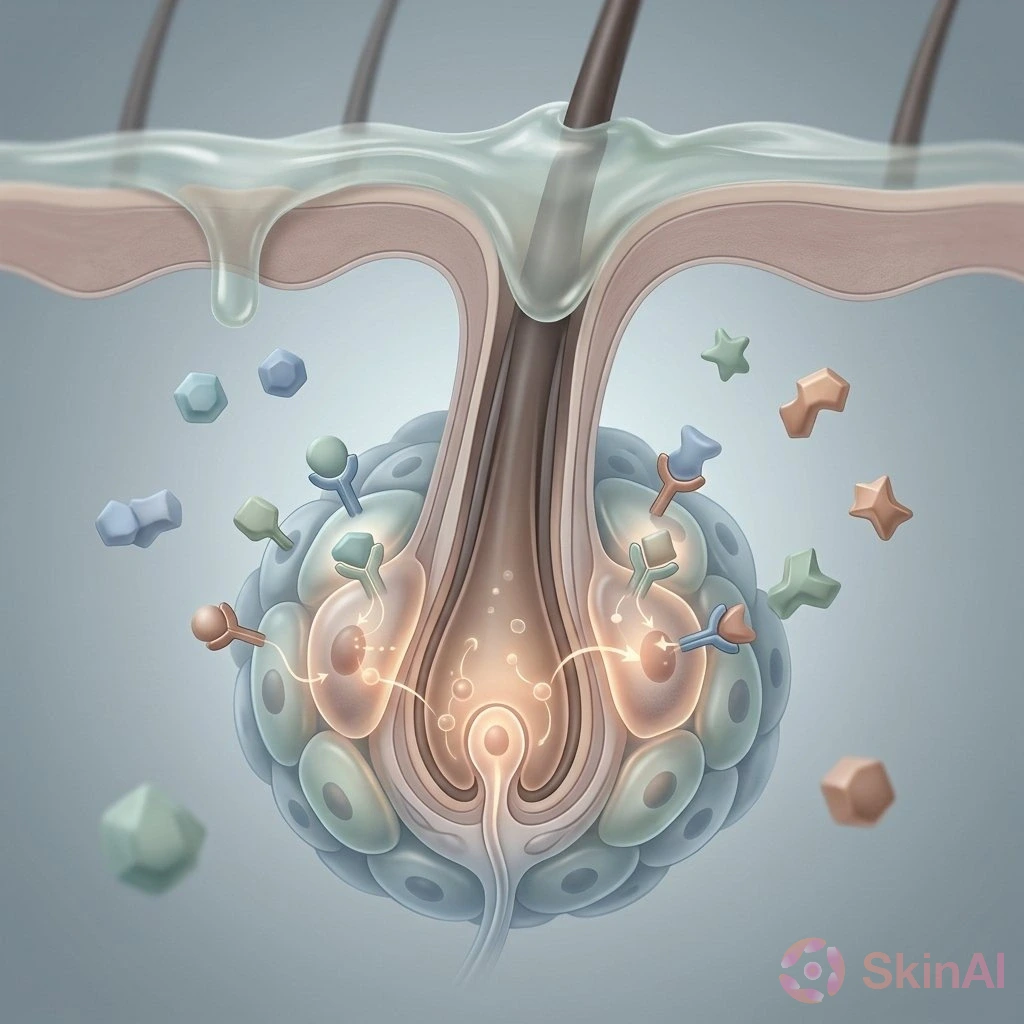
Second, laboratory research has suggested ricinoleic acid may affect a biochemical pathway linked to a common type of hair loss called androgenetic alopecia, sometimes called male- or female-pattern hair loss. A substance called prostaglandin D2, or PGD2, has been found at higher levels in balding scalp, and some lab studies suggest ricinoleic acid might reduce the activity of the enzyme that makes PGD2. That gives a theoretical reason castor oil could influence hair loss (Source: Girdler K, Cabatu A, Olds H, Potts GA. Use of castor oil in dermatology: a narrative review).
What does the research actually show?
The short answer is: mixed. The longer answer is more helpful.
A 2022 systematic review looked at studies of coconut, castor, and argan oils for hair growth and hair quality. For castor oil, the review found limited evidence that it improves hair quality and shine, but it did not find strong proof that castor oil makes new hair grow or meaningfully increases hair density (Source: Phong C, Lee V, Yale K, Sung C, Mesinkovska N. Coconut, castor, and argan oil for hair in skin of color patients: a systematic review).
A later dermatology review noted some intriguing lab findings about ricinoleic acid and the PGD2 pathway, which makes castor oil an interesting candidate for more study. However, the review also stressed that a plausible mechanism seen in the lab is not the same as proof that a treatment works in people. We still need well-designed clinical trials to know whether topical castor oil actually stimulates hair regrowth in humans (Source: Girdler K, Cabatu A, Olds H, Potts GA. Use of castor oil in dermatology: a narrative review).
So what can castor oil realistically do?
Based on current evidence, castor oil may:
-
Coat and smooth the hair shaft, making hair look shinier and sometimes fuller.
-
Help with manageability and reduce the appearance of dryness or split ends when used as part of a hair-care routine.
But castor oil is not proven to trigger new hair growth or reverse pattern hair loss. The idea that it regrows hair comes mostly from lab studies and social media stories, not from strong clinical trials in people (Source: Phong et al.; Girdler et al.).
Safety and side effects
Castor oil is generally well tolerated when applied to the skin or scalp, but “natural” does not always mean risk-free.
Some people can develop contact dermatitis, which is skin irritation or a rash. A rare but reported problem is “hair felting,” where hair becomes severely matted or tangled. Because castor oil is very thick, it may increase that risk for some hair types.
How to think about castor oil if you’re considering trying it
If you enjoy using castor oil as part of your hair routine because it makes your hair softer or shinier, that’s a reasonable cosmetic choice. Just keep a few points in mind:
-
Appearance versus growth: Improvements in shine or thickness of the hair shaft do not mean new follicles are producing hair.
-
Evidence is limited: There is not strong clinical proof that topical castor oil causes meaningful hair regrowth in humans, even though lab studies give a reason to study it further (Source: Girdler et al.; Phong et al.).
-
Watch for irritation: Stop use and see a clinician if you get redness, itching, or a rash where you applied the oil.
-
Don’t let a viral hack delay care: If you have ongoing thinning, patchy hair loss, or noticeable shedding, it’s a good idea to get evaluated rather than relying only on at-home remedies.
When to see a doctor
Talk to a primary care doctor or dermatologist if you have:
-
Rapid or patchy hair loss.
-
Sudden, heavy shedding.
-
Scalp symptoms such as pain, bleeding, pus, or severe itching.
-
Concerns about hair thinning that affect your confidence or daily life.
A medical evaluation can help find the underlying cause and discuss evidence-based treatment options if needed.
The bottom line
Castor oil can make hair look shinier and might improve how existing hair feels and behaves. Laboratory research suggests one of its components could, in theory, affect a pathway linked to pattern hair loss, but that has not yet translated into strong proof that castor oil grows new hair. If you like using castor oil as a cosmetic treatment, that’s fine, but don’t assume it’s a medically proven cure for hair loss. For persistent or worrying hair changes, see a clinician.
This article is for general information and does not replace medical advice. Talk with a doctor or dermatologist for personalized guidance.
Sources
- Girdler K, Cabatu A, Olds H, Potts GA. Use of castor oil in dermatology: a narrative review. doi:10.7759/cureus.103289.
- Phong C, Lee V, Yale K, Sung C, Mesinkovska N. Coconut, castor, and argan oil for hair in skin of color patients: a systematic review. doi:10.36849/JDD.6972.
- Mysore V, Arghya A. Hair oils: indigenous knowledge revisited. doi:10.4103/ijt.ijt_189_20.