
New Study Reveals Overlapping Health Risks in Eczema and Psoriasis Patients
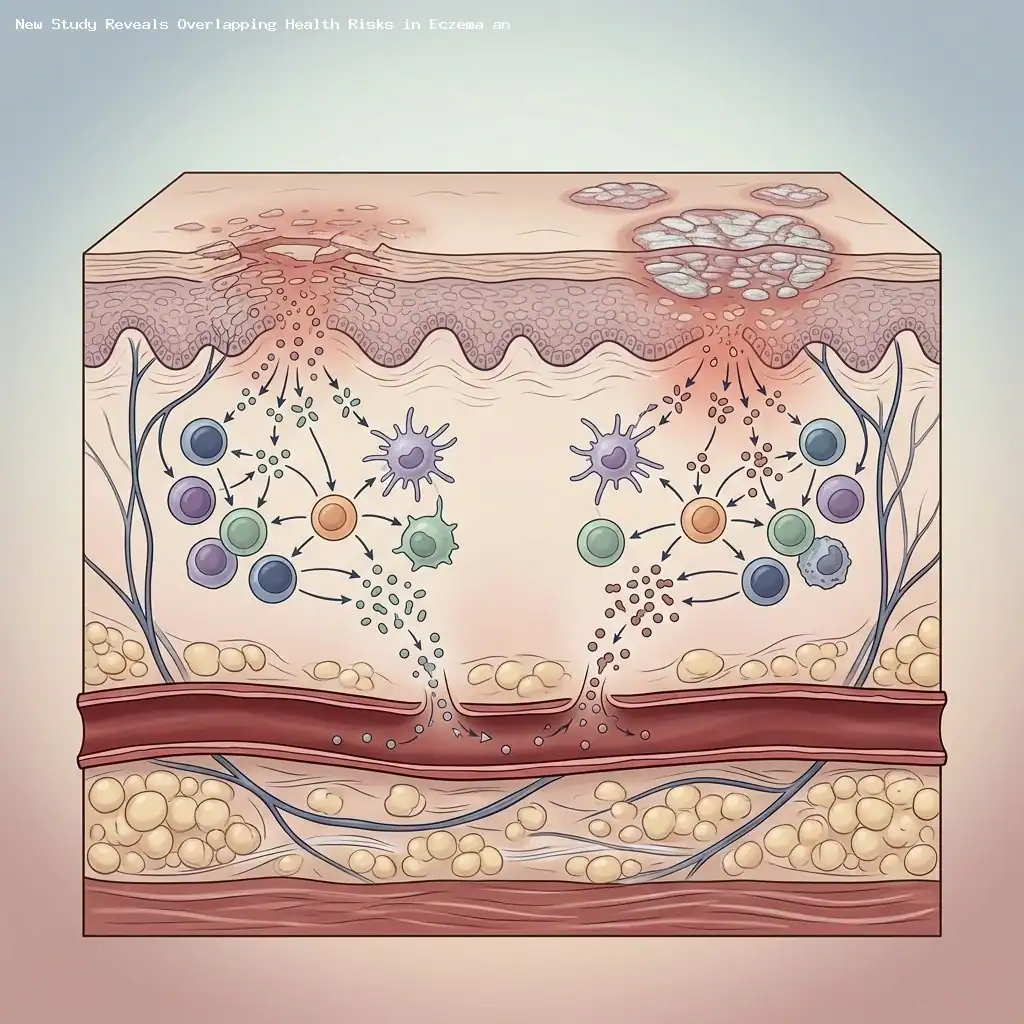
New large-scale US data show major systemic burden in eczema and psoriasis — and important care gaps
The 2026 American Academy of Dermatology Annual Meeting featured new real-world data that shine a spotlight on how much more than skin disease both eczema and psoriasis can be for many people.
Investigators used the National Institutes of Health All of Us Research Program to compare these two common inflammatory skin conditions across a large, diverse sample of US adults (Source: NIH All of Us Research Program, Harikrishnan et al., AAD 2026 poster).
Study design and who was included
The analysis was a cross-sectional snapshot that included 623,464 participants from the All of Us database (Source: NIH All of Us Research Program, Harikrishnan et al., AAD 2026 poster).
Within that cohort, investigators identified 10,449 people with eczema and 5,614 people with psoriasis, and used a lymphoma group (n = 2,841) as a reference population for some comparisons (Source: NIH All of Us Research Program, Harikrishnan et al., AAD 2026 poster).
The team looked at a broad set of variables: demographic and behavioral characteristics and clinical comorbidities such as cardiometabolic disease, depression, respiratory conditions, smoking history, and exposure to systemic prednisone (Source: NIH All of Us Research Program, Harikrishnan et al., AAD 2026 poster).
Both conditions carry a heavy comorbidity burden
Consistent with the evolving understanding that many chronic inflammatory skin disorders have systemic effects, both the eczema and psoriasis groups showed substantial burdens of other diseases and conditions (Source: NIH All of Us Research Program, Harikrishnan et al., AAD 2026 poster).
Rates of obesity were strikingly high in both groups: 43.9% of the eczema cohort and 46.5% of the psoriasis cohort met criteria for obesity (Source: NIH All of Us Research Program, Harikrishnan et al., AAD 2026 poster).
Mental health symptoms were also common. Nearly half of each group had documentation of depression—47.1% in the eczema group and 45.6% in the psoriasis group—far above the approximately 28–29% seen in the lymphoma reference cohort (Source: NIH All of Us Research Program, Harikrishnan et al., AAD 2026 poster).
These findings echo previous population research showing links between chronic inflammatory skin disease and both metabolic dysfunction and psychiatric comorbidity, and they suggest that mental health needs may be underrecognized in dermatology care (Source: Schonmann et al., J Allergy Clin Immunol Pract. 2020).
Psoriasis shows a stronger cardiometabolic and behavioral risk signal
Although both conditions were associated with systemic disease, the analysis found a clearer cardiometabolic risk profile among people with psoriasis (Source: NIH All of Us Research Program, Harikrishnan et al., AAD 2026 poster).
For example, documented history of myocardial infarction was higher in psoriasis (8.6%) than in eczema (7.1%), and rates of stroke were 0.6% in psoriasis versus 0.3% in eczema (Source: NIH All of Us Research Program, Harikrishnan et al., AAD 2026 poster).
Smoking history was more common in the psoriasis group (42.4%) compared with the eczema group (34.9%), a behavioral risk factor that can further increase cardiovascular risk and that highlights opportunities for integrated counseling in dermatology settings (Source: NIH All of Us Research Program, Harikrishnan et al., AAD 2026 poster).
Respiratory disease overlap challenges classic immune-pathway distinctions
An unexpected result was the similar prevalence of respiratory comorbidity: asthma was present in 34.6% of those with eczema and 32.1% of those with psoriasis (Source: NIH All of Us Research Program, Harikrishnan et al., AAD 2026 poster).
This observation challenges simple models that categorize eczema as purely Th2-driven and psoriasis as Th1/Th17-driven, and it may reflect shared inflammatory pathways, diagnostic overlap in real-world records, environmental or behavioral factors, or a mix of these contributors (Source: NIH All of Us Research Program, Harikrishnan et al., AAD 2026 poster).
Clinically, the finding supports being alert to respiratory comorbidities in patients with either condition rather than assuming risk based solely on classic immunologic labels.
Cognitive symptoms and quality-of-life signals
Beyond traditional comorbidities, investigators noted that a measurable share of patients reported trouble concentrating—between 6.8% and 8.1% depending on the group (Source: NIH All of Us Research Program, Harikrishnan et al., AAD 2026 poster).
While the dataset doesn’t fully characterize the cause of concentration difficulties, this signal raises concern about possible neurocognitive impacts, medication effects, sleep disturbance, pain, or broader quality-of-life consequences that clinicians may not routinely screen for.
Widespread systemic corticosteroid exposure
One of the most actionable and concerning findings was the high prevalence of systemic prednisone exposure: roughly one-third of patients in both groups had received systemic corticosteroids (Source: NIH All of Us Research Program, Harikrishnan et al., AAD 2026 poster).
Long-term or repeated systemic corticosteroid use carries well-known risks, and in the case of psoriasis there is specific concern about disease rebound or severe flare after withdrawal, which is why current guidelines favor steroid-sparing strategies when treating chronic inflammatory skin disease (Source: NIH All of Us Research Program, Harikrishnan et al., AAD 2026 poster).
The authors caution that the dataset cannot reliably determine the reason prednisone was prescribed — prescriptions may have been for non-dermatologic conditions — but the high exposure nonetheless points to potential gaps in guideline-concordant care.
Practical implications for clinicians
Taken together, these results support thinking about eczema and psoriasis as conditions that often require care beyond topical treatments, with attention to the whole person rather than only the skin (Source: NIH All of Us Research Program, Harikrishnan et al., AAD 2026 poster).
Routine screening for obesity and depression in patients with either condition appears warranted based on the high rates observed in this study (Source: NIH All of Us Research Program, Harikrishnan et al., AAD 2026 poster).
Patients with psoriasis may particularly benefit from proactive cardiovascular risk assessment, including measurement of blood pressure, fasting or nonfasting lipid profiles, and careful documentation and counseling around smoking status (Source: NIH All of Us Research Program, Harikrishnan et al., AAD 2026 poster).
The high prevalence of depression across both conditions also supports implementing structured mental health screening (for example, brief validated questionnaires) and clear referral pathways so patients can access appropriate care (Source: Schonmann et al., J Allergy Clin Immunol Pract. 2020; NIH All of Us Research Program, Harikrishnan et al., AAD 2026 poster).
The frequent systemic corticosteroid exposure identified presents an opportunity to reinforce guideline-based care, including consideration of steroid-sparing systemic therapies and greater access to biologic options where clinically appropriate.
Study limitations and what they mean
Because this was a cross-sectional analysis, it cannot establish cause-and-effect or determine whether the skin disease preceded the comorbidities or vice versa (Source: NIH All of Us Research Program, Harikrishnan et al., AAD 2026 poster).
Real-world data, including electronic health records used in All of Us, can vary in how diagnoses are recorded and coded, which may introduce misclassification or under- and over-reporting of some conditions (Source: NIH All of Us Research Program, Harikrishnan et al., AAD 2026 poster).
The study also could not reliably determine the clinical indication for medications such as prednisone, so some corticosteroid use may have been for other medical problems rather than for eczema or psoriasis specifically (Source: NIH All of Us Research Program, Harikrishnan et al., AAD 2026 poster).
Despite these caveats, the size and diversity of the All of Us cohort provide useful, real-world insight into disease burden across populations that have historically been underrepresented in clinical research (Source: NIH All of Us Research Program, Harikrishnan et al., AAD 2026 poster).
Conclusions
This analysis reinforces the idea that both eczema and psoriasis are often systemic conditions with substantial physical and mental health consequences beyond visible skin findings (Source: NIH All of Us Research Program, Harikrishnan et al., AAD 2026 poster).
While psoriasis in this dataset showed a stronger cardiometabolic risk profile, both disease groups shared high rates of depression, obesity, respiratory comorbidity, and meaningful exposure to systemic corticosteroids, all of which point to gaps in comprehensive care (Source: NIH All of Us Research Program, Harikrishnan et al., AAD 2026 poster).
The practical takeaway for clinicians is to adopt more integrated, multidisciplinary approaches: screen routinely for metabolic and mental health concerns, incorporate cardiovascular risk assessment (especially for psoriasis), and prioritize steroid-sparing strategies where possible.
Sources
- Harikrishnan N, Chen E, Wisco O. Systemic burdens and care gaps in eczema and psoriasis: insights from the NIH All of Us Research Program. Poster presented at: 2026 American Academy of Dermatology Annual Meeting; March 27–31, 2026; Denver, Colorado. Poster PDF: https://eposters.aad.org/s3/AM2026/poster/75276/Systemic+Burdens+and+Care+Gaps+in+Eczema+and+Psoriasis+Insights+from+the+NIH+All+of+Us+Research+Program.pdf (Source: NIH All of Us Research Program, Harikrishnan et al., AAD 2026 poster).
- All of Us Research Program. National Institutes of Health. https://allofus.nih.gov (Source: NIH All of Us Research Program).
- Schonmann Y, Mansfield KE, Hayes JF, et al. Atopic eczema in adulthood and risk of depression and anxiety: a population-based cohort study. J Allergy Clin Immunol Pract. 2020;8(1):248-257.e16. doi:10.1016/j.jaip.2019.08.030 (Source: J Allergy Clin Immunol Pract, Schonmann et al. 2020).