
Vitiligo (ICD-10: L80) ⚠️
Vitiligo: Loss of Skin Pigment in Well-Defined Patches
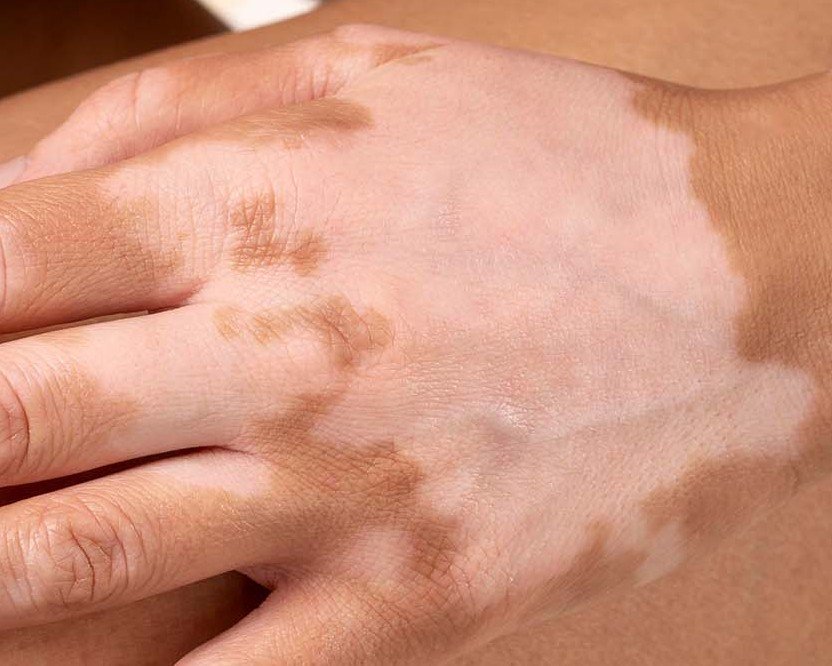
Vitiligo is a long-term condition in which the skin loses its pigment in patches. It happens because melanocytes — the cells that make melanin — are lost or stop working, through an immune-mediated process, and the result is areas of skin that are milky white, sharply outlined and otherwise completely normal to the touch. The patches do not itch, hurt or scale.
It affects roughly half a per cent to one per cent of people worldwide, in every population and every skin tone, and men and women equally. About half of those affected notice the first patch before the age of twenty. Vitiligo is not contagious, it is not caused by diet, and nothing a person did brought it on.
The evidence points to an autoimmune process: the immune system attacks the pigment cells. That is why vitiligo keeps company with other autoimmune conditions, and why treatments that calm the immune response have a central place. They are not the only ones that help — phototherapy and surgical grafting work through different mechanisms. Grafting is reserved for carefully selected cases: vitiligo that has been stable for a period, and that has not responded adequately to medical treatment. Stability is judged clinically, by watching the patches over time, rather than inferred from the pattern of disease.
The Two Main Patterns
The distinction matters, because the two behave differently and are treated differently.
- Non-segmental vitiligo, by far the more common. Patches usually appear on both sides of the body, often but not always in a roughly symmetrical pattern, typically around the eyes and mouth, on the hands and wrists, the elbows, knees, feet and genitals. It tends to progress in unpredictable episodes over years, with periods of stability in between.
- Segmental vitiligo, less common. Patches are usually confined to one side of the body, often in a band-like area, though more than one segment may be involved. It typically begins earlier in life, spreads over a limited period and then settles, and tends to be more stable afterwards — which is why it is the form most often considered for surgery. Stability still has to be documented rather than assumed from the pattern.
Predisposing Factors: What Is Associated with Vitiligo
- Autoimmune disease: Autoimmune thyroid disease is the association reported most consistently, and thyroid assessment is commonly considered — particularly where there are symptoms, a family history or other autoimmune features. Guidelines differ on whether everyone should be tested. Type 1 diabetes, alopecia areata, pernicious anaemia and Addison’s disease also occur more often than expected, but these are associations rather than conditions every symptom-free patient is screened for.
- Family history: Around one person in five has an affected relative, but vitiligo is not inherited in a simple pattern and most children of affected parents never develop it.
- Skin injury: New patches may appear at sites of cuts, burns, friction or sunburn. This is called the Koebner phenomenon and it is a reason to protect the skin from avoidable trauma.
- Chemical exposure: Certain phenolic compounds, found in some industrial settings and occasionally in hair dyes and adhesives, can trigger depigmentation in susceptible people.
- Stress: Frequently reported by patients as preceding a flare, though the relationship is difficult to study and should not be presented as a cause.
Diagnostics: How Vitiligo Is Diagnosed
The diagnosis is clinical, made from the appearance and distribution of the patches. A Wood’s lamp — an ultraviolet light used in a darkened room — accentuates depigmented skin, which helps distinguish complete pigment loss from partial hypopigmentation, reveals patches that are hard to see in pale skin, and helps map the extent of the condition. It supports the diagnosis rather than proving it.
Blood tests are used to look for associated autoimmune disease rather than to confirm vitiligo itself; thyroid function is the one checked most often. Biopsy is rarely needed and is reserved for cases where another cause of pale patches is genuinely in question.
Symptoms: What Vitiligo Looks Like
- Milky-white patches with a sharp border, most obvious against darker or tanned skin.
- A preference for certain sites: around the eyes, mouth and nostrils, on the fingers and wrists, and over the elbows, knees and ankles.
- A broadly bilateral distribution in the non-segmental form; involvement usually restricted to one side in the segmental form.
- White hair (leukotrichia): Hairs growing within a patch may turn white, including eyelashes, eyebrows and scalp hair.
- Sunburn within the patches, because depigmented skin has lost its melanin protection.
- Few other symptoms: The skin is typically not itchy, scaly, thickened or painful, which helps separate vitiligo from most other causes of pale skin — though itch or inflammation can occur, and another skin condition may be present alongside it.
Differential Diagnosis: Ruling Out Other Conditions
- Pityriasis alba: Faint pale patches with fine scale, usually on the cheeks of children with dry or atopic skin, and never completely depigmented.
- Tinea versicolor: Pale or fawn patches with fine scale on the trunk, caused by a yeast, and confirmed by microscopy. See pityriasis versicolor.
- Post-inflammatory hypopigmentation: Pale areas left behind by eczema, psoriasis or injury; the border is indistinct and the colour usually returns over months, though recovery can be slow or incomplete.
- Idiopathic guttate hypomelanosis: Small scattered white spots on sun-exposed limbs, a common and harmless change with age.
- Halo nevus: A pale ring around a mole, which can occur on its own or alongside vitiligo. See halo nevus.
- Chemical leukoderma: Depigmentation from an identifiable chemical exposure, often starting at the site of contact.
- Leprosy: Considered where the condition is endemic, distinguished by loss of sensation within the patch.
Risks: What Vitiligo Does and Does Not Do
Vitiligo does not damage health in the way most skin diseases can. It is not a precancerous condition and does not turn into skin cancer, it does not spread to other people, and it does not shorten life.
Two real risks remain. The first is sunburn: skin that has lost its melanin has greatly reduced natural protection and burns readily, so sun protection within the patches is not cosmetic advice but medical advice. The second is the associated autoimmune conditions, particularly thyroid disease. Which tests are appropriate — thyroid function, thyroid antibodies, or none for now — depends on symptoms, personal and family history and local guidance, so this is a conversation to have rather than a fixed panel.
The burden that patients themselves report most is psychological, and it should not be minimised. Visible depigmentation on the face and hands attracts comment and, in some communities, stigma. It is associated with measurable rates of anxiety, depression and social withdrawal. The burden is substantial across every skin tone; how far it differs by skin tone, culture and community varies between studies. Treatment for vitiligo includes acknowledging this, not only treating the patches.
Tactics: When and How to Seek Treatment
See a clinician when pale patches appear, particularly if they are spreading, if they are on the face, or if they appeared after an injury or chemical exposure. Earlier assessment is worth seeking: recently depigmented skin tends to repigment more readily than skin that has been white for years, probably because pigment cells survive longer in the hair follicles. Response still depends heavily on the site, on how active the disease is and on the treatment used, so this is a reason not to wait rather than a guaranteed window.
Ask for the associated conditions to be considered, thyroid function in particular, and raise the psychological side if it is affecting you. Both are part of proper care rather than extras.
Treatment: Modern Strategies for Vitiligo
Repigmentation is slow, measured in months rather than weeks, and it varies greatly by site: the face and neck respond best, while the hands and feet respond least well. Treatment aims to stop the disease progressing and to bring colour back where it can.
- Topical corticosteroids: A first-line option for limited disease, used in courses under supervision because of the effects of long-term use on thin skin.
- Topical calcineurin inhibitors: Tacrolimus or pimecrolimus, particularly on the face and around the eyes, where they avoid the drawbacks of steroids.
- Topical JAK inhibitors: Ruxolitinib cream is licensed for non-segmental vitiligo in a number of countries and has changed what can be offered for facial disease. It is used under a clinician’s supervision: availability, the approved age, how much of the body may be treated, how long it may be used and the class warnings all differ between jurisdictions, so the local product information governs.
- Narrowband UVB phototherapy: The established treatment for widespread disease, given in a clinic over months.
- Combined approaches: Phototherapy together with a topical agent, which generally does better than either alone.
- Surgical treatment: Melanocyte or skin grafting for stable disease that has not changed for a year or more, and particularly suited to segmental vitiligo.
- Camouflage: Cosmetic camouflage and self-tanning preparations are a legitimate option, used alongside medical treatment or on their own.
- Depigmentation: In very extensive disease, removing the remaining pigment to even out the skin is occasionally chosen. It is intended to be lasting and is effectively irreversible for most people, although some repigmentation can occur and sun protection is needed afterwards either way. It is decided slowly with a specialist.
- Psychological support, which is part of treatment rather than an afterthought.
Prevention: Protecting the Skin
- Use sun protection on depigmented skin: broad-spectrum SPF 30 or higher, shade and covering up. Patches burn easily.
- Avoid sunbeds, which do not repigment vitiligo and damage the skin.
- Protect the skin from injury where practical, since new patches can follow cuts, friction and burns.
- Avoid known chemical triggers where an exposure has been identified.
- Keep up the follow-up for associated autoimmune conditions.
Vitiligo cannot yet be cured, and the course is unpredictable enough that nobody can promise an individual outcome. What can be said is that the options have improved substantially in recent years, that starting early and keeping treatment going is the most reasonable way to give repigmentation a chance — though the result still turns on the site, on how active the disease is and on the treatment — and that the condition itself leaves the skin otherwise healthy.

Medical review
Board-Certified Dermatologist · Fellow of the American Academy of Dermatology (FAAD)