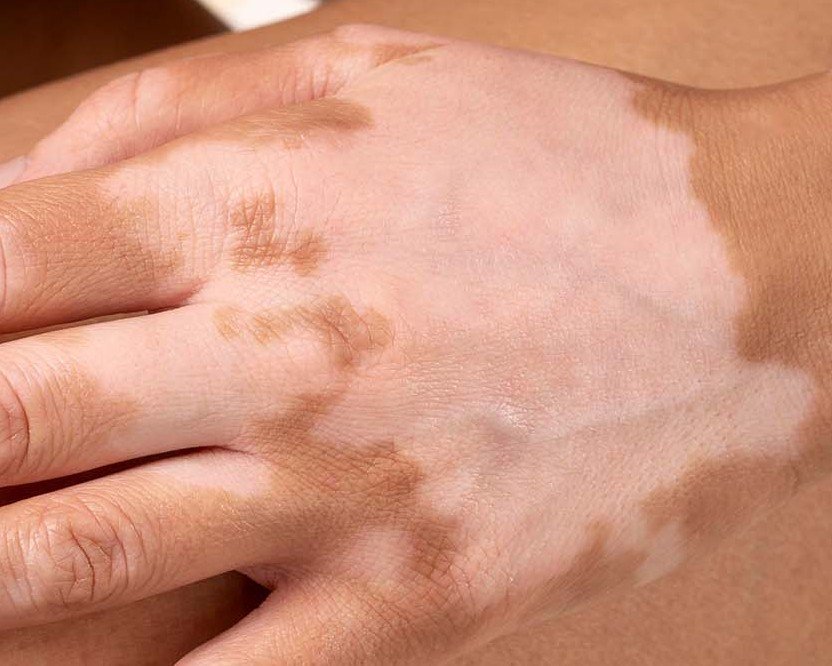
Vitiligo
Vitiligo is a long-term condition in which the skin loses its pigment in well-defined patches. It happens because the pigment cells, called melanocytes, are lost or stop working through an immune-mediated process. The patches are milky white, sharply outlined and otherwise normal skin: they do not itch, hurt or scale.
It affects roughly half a per cent to one per cent of people worldwide, in every population and every skin tone, and about half of those affected see the first patch before the age of twenty. Vitiligo is not contagious, it is not caused by diet, and nothing a person did brought it on.
Two patterns are recognised, and the difference matters for treatment:
- Non-segmental vitiligo: the more common form, usually affecting both sides of the body, often around the eyes and mouth and on the hands, elbows, knees and feet. It progresses in unpredictable episodes over years.
- Segmental vitiligo: usually confined to one side of the body, beginning earlier in life, spreading over a limited period and then settling. It is more stable, which is why it is the form most often considered for surgical treatment.
Vitiligo keeps company with other autoimmune conditions, autoimmune thyroid disease most consistently, which is why a diagnosis usually prompts a conversation about what else is worth checking.
Explanation of risks:
- Medium Risk: Vitiligo is not a precancerous condition and does not turn into skin cancer, it does not spread to other people and it does not shorten life. Two things do need attention: depigmented skin has greatly reduced natural protection and burns readily, and the associated autoimmune conditions are worth assessing. The burden patients report most is psychological, and that is part of the condition rather than a side issue.
💊 Treatment: Vitiligo cannot yet be cured, but the options have improved substantially. Topical corticosteroids and calcineurin inhibitors, topical JAK inhibitors where they are licensed, narrowband UVB phototherapy, and surgical grafting for stable disease all have a place. Repigmentation is slow — measured in months — and the face and neck respond better than the hands and feet. Starting early gives the best chance, so a new patch is worth showing to a dermatologist rather than watching.
💡 Skin Self-Exams Tips: Check the skin in good light for new or enlarging pale patches, particularly around the eyes and mouth and on the hands. New patches can appear at sites of cuts, burns or sunburn, so protect the skin from avoidable injury. Use broad-spectrum SPF 30 or higher on depigmented areas, avoid sunbeds, and raise any change with your doctor along with symptoms such as tiredness or weight change that might point to associated thyroid disease.

Medical review
Board-Certified Dermatologist · Fellow of the American Academy of Dermatology (FAAD)