
Micro-Gauge Needles with LDSI Reduce Pain and Waste in Botox Injections
Why this matters
If you’re thinking about getting Botox in the upper face, a new study offers news you might like: certain needles and syringe designs may make injections less painful, cause less bruising in some areas, and waste less product. That can mean a more comfortable visit and slightly better use of the medicine.
What the study looked at
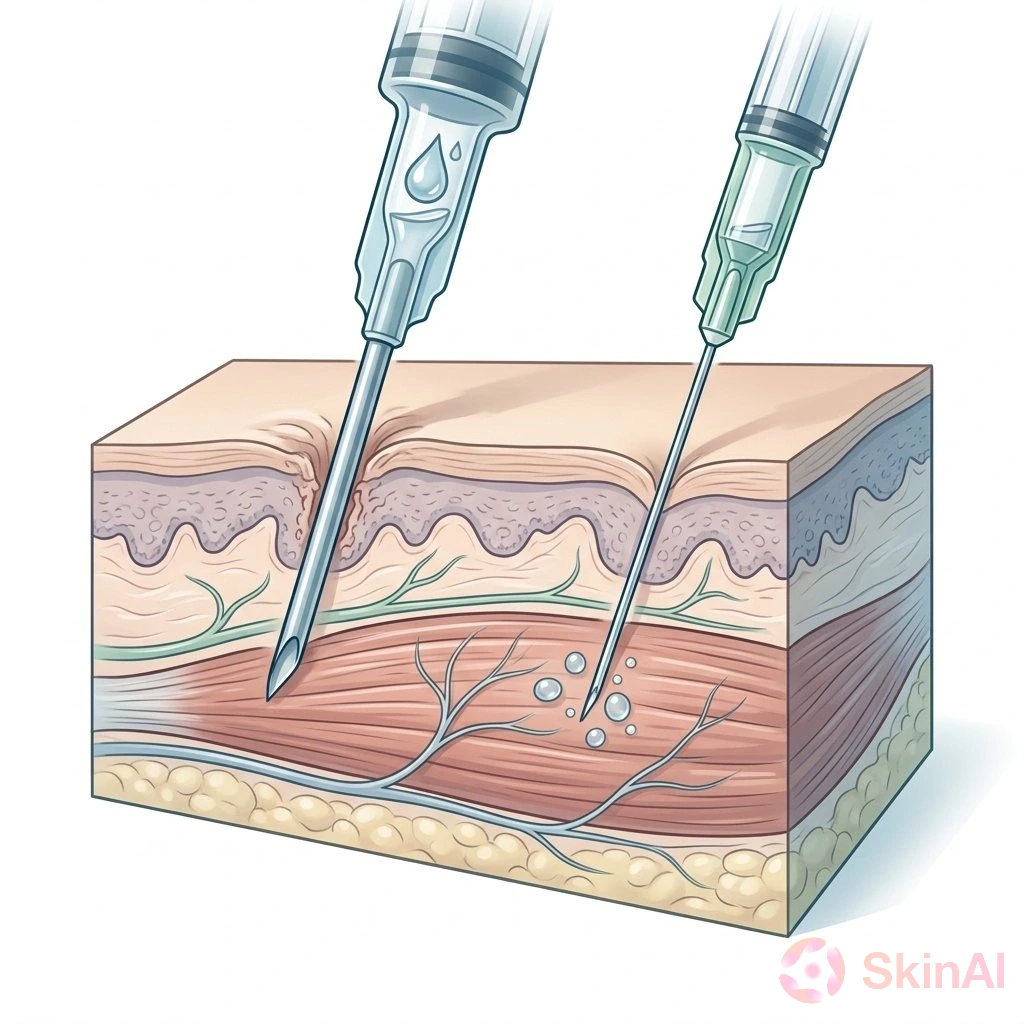
Researchers at Baskent University Ankara Hospital in Turkey tested two injection systems for upper-face botulinum toxin (commonly called Botox) on 42 healthy adults aged 18 to 65. Each person had one side of the face treated with a 34-gauge needle attached to a low dead space injector (LDSI) and the other side treated with a standard 30-gauge insulin syringe with a fixed needle.
Low dead space injector (LDSI) means the syringe and needle are designed to leave less liquid behind after a dose is pushed out. The study used a split-face design so each person served as their own comparison, and patients did not know which side got which system.
How results were measured
Investigators measured three things:
- Pain in three areas (forehead/frontal, between the eyebrows/glabellar, and around the eyes/periorbital) using a 0-to-10 scale where higher numbers mean more pain.
- Bruising the day after treatment using a 4-point scale from no bruising up to a hematoma (large bruise).
- Product wastage by weighing how much solution stayed in the needle and syringe after injection.
What they found
Less pain with the 34-gauge needle plus LDSI
Pain scores were lower on the sides treated with the 34-gauge needle and LDSI in all three areas. Average scores on the study side compared with the standard syringe side were:
- Frontal (forehead): 3.90 vs 5.66
- Glabellar (between the eyebrows): 3.30 vs 5.07
- Periorbital (around the eyes): 2.00 vs 3.33
All of these differences were statistically significant, meaning they were unlikely to be due to chance in this study.
Less bruising in some areas
The side injected with the 34-gauge needle and LDSI had no bruising in any of the three regions the day after treatment. On the standard-syringe side:
- Frontal region: 6 people had mild bruising (grade 1)
- Glabellar region: 2 people had mild bruising (grade 1)
- Periorbital region: 8 people had mild bruising (grade 1) and 3 had moderate bruising (grade 2)
The difference between the two systems was significant for the forehead and around the eyes, but not for the glabellar area.
Less product left behind (less waste)
The LDSI system left less residual product in the syringe and needle after injection. Average leftover amounts (in grams) were:
- Frontal: 0.0189 g (LDSI) vs 0.0501 g (standard syringe)
- Glabellar: 0.0182 g vs 0.0578 g
- Periorbital: 0.0207 g vs 0.0539 g
On average, the LDSI system lost about 0.0192 g per region compared with 0.0539 g for the standard syringe, which is roughly 2.8 times more wastage with the standard syringe. Based on how the researchers diluted and weighed the product, that leftover amount translated to about 0.48 units of botulinum toxin with the LDSI and about 1.36 units with the standard syringe.
What this might mean for you
The study suggests using a very thin needle (34-gauge) together with a low dead space injector may make upper-face Botox injections feel less painful and cause less bruising in some areas. It also suggests this combination wastes less of the product.
That said, the researchers pointed out the results don’t show that the needle size alone caused the benefits. The syringe design likely played a big role, especially when it comes to less waste. In other words, both the needle and the injector matter.
Limitations to keep in mind
This was a small, single-blind study with 42 participants. Although the split-face design helps reduce differences between people, pain is a subjective experience and can be influenced by many things such as:
- How the solution is prepared (pH and dilution)
- How fast the injection is given and how deep it goes
- An individual’s personal sensitivity to injections
The authors said larger studies and experiments that test needle and syringe features separately would help clarify which part of the setup is most important.
Tracking visible changes after treatment
If you’re keeping an eye on bruises or swelling after an injection, a quick photo each day can help you see how things are healing and be useful to show your clinician if you have concerns.
When to see a doctor
If you have heavy bleeding, increasing pain, signs of infection (such as spreading redness, warmth, pus, or fever), or any sudden changes after an injection, contact your provider or seek medical care promptly. If you’re unsure whether your reaction is normal, reach out to the clinic that performed the treatment or your dermatologist.
Short disclaimer
This article summarizes the findings of a clinical study and is for information only. It is not medical advice. Talk with your clinician or dermatologist about which injection tools and techniques are best for you.
Sources
- (Source: Gultekin G, Koycu A, İnan S, Buyuklu AF. Needle and Syringe Preference in Cosmetic Botulinum Toxin Treatment of the Upper Face: A Randomized, Controlled, Single-Blind Study. 2026;7:e71052. doi:10.1111/jocd.71052)
- (Source: Golan S, Pena J, Moore J, Tandalam S, Lelli G. The Association between Needle Size and Waste Product and Its Effect on Cost-Effectiveness of Botulinum Toxin Injections?. doi:10.1055/s-0040-1713793)