
Rash under breast: causes, pictures and when to see a doctor
This tool is for informational purposes only and does not constitute medical advice. Always consult a qualified dermatologist.
What causes a rash under the breast?
The skin fold under the breast is warm, moist and rubs against itself, which can lead to under-breast soreness (intertrigo): a red, sore, itchy rash, often with a yeast infection (candida, or thrush). Other causes include heat rash, contact dermatitis from a bra or a product, psoriasis, ringworm and other fungal patches, impetigo, painful lumps that keep coming back (hidradenitis suppurativa), shingles and scabies. A change in the breast itself — a lump, dimpling, a change in skin colour or a rash on the nipple — is different from a rash in the fold: see breast changes. Pictures can help you describe a rash, but they cannot tell you which one you have. Some signs need help quickly: all of them, and how soon to act on each, are in one place, the list of when to see a doctor below.
Sources: Gloucestershire Hospitals NHS — Under-breast soreness (intertrigo) · NHS — Thrush in men and women · NHS — Heat rash (prickly heat) · NHS — Contact dermatitis · NHS — Psoriasis · NHS — Pityriasis versicolor · NHS — Hidradenitis suppurativa · NHS — Shingles · NHS — Scabies · NHS — Symptoms of breast cancer in women · NHS — Paget’s disease of the nipple
A change in the breast is not a skin-fold rash
A rash in the crease under the breast often comes from moisture, heat and rubbing. These changes in the breast or nipple are different. The NHS lists them as possible symptoms of breast cancer; some, including breast lumps, are very common and can have other causes, and having one does not definitely mean you have cancer. None of them can be checked with a photo. Men can get breast cancer and Paget’s disease of the nipple too.
- a lump or swelling in the breast, chest or armpit
- a change in the skin of the breast, such as dimpling (it may look or feel like orange peel)
- a change in the colour of the skin on the breast — on black or brown skin it may look darker than usual, on white skin it may look red
- a change in the size or shape of one or both breasts, or of either side of the chest
- nipple discharge if you are not pregnant or breastfeeding, which may have blood in it
- a change in the shape or look of the nipple, such as it turning inwards, or a rash on the nipple or the darker skin around it (the areola), which may look like eczema — a red, scaly, sore, itchy or burning rash there can be Paget’s disease of the nipple, which is linked to breast cancer
- sores or ulcers on the chest (listed for men)
How soon to get them checked — sooner for a breast that is hot, swollen or has changed colour — is in the list of when to see a doctor. Pain in the breast on its own is not usually a symptom of breast cancer, but the NHS says it is best to get it checked.
Sources: NHS — Symptoms of breast cancer in women · NHS — Symptoms of breast cancer in men · NHS — Paget’s disease of the nipple · NHS — Breast pain
When to see a doctor about a rash under the breast
Most rashes under the breast are not serious, but some signs need help quickly, and some are signs in the breast itself. This is the only place on the page where the signs and how soon to act are listed; the rest of the page links back here.
Call emergency services now — don’t wait for a photo check — for:
Trust your instincts: someone with sepsis or meningitis might not have every symptom listed, so get help if you think someone is seriously ill. For a serious allergic reaction, call for an ambulance and do not stand or walk. For every other item, do not drive yourself to A&E: ask someone to drive you or call for an ambulance, and bring any medicines you take.
- A rash or spots that do not fade when you press the side of a clear glass firmly against the skin. A meningitis rash usually starts as small red pinpricks and spreads quickly into red or purple blotches; on brown or black skin check paler areas: the palms, the soles of the feet, the roof of the mouth, the whites of the eyes or inside the eyelids. Not everyone with meningitis or sepsis gets a rash, so the other signs below matter as much
- In an adult or a child aged 5 or over, signs that could be sepsis or meningitis: breathing very fast; being confused, slurred speech or not making sense; blue, pale or blotchy skin (on black or brown skin this may be easier to see on the palms or the soles of the feet); a very high or very low temperature, feeling hot or cold to the touch, or shivering; a very painful headache; a stiff neck and not being able to look at bright lights; a seizure (fit) for the first time; or symptoms you are worried might be sepsis or meningitis
- In a baby or child under 5, signs that could be sepsis or meningitis: breathing very fast or having difficulty breathing (grunting, or the tummy sucking in under the ribs); blue, grey, pale or blotchy skin, lips or tongue; a temperature of 38C or more under 3 months old or 39C or more at 3 to 6 months; a temperature below 36C, feeling cold to the touch or shivery; a weak, high-pitched or continuous cry; not responding as usual, not feeding, floppy, difficult to wake or more sleepy than usual; no pee for 12 hours; or symptoms you are worried about
- A child who is unwell with a rash and has a stiff neck, is bothered by light, seems confused, agitated or is not responding as usual, has difficulty breathing (grunting, the tummy sucking in under the ribs), is breathless or breathing very fast, or whose skin, lips or tongue look pale, blue, grey or blotchy
- Signs of a serious allergic reaction: the lips, mouth, throat or tongue suddenly swell; breathing very fast or struggling to breathe; the throat feels tight or it is hard to swallow; skin, tongue or lips turn blue, grey or pale (on brown or black skin this may be easier to see on the palms or soles); suddenly becoming very confused, drowsy or dizzy; someone faints and cannot be woken; or a child is limp, floppy or not responding as usual. Use an adrenaline auto-injector if you have one, call for an ambulance and say you think it is anaphylaxis, and lie down — you can raise your legs, and if you are struggling to breathe, raise your shoulders or sit up slowly (if you are pregnant, lie on your left side). If symptoms have not improved after 5 minutes, use a second auto-injector. Do not stand or walk at any time, even if you feel better
- Painful, hot, swollen skin, which can be cellulitis, together with a very high temperature or feeling hot, cold or shivery, a fast heartbeat or fast breathing, purple patches (less obvious on brown or black skin), feeling dizzy or faint, confusion, cold, clammy or pale skin, or not responding
- Psoriasis where the skin quickly turns red and then white bumps filled with pus appear and join together, psoriasis patches on the feet that turn yellow-brown and fill with pus, or red, scaly bumps filled with pus on the tips of the fingers and toes — redness may be harder to see on brown or black skin
Same day — urgent medical advice
Get urgent medical advice the same day — an urgent GP appointment or NHS 111 in the UK — unless an emergency sign above applies, for:
- any part of the breast itself that is hot, swollen or has changed colour — on black or brown skin it may look darker than usual, on white skin it may look red — including redness that spreads from the fold onto the breast; or breast pain with a very high temperature, or feeling hot, cold or shivery. This includes mastitis: a swollen area on the breast that may feel hot and painful to touch, sometimes with a high temperature, aches and tiredness — and mastitis you have already had advice for if you feel very unwell or it is getting worse quickly. A sore or itchy rash that stays in the fold under the breast is covered by the thrush and under-breast soreness items below
- a child with a rash you are worried about and are not sure what to do; a child who feels hotter than usual when you touch their back or chest or feels sweaty; or a child aged 6 months or older with a temperature of 39C or higher — but a temperature of 38C or more under 3 months or 39C or more at 3 to 6 months, a very low temperature or shivering in any child, and a child aged 5 or over who feels hot or cold to the touch together with other signs that could be sepsis or meningitis are in the emergency list above
- skin that is painful, hot and swollen, which can be cellulitis — redness may be less obvious on brown or black skin — or, around spots, an area that is becoming hot, swollen and more and more painful, or spots with a fever, which can be an abscess
- a shingles-type rash — painful blotches or blisters on one side only — if you are pregnant, are breastfeeding and the rash is on your breasts, are 17 or younger, have a severely weakened immune system, or the rash is on your eye or nose or your vision has changed
- hives that have not improved after 2 days, are spreading or keep coming back, come with a high temperature and feeling unwell or with swelling under the skin, or hives in a child you are worried about
- eczema or dermatitis that is blistered, crusty, leaking fluid or has spots filled with pus, is painful, swollen or feels warm, suddenly gets worse or bigger, or comes with a high temperature or feeling generally unwell — these can be signs that eczema is infected
Pharmacist first
A pharmacist can advise first — unless an emergency or same-day sign above, or a sign in the “See a GP” list below, applies — for:
- a painful rash of blotches or blisters on one side of the chest or tummy, which can be shingles, if you are 18 or older: try to see a pharmacist within 3 days of the rash appearing, because antiviral medicine works best when started early
- a red, sore or itchy rash in the fold under the breast if a doctor has diagnosed thrush there before and you know the symptoms: a pharmacist can recommend an antifungal cream or powder, and a hydrocortisone cream if the skin is very red, inflamed or sore; do not use antifungal medicine more than twice in 6 months without speaking to a pharmacist or doctor
- heat rash, mild contact dermatitis, hives without any of the signs above, ringworm (a ring-shaped rash that may be scaly, dry, swollen or itchy), impetigo in anyone aged 12 months or over, scabies in anyone aged 2 or over, or itchy skin: a pharmacist can recommend treatment and tell you if you should see a GP
Book an appointment
See a GP — unless an emergency or same-day sign above applies — for:
- any of these breast or nipple changes (a breast that is hot, swollen or has changed colour is in the same-day list above): a lump in the breast, chest or armpit, or swelling in the chest or armpit; a change in the skin of the breast, such as dimpling (it may look or feel like orange peel); a change in the size or shape of one or both breasts, or of either side of the chest; nipple discharge if you are not pregnant or breastfeeding, which may have blood in it; a change in the shape or look of the nipple, such as it turning inwards, or a rash on the nipple or the darker skin around it (the areola), which may look like eczema — a red, scaly, sore, itchy or burning rash there can be Paget’s disease of the nipple, which is linked to breast cancer; sores or ulcers on the chest (listed for men); itching, burning or bleeding of the nipple, even if the nipple looks normal; or any other change in your breasts, chest or nipples that is not normal for you
- breast pain that is not improving or not helped by painkillers, is new or different for you, or that you are worried about, and pain in the breast or armpit when other people in your family have had breast cancer or ovarian cancer
- mastitis you have already had advice for that has not started to get better 12 to 24 hours after treating it at home or 48 hours after starting antibiotics — but if you feel very unwell or it is getting worse quickly, use the same-day list above
- a rash in a skin fold that may be thrush — a red, itchy or painful rash that scales over with white or yellow discharge — if it is the first time, you are under 16 or over 60, you are pregnant or breastfeeding, you have a weakened immune system (for example because of diabetes), thrush keeps coming back (more than 4 times in 12 months) or treatment has not worked; and under-breast soreness that has not improved with pharmacy treatment or is getting worse — for example if it has become infected, with a creamy discharge or a strong smell
- painful lumps that keep coming back in the same places — under the breasts, in the armpits, groin or buttocks — lumps treated as boils more than once in the same place, a lump that leaks fluid, or scarring: these can be hidradenitis suppurativa, which it is important to diagnose early; our atlas article advises seeing a dermatologist and warns against draining the lumps at home
- spots around hairs (folliculitis) that are spreading, painful or deep, keep coming back or have not settled within a week or two — our atlas article advises seeing a clinician
- ringworm that has not improved after antifungal medicine recommended by a pharmacist, or ringworm when you have a weakened immune system (for example from chemotherapy, steroids or diabetes)
- impetigo if you are breastfeeding and the sores are on your breasts, in a baby aged 11 months or younger, with a weakened immune system, if it has changed or got worse after treatment, or if it has come back within a year; impetigo is very infectious, so check with the GP surgery before you go in
- contact dermatitis that is persistent, keeps coming back or is severe; symptoms of psoriasis, psoriasis treatment that is not working or is giving you side effects, or psoriasis with pain, stiffness and swelling in the joints that keeps coming back
- heat rash that does not improve after a few days, or cellulitis that is not starting to feel better 2 to 3 days after starting antibiotics
- patches of skin that have changed colour — if it is pityriasis versicolor it will usually only go away if treated, and similar patches can be other conditions — or any other change to your skin that worries you
- scabies in a child under 2 or in a household with a child under 2, scabies with skin that may be infected or with another skin condition such as eczema, a crusted, flaky rash on the elbows, knees, hands or feet, or skin still itching 2 to 4 weeks after finishing pharmacy treatment for scabies
- itching that affects your daily life, does not get better with self-care or keeps coming back, is all over your body, is severe, comes with a new rash, lump or swelling that worries you, or happens during pregnancy
Sources: NHS — Meningitis · NHS — Sepsis · NHS — Rashes in babies and children · NHS — Anaphylaxis · NHS — Breast pain · NHS — Cellulitis · NHS — Psoriasis · NHS — Mastitis · NHS — Shingles · NHS — Hives · NHS — Atopic eczema · Gloucestershire Hospitals NHS — Under-breast soreness (intertrigo) · NHS — Thrush in men and women · NHS — Heat rash (prickly heat) · NHS — Contact dermatitis · NHS — Pityriasis versicolor · NHS — Scabies · NHS — Itchy skin · NHS — Symptoms of breast cancer in women · NHS — Symptoms of breast cancer in men · NHS — Paget’s disease of the nipple · NHS — Hidradenitis suppurativa · Atlas — Hidradenitis suppurativa · Atlas — Folliculitis · NHS — Ringworm · NHS — Impetigo
Why the skin under the breast gets rashes
The fold under the breast is a warm, closed space where skin rubs on skin and sweat cannot dry. A Gloucestershire NHS hospital leaflet names moisture (such as sweating), heat and skin-to-skin rubbing as the main causes of under-breast soreness.
-
Heat, sweat and skin rubbing on skin
DermNet explains that sweat cannot evaporate in a closed fold and that the movement of skin against skin causes chafing; rashes in folds happen more easily when it is hot and humid. See fungal skin infection.
-
The bra
The leaflet advises a good supportive bra to reduce skin-to-skin rubbing, and says cotton is more effective than nylon, which is known to make the condition worse. DermNet lists rubber in elastic and nickel in bra wire among causes of allergic contact dermatitis in folds. See contact dermatitis.
-
Deodorants, wipes and soap
DermNet lists fragrance, preservatives or medicines in a deodorant, wet wipe or other product as possible allergens in skin folds, and sweat, soap, excessive washing and dryness from antiperspirant as irritants.
-
Larger breasts, sport, weight and diabetes
The leaflet says under-breast soreness usually affects women who are larger breasted or very sporty, and that diabetes can make the skin more prone to fungal and bacterial infections. DermNet notes that rashes in folds are particularly common in people who are overweight.
-
Breastfeeding
Mastitis — a swollen, hot and painful area of the breast — is most common in breastfeeding women; women who are not breastfeeding can get it too, and so can men. Mastitis.
Sources: Gloucestershire Hospitals NHS — Under-breast soreness (intertrigo) · DermNet — Intertrigo · NHS — Mastitis
Possible causes: examples with pictures
Grouped by how the rash looks, not by every way a condition can look. Groups overlap and cannot identify or rule out a condition, so look through all of them. The atlas photos show these conditions on other parts of the body, such as skin folds, the chest and the trunk. Each card description is quoted word for word from the atlas article, and the group notes come from the NHS, DermNet and atlas pages linked below the cards; open a card for the full article and all its photos.
Red, sore or itchy in the fold
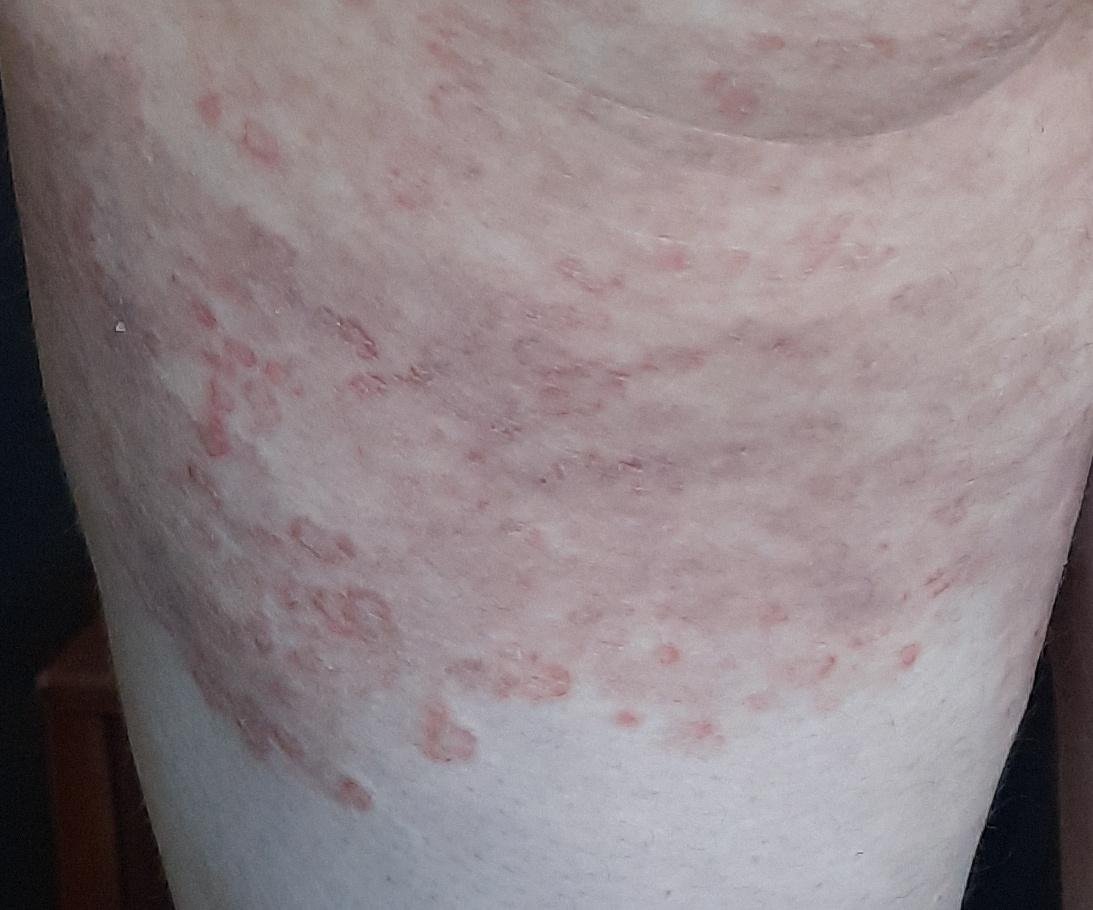
Under-breast soreness (intertrigo) is mainly caused by moisture, heat and skin rubbing on skin, and is often infected with the yeast candida (thrush). It can cause a red rash, soreness, cracked or split skin, a prickling feeling and itchy, weeping skin. The NHS describes thrush on the skin as a red, itchy or painful rash that scales over with white or yellow discharge, which may not be so obvious on darker skin. Contact dermatitis makes skin itchy, blistered, dry and cracked: red on lighter skin, and dark brown, purple or grey on darker skin. Words in the quotes: erythematous means red; macerated means softened by moisture; edema means swelling; pustules are small spots filled with pus, papules are small bumps and vesicles are small blisters.
 29 photos
Fungal skin infection (candida (thrush))
“Common locations: Inguinal and perineal folds; Axillae; Submammary area (under breasts); Intergluteal cleft and diaper area in infants; Interdigital spaces (hands and feet).”
“Clinical signs: Erythematous, moist, macerated patches with satellite pustules or vesicles at the periphery.”
Read the article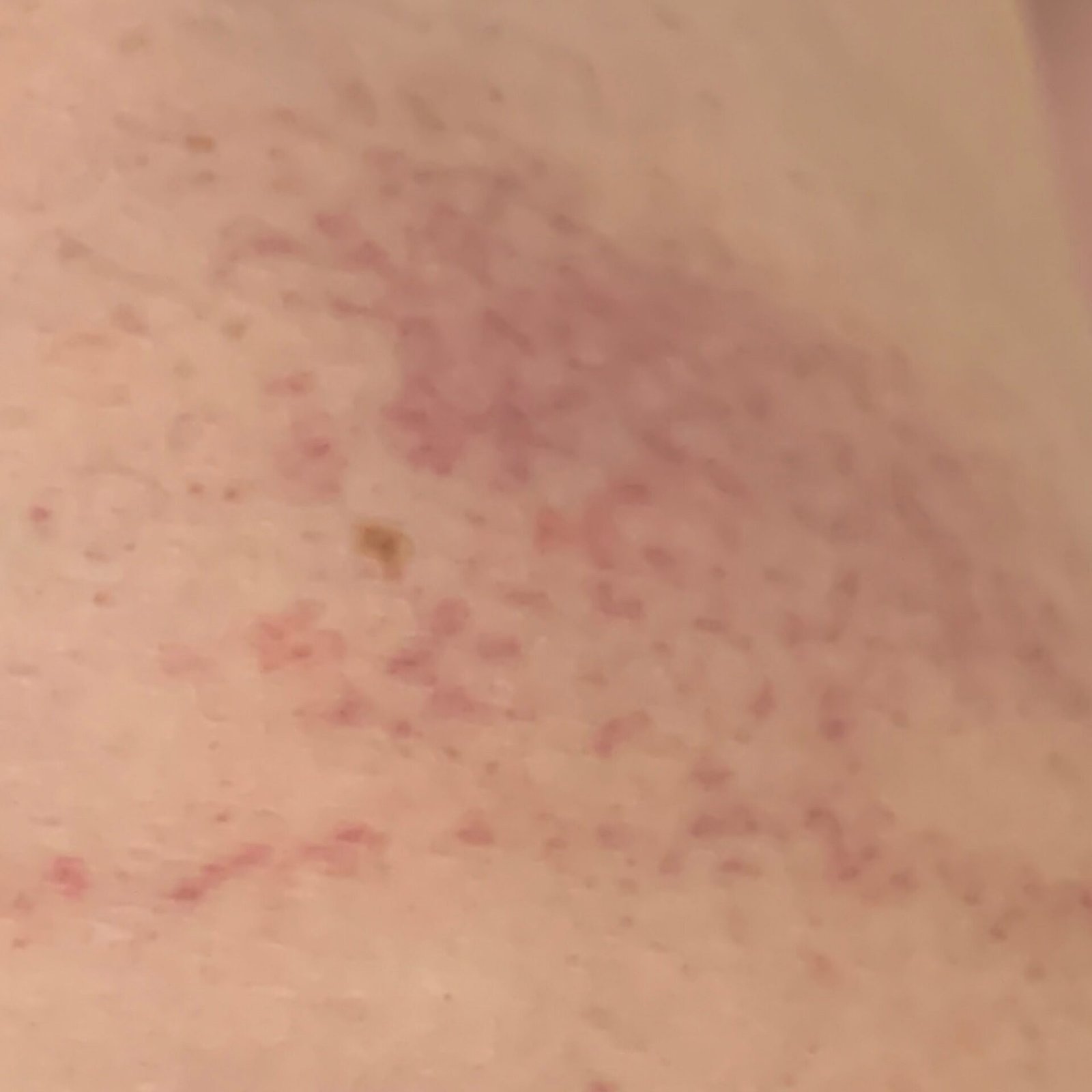 25 photos
Contact dermatitis
“It may result from a single exposure to a strong substance (e.g., acid or alkali), or from repeated exposure to milder irritants (e.g., water, soap, detergents, friction, cold air).”
“Acute phase: Erythema (redness), edema, vesicles or papules, weeping (exudation), crust formation, burning sensation, soreness, occasional itching”
Read the articleClear-edged or colour-changing patches
Under the breast, psoriasis often looks different from the photo. The NHS notes psoriasis can appear in the folds of the body, such as under the breasts. In folds it tends not to have silvery scale but looks shiny and smooth, deep red with clear edges, and may crack in the crease; DermNet notes it can be hard to tell apart from seborrheic dermatitis, which in folds forms thin, salmon-pink patches with less clear edges. Pityriasis versicolor patches are flat and round, may feel scaly and usually appear on the chest, upper back, upper arms, neck or tummy; on brown or black skin they tend to be paler than the skin around them. Neither psoriasis nor pityriasis versicolor can be passed on to other people. Words in the quotes: erythematous plaques are red, raised patches; well-demarcated means with clear edges; hypopigmented means paler than the skin around it.
 30 photos
Psoriasis (psoriasis vulgaris)
“Psoriasis vulgaris typically presents with erythematous plaques covered by thick, white or silvery scales.”
Read the article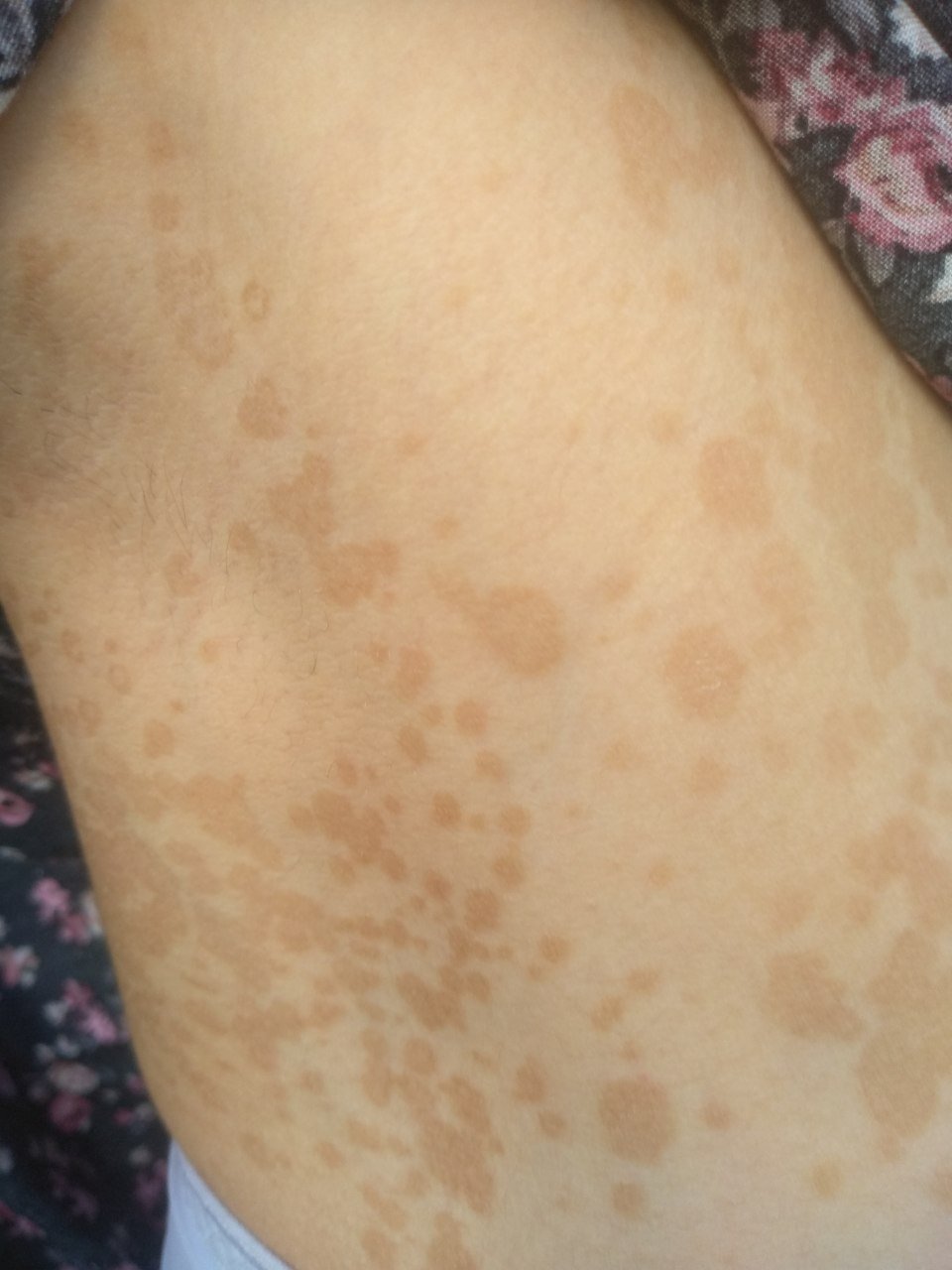 25 photos
Tinea versicolor (pityriasis versicolor)
“The hallmark of pityriasis versicolor is the development of well-demarcated, scaly, discolored patches that vary in hue—from pink, tan, and light brown to hypopigmented or chalky white, especially in darker-skinned individuals.”
Read the articlePainful lumps and spots around hairs
Hidradenitis suppurativa causes boil-like lumps, blackheads and channels in the skin that leak pus; the NHS lists below the breasts among the usual places. It is not infectious and is not linked to poor hygiene. Folliculitis bumps each sit around a hair, and heat, sweating and tight clothing can set them off. Words in the quotes: apocrine glands are a type of sweat gland in the armpits and groin; pustules are small spots filled with pus.
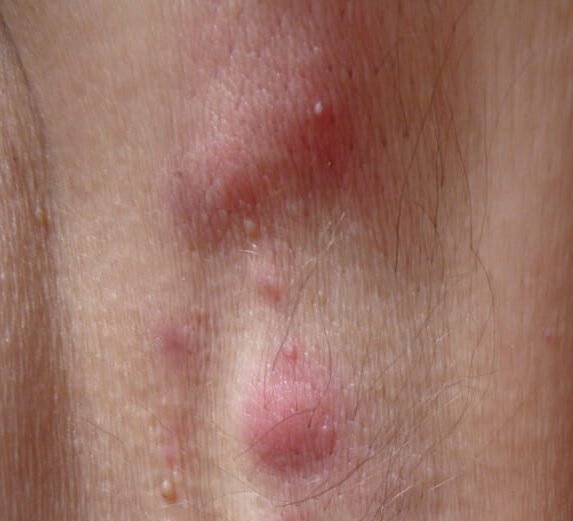
Hidradenitis suppurativa (HS)
“HS affects skin where hair follicles sit alongside apocrine glands and where skin rubs against skin: the armpits, the groin, the inner thighs, the skin under the breasts, the buttocks and the perianal area.”
Read the article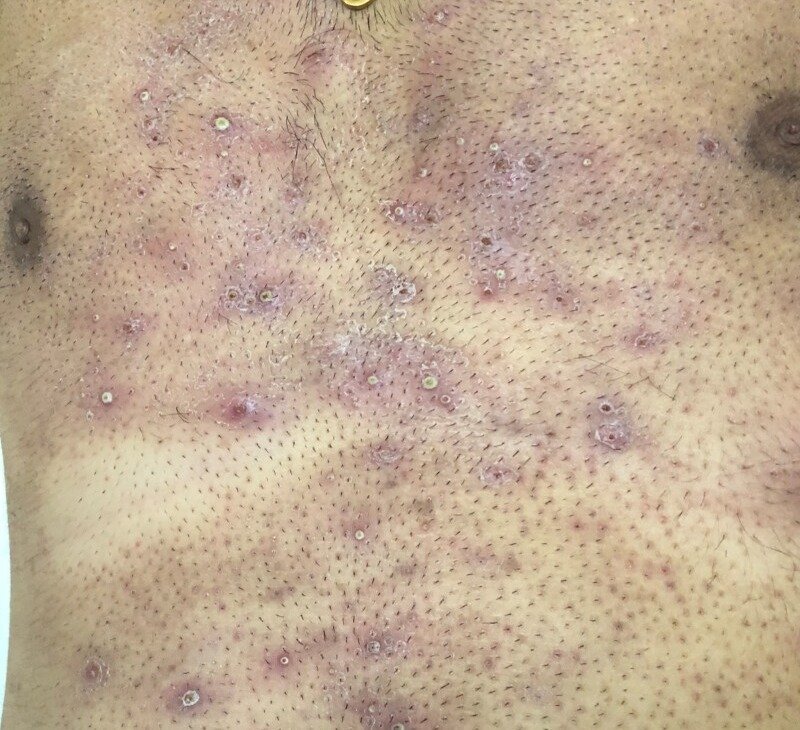
Folliculitis
“It appears as small red bumps or pustules, each one centred on a hair, and it can affect any part of the body that grows hair — most often the scalp, beard area, chest and back, armpits, buttocks and thighs.”
“Heat and humidity, and prolonged sweating under clothing.”
Read the articleA painful band on one side
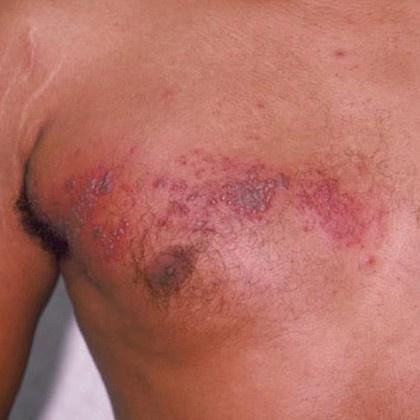
Shingles often starts with tingling or pain in one area of skin; a rash of blotches that turn into itchy, oozing blisters usually follows a few days later, on one side of the body only, most often on the chest and tummy. A rash on both sides is unlikely to be shingles. Words in the quote: vesicular means made of small blisters; a dermatome is the strip of skin served by one nerve. How soon to get it checked: see the list of when to see a doctor.
 32 photos
Shingles (herpes zoster)
“The hallmark symptom of herpes zoster is a localized, painful vesicular rash that typically appears on one side of the body, following the distribution of a single dermatome—the area of skin supplied by one sensory nerve.”
Read the articleSources for the group notes: Gloucestershire Hospitals NHS — Under-breast soreness (intertrigo) · NHS — Thrush in men and women · NHS — Contact dermatitis · NHS — Psoriasis · DermNet — Flexural psoriasis · NHS — Pityriasis versicolor · NHS — Hidradenitis suppurativa · Atlas — Folliculitis · NHS — Shingles
Other common causes
Described from the linked NHS and DermNet pages; seborrheic dermatitis and scabies also have articles in our atlas. Mastitis and Paget’s disease of the nipple affect the breast or nipple rather than the fold.
Under-breast soreness (intertrigo)
The skin fold under the breast
A red, sore rash in the fold, with cracked or split skin, a prickling feeling and itchy, weeping skin; it is often a candida (yeast) infection. If untreated it may get worse and become infected, and in some cases there is a creamy discharge with a strong smell.
Wash the area regularly and pat it dry, wear a supportive cotton bra, and do not share flannels or towels. Whether a GP or a pharmacist comes first — for example if it is the first time — is in when to see a doctor.
Gloucestershire Hospitals NHS — Under-breast soreness (intertrigo) · DermNet — Intertrigo · NHS — Thrush in men and women
Heat rash (prickly heat)
Where you sweat
Small, raised spots with an itchy, prickly feeling and mild swelling. It looks red on white skin and may be harder to see, or look grey or white, on brown or black skin. It is usually caused by sweating a lot, cannot be passed on to other people, and usually gets better on its own after a few days.
Keep the skin cool: loose cotton clothing, cool showers, and pat rather than scratch. When to see a doctor.
Seborrheic dermatitis
Upper chest and skin folds
Our atlas lists the upper chest and back among its common sites, and the armpit and groin folds in severe or widespread cases. In skin folds DermNet describes thin, salmon-pink patches that are less well defined than psoriasis; on the face and scalp the patches tend to be flaky. Atlas article and photos.
Atlas — Seborrheic dermatitis · DermNet — Intertrigo · DermNet — Flexural psoriasis
Scabies
Breasts, armpits, waist and between the fingers
Intense itching, especially at night, and a raised rash or spots that may look red and are harder to see but can be felt on brown or black skin. Our atlas lists the breasts in women among its typical sites. It spreads by close skin contact, and everyone in the home needs treating at the same time. Atlas article and photo.
Erythrasma
Skin folds
A bacterial infection of skin folds that DermNet describes as persistent brown patches with little scale that are usually neither painful nor itchy.
Ringworm (tinea)
Anywhere, including skin folds
A fungal infection: a rash that is usually ring-shaped and may be scaly, dry, swollen or itchy. It may look red or darker than the skin around it, and its colour may be less noticeable on brown and black skin. DermNet lists it among the infections that cause rashes in skin folds.
Impetigo
Sores that crust
Red sores or blisters that quickly burst and often leave crusty, golden-brown patches; the redness may be harder to see on brown and black skin. The patches can be itchy and sometimes painful. It is very contagious; DermNet lists it among the infections that cause rashes in skin folds.
Mastitis
Usually 1 breast
A swollen area on the breast that may feel hot and painful to touch, a wedge-shaped lump or hard area, or a burning pain; the area may become red, but this can be harder to see on black or brown skin. You may also get flu-like symptoms. It is most common in breastfeeding women but can affect women who are not breastfeeding, and men.
How soon to get a hot, swollen breast checked: when mastitis needs a doctor. If you are breastfeeding, keep feeding your baby; rest, and wear a comfortable, supportive bra.
Paget’s disease of the nipple
The nipple and areola, not the fold
A rare condition linked to breast cancer. It always starts in the nipple and may spread to the areola, as a red, scaly rash that is often sore and can itch or burn; it can look like eczema or psoriasis. It can also affect men, but this is extremely rare.
Hives
Anywhere, including the chest
Raised bumps or patches in many shapes and sizes that can itch, sting or burn; they look pink or red on white skin, and the colour can be harder to see on brown and black skin. Triggers include hot, sweaty skin.
Rashes under the breast on brown and black skin
Redness can be hard to see on darker skin: a change in the breast may look darker than usual, some rashes show as paler patches, and some spots are easier to feel than to see. The psoriasis photo on this page shows patches on brown skin.
-
Changes in the breast
A change in the colour of the skin on the breast may look darker than usual on black or brown skin, and the redness of mastitis can be harder to see. Breast changes.
-
Thrush and contact dermatitis
A thrush rash may not be so obvious on darker skin, and contact dermatitis can turn dark brown, purple or grey rather than red.
-
Heat rash and pityriasis versicolor
Heat rash may be harder to see, and its spots may look grey or white. Pityriasis versicolor patches tend to be paler than the skin around them.
-
Feel, and the glass test
Scabies spots are harder to see but can be felt; psoriasis can look grey and leave dark marks after it goes. A rash that does not fade under a glass can also be harder to see: check paler areas such as the palms and the soles of the feet, and see when to see a doctor.
Sources: NHS — Symptoms of breast cancer in women · NHS — Mastitis · NHS — Thrush in men and women · NHS — Contact dermatitis · NHS — Heat rash (prickly heat) · NHS — Pityriasis versicolor · NHS — Scabies · NHS — Psoriasis · NHS — Meningitis
Preventing a rash under the breast
From the Gloucestershire NHS leaflet and DermNet. They do not replace treatment for a rash that is already there.
-
Wash and pat dry
Wash the area regularly and pat it dry rather than rubbing.
-
Dry the fold after exercise
DermNet advises bathing and drying skin folds completely after physical exertion, and says a hairdryer on a cool setting works well for drying under the breasts.
-
A supportive cotton bra
A good supportive bra reduces skin-to-skin rubbing; cotton is better than nylon.
-
Your own towel
Do not share flannels or towels, to avoid spreading an infection.
-
A barrier cream once it clears
Once an infection has cleared, a barrier cream may help stop it coming back.
Sources: Gloucestershire Hospitals NHS — Under-breast soreness (intertrigo) · DermNet — Intertrigo
Rash under breast: FAQ
Why do I get a rash under my breasts?
The fold under the breast is warm and moist and rubs against itself; moisture, heat and skin-to-skin rubbing are the main causes of under-breast soreness (intertrigo), which is often infected with candida. Larger breasts, sport, diabetes and being overweight make it more likely. Heat rash, contact dermatitis from a bra or a product, psoriasis and hidradenitis suppurativa can also appear there. Sources: Gloucestershire Hospitals NHS — Under-breast soreness (intertrigo), DermNet — Intertrigo, NHS — Heat rash (prickly heat), NHS — Psoriasis, NHS — Hidradenitis suppurativa.
Is a rash under the breast a yeast infection?
Often, but not always. A Gloucestershire NHS leaflet describes under-breast soreness as an infection with the yeast candida, and our atlas lists the area under the breasts among the common places for candida of the skin. But psoriasis, seborrheic dermatitis, contact dermatitis, ringworm and erythrasma can also cause a rash in a skin fold. Who to see first, and how soon, is in the list of when to see a doctor. Sources: Gloucestershire Hospitals NHS — Under-breast soreness (intertrigo), Atlas — Skin mycoses, DermNet — Intertrigo.
Can a rash under the breast be breast cancer?
This page cannot tell you that. Moisture, heat and rubbing are the main causes of under-breast soreness in the fold. The NHS lists changes in the breast itself as possible symptoms of breast cancer — such as a lump, dimpling, a change in skin colour or a rash on the nipple — and says some of these symptoms are very common and can be caused by other conditions, and having them does not definitely mean breast cancer. The full list is under breast changes, and how soon to act is in the list of when to see a doctor. Sources: NHS — Symptoms of breast cancer in women, NHS — Symptoms of breast cancer in men, NHS — Paget’s disease of the nipple, Gloucestershire Hospitals NHS — Under-breast soreness (intertrigo).
What is the fastest way to get rid of a rash under the breast?
It depends on the cause, so there is no single fastest way. For under-breast soreness, the leaflet advises washing the area and patting it dry, a supportive cotton bra and not sharing towels; the antifungal and hydrocortisone creams it mentions are sold in pharmacies, but if it may be thrush and it is the first time, the NHS advises seeing a GP first. Heat rash settles when the skin is kept cool. Who to see first for each cause: when to see a doctor. Sources: Gloucestershire Hospitals NHS — Under-breast soreness (intertrigo), NHS — Heat rash (prickly heat), NHS — Thrush in men and women.
Is a rash under the breast contagious?
Some can be passed on and some cannot. Heat rash, psoriasis, pityriasis versicolor and hidradenitis suppurativa cannot be passed on to other people. The leaflet advises not sharing flannels or towels with under-breast soreness, scabies spreads by close skin contact, and impetigo is very contagious. You cannot spread shingles to others, but people who have not had chickenpox or the chickenpox vaccine could catch chickenpox from you. Sources: NHS — Heat rash (prickly heat), NHS — Psoriasis, NHS — Pityriasis versicolor, NHS — Hidradenitis suppurativa, Gloucestershire Hospitals NHS — Under-breast soreness (intertrigo), NHS — Scabies, NHS — Impetigo, NHS — Shingles.
Can heat rash appear under the breasts?
Yes. Heat rash can appear anywhere on the body and is usually caused by sweating a lot: small, raised spots with an itchy, prickly feeling. It cannot be passed on, and usually gets better on its own after a few days if you keep the skin cool. The leaflet lists a red rash, soreness, cracked or split skin and itchy, weeping skin as symptoms of under-breast soreness. Sources: NHS — Heat rash (prickly heat), Gloucestershire Hospitals NHS — Under-breast soreness (intertrigo).
Why does the rash under my breast smell?
The leaflet says that if under-breast soreness is not treated it may get worse and become infected, and in some cases it causes a creamy discharge with a strong smell. DermNet notes that a rash in a skin fold with a bacterial infection can cause a foul smell. How soon to get it checked is in the list of when to see a doctor. Sources: Gloucestershire Hospitals NHS — Under-breast soreness (intertrigo), DermNet — Intertrigo.
Can men get a rash under the breast?
Yes. DermNet notes that rashes in skin folds can affect males or females of any age, particularly people who are overweight. Men can also get mastitis, and breast cancer and Paget’s disease of the nipple, so changes in the chest or nipple matter for men too: see breast changes. Sources: DermNet — Intertrigo, NHS — Mastitis, NHS — Symptoms of breast cancer in men, NHS — Paget’s disease of the nipple.
Can a photo or an AI skin check tell me what my rash is?
No. Pictures show what rashes can look like, but many look alike, and the output of an AI skin check is not a medical diagnosis. It cannot check a change in the breast, and it cannot tell you how soon to get help: if any sign in the list of when to see a doctor applies, get medical help instead.
For a clear photo of a rash: daylight, close and in focus, no filters. AI output is not a medical diagnosis and cannot check a change in the breast or nipple. If you have any of the signs in the list of when to see a doctor, get medical help instead.
Check my skin ↑SkinAI Lab is a paid AI analysis; pricing is shown before you scan.


Prepared by the SkinAI Lab editorial team · Updated . Apart from the quoted atlas text, this page has not been reviewed by a doctor. It is general information, not medical advice.