
Bumps on skin: types, pictures and when to see a doctor
This tool is for informational purposes only and does not constitute medical advice. Always consult a qualified dermatologist.
What are bumps on the skin, and are they serious?
It is common to get lumps and growths on the skin. They can be soft or hard, move around, be very small or up to the size of a golf ball, and sit under the skin or hang off it. Most are harmless. Tiny white or skin-coloured bumps can be milia, whiteheads or keratosis pilaris; pimple-like bumps can be acne, folliculitis or razor bumps; rough growths can be warts or seborrheic keratoses; soft or firm bumps can be skin tags, raised moles or dermatofibromas; and lumps under the skin can be cysts, lipomas or boils. Pictures can help you describe a bump, but they cannot tell you which one you have. Some bumps and lumps need a doctor, and a few need help sooner: all the signs, and how soon to act on each, are in one place, the list of when to see a doctor below.
Sources: NHS — Lumps · Atlas — Milium · NHS — Keratosis pilaris · NHS — Acne · Atlas — Folliculitis · NHS — Warts and verrucas · AAD — Seborrheic keratoses · NHS — Skin tags · Atlas — Papillomatous nevus · Atlas — Dermatofibroma · NHS — Skin cyst · NHS — Lipoma · NHS — Boils · DermNet — Pseudofolliculitis barbae (razor bumps)
When to see a doctor about a bump or lump
Most lumps are harmless, but some need a doctor. This is the only place on the page where the signs and how soon to act are listed; the rest of the page links back here. Where two NHS pages give different advice for the same sign, the stricter one is used; the exceptions are the pharmacist advice for insect bites (in the bites box) and for ordinary acne spots, which follow the NHS pages written for them.
Call emergency services now — don’t wait for a photo check — for:
- Sudden swelling of the lips, mouth, throat or tongue, or struggling to swallow, for example after an insect bite or sting
- Breathing very fast or struggling to breathe
- Blue, grey or pale skin, tongue or lips — on brown or black skin this may be easier to see on the palms of the hands or the soles of the feet
- Feeling very confused, drowsy or dizzy, someone who faints and cannot be woken, or a child who is limp, floppy or not responding as usual
- Painful, hot, swollen skin — which can be cellulitis, a skin infection — together with a very high temperature or feeling hot, cold or shivery, a fast heartbeat or fast breathing, purple patches (less obvious on brown or black skin), feeling dizzy or faint, confusion or disorientation, cold, clammy or pale skin, or not responding or losing consciousness — do not drive yourself to A&E: ask someone to drive you or call for an ambulance
Same day — urgent medical advice
Get urgent medical advice the same day — an urgent GP appointment or NHS 111 in the UK — for:
- a lump that is sore, painful, red or hot to the touch, when no item in this section for a named condition (boils, swollen glands, acne, warts and verrucas, skin tags, moles, molluscum, hidradenitis suppurativa, hemangioma) covers it — redness can be harder to see on brown or black skin (insect bites and stings have their own box below; for an ordinary acne spot, see the pharmacist line)
- skin that is painful, hot and swollen, which can be cellulitis; the NHS says cellulitis in the eye is very serious (for an insect bite or sting, see the bites box below)
- acne with signs of a skin infection, such as skin around the spots that is hot and also swollen and red (redness can be harder to see on brown and black skin)
- a boil on your face; a boil with hot, painful, swollen skin around it; a boil while you feel hot, cold or shivery; or a boil if you have a weakened immune system, for example from steroid treatment or a condition such as diabetes (if the skin around the boil is hot, painful and swollen and you also feel hot, cold or shivery, or you have any of the other emergency signs above, call emergency services)
- swollen glands and great difficulty swallowing, or difficulty breathing (with any of the emergency signs above, call emergency services)
- a hemangioma in a baby that is growing quickly or is interfering with feeding, breathing or vision: our atlas says such a lesion “should be assessed without waiting” (with any of the emergency signs above, such as struggling to breathe, call emergency services)
Pharmacist first
A pharmacist can advise first — unless an emergency or same-day sign above applies — for:
- ordinary acne spots, which can be sore and feel hot or painful to touch: a pharmacist can recommend acne treatments; acne with signs of a skin infection is in the same-day list above, and the other acne signs that need a GP are listed below
Book an appointment
See a GP for:
- a lump that gets bigger, is hard and does not move, lasts more than 2 weeks, or grows back after it has been removed
- a lump in the breast or testicles
- swollen glands in the neck, under the chin, in the armpits or around the groin that are getting bigger or have not gone down within 1 week, feel hard or do not move when you press them, come with night sweats or a very high temperature, or come with no other sign of illness or infection; and swollen glands just above or below the collarbone
- a growth on your skin that is getting bigger or has changed colour or texture, or a growth or area of skin that hurts, itches, bleeds, crusts or scabs for more than 4 weeks
- a mole that has changed size, shape or colour, is painful or itchy, or is inflamed, bleeding or crusty, or a new or unusual mark on your skin that has not gone away after a few weeks, including on the palms of the hands or the soles of the feet
- a wart that bleeds or changes in how it looks; a wart or verruca that keeps coming back or is very large or painful; a wart on your face or genitals; and a skin tag that gets bigger, becomes painful, starts bleeding or turns into lots of skin tags
- spots you are not sure are molluscum contagiosum, molluscum spots that are very itchy, painful, swollen or covered with crusts, spots near the eyes or genitals, or molluscum with a weakened immune system
- acne that is not getting better, lots of spots, or spots that are deep, painful or leaving scars, or acne that is affecting your mental health
- a boil that has lasted 2 weeks and is not getting better, boils that keep coming back, or a group of boils (a carbuncle)
- a hemangioma in a baby that is around the eye, breaks down into an open sore, is large, or is one of five or more (see a GP promptly): our atlas says some infantile hemangiomas “need prompt specialist assessment rather than watchful waiting”
- painful lumps that keep coming back in the same places: our atlas article on hidradenitis suppurativa advises seeing a dermatologist if “Painful lumps recur in the armpits, groin, buttocks or under the breasts.”
- a raised mole, a firm lump in the skin, a rough or stuck-on growth, a red or purple bump, or a growth on a stalk that is firm, dark or broken, that a doctor has never checked: our atlas says that skin cancers can look like these growths, that “a raised pigmented lesion cannot be classified from its appearance alone”, and that “a firm nodule that has not been examined should be shown to a dermatologist”
- a new lump under your skin that a doctor has not checked, even if it feels like a lipoma or a cyst (swollen glands have their own item above); any lump that worries you; or a lump on your skin when you do not know what it is
Insect bites and stings, by age
Insect bites and stings — every level for bites, by age, in one place:
- Any age: call emergency services for any of the emergency signs at the top of this section, such as sudden swelling of the lips, mouth, throat or tongue, or struggling to breathe
- Same day — an urgent GP appointment or NHS 111; for a child under 5, phone 111 rather than using 111 online — if the symptoms get worse or are not getting better, the sting was in the mouth or throat or near the eyes, there is tummy pain and being sick, you feel dizzy or lightheaded, there is a high temperature and swollen glands, there was more than one sting, there has been a serious allergic reaction to a bite or sting before, a baby under 1 has a bite or sting where the skin around it feels hot, looks red, is painful or swollen, or has pus or fluid coming out (the stricter-advice rule in the introduction to this section), or there are any other symptoms that worry you
- See a GP for any insect bite or sting on a baby under 1 year old, and for flu-like symptoms or a round or oval rash with a ring around it like a bullseye after a tick bite
- A pharmacist can advise first — for anyone aged 1 or over, when none of the other lines in this box applies — if the skin around the bite or sting feels hot or looks red (redness can be harder to see on brown and black skin), it is painful, the area looks swollen, or pus or fluid is coming out of it
On brown and black skin, redness around an infected lump or bite, or in a skin infection such as cellulitis, can be harder to see, but you should still be able to feel a lump, and infected skin can still feel painful, hot or swollen.
Sources: NHS — Insect bites and stings · NHS — Cellulitis · NHS — Lumps · NHS — Skin cyst · NHS — Lipoma · NHS — Boils · NHS — Swollen glands · NHS — Non-melanoma skin cancer: symptoms · NHS — Melanoma skin cancer: symptoms · NHS — Warts and verrucas · NHS — Skin tags · NHS — Molluscum contagiosum · NHS — Acne · Atlas — Hidradenitis suppurativa · Atlas — Seborrheic keratosis · Atlas — Papillomatous nevus · Atlas — Dermatofibroma · Atlas — Pyogenic granuloma · Atlas — Papilloma · Atlas — Hemangioma
Bumps, spots or a rash? Pages for what you see
This page covers bumps you can see or feel on the skin and lumps under it, usually one or a few at a time. If what you see is closer to one of these, the page for it has more pictures and causes.
-
An itchy crop of bumps
Many itchy bumps that appear together, such as hives, insect bites, scabies and heat rash: skin rash.
-
Tiny red dots or cherry angiomas
Pinpoint red dots, and cherry angiomas: small red bumps that are harmless: Red spots and dots on skin. A red bump that a doctor has never checked: when to see a doctor.
-
Flat white or brown spots
Spots and patches you can see but not feel: white spots and brown and dark spots.
-
A ring-shaped patch
Ring-shaped patches, such as ringworm, and the conditions that look like them: Fungal infection on skin.
-
A changing mole or a growth that does not heal
Pictures of skin cancer by type: What does skin cancer look like?. Which changes need a doctor: when to see a doctor.
-
All symptom pages
Every page, sorted by what you see: Skin symptoms in pictures.
Sources: NHS — Hives · NHS — Insect bites and stings · NHS — Scabies · NHS — Heat rash (prickly heat) · DermNet — Cherry angioma · NHS — Non-melanoma skin cancer: symptoms
Types of bumps on skin: pictures by look and feel
Photos from our dermatology atlas, grouped by what the bump looks or feels like. A bump can fit more than one group, and the groups cannot identify or rule out a condition, so look through all of them. Each description is quoted word for word from the atlas article; open a card for the full article and all its photos.
Tiny white or skin-coloured bumps
Tiny, rough bumps in patches on the upper arms, thighs or bottom can be keratosis pilaris, which is very common and has no atlas article; it is described below the pictures. Molluscum contagiosum spreads by skin-to-skin contact and usually clears within 18 months without treatment (NHS). Our atlas advises people with flat warts: “Do not shave over lesions.”
 20 photos
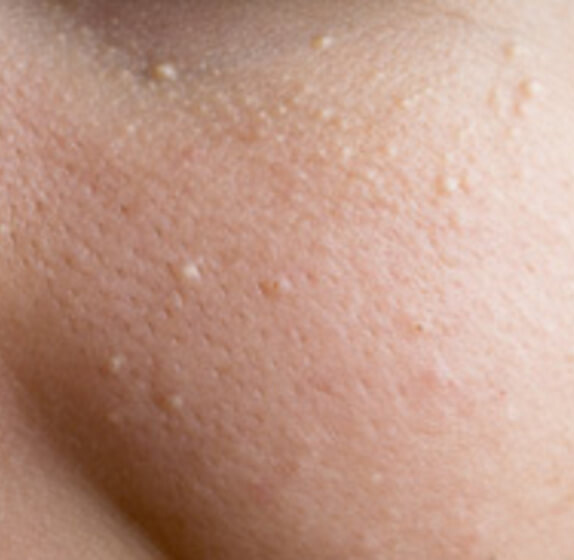
Milia (milium cysts)
“Color: White to pale yellow, due to keratin contents visible through the thin overlying epidermis.”
“Sensation: Milia are typically asymptomatic—there is no pain, itching, or discomfort.”
Read the article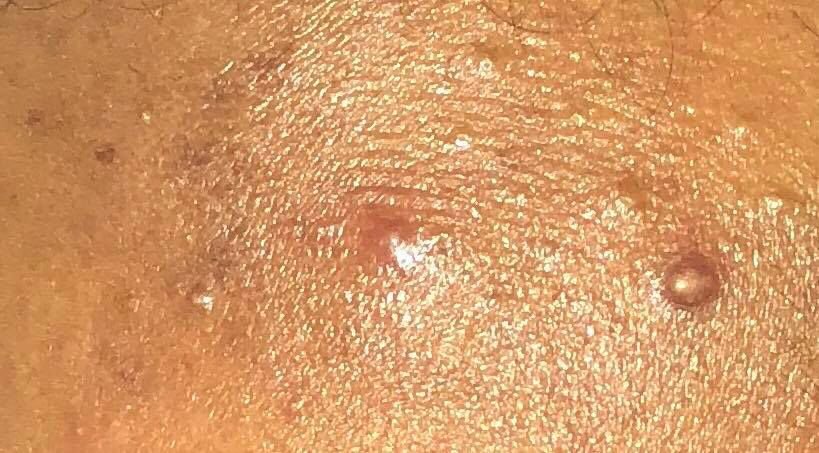 24 photos
Whiteheads (closed comedones)
“In contrast to inflammatory acne, closed comedones are not red, warm, or painful to the touch.”
Read the article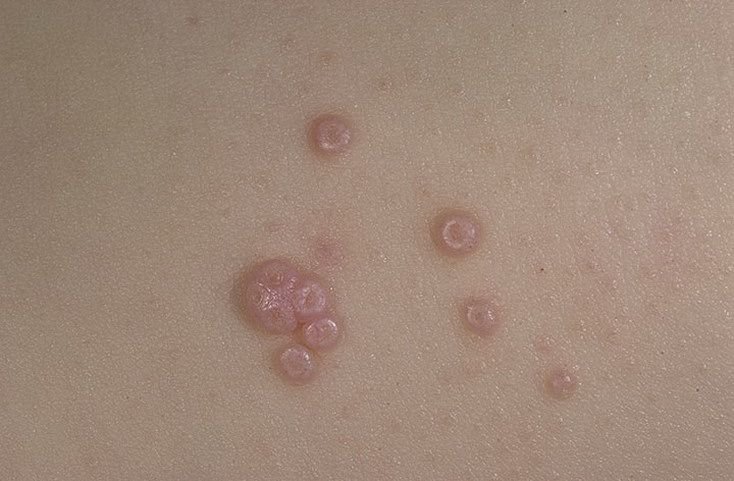 24 photos
Molluscum contagiosum
“The disease manifests as small, raised, dome-shaped lesions that often have a central dimple or umbilication.”
Read the article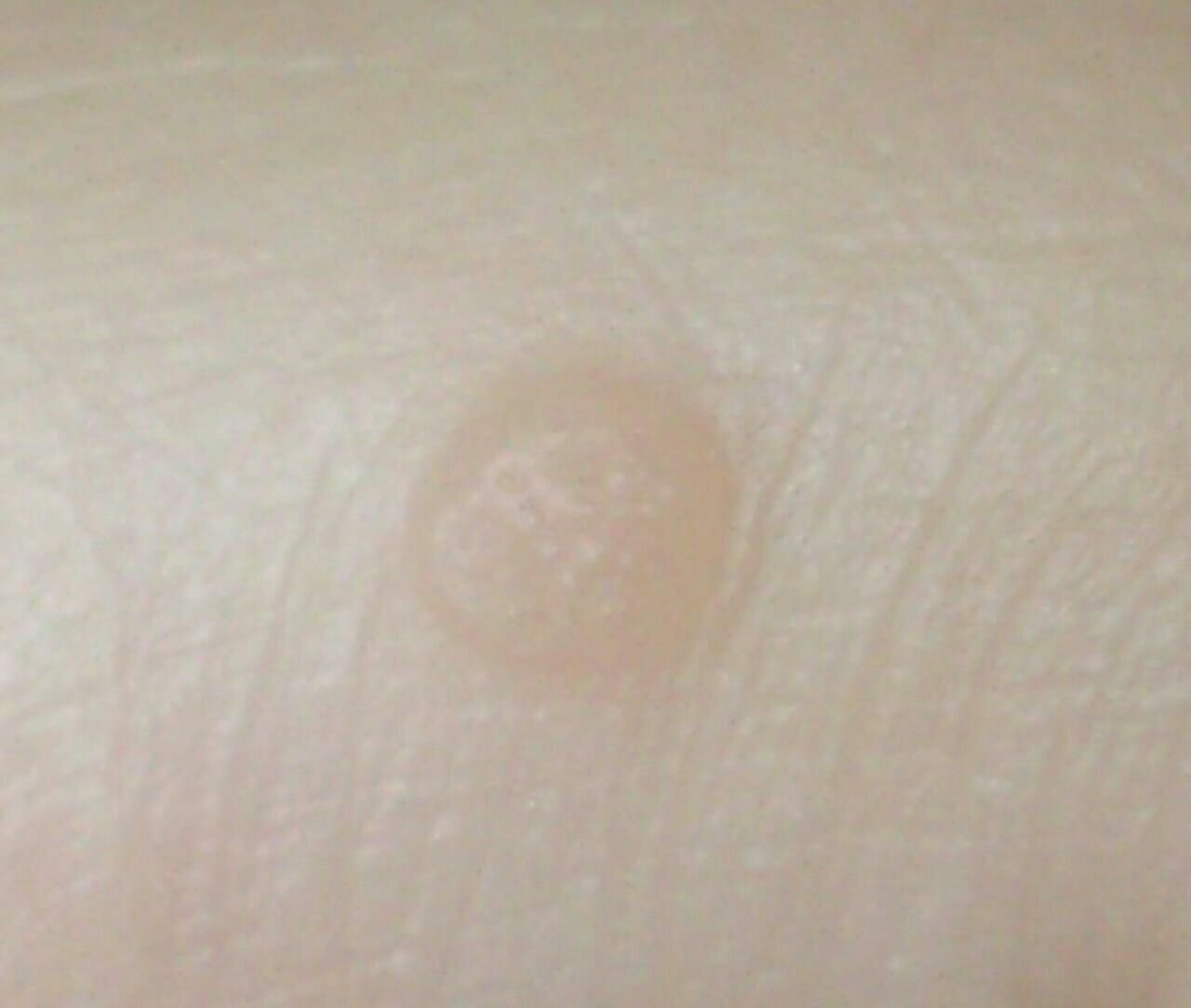 24 photos
Flat warts (plane warts)
“They often occur in clusters or linear patterns due to the Koebner phenomenon (appearance of new lesions after trauma).”
Read the articlePimple-like bumps and blackheads
Acne usually affects the face, chest and back; its raised bumps look pink or red on white skin and may look brown or purple on brown and black skin (NHS). Bumps after shaving can be razor bumps, described below the pictures. Rosacea, which also causes pimple-like bumps on the face, is pictured on our red spots page.
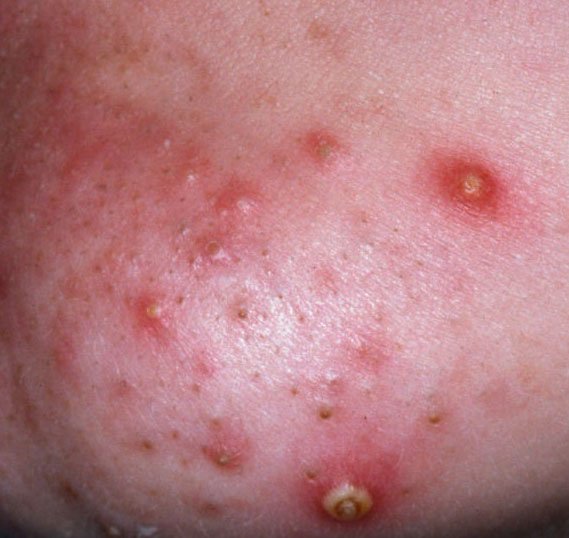 28 photos
Acne pimples (papules and pustules)
“Pustules: These lesions are similar in size to papules but contain visible yellowish or whitish pus.”
“Papules: Red or pink inflamed bumps that are tender to touch.”
Read the article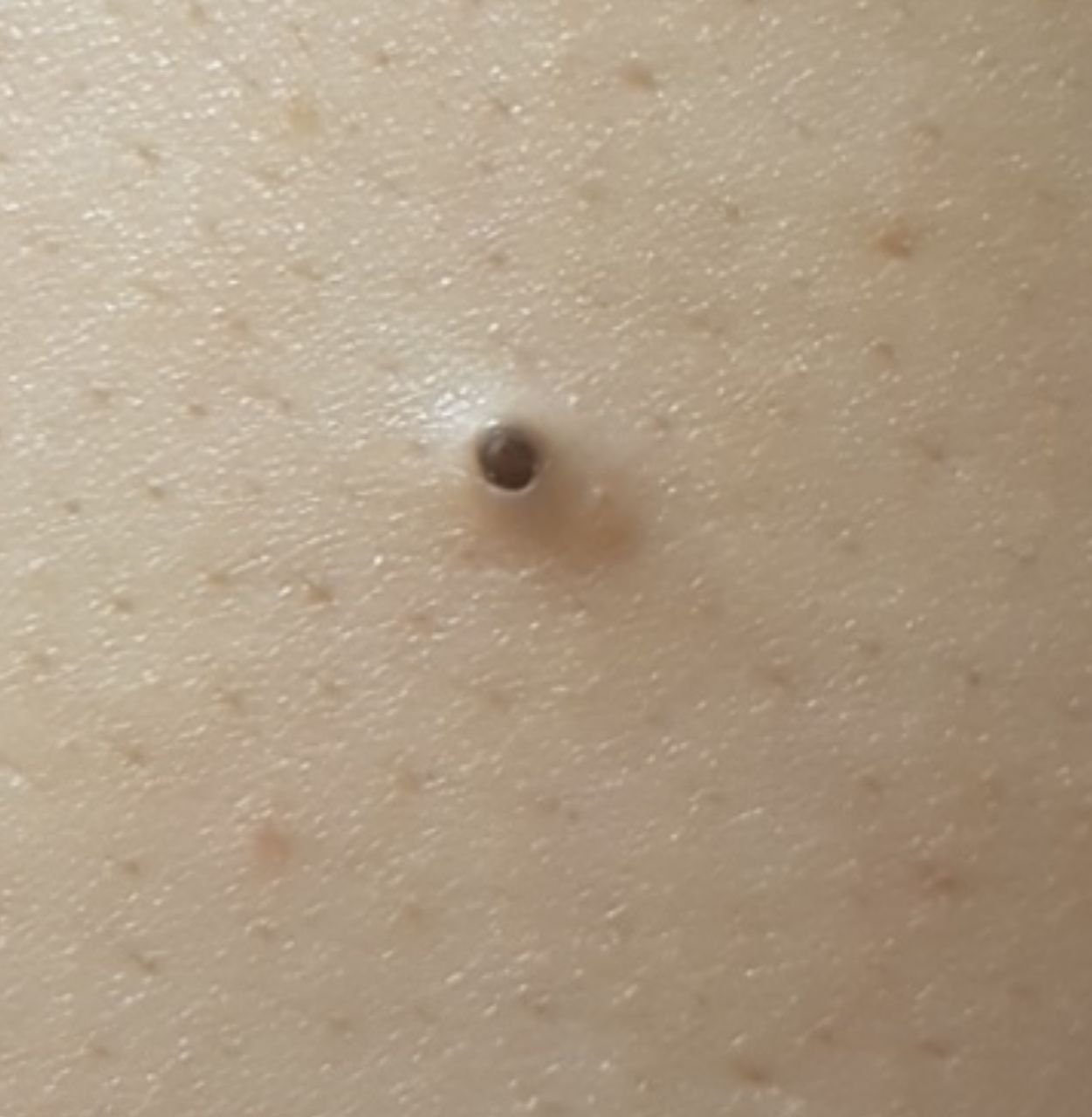 20 photos
Blackheads (open comedones)
“Their most distinguishing feature is a visible black dot at the center—this is the result of oxidized sebum and keratin at the opening of the clogged follicle.”
Read the article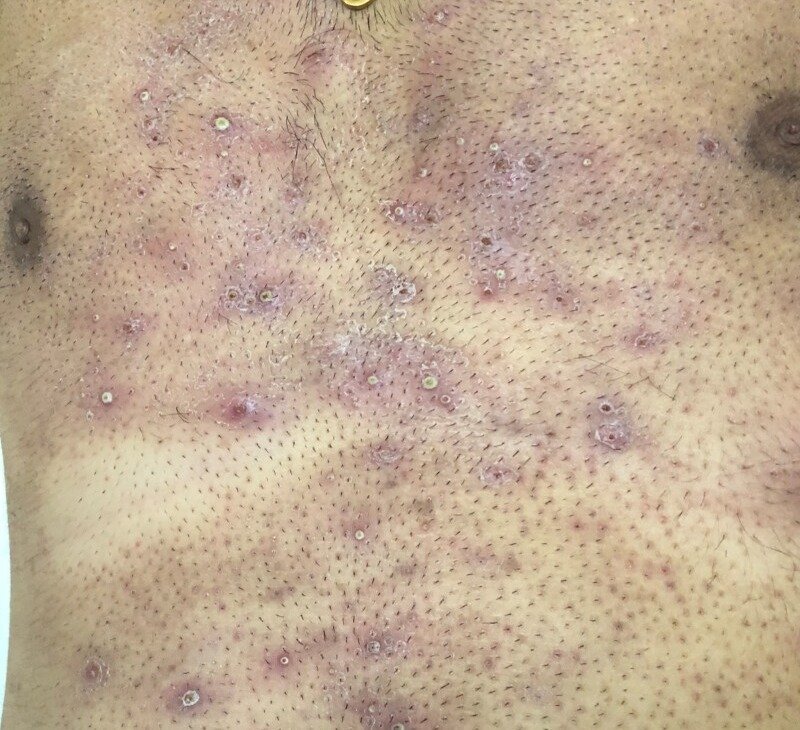
Folliculitis
“Itch or mild soreness, with itch predominating in Malassezia folliculitis and tenderness in bacterial forms.”
Read the articleRough, warty or stuck-on growths
Warts and verrucas are caused by a virus and can spread through close skin contact or from contaminated surfaces; verrucas have tiny black dots under the hard skin (NHS). Seborrheic keratoses are harmless and not contagious, but they can look like a wart or skin cancer; most people get them in middle age or later (AAD). Our atlas says other growths can look like a seborrheic keratosis and “a photograph cannot settle which it is.” A wart or growth that bleeds, changes or has never been checked: see When to see a doctor, above.
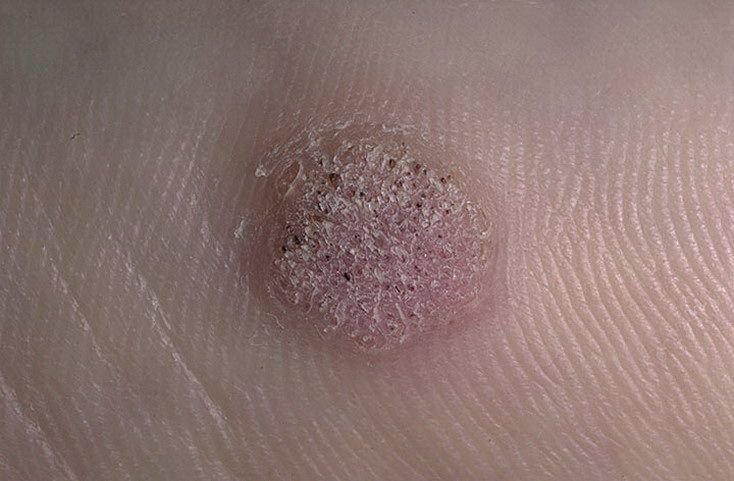 28 photos
Common warts
“Their papillomatous architecture resembles miniature cauliflower-like growths.”
Read the article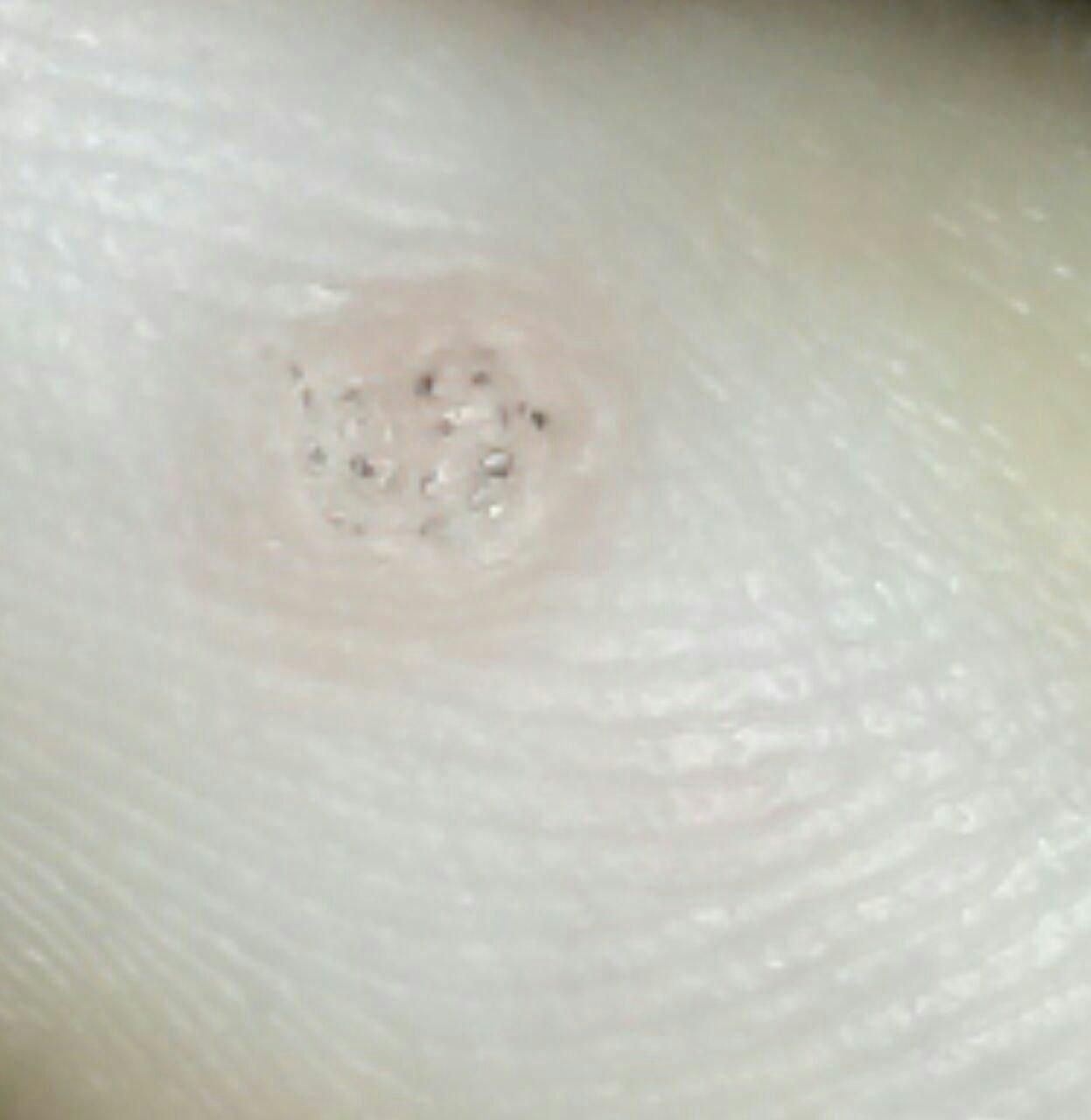 28 photos
Plantar warts (verrucas)
“Plantar warts appear as flat or slightly elevated lesions with a rough, thickened surface and often a keratin plug at the center.”
“Symptoms: Pain or tenderness when walking, pressure sensitivity, and possible tingling or discomfort.”
Read the article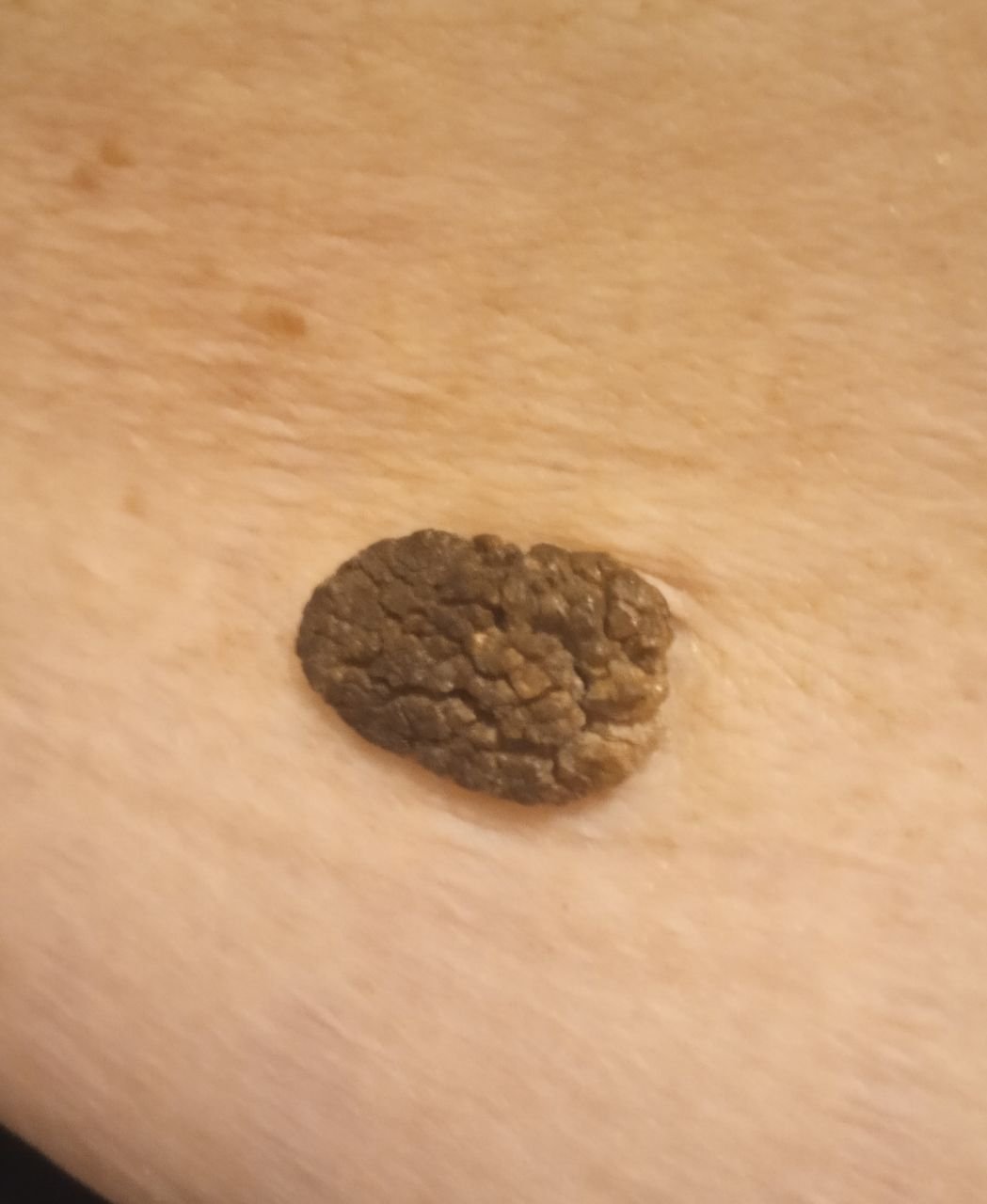 30 photos
Seborrheic keratosis
“During a visual examination, seborrheic keratosis appears as a flattened, hemispherical, or short-stalked lesion that rises above the skin.”
“In certain instances, the keratinization is so pronounced that parts of the keratosis may fall off on their own or with minimal physical impact.”
Read the articleSoft or firm raised bumps
Skin tags are soft growths, usually the colour of your skin or a little darker, that often grow where skin rubs together, such as the neck, armpits, eyelids, under the breasts, around the bottom and the groin, and range from about 2 mm to 5 cm; the NHS advises not removing a skin tag yourself unless a GP recommends it. Moles that are flat or changing are pictured on our brown spots and skin cancer pages. Our atlas says “a raised pigmented lesion cannot be classified from its appearance alone”, and that a firm lump can also be a skin cancer: see When to see a doctor, above.
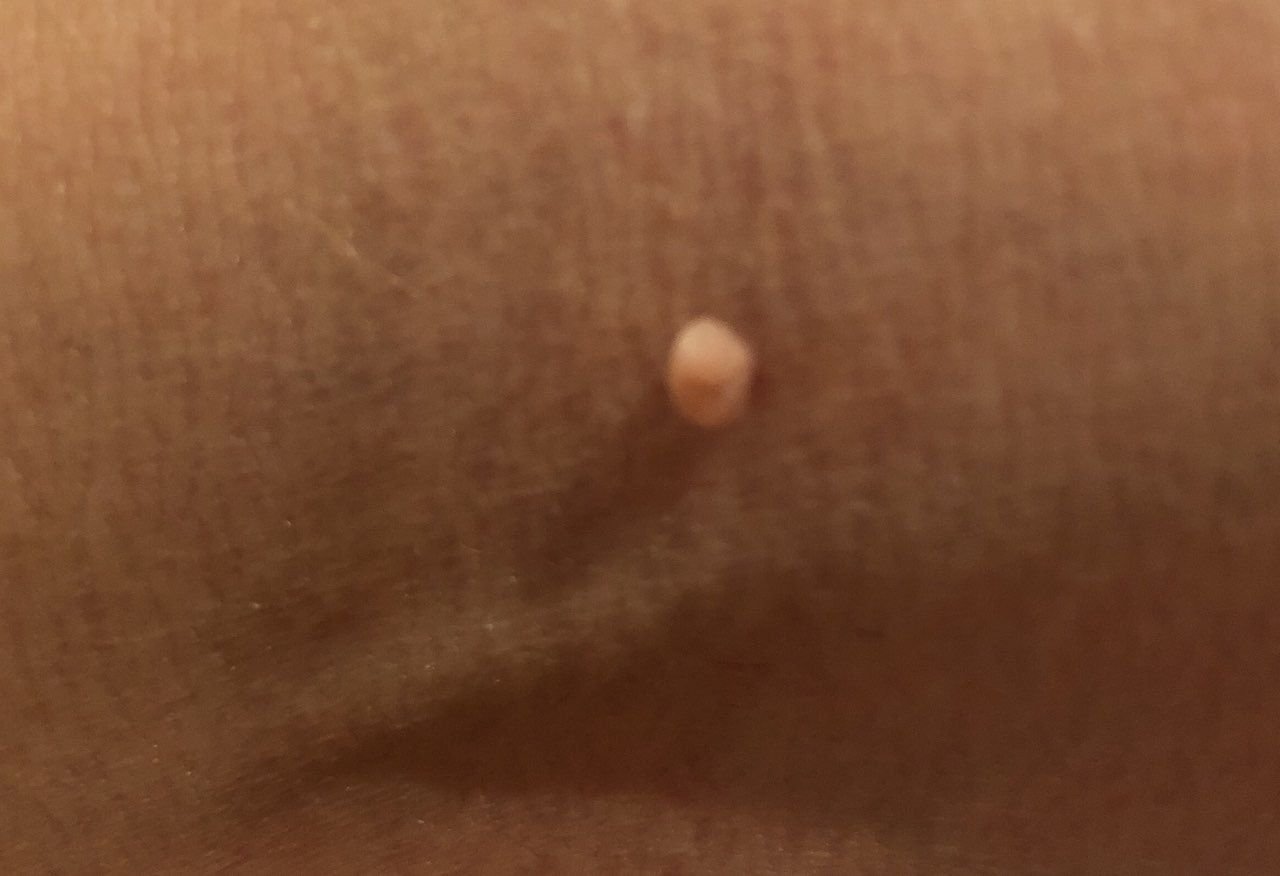 30 photos
Skin tags (papilloma)
“Upon visual inspection, a papilloma is recognized as an elongated formation that rises above the skin on a stem (pedicle).”
“Papillomas are most commonly found on the neck, axillary regions, inguinal regions, and the trunk (chest and back), though they can also appear on mucous membranes.”
Read the article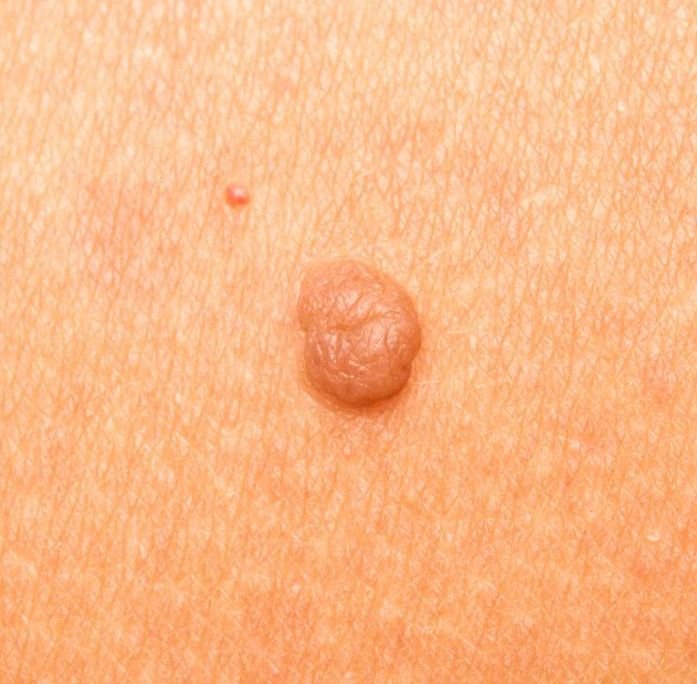 30 photos
Raised mole (papillomatous nevus)
“Upon visual examination, a papillomatous nevus typically presents as a hemispherical or slightly elevated growth that rises above the skin on a short, wide stalk (pedicle).”
Read the article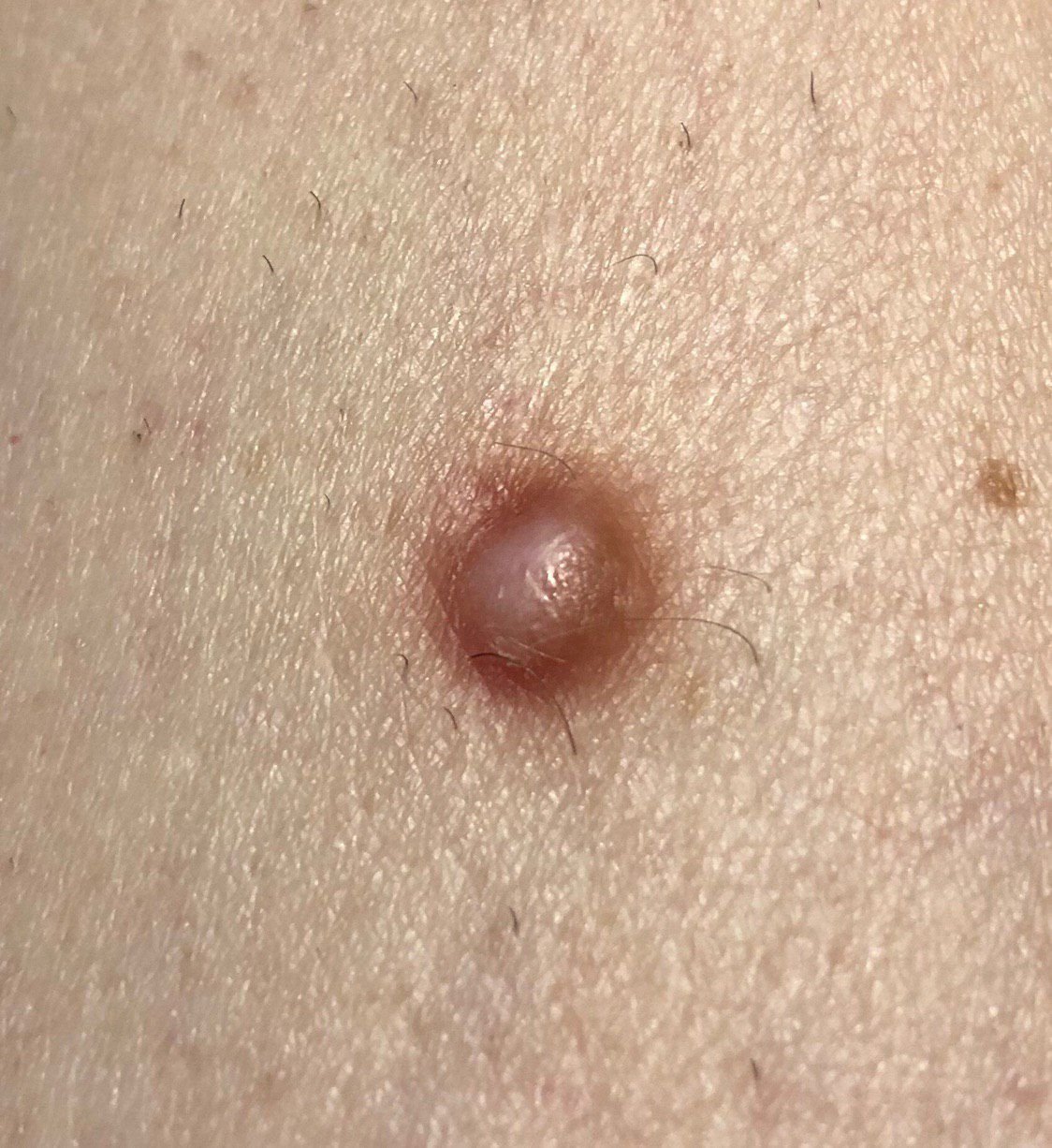 24 photos
Dermatofibroma
“On palpation, dermatofibromas feel firm and dense.”
“Dermatofibromas typically do not exceed 10 mm in diameter, with the majority being smaller.”
Read the articleLumps under the skin: deep, tender or swollen
Skin cysts, lipomas and boils have no atlas article; they are described below the pictures, with how each one usually feels. Acne nodules and cysts are larger lumps under the skin that can join together and be painful (NHS). Hidradenitis suppurativa can be mistaken for acne or ingrown hairs (NHS).
 28 photos
Acne nodules and cysts (cystic acne)
“Nodules: Larger, deeper, and firmer lesions located within the dermis.”
“Cysts: The hallmark of severe nodulocystic acne, these are deep, inflamed, fluid- or pus-filled lumps that develop beneath the skin.”
Read the article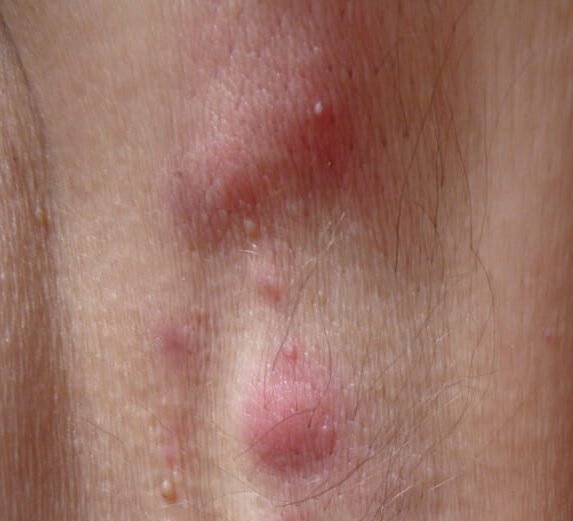
Hidradenitis suppurativa
“Deep painful nodules: Firm, tender lumps that sit under the skin rather than on it, often appearing days before anything is visible on the surface.”
“Lesions are usually bilateral and recur in the same places.”
Read the articleRed, purple or bleeding bumps
Cherry angiomas are firm red, blue or purple bumps, usually several, that become much more common from about the age of 40 (DermNet); our atlas article on hemangioma says “Lesions appearing in adult life, such as cherry angiomas, are again separate.” They are pictured on our red spots page. Our atlas says a pyogenic granuloma may bleed easily if it is injured, and that some skin cancers can look very similar: see When to see a doctor, above.
 24 photos
Hemangioma (blood-vessel growth)
“Acquired Hemangiomas: These lesions usually appear as small, hemispherical (sometimes on a narrow stalk), symmetrical nodules that protrude slightly above the skin.”
“Hemangioma is a benign growth made up of small blood vessels, usually capillaries, which appears as a flat or slightly raised red lesion.”
Read the article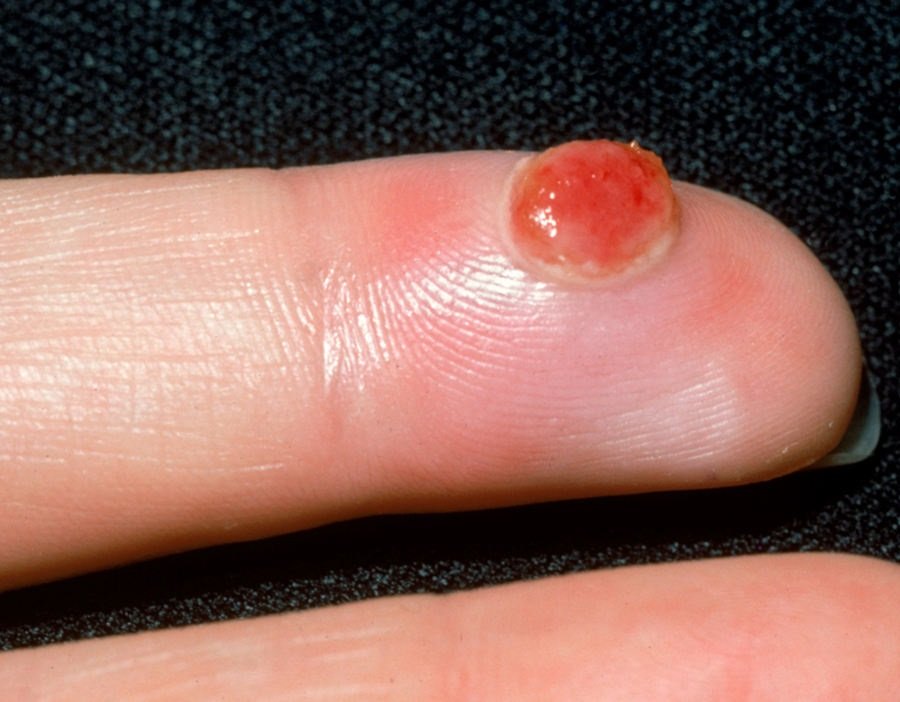 16 photos
Pyogenic granuloma
“The granuloma grows rapidly, often reaching a diameter of 1-1.5 cm within a short period.”
“The surface texture of the granuloma can differ from the surrounding skin, sometimes appearing smooth or lobed, resembling raspberries.”
Read the articleA bump that grows, bleeds or does not heal
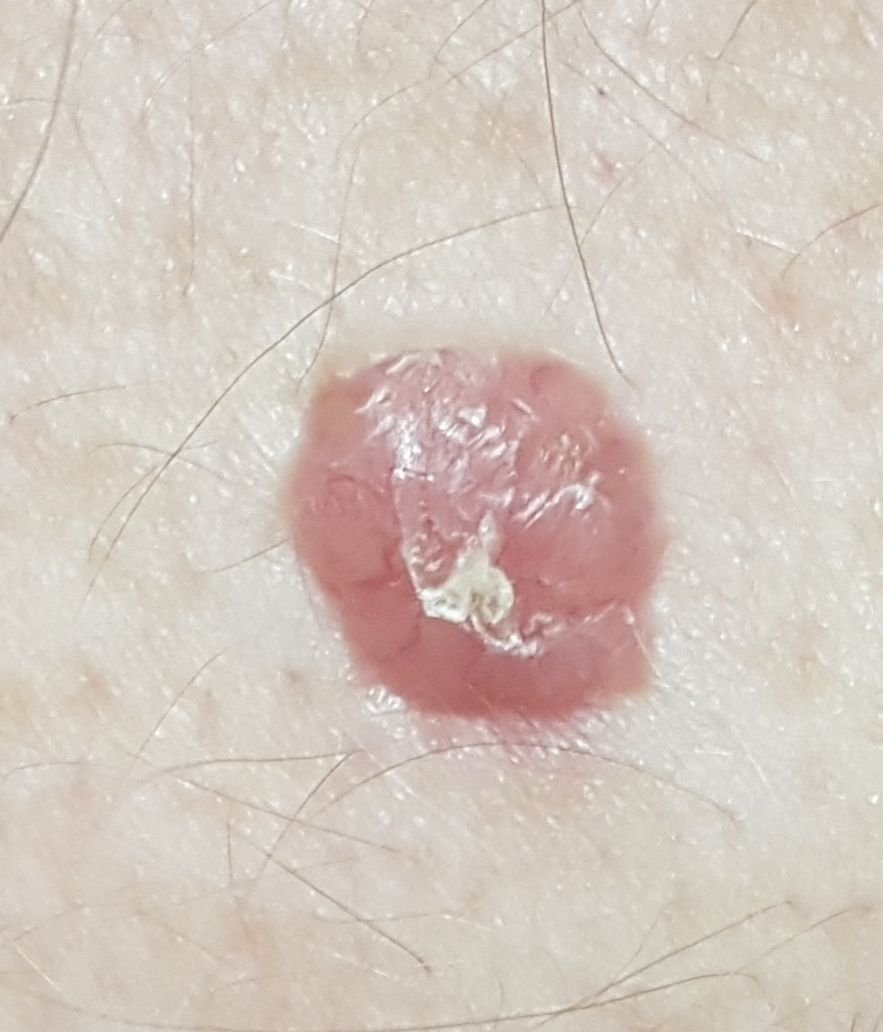
Some skin cancers are raised and smooth with clear edges; others are bumpier, rough or crusty (NHS). Our atlas says basal cell carcinoma can bleed “even with minor trauma or spontaneously”, and that a keratoacanthoma “may initially grow rapidly over weeks”; our atlas article on dermatofibroma adds that melanoma and squamous cell carcinoma can also present as a firm lump, and the one on raised moles that melanoma can be raised. Only a doctor can tell these growths apart: see When to see a doctor, above. More pictures are on our skin cancer page.
 32 photos
Basal cell carcinoma (nodular form)
“A nodular basal cell carcinoma, the commonest form, typically has a well-defined border with a raised, rolled, pearly rim.”
“Alternatively, it may present as a protruding nodule fixed to the skin, sometimes on a broad base.”
Read the article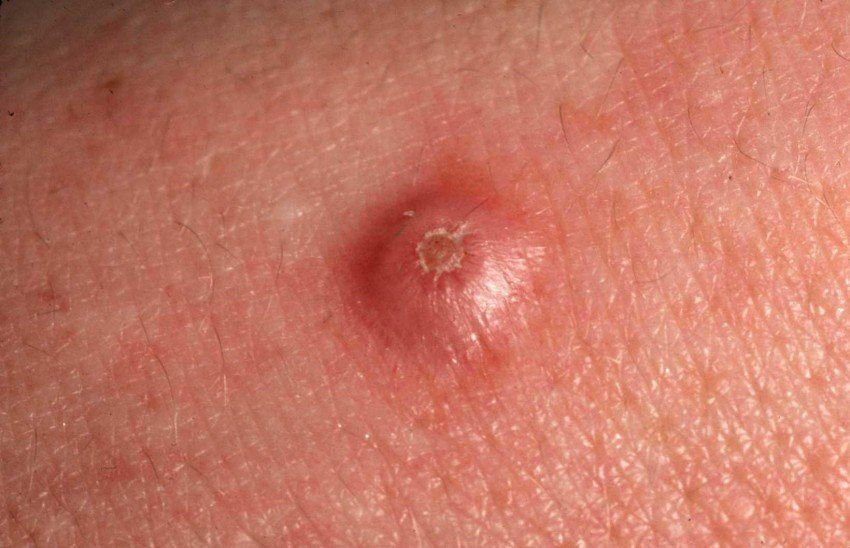 12 photos
Keratoacanthoma (managed like a skin cancer)
“Due to its clinical resemblance to invasive carcinomas, histological confirmation is essential.”
“On palpation, the lesion feels firm yet mobile relative to deeper tissues.”
Read the article
Medical review of the atlas articles above
Board-Certified Dermatologist · Fellow of the American Academy of Dermatology (FAAD)
Sources for the group notes: NHS — Keratosis pilaris · NHS — Molluscum contagiosum · Atlas — Flat warts · NHS — Acne · Atlas — Pustular acne · DermNet — Pseudofolliculitis barbae (razor bumps) · NHS — Warts and verrucas · AAD — Seborrheic keratoses · Atlas — Seborrheic keratosis · NHS — Skin tags · Atlas — Papilloma · Atlas — Papillomatous nevus · Atlas — Dermatofibroma · NHS — Skin cyst · NHS — Lipoma · NHS — Boils · NHS — Hidradenitis suppurativa · DermNet — Cherry angioma · Atlas — Hemangioma · Atlas — Pyogenic granuloma · NHS — Non-melanoma skin cancer: symptoms · Atlas — Basal cell carcinoma · Atlas — Keratoacanthoma
Keratosis pilaris: tiny rough bumps on the arms and thighs
Keratosis pilaris is a very common, harmless condition where small bumps appear on the skin. It has no atlas article, so this section uses the linked sources.
-
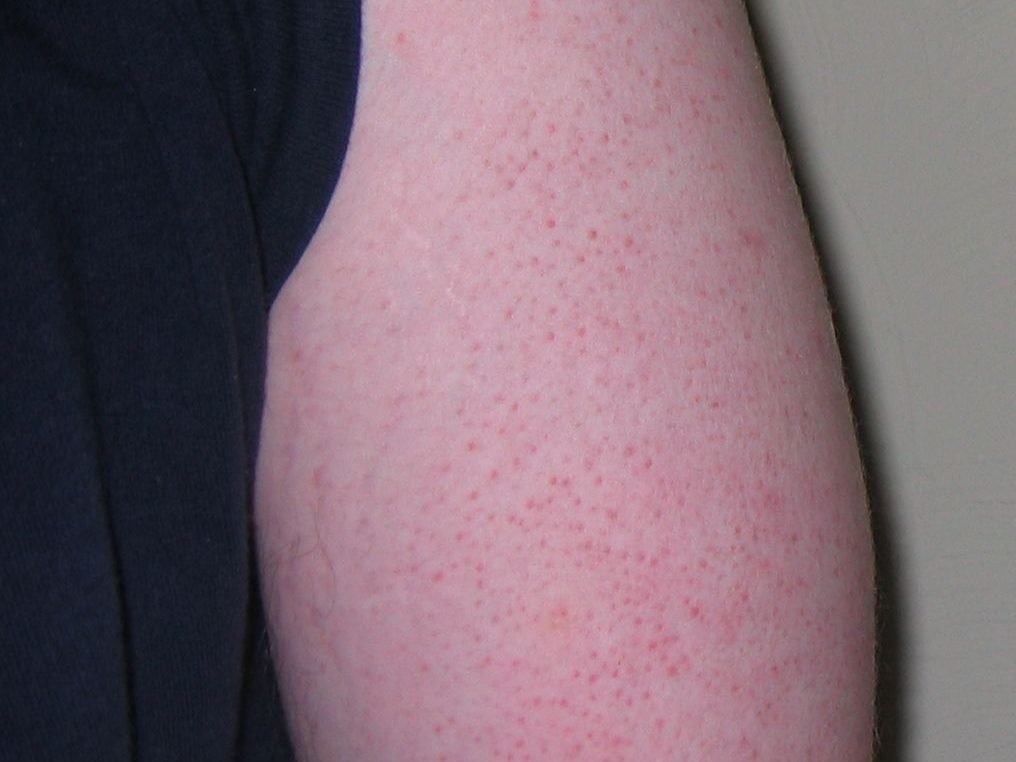
Photo: Feedmecereal, public domain, via Wikimedia Commons, cropped -
What it looks like
Patches of small, painless bumps and dry, rough skin. Some people say the bumps look like goosebumps or the skin of a plucked chicken; others mistake them for small pimples. The bumps are usually the colour of your skin, and can look red on white skin or darker on brown or black skin.
-
Where it appears
Usually the upper arms, thighs or bottom, though it can appear elsewhere; children may have the bumps on their cheeks. Our atlas article on folliculitis describes it as “Rough follicular bumps without inflammation, usually on the upper arms and thighs, present for years”.
-
How it changes
The skin can feel itchy. It may be better in summer and worse in winter, and dry skin makes the bumps more noticeable. Most people have it for years, and it may eventually clear up by itself.
-
Why it happens
Hair follicles become blocked with a build-up of keratin, a substance found in skin, hair and nails. It is thought to run in families, and it is not infectious: you cannot catch it or spread it.
-
What can help
The NHS suggests moisturising, mild unperfumed soaps, cool or lukewarm showers and baths, and not scratching, picking or rubbing the skin; harsh scrubs can make it worse. A pharmacist can advise if it bothers you or the skin becomes itchy or inflamed.
Sources: NHS — Keratosis pilaris · AAD — Keratosis pilaris · Atlas — Folliculitis
Lumps under the skin: cyst, lipoma, boil or something else?
How a lump feels can be a clue, but not an answer: the NHS describes a soft, squashy lump that moves as a possible lipoma, a smooth lump under the skin as a possible skin cyst, and a swollen, painful lump with a high temperature as a possible skin abscess, and advises not to self-diagnose. Acne nodules and hidradenitis suppurativa are pictured above. Which lumps need a doctor, and how soon: when to see a doctor.
Sources for this introduction: NHS — Lumps
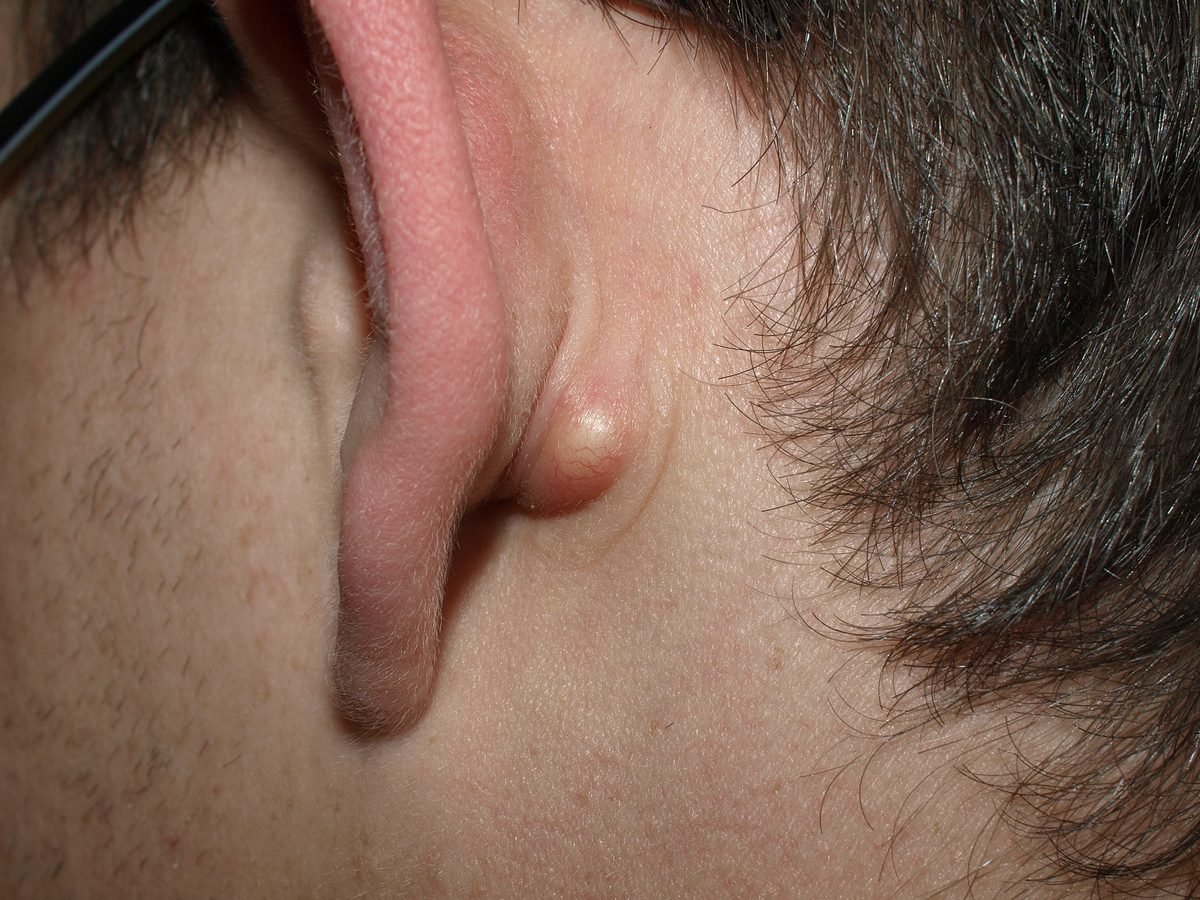
Skin cyst
Head, face, neck, chest, back
A round lump just under the skin that often contains fluid or pus and sometimes has a small, dark spot in the middle. It grows slowly, from smaller than a pea to several centimetres across, and can get sore or red if it gets infected. Our atlas describes epidermoid and pilar cysts as “Mobile, well-defined, often with a central punctum, and not inflamed unless ruptured”. Skin cysts are not cancerous, and you cannot catch one.
Do not squeeze a skin cyst: if it bursts it could become infected. When to see a doctor.
NHS — Skin cyst · Atlas — Hidradenitis suppurativa · NHS — Lumps
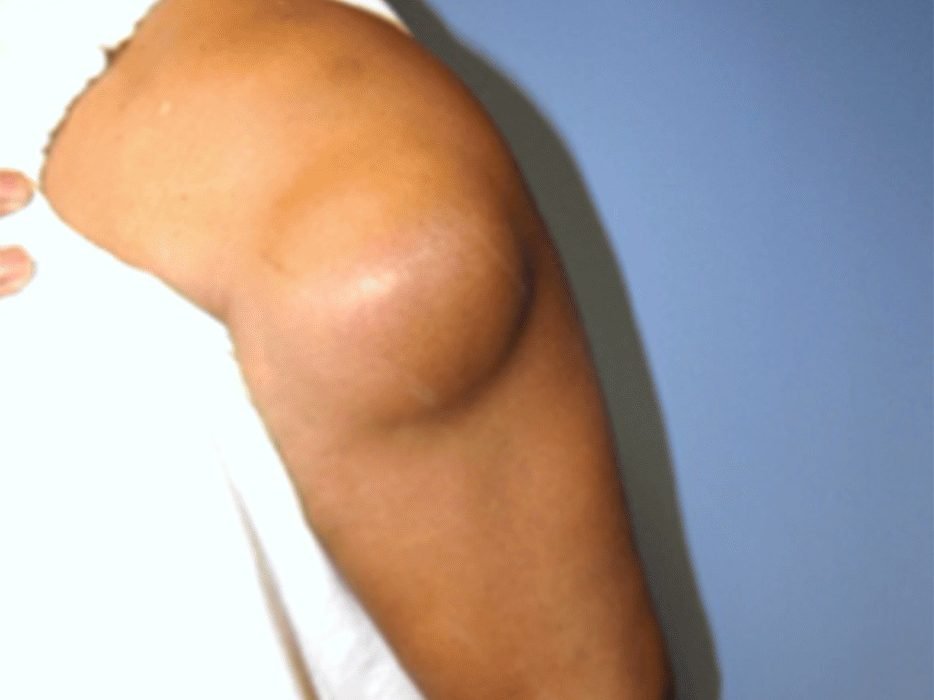
Lipoma
Shoulders, chest, arms, back, bottom, thighs
A soft, fatty lump under the skin that feels squishy, may move slightly when you press it, is not usually painful and grows slowly. It can be the size of a pea or a few centimetres across. Lipomas are common and harmless, but in rare cases a lump under the skin can be a sign of something more serious.
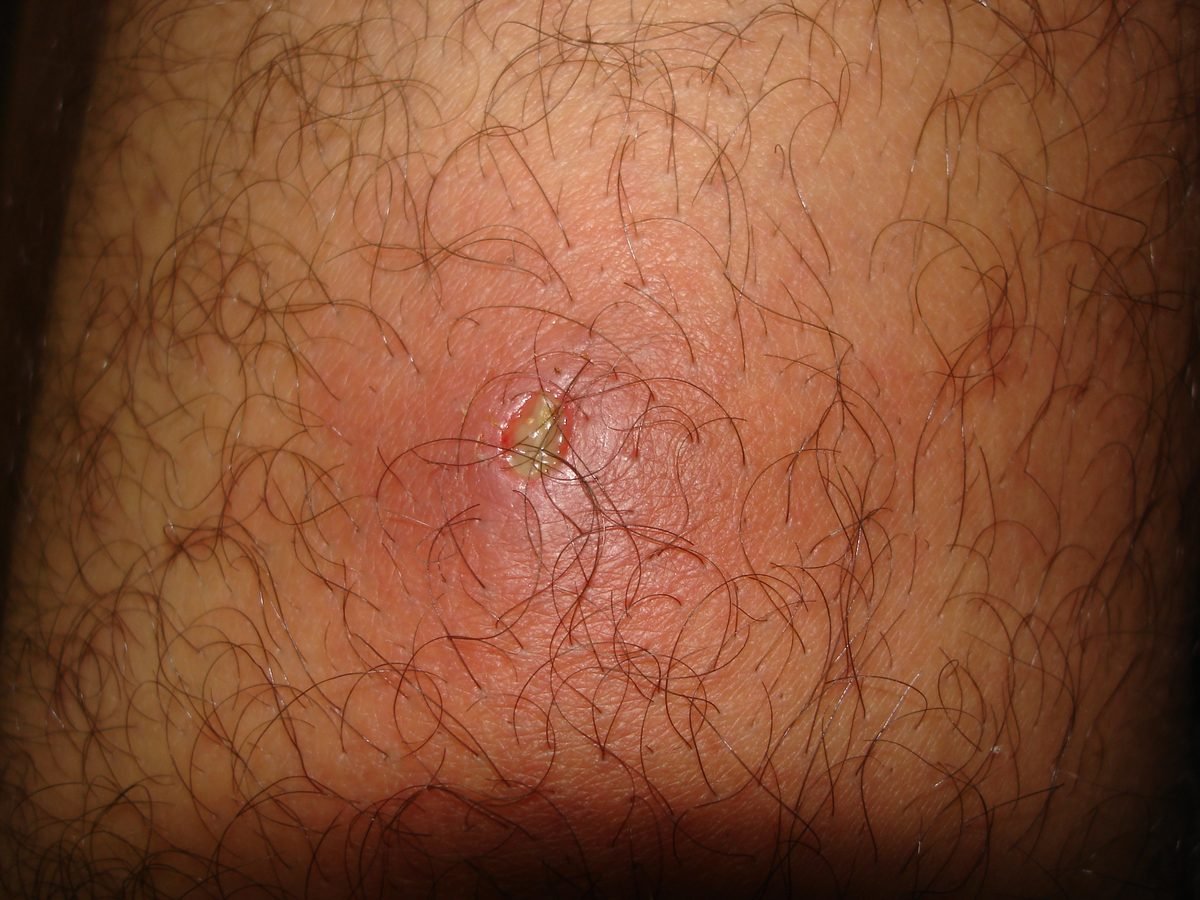
Boil
Anywhere on the body
A hard, painful lump that fills with pus. It often starts as an itchy or tender spot and can leak pus; several boils together are called a carbuncle. Most boils go away on their own, but some need a doctor.
Do not pick, squeeze or pierce a boil, and do not share towels until it has gone. When to see a doctor.
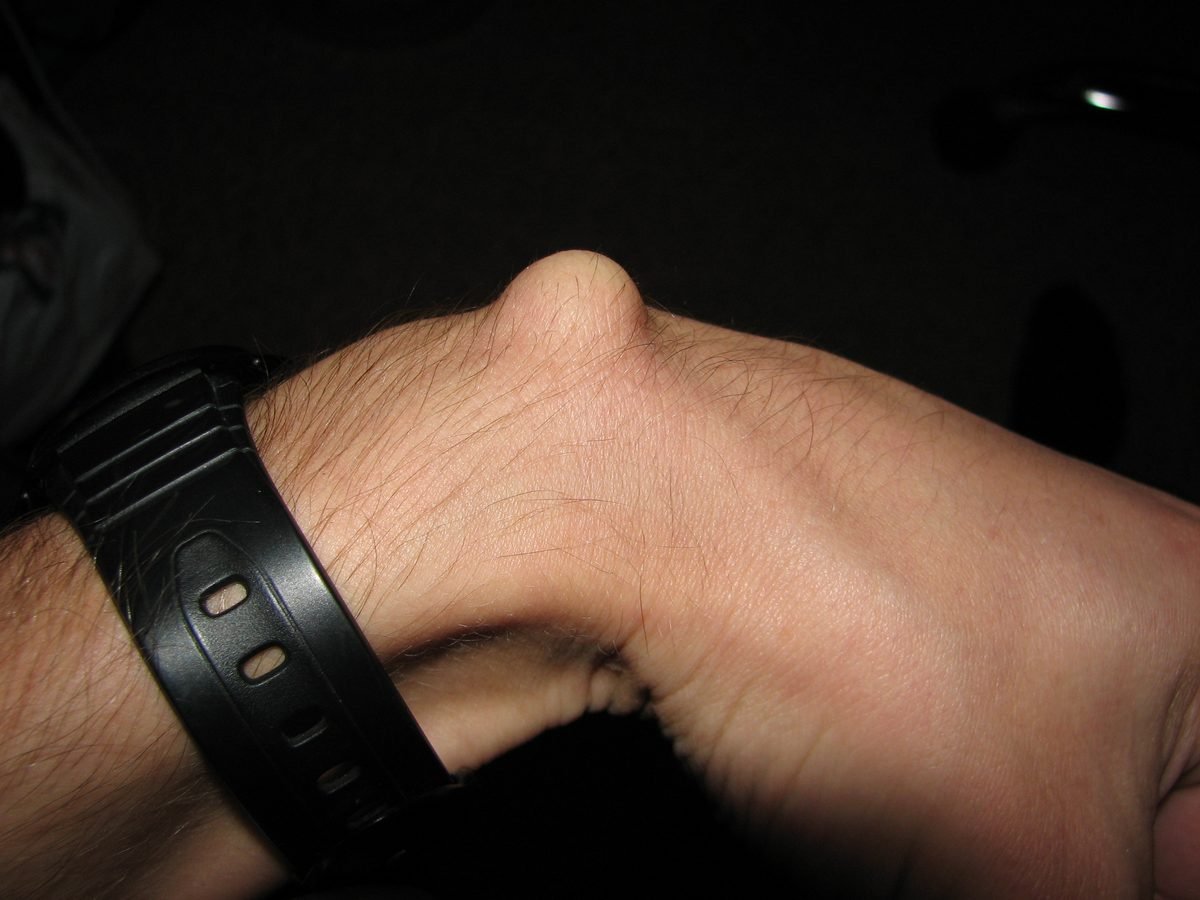
Ganglion cyst
Hand, wrist or finger
A smooth lump on the hand, wrist or finger. It is a type of cyst that forms in a joint or tendon.
Swollen glands
Neck, under the chin, armpits, groin
Tender, painful lumps on each side of the neck, under the chin, in the armpits or around the groin. They are usually a sign that the body is fighting an infection, such as a cold or a throat infection, and sometimes only one side swells. They are rarely caused by something more serious.
How long is too long, and the other signs that need a doctor: when to see a doctor.
Bumps on the face
Small bumps on the face can be one of several common types; most of them are pictured above. Many look alike, so the pictures cannot tell you which one you have.
-
Tiny, hard white bumps
Often milia. Our atlas says they are most common on the face, “particularly around the eyes (periorbital region), nose, chin, forehead, and cheeks”, and that they are common in newborns, where they clear without treatment within a few months. See milia.
-
Whiteheads and blackheads
Whiteheads are small bumps the same colour as your skin; blackheads are black or brown, usually flat but may be raised. Both are part of acne. See whiteheads.
-
Shiny bumps with a dimple
Molluscum contagiosum: raised, dome-shaped spots about 2 to 5 mm wide with a shiny white dimple in the middle, more common in children. See molluscum.
-
Smooth, flat-topped bumps
Flat warts are round and flat and can be yellow, and you can have many of them; our atlas describes them as “usually numerous and grouped on the face or the backs of the hands”. See flat warts.
-
Rough bumps on a child’s cheeks
Keratosis pilaris, usually on the arms and thighs, can appear on the cheeks in children. Keratosis pilaris.
-
Redness with pimple-like bumps
This can be rosacea, pictured on our red spots page.
-
A pearly bump that grows, bleeds or crusts
This can be basal cell carcinoma, a skin cancer; our atlas says it is most common on “sun-exposed areas such as the face (especially the nose, forehead, and cheeks)”. See basal cell carcinoma. Which changes need a doctor: when to see a doctor.
Sources: Atlas — Milium · NHS — Acne · NHS — Molluscum contagiosum · NHS — Warts and verrucas · Atlas — Flat warts · AAD — Keratosis pilaris · Atlas — Pustular acne · Atlas — Basal cell carcinoma
Razor bumps and ingrown hairs
Razor bumps (pseudofolliculitis barbae) are a common inflammatory reaction around hair follicles after shaving. They have no atlas article of their own; folliculitis, which can follow them, is pictured above.
-
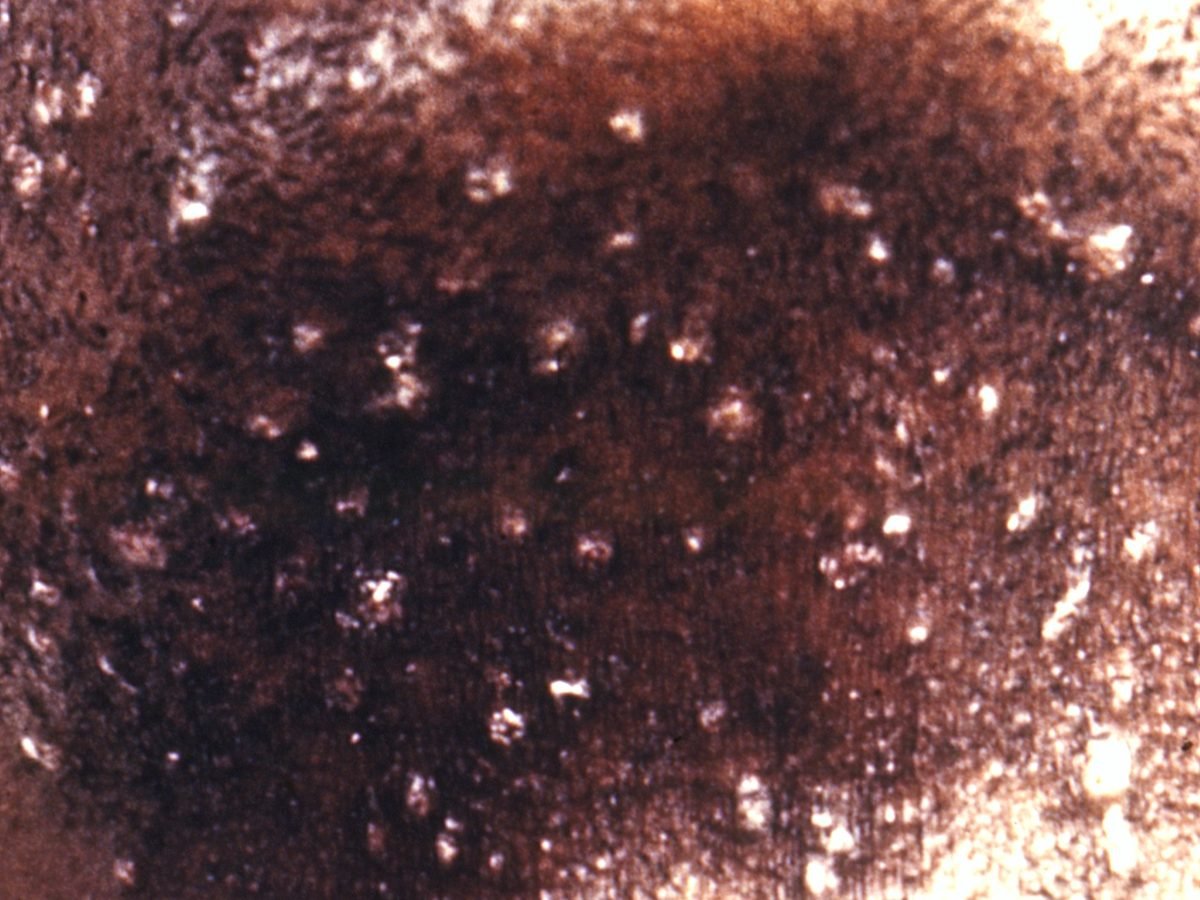
Photo: CDC / Renelle Woodall, Public Health Image Library #15565, public domain, cropped -
What they look like
Skin-coloured or red bumps with ingrown hairs, which can look like acne. They may be itchy or tender and may bleed when shaved. Our atlas article on folliculitis explains: “In tightly curled hair this produces pseudofolliculitis barbae, where the hair re-enters the skin and provokes inflammation without infection”.
-
Where they appear
Most often on the face and neck after shaving, typically under the jawline, but anywhere hair is shaved or plucked, including the armpits, pubic area and legs.
-
Who gets them
They are more common in people with tightly curled, coarse hair. They are most common in men of African ancestry, probably because tightly curled, coarse hair is more common in this group; women can get them too, especially in the groin.
-
What they can leave
Dark marks (post-inflammatory hyperpigmentation) and scars, including raised keloid scars. Injured follicles can become infected (folliculitis), and an abscess can form.
-
What can help
DermNet says the safest and surest cure is to stop shaving the area, and that changing how you shave or remove hair can reduce them. Bumps that become painful, hot or swollen: when to see a doctor.
Sources: DermNet — Pseudofolliculitis barbae (razor bumps) · Atlas — Folliculitis
Bumps on brown and black skin
Some bumps look different on brown and black skin. Four photos on this page show darker skin: whiteheads, skin tags, lipoma and razor bumps.
-
Colour
Acne bumps may look brown or purple rather than pink or red. Keratosis pilaris can look darker than the skin around it. Redness around an infected cyst or bite, or in a skin infection such as cellulitis, can be harder to see.
-
Feel as well as look
You should still be able to feel a lump or a bite even when its colour is hard to see, and infected skin can still feel painful, hot or swollen.
-
Razor bumps
Razor bumps are more common with tightly curled hair, and they can leave dark marks and keloid scars.
-
Marks after treatment
Removing a skin tag can leave a scar or a darker patch, particularly on brown or black skin; it is usually temporary but can be permanent.
Sources: NHS — Acne · NHS — Keratosis pilaris · NHS — Skin cyst · NHS — Cellulitis · NHS — Insect bites and stings · DermNet — Pseudofolliculitis barbae (razor bumps) · NHS — Skin tags
How common bumps differ
A summary of features from our atlas articles and the sources on this page. Many bumps look alike, so this table cannot tell you which one you have. Tap a name to see its picture or description.
| Bump | What it often looks like | Clues | Where it often appears |
|---|---|---|---|
| Milia | Tiny white or yellowish domes | Firm; no pain or itch; common in newborns | Face, especially around the eyes, nose and cheeks |
| Whiteheads | Small bumps the same colour as the skin | Part of acne; not red, warm or painful | Forehead, cheeks, chin, neck, chest, upper back |
| Keratosis pilaris | Patches of tiny, rough bumps | Can itch; may be better in summer, worse in winter; may run in families | Upper arms, thighs, bottom |
| Molluscum contagiosum | Small, shiny domes with a dimple in the middle | About 2 to 5 mm; in groups; spreads by skin contact | Children: body and skin folds; adults: lower tummy, genitals, thighs |
| Flat warts | Small, smooth, flat-topped bumps, often many | Can line up along a scratch | Face, backs of the hands |
| Acne pimples | Red or pink bumps (brown or purple on darker skin), some with pus | Tender; often with whiteheads and blackheads | Face, chest, back |
| Blackheads | A black or brown dot in a pore, usually flat but may be raised | Part of acne | Nose, forehead, chin, neck, chest, upper back |
| Folliculitis | Small red bumps or pus spots, each around a hair | Itchy or mildly sore | Scalp, beard area, chest, back, armpits, buttocks, thighs |
| Razor bumps | Skin-coloured or red bumps with ingrown hairs | After shaving or plucking; may itch or bleed when shaved | Beard area and under the jawline; armpits, groin, legs |
| Common warts | Firm, rough, cauliflower-like bumps | Caused by a virus; can spread | Hands and fingers, knuckles, knees |
| Verrucas | Hard skin with tiny black dots | Can hurt when walking, like standing on a needle | Feet |
| Seborrheic keratosis | A stuck-on, warty or waxy growth, usually tan or brown | Harmless, but can look like a wart or skin cancer; not contagious; most common from middle age | Chest, back, head, neck; not the palms or soles |
| Skin tags | Soft growths that hang off the skin | The colour of the skin or a little darker; usually painless | Neck, armpits, eyelids, under the breasts, around the bottom, groin |
| Raised mole | A dome on a short, wide stalk | Flesh-coloured to brown; feels like normal skin | Face, scalp, neck, chest, back |
| Dermatofibroma | A small, firm bump, flesh-coloured to brown | Feels firm and dense; usually 10 mm or smaller | Legs and shoulders |
| Skin cyst | A round lump under the skin, sometimes with a dark dot | Grows slowly; can get sore or red if infected | Head, face, neck, chest, back |
| Lipoma | A soft, squishy lump under the skin | May move slightly when pressed; not usually painful | Shoulders, chest, arms, back, bottom, thighs |
| Boil | A hard, painful lump that fills with pus | Often starts as an itchy or tender spot | Anywhere |
| Acne nodules and cysts | Large, deep lumps under the skin | Can be painful; can leave scars | Face, chest, back, shoulders |
| Hidradenitis suppurativa | Painful lumps under the skin that can leak pus | Keep coming back in the same places | Armpits, groin, buttocks, under the breasts |
| Hemangioma | A small red dome, sometimes on a narrow stalk | A growth of small blood vessels; the small domed type is usually up to 5 to 7 mm across | Trunk, arms |
| Pyogenic granuloma | A red bump, smooth or lobed like a raspberry | Grows fast; bleeds easily if injured | Hands and feet, especially the fingers |
| Basal cell carcinoma | A pearly bump with a raised, rolled edge | Can bleed or crust; a skin cancer | Sun-exposed skin: face, ears, scalp, neck, shoulders |
| Keratoacanthoma | A firm dome with a crater or plug in the middle | Can grow fast at first; managed like a skin cancer | Forearms, hands, face, neck, back, lower legs |
Sources: the atlas articles linked in the cards · NHS — Keratosis pilaris · NHS — Molluscum contagiosum · NHS — Acne · DermNet — Pseudofolliculitis barbae (razor bumps) · NHS — Warts and verrucas · AAD — Seborrheic keratoses · NHS — Skin tags · NHS — Skin cyst · NHS — Lipoma · NHS — Boils · NHS — Hidradenitis suppurativa · NHS — Non-melanoma skin cancer: symptoms
Other causes of bumps
Other bumps and lumps, described briefly using the linked sources; several of them have their own page on this site.
Sources for this introduction: NHS — Insect bites and stings
Insect bites and stings
Often exposed skin
A small, swollen lump with pain and itching where you were bitten or stung, sometimes with a mark where you were bitten or stung, or many bites grouped together. Mosquito bites are usually small, raised and itchy; flea bites are often in groups on the ankles and lower legs. Our atlas article on folliculitis says bites are “Scattered rather than follicular, and usually on exposed skin”. Most get better in a few days.
Which bites need a doctor, and how soon: when to see a doctor.
Itchy bumps that come in a crop
Anywhere
Hives (raised, itchy bumps or patches that can sting or burn), heat rash (small raised spots 2 to 4 mm across with a prickly feeling) and scabies (intense itching, worse at night, often between the fingers) cause many itchy bumps at once. They are pictured and described on our skin rash page.
NHS — Hives · NHS — Heat rash (prickly heat) · NHS — Scabies
Lumps in particular places
Groin, neck, eyelid, knee, bottom, or anywhere
The NHS lists other possible causes for lumps in some places: a lump in the groin can be a hernia, and fleshy growths around the groin can be genital warts; a lump on the front of the neck can be a goitre; a small lump or swelling on the eyelid can be a meibomian cyst (chalazion); a fluid-filled swelling on the back of the knee can be a Baker’s cyst; and a lump around the bottom, often with itching or pain, can be piles. Anywhere on the body, a lump that is painless at first, then gets bigger and becomes painful, can be a soft tissue sarcoma.
Do not self-diagnose: when to see a doctor.
Cherry angiomas
Most of the body
Firm red, blue or purple bumps from 1 mm to 1 cm across, usually several, that become much more common from about the age of 40 and are harmless; they are rare on the hands and feet. They are more noticeable on white skin. They are pictured on our red spots page.
A red bump that a doctor has never checked: when to see a doctor.
Terms used on this page
- Papule
- A small, solid, raised bump on the skin that has a border with edges that are easy to see. (NCI)
- Nodule
- A growth or lump that may be cancer or not cancer. (NCI) Our atlas uses it for a larger, deeper bump.
- Cyst
- A closed, sac-like pocket of tissue that may be filled with fluid, pus or other material. Most cysts are not cancer. (NCI)
- Pustule
- A raised bump filled with pus. (NHS)
- Comedone
- A blocked pore. A closed comedone is a whitehead and an open comedone is a blackhead; both are part of acne. (NHS, atlas)
- Hair follicle
- The part of the skin where a hair grows. Acne, folliculitis and keratosis pilaris all start in blocked or inflamed hair follicles. (NHS, atlas)
- Keratin
- A substance found in skin, hair and nails. A build-up of keratin blocks the hair follicles in keratosis pilaris and fills milia. (NHS, atlas)
- Pedicle
- A stalk. Our atlas describes a skin tag (papilloma) as rising above the skin “on a stem (pedicle)”.
- Umbilication
- A small dimple in the middle of a bump, typical of molluscum contagiosum. (atlas)
- Benign
- Not cancer. (NCI)
- Lesion
- An area of abnormal or damaged tissue (NCI). Our atlas uses the word for bumps, spots and patches on the skin.
- Biopsy
- A test in which a very small sample of a lump is removed and checked. (NHS)
Sources: NCI Dictionary of Cancer Terms · NHS — Acne · NHS — Keratosis pilaris · Atlas — Folliculitis · Atlas — Closed comedone · Atlas — Open comedone · Atlas — Milium · Atlas — Papilloma · Atlas — Molluscum contagiosum · NHS — Lumps.
Bumps on skin: FAQ
What are these small bumps on my skin?
Common small bumps include milia, whiteheads and blackheads, acne, keratosis pilaris, molluscum contagiosum, warts, skin tags and folliculitis. Look at three things: what the bump looks like (white, skin-coloured, red, brown, rough or smooth), how it feels (soft, firm, tender or not at all) and where it is. The pictures and the table on this page can help you describe it, but they cannot tell you which one you have, and some bumps need a doctor: when to see a doctor. Sources: NHS — Lumps, Atlas — Milium, NHS — Keratosis pilaris, NHS — Acne, NHS — Molluscum contagiosum, NHS — Warts and verrucas, NHS — Skin tags, Atlas — Folliculitis.
What are the tiny bumps on my upper arms?
It can be keratosis pilaris, a very common condition: patches of small, rough bumps, usually on the upper arms, thighs or bottom, that can look like goosebumps. It is harmless, may be better in summer and worse in winter, and it is not infectious. More about keratosis pilaris. Sources: NHS — Keratosis pilaris, AAD — Keratosis pilaris.
When should I worry about a lump under the skin?
Most lumps are harmless; common causes include skin cysts, lipomas and swollen glands. But some signs mean a lump needs a doctor, and a few need help sooner. They are listed in one place, with how soon to act on each: when to see a doctor. Sources: NHS — Lumps, NHS — Skin cyst, NHS — Lipoma, NHS — Swollen glands.
What are white bumps on my face if they are not milia?
They can be whiteheads (small bumps the same colour as your skin, part of acne), molluscum contagiosum (shiny domes with a dimple in the middle) or flat warts, which can be yellowish. In children, rough skin-coloured or red bumps on the cheeks can be keratosis pilaris. Flat white spots that you cannot feel are on our white spots page. Bumps on the face. Sources: NHS — Acne, NHS — Molluscum contagiosum, NHS — Warts and verrucas, NHS — Keratosis pilaris, AAD — Keratosis pilaris.
What is the difference between milia and whiteheads?
Milia are tiny cysts filled with keratin: white to pale yellow, firm, and with no pain or itch, often around the eyes and nose. Whiteheads are blocked pores (closed comedones) and part of acne, and you may also have other types of acne spots, such as blackheads and pimples. Our atlas says closed comedones are not red, warm or painful to the touch. Sources: Atlas — Milium, Atlas — Closed comedone, NHS — Acne.
Are skin bumps contagious?
Some are. Warts, verrucas and molluscum contagiosum are caused by viruses and spread through close skin contact, and warts can also spread from contaminated surfaces. Boils can pass an infection on, so do not share towels until a boil has gone. Keratosis pilaris, skin cysts, seborrheic keratoses and hidradenitis suppurativa are not contagious. Sources: NHS — Warts and verrucas, NHS — Molluscum contagiosum, NHS — Boils, NHS — Keratosis pilaris, NHS — Skin cyst, AAD — Seborrheic keratoses, NHS — Hidradenitis suppurativa.
Why do I get bumps after shaving?
They can be razor bumps: cut hairs grow back into the skin and cause red or skin-coloured bumps, most often in the beard area and under the jawline, and more often with tightly curled hair. Folliculitis, an inflammation of the hair follicles that can follow shaving, looks similar. Shaving can also spread flat warts, which is why our atlas advises not to shave over them. More about razor bumps. Sources: DermNet — Pseudofolliculitis barbae (razor bumps), Atlas — Folliculitis, Atlas — Flat warts, NHS — Warts and verrucas.
What are itchy bumps that look like bites but aren’t?
Hives, scabies and heat rash all cause itchy bumps, and so does folliculitis; our atlas notes that insect bites are “Scattered rather than follicular, and usually on exposed skin”. Bumps that come in a crop and itch are often a rash: they are pictured on our skin rash page. Insect bites themselves are usually small, swollen, itchy lumps on exposed skin. Sources: NHS — Hives, NHS — Scabies, NHS — Heat rash (prickly heat), NHS — Insect bites and stings, Atlas — Folliculitis.
Can a bump on the skin be cancer?
Sometimes. Some skin cancers are raised and smooth with clear edges; others are bumpier, rough or crusty, and they are most common on skin exposed to the sun. Basal cell carcinoma and keratoacanthoma are pictured in the last group of cards; more types are on our skin cancer page. Most lumps are harmless, but the changes that need a doctor are listed in when to see a doctor. Sources: NHS — Non-melanoma skin cancer: symptoms, NHS — Melanoma skin cancer: symptoms, NHS — Lumps, Atlas — Basal cell carcinoma, Atlas — Keratoacanthoma.
Should I squeeze or pop a bump?
No. The NHS advises not to squeeze a skin cyst, because if it bursts it could become infected; not to pick, squeeze or pierce a boil; not to pick or squeeze acne spots, because this can cause scars; not to squeeze or scratch molluscum spots; not to scratch or pick a wart; and not to remove a skin tag yourself unless a GP recommends it. Sources: NHS — Skin cyst, NHS — Boils, NHS — Acne, NHS — Molluscum contagiosum, NHS — Warts and verrucas, NHS — Skin tags.
How do I get rid of bumps on my skin?
It depends on the cause, so there is no single answer. Many bumps need no treatment once a doctor has checked what they are: skin cysts, lipomas, skin tags and seborrheic keratoses are usually harmless, and molluscum contagiosum usually clears on its own. Warts usually go away on their own too, though it may take months or even years. A pharmacist can advise on acne, warts (not on the face or genitals) and keratosis pilaris, and can tell you if you need to see a GP, and a GP can check a bump and treat or remove it if needed. Removing a harmless skin tag, cyst or lipoma only because of how it looks is usually not available on the NHS. Which bumps need a doctor: when to see a doctor. Sources: NHS — Skin cyst, NHS — Lipoma, NHS — Skin tags, AAD — Seborrheic keratoses, NHS — Molluscum contagiosum, NHS — Warts and verrucas, NHS — Acne, NHS — Keratosis pilaris.
Can a photo or an AI skin check tell me what my bump is?
No. Pictures show what bumps can look like, but many bumps look alike, and the output of an AI skin check is not a medical diagnosis. The photo check also does not cover every cause on this page — for example keratosis pilaris, skin cysts, lipomas, boils, folliculitis or razor bumps — so its result cannot rule a cause out, and a photo cannot show what is under the skin. If you have any of the signs in when to see a doctor, get medical help instead. Sources: NHS — Lumps.
For a clear photo: daylight, close and in focus, no filters. Upload a photo for an AI skin check. AI output is not a medical diagnosis. If you have any of the signs in the list of when to see a doctor, get medical help instead.
Check my skin ↑SkinAI Lab is a paid AI analysis; pricing is shown before you scan.


Prepared by the SkinAI Lab editorial team · Updated . Apart from the quoted atlas text, this page has not been reviewed by a doctor. It is general information, not medical advice.