
Fungal infection on skin: pictures, types and look-alikes
This tool is for informational purposes only and does not constitute medical advice. Always consult a qualified dermatologist.
The pictures and answers on this page are free. SkinAI Lab is a paid AI analysis; pricing is shown before you scan. A photo check cannot confirm or rule out a fungal infection, and it does not cover every cause on this page.
What does a fungal skin infection look like?
It depends on where it is. On most of the body, ringworm (a fungal infection, not a worm) causes roundish, flat patches with a raised, scaly border; the centre tends to clear first, and the patches can be very itchy. In the groin it is called jock itch, on the feet athlete’s foot, and in a nail it makes the nail thick, discoloured and brittle. On the scalp it can cause a scaly patch with hair loss. Tinea versicolor, caused by a yeast that normally lives on the skin, makes flat patches that are lighter or darker than the skin around them, usually on the chest and back. A yeast infection of the skin (candidiasis) causes red, moist patches in skin folds. Eczema, psoriasis and other rashes can look very similar, so pictures cannot tell you whether a rash is fungal. A doctor can check a skin scraping under a microscope. First, should you see a doctor?
- Get help urgently — call a doctor or go to an emergency department — if a rash is all over your body, starts suddenly and spreads quickly, is painful, blistered or infected, or comes with a fever. If you are pregnant, contact your midwife or doctor straight away about any new rash. All the signs
- See a doctor if you are not sure what the rash is; if it is on your scalp or in your beard; if it has not cleared with treatment or keeps coming back; if a nail infection is severe and has not improved with treatment, or has spread to other nails; or if you have diabetes or a weakened immune system.
- Usually treatable: antifungal medicine can clear ringworm from every area of the body, though nails and hands take time. Because many rashes look alike, have a rash checked before you treat it as fungal, and before you put a steroid cream on it.
Sources: AAD — Ringworm: signs and symptoms · NHS — Ringworm · NHS — Athlete’s foot · NHS — Fungal nail infection · NHS — Pityriasis versicolor · Atlas — Skin mycoses · Atlas — Nummular eczema · AAD — Ringworm: diagnosis and treatment · Cleveland Clinic — Skin fungus · DermNet — Tinea incognito · NHS — Pityriasis rosea
See a doctor — don’t rely on a photo check — if you have:
- A rash that has not cleared with treatment, or that keeps coming back
- A rash or a scaly patch on your scalp, or patchy hair loss
- A rash in the beard area, especially with swelling or pus-filled bumps
- A painful, swollen patch with pus on the scalp or in the beard — see a doctor promptly, because delayed treatment can leave permanent bald patches
- Athlete’s foot that is very painful, or that has spread to other parts of your body, such as your hands
- A nail infection that is severe and has not improved with treatment, or has spread to other nails
- Any of these infections if you have diabetes or a weakened immune system, for example from chemotherapy, steroid medicines or an organ transplant
- Patches of skin that have turned lighter or darker
- A single scaly patch that does not change with treatment
Get help urgently — call a doctor or go to an emergency department — if a rash is all over your body, starts suddenly and spreads quickly, is painful, blistered or infected, or comes with a fever. Ask for an urgent appointment if the skin is painful, hot and swollen: this can be cellulitis, a bacterial skin infection, which can start near the toes in people with athlete’s foot. If you are pregnant and get a new rash, contact your midwife, maternity unit or doctor straight away; our atlas says pityriasis rosea (pictured below) appearing in pregnancy “warrants prompt clinical and obstetric assessment”.
Steroid creams can hide a fungal infection. Our atlas article on skin mycoses says: “A steroid applied to a dermatophyte infection suppresses the appearance while the infection spreads”. The rash can then spread and look like another skin condition, which doctors call tinea incognito. Cleveland Clinic also warns that an anti-itch cream with a steroid may make a fungal infection worse and harder to treat, and DermNet advises against using steroid creams on skin conditions that have not been diagnosed, so have the rash checked first. If a doctor has prescribed a cream that contains a steroid, talk to them before you stop it.
A severely weakened immune system. In newborns and in people in intensive care, having chemotherapy or after a transplant, Candida yeast can spread through the blood. Signs include a persistent or unexplained fever and new red spots or bumps on the body or limbs, some with a dark or bloody centre, and our atlas says this “requires urgent antifungal therapy and often hospitalization”. Tell the doctor or care team at once about a fever or new spots.
Sources: NHS — Ringworm · NHS — Athlete’s foot · NHS — Fungal nail infection · NHS — Pityriasis versicolor · AAD — Ringworm: signs and symptoms · AAD — Ringworm: diagnosis and treatment · Atlas — Tinea capitis and tinea barbae · Atlas — Nummular eczema · Atlas — Pityriasis rosea · NHS — Pityriasis rosea · Cleveland Clinic — Skin fungus · NHS — Cellulitis · Atlas — Skin mycoses · DermNet — Tinea incognito · NHS — Discoid eczema
Signs of a fungal skin infection, by body area
-
Body: ringworm
Roundish, flat patches with a raised, scaly border. The centre tends to clear first. Patches can grow slowly, appear on more areas of the body and be intensely itchy. On the face, neck or scalp it may look different and not be ring-shaped.
-
Groin: jock itch
It starts in the crease where the leg meets the body and can spread to the inner thigh, waist and buttocks. The rash itches, often feels scaly and has a raised border; the skin can flake, peel and crack.
-
Feet: athlete’s foot
Itchy white patches between the toes, and sore, flaky patches that can spread to the soles and sides of the feet. The skin can crack or bleed, and sometimes fluid-filled blisters form.
-
Nails: nail fungus
A nail that becomes thicker and discoloured — yellow, white or brown — and may turn brittle, crumble or lift. It usually starts at the edge of the nail and is much more common on toenails.
-
Scalp and beard
On the scalp, a scaly bald patch, sometimes with black dots where hairs have broken off. In the beard area, redness, swelling and pus-filled bumps that can look like acne or folliculitis.
-
Chest and back: tinea versicolor
Flat, round patches that can join up into large areas: on white skin usually pink, red or pale brown, on brown or black skin often paler than the skin around them. The patches may not tan.
-
Skin folds: yeast (Candida)
Red, moist patches in skin folds such as the groin, the armpits and under the breasts, often with small spots or pustules around the edges. The rash can burn or itch.
On brown and black skin. Redness can be harder to see. Ringworm patches on skin of colour are usually brown or grey rather than red or pink, and tinea versicolor patches tend to be paler than the skin around them.
Sources: AAD — Ringworm: signs and symptoms · NHS — Ringworm · AAD — Groin itch · NHS — Athlete’s foot · NHS — Fungal nail infection · AAD — Nail fungus: signs · Atlas — Tinea capitis and tinea barbae · NHS — Pityriasis versicolor · Atlas — Skin mycoses · DermNet — Candidal intertrigo
Fungal skin infection pictures and look-alikes
Photos from our dermatology atlas, grouped by where the rash is: in each group the fungal infection comes first, then conditions that can look like it. Each description is quoted word for word from the atlas article; open a card for the full article and all its photos. These pictures cannot tell you whether a rash is fungal. Look through all five groups.
Source: Atlas — Nummular eczema
Ring-shaped or scaly patches on the body and groin
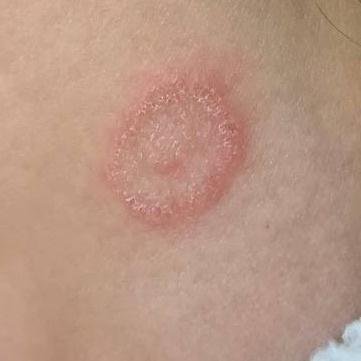
Ringworm and jock itch come first, then rashes that can look like them. Our atlas article on nummular eczema says ringworm “can be almost indistinguishable to the eye” from nummular eczema; a skin scraping looked at under a microscope tells them apart.
 29 photos
Ringworm (tinea corporis)
“Ring-shaped erythematous patches with active, scaly, vesiculated borders and a central area that may be clear or slightly scaly.”
“Itching is common but may vary in intensity.”
Read the article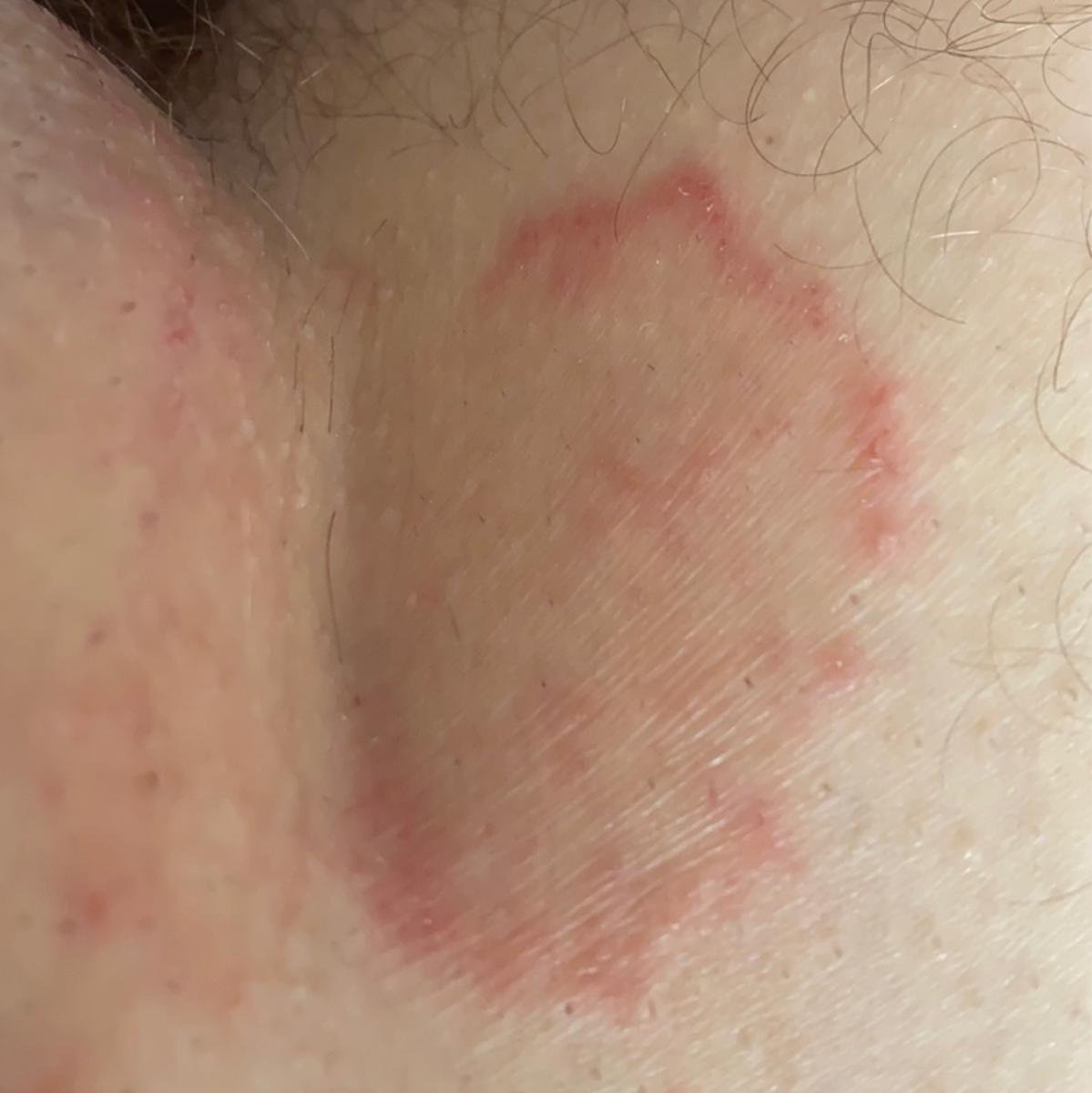 29 photos
Jock itch (tinea cruris)
“Tinea cruris is a fungal infection of the groin area, commonly affecting the inner thighs, perineum, buttocks, and pubic region.”
“It is most common in adult males.”
Read the article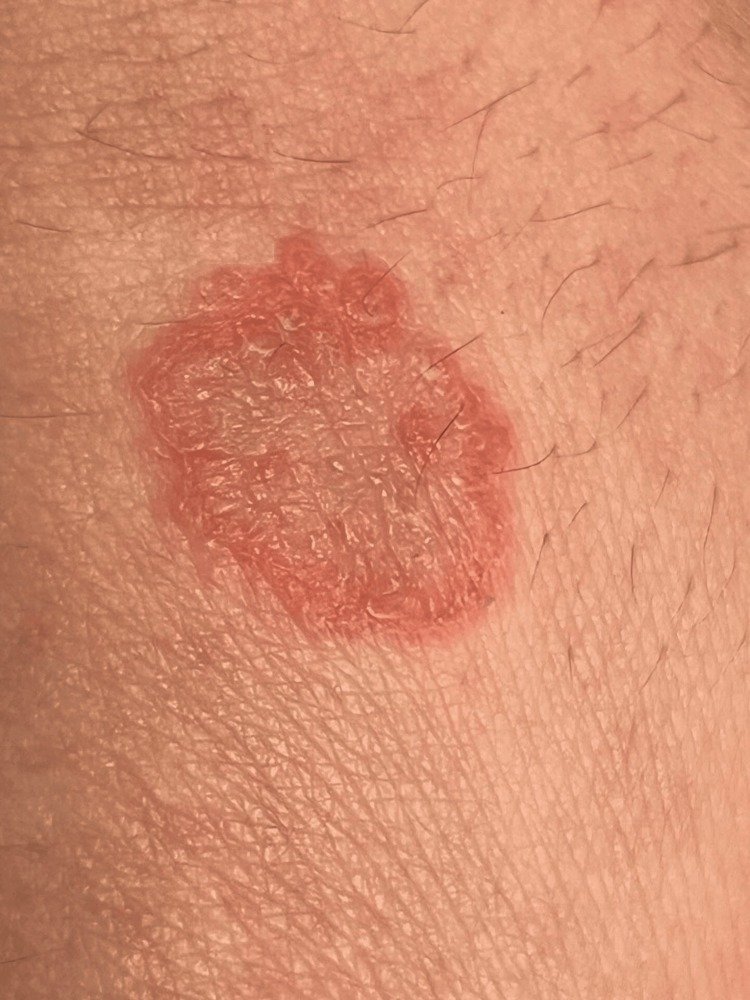
Nummular eczema (discoid eczema)
“Coin-shaped plaques: Round or oval, with a distinctly sharper border than most forms of eczema, usually 1–5 cm across.”
“Some patches fade centrally, which adds to the resemblance to ringworm.”
Read the article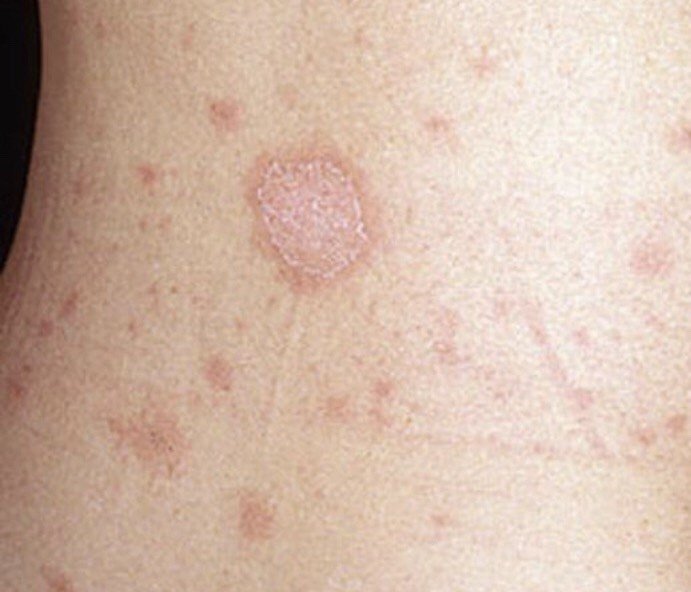 24 photos
Pityriasis rosea
“The first clinical sign is typically a herald patch — a single, round or oval pink to salmon-colored lesion with a fine scaly border and a central area of wrinkling or yellowish peeling.”
“On the back, the rash often aligns along skin cleavage lines in a “Christmas tree” or “fir tree” pattern.”
Read the article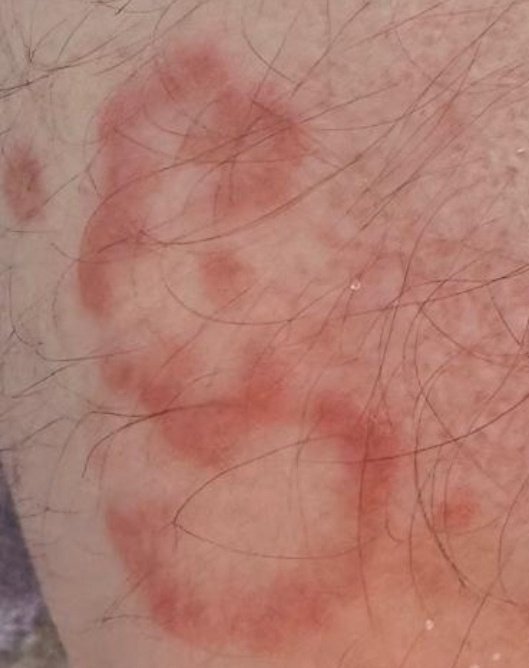 20 photos
Erythema annulare centrifugum (a slowly spreading ring-shaped rash)
“In the superficial form the scale is trailing scale: it sits on the inner side of the advancing edge, just behind the border rather than on it.”
“These lesions often appear on the thighs, shins, and occasionally on the trunk and face.”
Read the article 30 photos
Psoriasis
“Psoriasis vulgaris typically presents with erythematous plaques covered by thick, white or silvery scales.”
“The lesions are sharply demarcated, elevated, and may vary in size and distribution.”
Read the articleLight, dark or pink patches on the chest and back
Light patches can also be vitiligo. Our atlas says that in vitiligo the skin is “typically not itchy, scaly, thickened or painful”, while tinea versicolor patches have a fine scale. Seborrheic dermatitis, pictured in the next group, can also affect the upper chest and back.
 25 photos
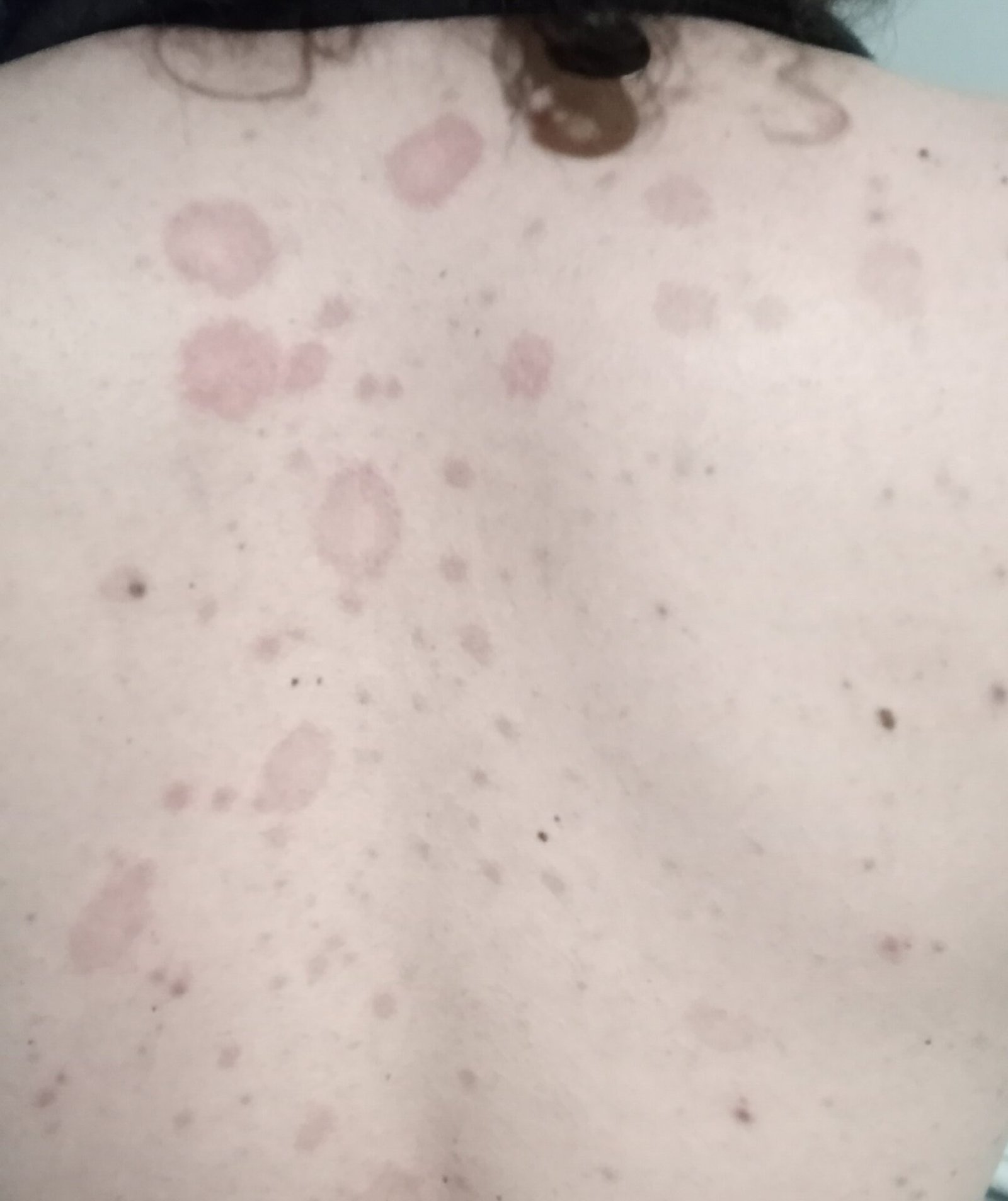
Tinea versicolor (pityriasis versicolor)
“The hallmark of pityriasis versicolor is the development of well-demarcated, scaly, discolored patches that vary in hue—from pink, tan, and light brown to hypopigmented or chalky white, especially in darker-skinned individuals.”
“Fine, bran-like scaling is typically visible when scratched (positive “scratch sign”)”
Read the article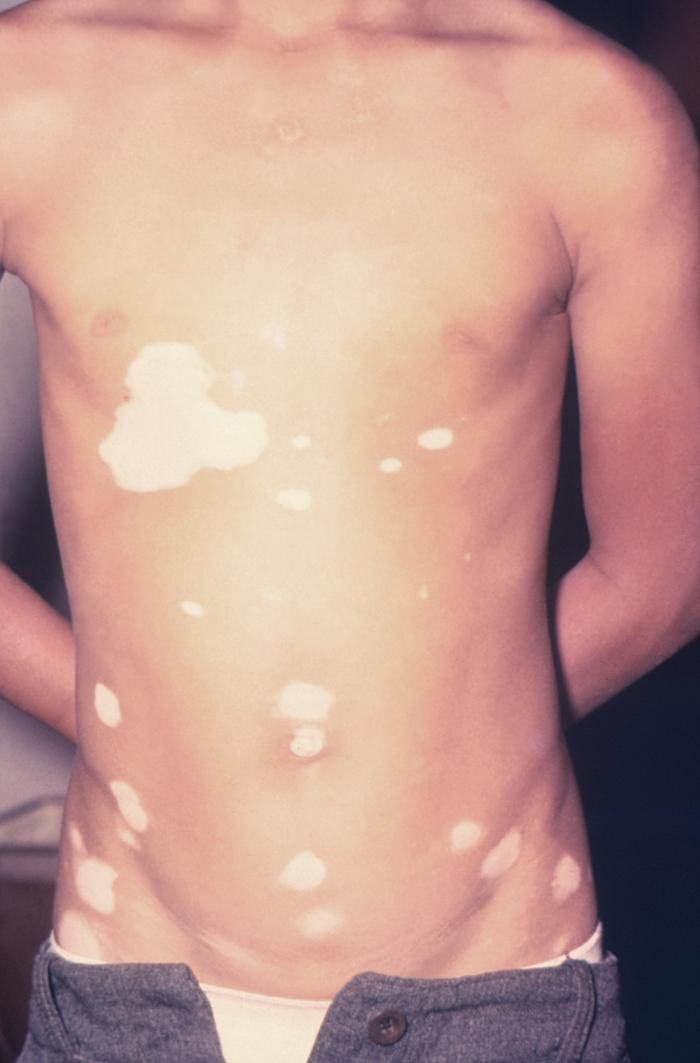 2 photos
Vitiligo
“Milky-white patches with a sharp border, most obvious against darker or tanned skin.”
“Tinea versicolor: Pale or fawn patches with fine scale on the trunk, caused by a yeast, and confirmed by microscopy.”
Read the articleScalp and beard
In the beard, ringworm (tinea barbae) can cause “Mild follicular inflammation, erythema, and scaling that resemble bacterial folliculitis” (atlas). Folliculitis is inflammation of hair follicles: our atlas says it “appears as small red bumps or pustules, each one centred on a hair”.
 24 photos
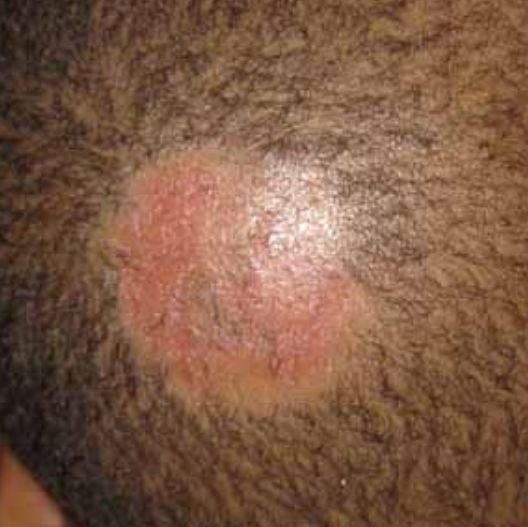
Scalp ringworm (tinea capitis)
“Round or oval scaly patches with mild redness or none at all; flaking and hair breakage are frequent”
“Prompt diagnosis and treatment matter: severe inflammatory disease, particularly a kerion, can cause permanent scarring hair loss if treatment is delayed.”
Read the article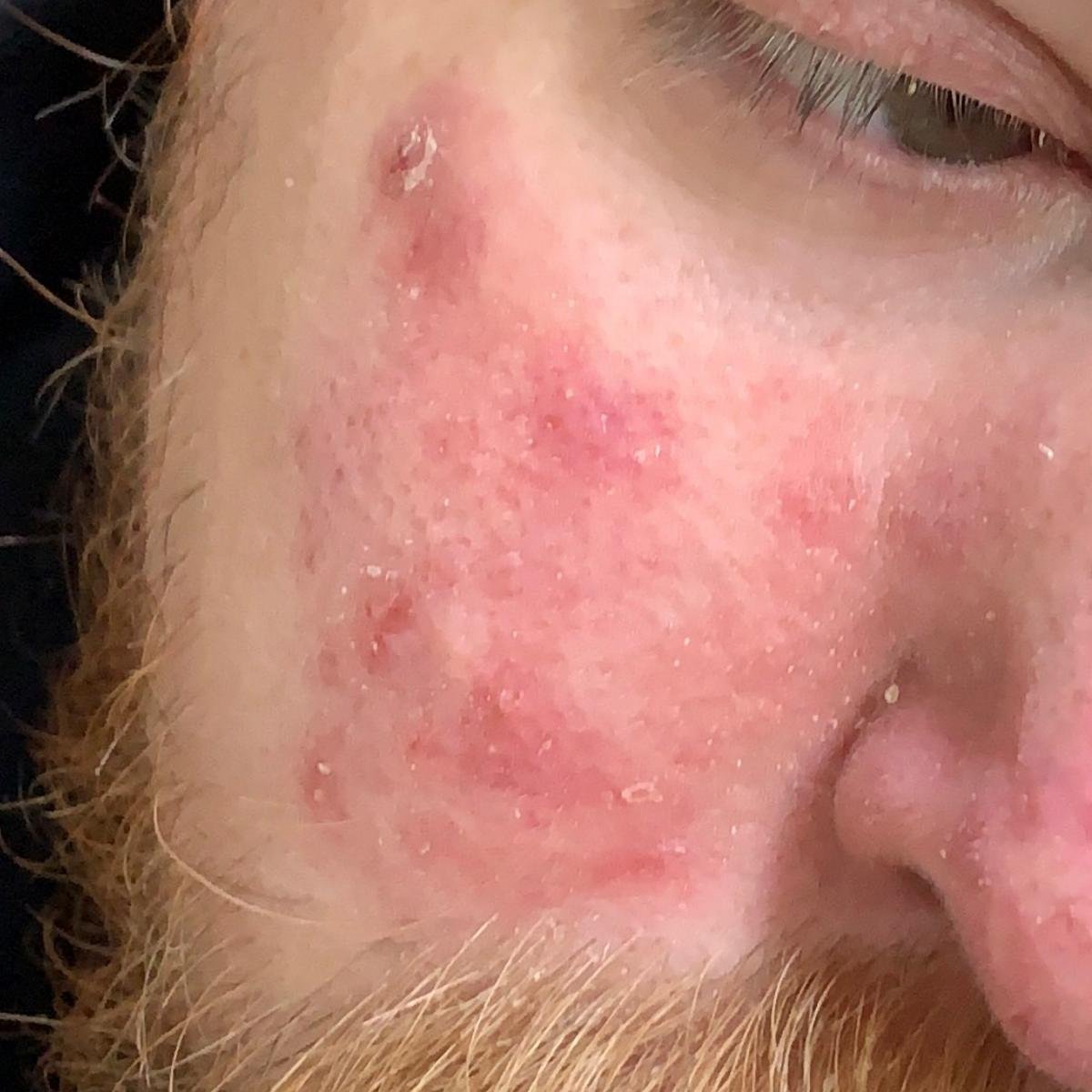 24 photos
Seborrheic dermatitis
“Greasy, yellowish scales over erythematous (red) skin”
“It is not contagious, not dangerous, and not caused by poor hygiene or inadequate washing”
Read the articleNails
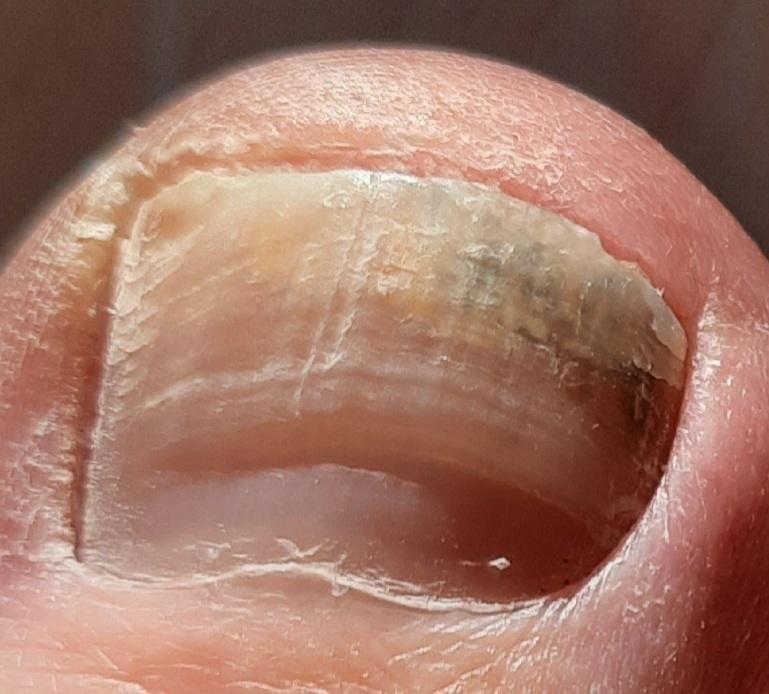
Nail fungus comes first, then psoriasis and lichen planus, which can also change the nails. Our atlas article on onychomycosis names psoriasis, injury and lichen planus among the conditions to rule out, and says a fungal nail infection should be confirmed in a laboratory before it is treated.
 24 photos
Nail fungus (onychomycosis)
“Onychomycosis often presents as discoloration, thickening, deformation, or crumbling of the nail, and may affect one or multiple nails, typically starting on the toenails and potentially spreading to fingernails.”
“Accurate diagnosis is essential before initiating antifungal therapy, as several other conditions can mimic fungal nail disease.”
Read the article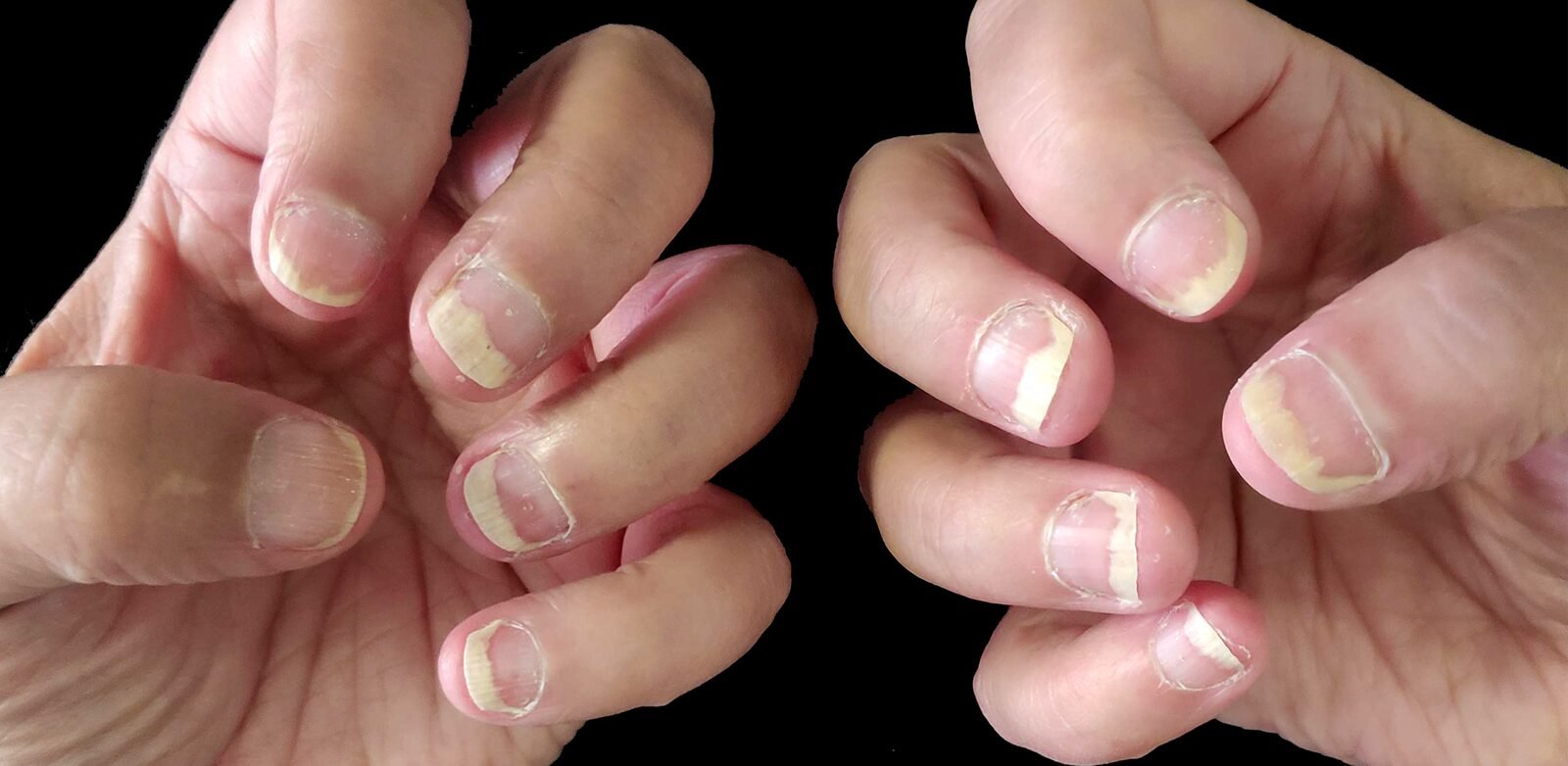 30 photos
Nail psoriasis
“Nails (psoriatic onychodystrophy): Pitting, onycholysis, subungual hyperkeratosis, dystrophic thickening.”
Read the article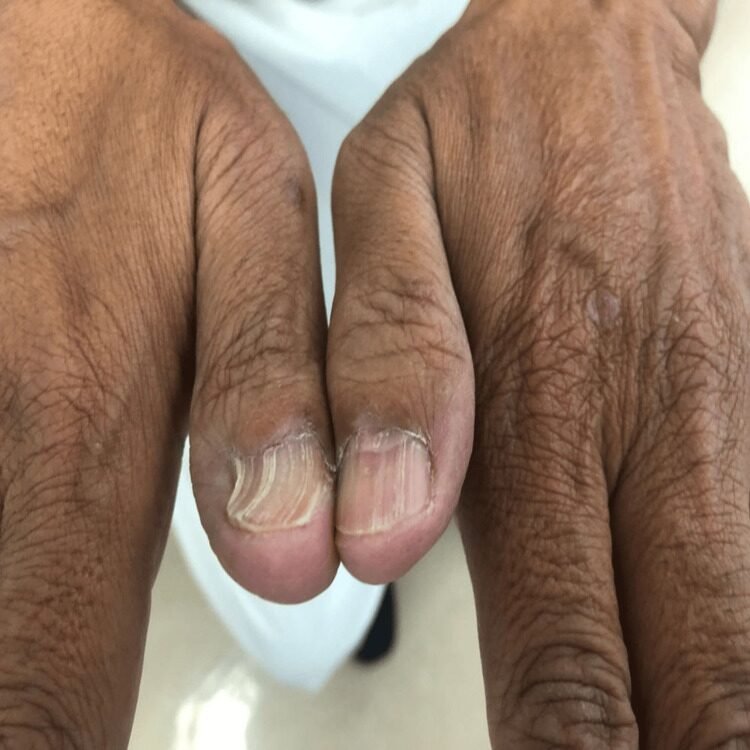 25 photos
Nail lichen planus
“LP may affect one or more nail plates and present as: Thinning and longitudinal ridging”
“Total nail loss: In advanced, untreated cases.”
Read the articleBlisters or peeling on the hands and feet
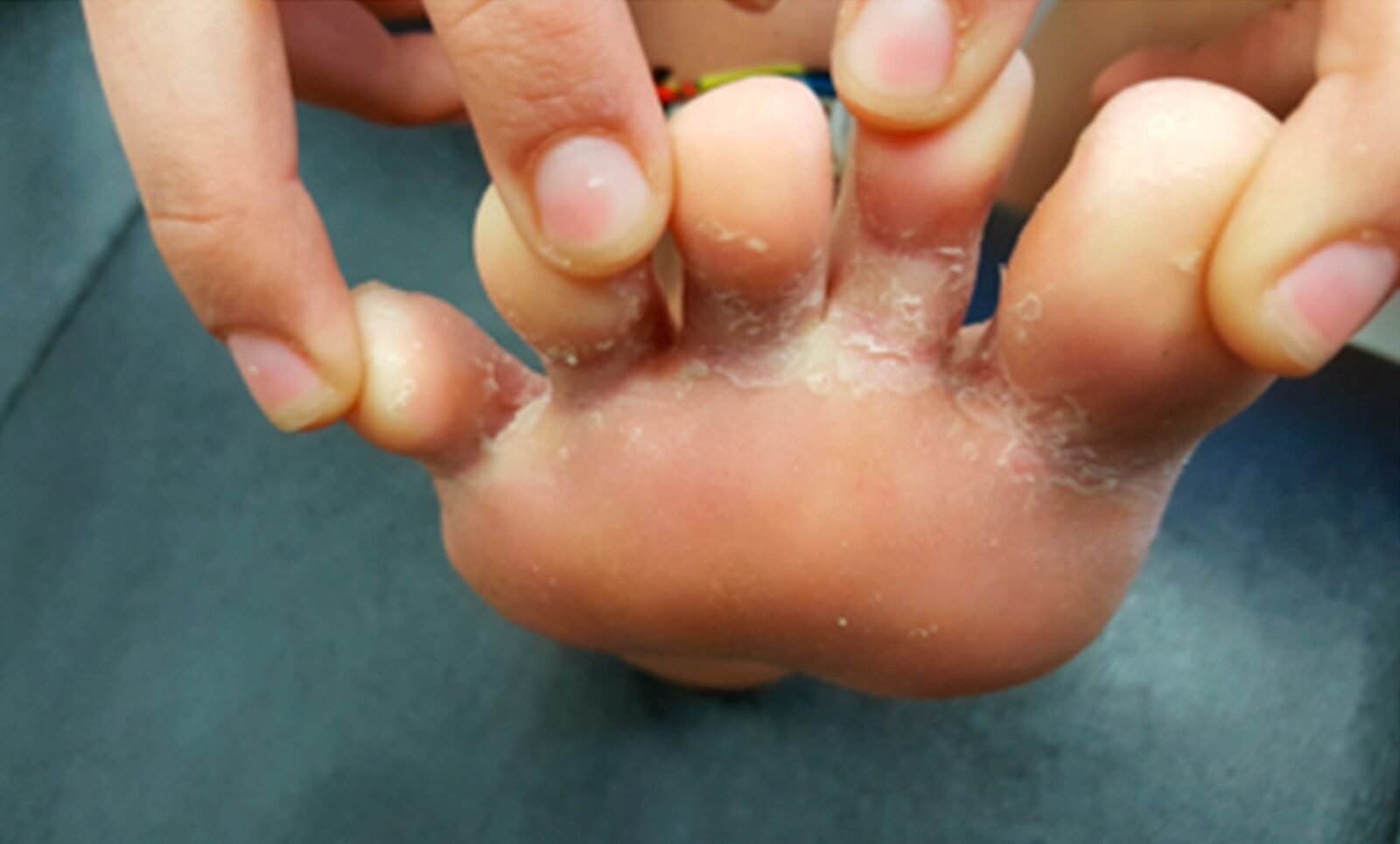
Athlete’s foot sometimes causes fluid-filled blisters (NHS). Contact dermatitis, pictured here, can also make the skin itchy, blistered, dry and cracked, most often on the hands and face (NHS). And athlete’s foot can set off blisters on the hands that are not fungal themselves: “A fungal infection elsewhere — most often athlete’s foot — can provoke a sterile vesicular eruption on the hands.” (atlas)
 29 photos
Athlete’s foot (tinea pedis)
“Tinea pedis is the most common fungal skin infection worldwide. It affects the soles, toes, and interdigital areas of the feet.”
“Interdigital type (“athlete’s foot”): Maceration, peeling, redness, and painful fissures between toes”
Read the article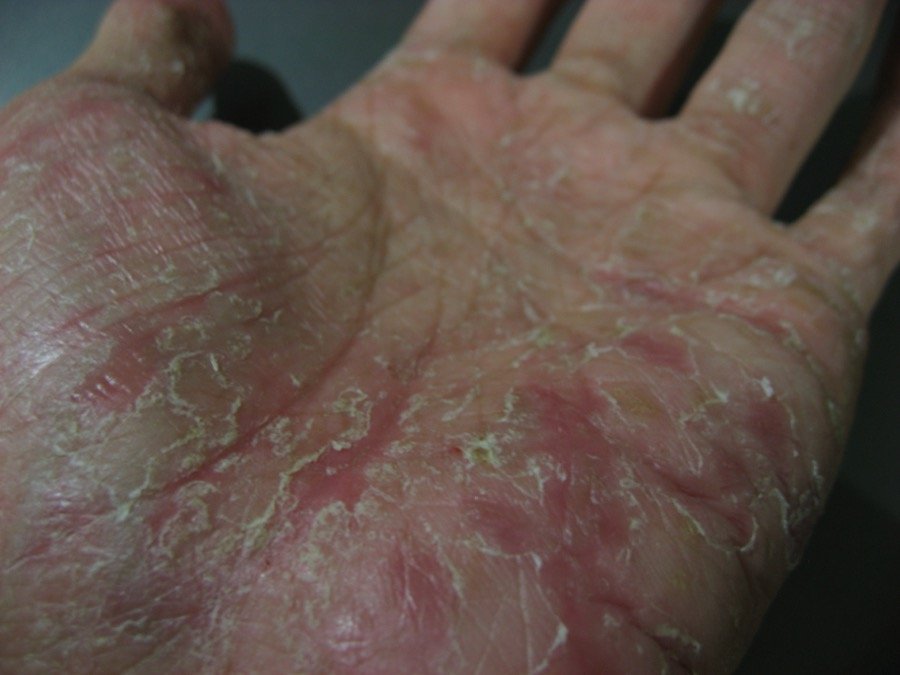
Dyshidrotic eczema (pompholyx)
“Firm, clear, 1–2 mm blisters set into the skin of the palms, the lateral aspects of the fingers and the soles, often grouped.”
“Tinea manuum or pedis: Fungal infection may blister and is often asymmetrical — classically one hand and two feet.”
Read the article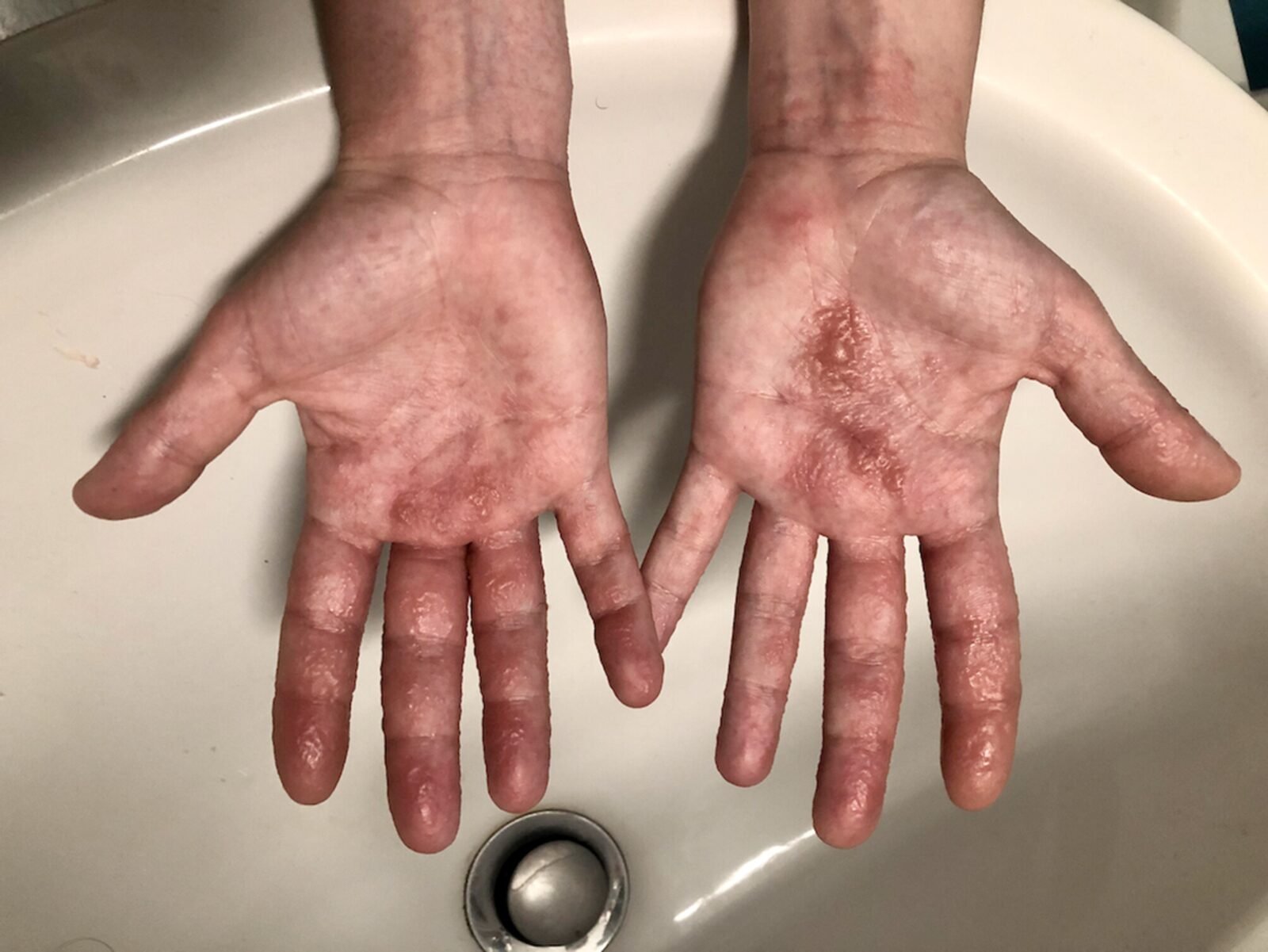 25 photos
Contact dermatitis (allergic)
“Objective signs: Vesicles, erythema, edema, scaling, crusting, in severe cases – bullae and erosions.”
“Subjective symptoms: Intense itching, sometimes burning or soreness.”
Read the article
Medical review of the atlas articles above
Board-Certified Dermatologist · Fellow of the American Academy of Dermatology (FAAD)
Sources for the group notes: Atlas — Nummular eczema · Atlas — Vitiligo · Atlas — Seborrheic dermatitis · Atlas — Tinea capitis and tinea barbae · Atlas — Folliculitis · Atlas — Onychomycosis · Atlas — Dyshidrotic eczema · NHS — Athlete’s foot · NHS — Contact dermatitis
Ringworm or eczema?
Ringworm
Roundish, flat patches with a raised, scaly border; the centre tends to clear first. Our atlas says ringworm “Usually has a more active, scaly leading edge with central clearing”. It is caught through contact with an infected person or animal or with objects such as towels, and a patch may grow or spread, or there may be more than one.
Nummular (discoid) eczema
Circular or oval patches. Early on they are often swollen, blistered and oozing, and very itchy, particularly at night; later they may become dry, crusty, cracked and flaky. Most people get several patches. The centre sometimes clears, leaving a ring that can be mistaken for ringworm.
The two can look almost the same: our atlas article on nummular eczema says ringworm “can be almost indistinguishable to the eye” and that “microscopy distinguishes them”. A doctor can scrape a little scale from the patch and look at it under a microscope. The difference matters, because a steroid cream, which is used for eczema, can make ringworm spread and harder to recognise. These two descriptions are common patterns, not a test.
Sources: AAD — Ringworm: signs and symptoms · NHS — Ringworm · NHS — Discoid eczema · Atlas — Nummular eczema · AAD — Ringworm: diagnosis and treatment · DermNet — Tinea incognito
Fungal or something else? How they differ
A summary of features from our atlas articles and the sources on this page. Fungal infections and other rashes overlap, so this table cannot tell you which one you have. Tap a name to see its picture or description.
| Condition | What it often looks like | Clues | Where it often appears |
|---|---|---|---|
| Ringworm | Roundish, flat patches with a raised, scaly border; red or pink on light skin, brown or grey on skin of colour | The centre tends to clear first; can be intensely itchy; patches grow slowly and can spread | Anywhere on the body |
| Jock itch | A red rash (brown or grey on dark skin) with a raised, scaly border | Starts in the crease where the leg meets the body; itchy; the skin can flake, peel and crack | Groin, inner thighs, buttocks |
| Athlete’s foot | Itchy white patches between the toes; sore, flaky patches; sometimes blisters | Itching, burning or stinging; can keep coming back; can spread to the nails | Between the toes, soles and sides of the feet |
| Nail fungus | A thick nail that turns yellow, white or brown and may crumble or lift | Usually starts at the edge of the nail; usually painless | Toenails much more often than fingernails |
| Scalp ringworm | A scaly bald patch, sometimes with black dots of broken hairs | Mostly in children; can become a swollen, painful patch with pus | Scalp |
| Tinea versicolor | Flat, round patches: pink, red or pale brown on white skin, paler than the skin on brown or black skin | Fine scale; patches may not tan; often comes back; does not spread from person to person | Chest, upper back, upper arms, neck, tummy |
| Yeast infection (Candida) | Red, moist patches with scaling at the edges and small spots or pustules around them | Can burn or itch; more likely with diabetes, excess weight or heavy sweating | Skin folds: groin, armpits, under the breasts |
| Nummular eczema | Round or oval patches with a sharp border, blistered and oozing early on, later dry and crusty | Very itchy, particularly at night; usually several patches; the centre sometimes clears | Lower legs, backs of the hands, forearms, trunk |
| Pityriasis rosea | One larger oval patch first, then many smaller scaly spots | Some people feel unwell for a few days before the rash; usually clears in 6 to 12 weeks | Chest and back; can reach the arms and legs |
| Erythema annulare centrifugum | Rings that slowly spread outwards and clear in the centre | Any scale sits on the inner side of the edge; in tinea it sits on the edge | Thighs, shins; sometimes the trunk and face |
| Psoriasis | Raised patches with sharp edges and thick, white or silvery scale | Can also cause dents and pits in the nails | Elbows, knees, scalp, lower back |
| Seborrheic dermatitis | Greasy, yellowish scales on red skin; dandruff | Mild to moderate itch; not contagious | Scalp, eyebrows, sides of the nose, behind the ears, beard area, upper chest |
| Dyshidrotic eczema | Small, firm, itchy blisters set into the skin | Comes and goes, each time for about 2 to 3 weeks; then the skin peels | Palms, sides of the fingers, soles |
Sources: the atlas articles linked in the cards · AAD — Ringworm: signs and symptoms · NHS — Athlete’s foot · NHS — Fungal nail infection · AAD — Nail fungus: signs · Cleveland Clinic — Skin fungus · NHS — Pityriasis versicolor · DermNet — Candidal intertrigo · NHS — Discoid eczema · NHS — Pityriasis rosea · NHS — Psoriasis · AAD — Seborrheic dermatitis: signs · NHS — Pompholyx
Other causes, fungal and not fungal
Only the yeast infection has a photo here; the others are described in words, using the linked sources.
Yeast infection on the skin (candidiasis)
Skin folds
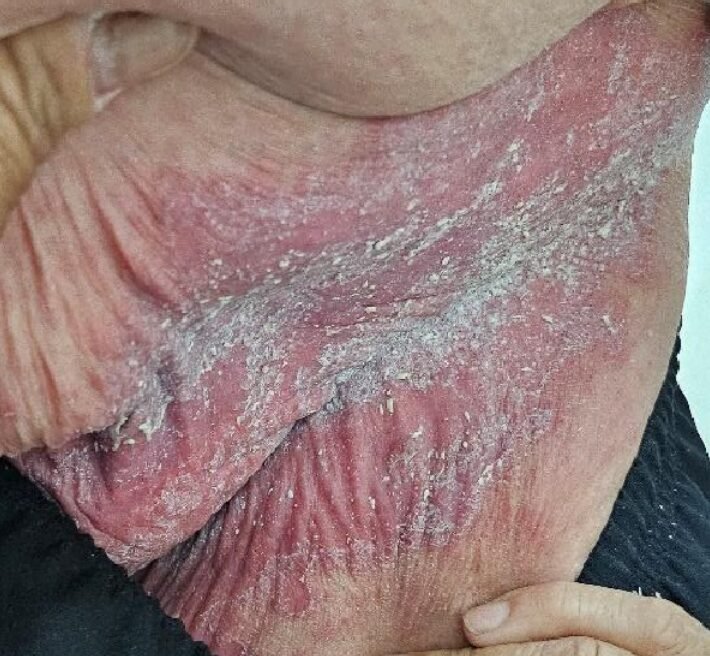
Candida is a yeast that normally lives on the skin in small amounts. When it overgrows, it can cause red, raised patches in skin folds such as the armpits, under the breasts, the groin and near the buttocks, and in babies it can cause nappy rash. The patches look red and moist, with scaling at the edges and small spots or pustules around them, and they can burn or itch. It is more likely with diabetes, excess weight, heavy sweating, tight clothing or a weakened immune system.
Cleveland Clinic advises contacting a doctor at the first signs, such as itching, pain, a rash or swelling.
Cleveland Clinic — Candidiasis · DermNet — Candidal intertrigo · Cleveland Clinic — Yeast infection under the breasts · Atlas — Skin mycoses
Intertrigo
Skin folds
A rash in skin folds — under the arms, under the breasts or tummy, in the groin, between the buttocks, between the fingers or toes — brought on by heat, sweat and friction. The skin is inflamed, red and uncomfortable, and it can become moist, crack and peel. It can be purely inflammatory or infected with yeast or bacteria, and the two often overlap.
Treatment depends on the cause, so a rash in a skin fold that does not settle needs a doctor to find out what is behind it.
Malassezia folliculitis
Upper back and chest
An itchy rash of small, even-sized bumps and pustules caused by a yeast that normally lives on the skin. Our atlas describes it as “A cause that is regularly mistaken for acne, producing uniform itchy papules and pustules on the upper back, chest and shoulders, typically in younger adults and in warm humid conditions.” Unlike acne, it has no blackheads or whiteheads, and the atlas adds: “It does not respond to antibacterial treatment.”
See a doctor if an acne-like rash on your chest or back has not responded to treatment.
Erythrasma
Armpits, groin, between the toes
A bacterial infection, not a fungal one, that can be confused with tinea or Candida and can occur together with them. It causes well-defined pink or brown patches with fine scaling and sometimes mild itching. It is more common in warm climates and with diabetes, excess weight and heavy sweating. Under an ultraviolet Wood’s lamp it glows coral pink, which helps a doctor tell it apart.
It is treated differently from a fungal infection, so have a rash in these places checked if it is not getting better.
Terms used in the quotes
- Erythematous
- Red. Erythema means redness of the skin. (NCI)
- Lesion
- An area of abnormal or damaged tissue caused by injury, infection, or disease. (NCI)
- Plaque
- A raised patch of skin. AAD describes plaques as “raised patches”; the NCI dictionary defines a plaque as a small, abnormal patch of tissue.
- Papule
- A small, solid, raised bump on the skin that has a border with edges that are easy to see. (NCI)
- Pustule
- A small bump with pus in it. Our atlas article on folliculitis describes papules and pustules together as “Small bumps, some topped with pus”.
- Perineum
- The area of the body between the anus and the genitals. (NCI)
- Interdigital
- Between the toes or fingers. In our atlas, the interdigital type of athlete’s foot is the one that affects the skin between the toes.
- Maceration
- Skin that has stayed wet for a long time and starts to break down. (AAD)
- Onycholysis
- The nail plate separating from the nail bed. (Cleveland Clinic)
- Follicular
- Of the hair follicles: in the skin, one follicle contains one hair. (NCI)
- Dermatophyte
- The group of fungi that cause ringworm, including athlete’s foot, jock itch and many fungal nail infections. (atlas)
- Kerion
- A deep, painful, swollen form of scalp ringworm with pus, which can leave permanent bald patches if treatment is delayed. (atlas)
- Vesicle, vesiculated
- A tiny blister; vesiculated means with tiny blisters. Our atlas article on nummular eczema describes vesicles as “Tiny blisters across the surface of a fresh patch”.
- Hypopigmented
- Lighter than the skin around it. Hypopigmentation is a condition in which the skin is lighter in colour than normal. (NCI)
- Yeast
- A type of microorganism. Small amounts of a certain type of yeast normally live on the skin, and yeast are a type of fungus. (NCI)
Sources: NCI Dictionary of Cancer Terms · AAD — Seborrheic dermatitis: signs · Cleveland Clinic — Candidiasis · Atlas — Folliculitis · Atlas — Nummular eczema · Atlas — Skin mycoses · Atlas — Onychomycosis · Atlas — Tinea capitis and tinea barbae.
Fungal skin infections: FAQ
What does a fungal infection on the skin look like?
It depends on the type and the place. Ringworm on the body makes roundish, flat patches with a raised, scaly border and a centre that tends to clear. Jock itch is a red, itchy rash in the groin with a raised border. Athlete’s foot causes itchy white patches between the toes and flaky skin on the feet. Nail fungus makes a nail thick, discoloured and brittle. Tinea versicolor causes flat patches lighter or darker than the skin around them on the chest and back, and a yeast infection causes red, moist patches in skin folds. A fungal rash may have more colour and scale at its border than in the middle. Sources: AAD — Ringworm: signs and symptoms, NHS — Athlete’s foot, NHS — Fungal nail infection, NHS — Pityriasis versicolor, Cleveland Clinic — Skin fungus, Atlas — Skin mycoses.
How can I tell if a rash is fungal?
You cannot be sure by looking, and neither can a picture: eczema, psoriasis, pityriasis rosea and other rashes can look very similar. Some features point towards a fungal rash, such as a raised, scaly border with a clearer centre, or a rash between the toes or in the groin, but none of them proves it. A doctor can often tell by looking at the skin, and may scrape off a little skin, or take some hair or a nail clipping, to look for fungus under a microscope. Sources: AAD — Ringworm: diagnosis and treatment, AAD — Ringworm: signs and symptoms, Atlas — Nummular eczema, DermNet — Tinea corporis, NHS — Pityriasis rosea, Cleveland Clinic — Skin fungus.
What is the difference between ringworm and eczema?
Ringworm usually has a more active, scaly edge with a clearer centre, and it is caught from people, animals or objects. Nummular (discoid) eczema makes circular or oval patches that are often blistered and oozing at first, very itchy, particularly at night, and later dry and crusty; its centre can also clear and look like ringworm. Our atlas says ringworm “can be almost indistinguishable to the eye” from this eczema, and a skin scraping looked at under a microscope tells them apart. This matters, because steroid creams used for eczema can make ringworm spread. Sources: Atlas — Nummular eczema, NHS — Discoid eczema, NHS — Ringworm, DermNet — Tinea incognito.
What does ringworm look like?
On most of the body, ringworm causes roundish, flat patches with a raised, scaly border. On light skin the patches tend to be red or pink, on skin of colour brown or grey. The centre tends to clear first, the patches can grow slowly and appear in more places, and they can be intensely itchy. On the feet, groin, nails, scalp and beard it looks different, and on the face, neck or scalp it may not be ring-shaped. Despite the name, it is caused by a fungus, not a worm. Sources: AAD — Ringworm: signs and symptoms, NHS — Ringworm.
What does a yeast infection on the skin look like?
A yeast (Candida) infection of the skin usually appears in skin folds, such as the armpits, under the breasts, in the groin and near the buttocks. The skin looks red and moist, with scaling at the edges and small spots or pustules around the main patch, and it can burn or itch. Under the breasts it can look like a bright red rash that may be shiny, with dry, cracked skin around it. Ringworm in the groin, erythrasma and other skin-fold rashes can look similar, so have it checked by a doctor. Sources: Cleveland Clinic — Candidiasis, DermNet — Candidal intertrigo, Cleveland Clinic — Yeast infection under the breasts, DermNet — Erythrasma, Atlas — Skin mycoses.
What can be mistaken for a fungal skin infection?
Several rashes: nummular eczema, which can also form rings; pityriasis rosea; psoriasis; seborrheic dermatitis; erythema annulare centrifugum; contact dermatitis; and, on the hands and feet, dyshidrotic eczema. Erythrasma, a bacterial infection, can look like a fungal rash in the groin, armpits and between the toes. The reverse also happens: Malassezia folliculitis, a yeast infection of hair follicles, is often mistaken for acne. Photos of most of them are on this page (erythrasma and Malassezia folliculitis are described in words only), but only a doctor can tell them apart reliably. Sources: Atlas — Nummular eczema, Atlas — Pityriasis rosea, Atlas — Psoriasis vulgaris, Atlas — Seborrheic dermatitis, Atlas — Erythema annulare centrifugum, Atlas — Contact dermatitis, Atlas — Dyshidrotic eczema, DermNet — Erythrasma, Atlas — Folliculitis, DermNet — Tinea corporis.
Are fungal skin infections contagious?
Some are. Ringworm can be passed on through close contact with an infected person or animal, or with infected objects such as bedsheets, combs or towels, and athlete’s foot can be caught by walking barefoot where someone else has it. Scalp ringworm is extremely contagious, so people who live together can pass it to each other. Tinea versicolor cannot spread from person to person: it is caused by a yeast that most people have on their skin. Seborrheic dermatitis is not contagious either. Sources: NHS — Ringworm, NHS — Athlete’s foot, AAD — Ringworm: diagnosis and treatment, NHS — Pityriasis versicolor, Atlas — Seborrheic dermatitis.
Can a steroid cream make a fungal rash worse?
Yes. A steroid cream can calm the redness and itch of a fungal infection while the fungus keeps spreading. Our atlas article on skin mycoses says: “A steroid applied to a dermatophyte infection suppresses the appearance while the infection spreads”. The rash can then look like another skin condition, which doctors call tinea incognito. That is a reason to have a rash checked before you use a steroid cream on it. If a doctor has prescribed a cream that contains a steroid, talk to them before you stop it. Sources: Atlas — Skin mycoses, DermNet — Tinea incognito, Cleveland Clinic — Skin fungus, NHS — Discoid eczema.
Why does a fungal skin infection keep coming back?
Some types return often. Athlete’s foot can keep coming back, and tinea versicolor patches can come back after treatment, especially in warm, humid weather. Ringworm may also fail to clear if treatment is stopped sooner than prescribed, and some ringworm fungi are becoming resistant to a common antifungal medicine: our atlas says a case that does not respond “is worth re-testing rather than simply re-treating”. A rash that keeps returning, or does not clear with treatment, is a reason to see a doctor: it may need a different treatment, or it may not be fungal at all. Sources: NHS — Athlete’s foot, NHS — Pityriasis versicolor, AAD — Tinea versicolor: signs, AAD — Ringworm: diagnosis and treatment, Atlas — Skin mycoses, Atlas — Nummular eczema.
Can a photo or an app tell me if a rash is fungal?
No. Pictures can show what fungal infections can look like, but many rashes look alike, and the output of an AI skin check is not a medical diagnosis. A doctor can confirm a fungal infection by looking at a skin, hair or nail sample under a microscope. Sources: AAD — Ringworm: diagnosis and treatment, Atlas — Nummular eczema.
When should I see a doctor about a fungal rash?
Get help urgently — call a doctor or go to an emergency department — if a rash is all over your body, starts suddenly and spreads quickly, is painful, blistered or infected, or comes with a fever. Ask for an urgent appointment if the skin is painful, hot and swollen, and if you are pregnant, contact your midwife or doctor straight away about any new rash. See a doctor if you are not sure what the rash is; if it has not cleared with treatment or keeps coming back; if it is on your scalp or in your beard, and promptly if it is a painful, swollen patch with pus; if a nail infection is severe and has not improved with treatment, or has spread to other nails; if athlete’s foot is very painful or has spread to other parts of your body, such as your hands; if patches of skin have turned lighter or darker; or if you have diabetes or a weakened immune system. Sources: Cleveland Clinic — Skin fungus, NHS — Cellulitis, NHS — Pityriasis rosea, NHS — Ringworm, NHS — Athlete’s foot, NHS — Fungal nail infection, NHS — Pityriasis versicolor, AAD — Ringworm: signs and symptoms, Atlas — Tinea capitis and tinea barbae.
For a clear photo: daylight, close and in focus, no filters. Upload a photo for an AI skin check. A photo check cannot confirm or rule out a fungal infection, and it does not cover every cause on this page. AI output is not a medical diagnosis. If you have any of the signs above, see a doctor instead.
Check my skin ↑SkinAI Lab is a paid AI analysis; pricing is shown before you scan.


Prepared by the SkinAI Lab editorial team · Updated . Apart from the quoted atlas text, this page has not been reviewed by a doctor. It is general information, not medical advice.