
Dyshidrotic Eczema (ICD-10: L30) ⚠️
Dyshidrotic Eczema: Deep-Seated Blisters on the Hands and Feet
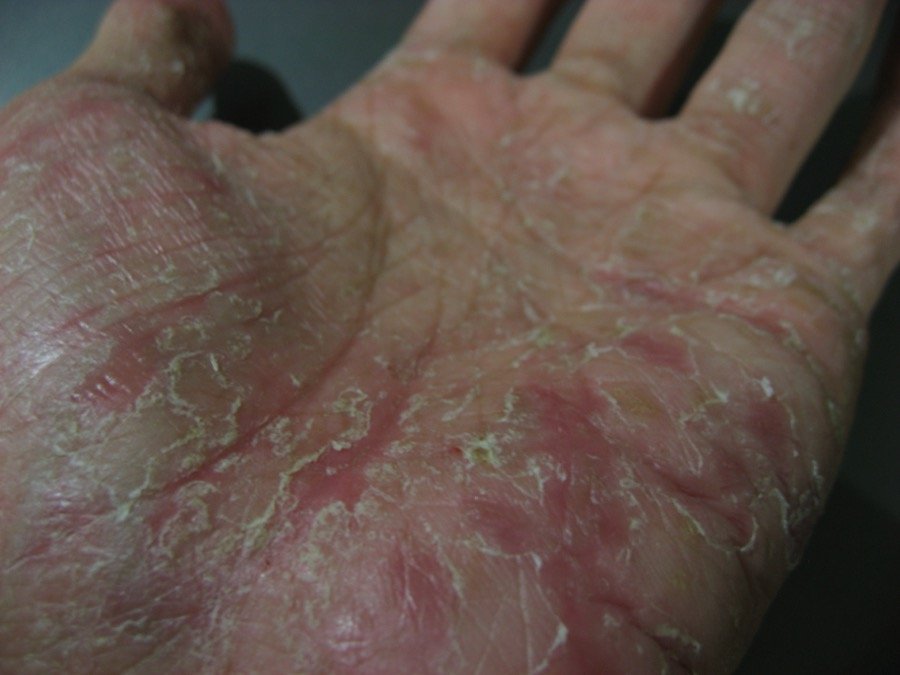
Dyshidrotic eczema, also called pompholyx, is a recurrent form of eczema that produces crops of small, deep-seated, intensely itchy blisters on the palms, the sides of the fingers and the soles. The blisters sit within the thick skin of these areas rather than on top of it, which gives them their characteristic appearance — often compared to tapioca — and makes them feel firm rather than fragile.
The name is a historical mistake worth correcting straight away. It comes from an old belief that the condition was a disorder of the sweat glands. It is not. Sweating can trigger an episode, but the blisters form through inflammation of the epidermis, not through blocked sweat ducts.
Episodes typically last two to three weeks. The blisters do not usually burst on their own; instead they dry out and the overlying skin peels away, leaving red, tender, sometimes cracked skin underneath. Attacks recur, often for years, and in some people follow a seasonal pattern.
Onset is usually in young adulthood, and the condition is reported somewhat more often in women. It ranges from a minor seasonal nuisance to a disabling problem: severe hand involvement interferes with grip, with work that requires manual dexterity, and with anything involving water.
Predisposing Factors: What Sets an Episode Off
No single cause explains dyshidrotic eczema, and in many people no trigger is ever identified. The associations below are the ones worth investigating.
- Atopy: A personal or family history of atopic dermatitis, asthma or hay fever is common in people with pompholyx, though far from universal.
- Contact allergy: Nickel and cobalt are the most frequently implicated. In a minority of patients, ingested nickel appears to provoke flares, but this is not established firmly enough to justify dietary restriction without specialist advice.
- Sweating and heat: Episodes cluster in warm weather and in people whose hands are frequently occluded by gloves.
- Stress: Widely reported by patients as a trigger, and plausible given the effect of stress on skin barrier function, though hard to quantify.
- Irritant exposure: Repeated wet work, detergents and solvents damage the barrier and lower the threshold for a flare. This is why hairdressers, caterers, cleaners and healthcare workers are over-represented.
- An “id” reaction: A fungal infection elsewhere — most often athlete’s foot — can provoke a sterile vesicular eruption on the hands. Treating the fungal infection often settles it, though the hand eruption may still need its own anti-inflammatory treatment. This is one reason the feet are examined when the hands are affected.
Diagnostics: How Dyshidrotic Eczema Is Diagnosed
The diagnosis is clinical, made from the appearance of the blisters, their distribution on the palms, finger sides and soles, and the history of recurrent episodes.
Two investigations matter more than the rest. Direct microscopy of skin scrapings is used to exclude a fungal infection, because tinea of the hand or foot can look very similar, and a corticosteroid applied to it suppresses the visible inflammation while allowing the infection to persist or spread, leaving a picture that is harder to recognise. Patch testing is used where a contact allergy is suspected, particularly when episodes are frequent, persistent or clearly linked to an exposure; it is the most reliable way to identify a responsible allergen, though a positive result still has to be judged against the clinical picture before it explains a given flare.
A bacterial swab is taken when a lesion is crusted, painful or weeping in a way that suggests secondary infection. Biopsy is rarely needed and is reserved for cases where another blistering condition is genuinely in question.
Symptoms: What Dyshidrotic Eczema Looks Like
- Deep-seated vesicles: Firm, clear, 1–2 mm blisters set into the skin of the palms, the lateral aspects of the fingers and the soles, often grouped.
- Intense itch, frequently preceding the blisters: Many people describe a burning or prickling sensation a day or two before anything is visible.
- Peeling: As the episode settles, the roof of the blistered area dries and lifts away in sheets, leaving red and sometimes raw skin.
- Fissures: Cracks that form in thickened or peeling skin, which are painful and slow to heal.
- Nail changes: Ridging, pitting or irregularity of the nails can follow repeated inflammation around the nail folds.
- Symmetry: Involvement is usually on both hands or both feet, which helps distinguish it from a localised contact reaction.
Differential Diagnosis: Ruling Out Other Conditions
- Tinea manuum or pedis: Fungal infection may blister and is often asymmetrical — classically one hand and two feet. Microscopy settles it.
- Allergic contact dermatitis: Can blister and itch identically; the distribution follows the exposure, and patch testing distinguishes them. The two also coexist.
- Palmoplantar psoriasis: Produces sterile pustules rather than clear vesicles, with sharper margins and thicker scale.
- Scabies: Itch is worse at night and burrows may be visible in the finger webs; household members are often affected.
- Autoimmune blistering disease: Rare at these sites, but considered when blisters are large, persistent or accompanied by mucosal involvement.
Risks: Why Dyshidrotic Eczema Should Be Treated
Pompholyx is not dangerous, but it is frequently underestimated. Repeated episodes thicken and crack the skin of the palms and soles, and fissures in weight-bearing or working skin are both painful and slow to close. Broken skin is also an entry point for bacterial infection, which turns an itchy eruption into a painful, crusted and sometimes spreading one.
The practical burden is the main argument for treating it properly. Hand involvement affects work, driving, childcare and sleep, and in some occupations forces a change of duties. Foot involvement affects walking and footwear. Treating an episode early and shortening it is more effective than waiting for it to resolve.
Tactics: When and How to Seek Treatment
See a clinician if blisters on the hands or feet recur, if an episode does not settle within a few weeks, if the skin becomes painful, crusted or spreads redness, or if the condition is interfering with work or sleep. Seek advice sooner if you have athlete’s foot at the same time, since treating it may resolve the hand eruption.
One thing not to do yourself is drain the blisters. They are not under pressure in the way an abscess is, opening them does not shorten the episode, and it introduces infection into skin that is already inflamed. A clinician may decide to drain a large or particularly painful blister under sterile conditions; that is a different matter from doing it at home with a needle.
Treatment: Modern Strategies for Dyshidrotic Eczema
- Topical corticosteroids: The mainstay for an active episode. Palms and soles have thick skin, so a potent preparation is usually needed, sometimes applied under occlusion for short periods under medical supervision.
- Emollients and barrier care: Applied consistently between episodes, not only during them. Soap substitutes and cotton-lined gloves for wet work reduce the frequency of flares.
- Topical calcineurin inhibitors: Tacrolimus or pimecrolimus are used where repeated steroid courses are undesirable, particularly for maintenance.
- Cool compresses and drying soaks: Provide symptomatic relief during the blistering phase.
- Phototherapy: Hand and foot ultraviolet treatment is an established option for disease that keeps returning.
- Systemic treatment: Reserved for severe or disabling disease, and chosen by a dermatologist. Short courses of oral corticosteroids are sometimes used for a severe flare, but they are not a long-term strategy.
- Treating the trigger: Clearing a fungal infection, or avoiding an allergen identified by patch testing, does more for recurrence than any topical treatment.
Prevention: Reducing Recurrence
- Protect the hands from wet work: Cotton liners under waterproof gloves, and limiting the time gloves are worn, since occlusion itself provokes flares.
- Use a soap substitute and lukewarm rather than hot water.
- Moisturise often, including in periods when the skin looks normal.
- Avoid known allergens once patch testing has identified them; a written list of what to avoid is more useful than a general instruction.
- Treat athlete’s foot promptly, and keep the feet dry.
- Do not pick or peel loose skin; trim it with clean scissors instead.
Dyshidrotic eczema is a relapsing condition rather than one that is cured, but most people can reduce both the frequency and the severity of episodes with consistent barrier care, prompt treatment of flares and removal of an identified trigger.
Image: Eugene Alvin Villar (seav), CC BY-SA 4.0, via Wikimedia Commons.

Medical review
Board-Certified Dermatologist · Fellow of the American Academy of Dermatology (FAAD)