
Avalo Therapeutics Shows Promising Phase 2 Results for Abdakibart in Hidradenitis Suppurativa
Abdakibart shows promising phase 2 results in hidradenitis suppurativa
Avalo Therapeutics has announced positive topline results from the phase 2 LOTUS trial testing abdakibart (AVTX-009) in adults with moderate to severe hidradenitis suppurativa (HS), reporting statistically significant improvements versus placebo at both dose levels evaluated (Source: Avalo Therapeutics press release, Phase 2 LOTUS trial).
Company reaction and significance
Garry Neil, MD, Chief Executive Officer of Avalo Therapeutics, described the results as a “strong, consistent, and deep response” across key clinical measures and said the data validate the potential of IL-1β inhibition as a treatment strategy for HS (Source: Avalo Therapeutics press release, Phase 2 LOTUS trial).
The company emphasized that this phase 2 data reduces clinical uncertainty and supports moving abdakibart into a registrational phase 3 program, highlighting the potential for a patient-friendly monthly dosing option if later trials confirm benefit (Source: Avalo Therapeutics press release, Phase 2 LOTUS trial).
Study design: how the LOTUS trial was run
The LOTUS study was a randomized, double-blind, placebo-controlled phase 2 trial that enrolled 253 adults with moderate to severe HS and evaluated efficacy, safety, and tolerability over a 16-week treatment period (Source: Avalo Therapeutics press release, Phase 2 LOTUS trial).
Enrollment for the trial was completed in October 2025, and participants were randomized in a 1:1:1 ratio to receive one of two dosing regimens of abdakibart or placebo (Source: Avalo Therapeutics press release, enrollment announcement).
The two active regimens were:
-
600 mg loading followed by 300 mg every 4 weeks.
-
300 mg loading followed by 150 mg every 2 weeks.
The study’s primary endpoint was the proportion of participants achieving HiSCR75 at week 16 — that is, a 75% reduction in abscess and inflammatory nodule count without a worsening of draining fistulas (Source: ClinicalTrials.gov, NCT06603077; Avalo Therapeutics press release, Phase 2 LOTUS trial).
Primary results: HiSCR75 and response rates
At week 16, the proportion of patients achieving HiSCR75 was 42.2% in the 150 mg group and 42.9% in the 300 mg group, compared with 25.6% in the placebo arm, with the differences reaching statistical significance versus placebo (Source: Avalo Therapeutics press release, Phase 2 LOTUS trial).
Avalo noted these represent some of the largest absolute improvements seen in trials of similar or larger size using this endpoint, and that the near-identical response across the two dosing strategies suggests a robust treatment effect (Source: Avalo Therapeutics press release, Phase 2 LOTUS trial).
Secondary endpoints and other efficacy findings
Abdakibart produced statistically significant gains across multiple pre-specified secondary measures, indicating benefit beyond the primary endpoint (Source: Avalo Therapeutics press release, Phase 2 LOTUS trial).
-
Improvement in HiSCR50 and HiSCR90 response rates, reflecting intermediate and very high levels of lesion count reduction.
-
Reduction in disease severity as measured by the International HS Severity Score System (IHS4).
-
Decreases in draining fistula count, abscess count, and inflammatory nodule count.
-
A meaningful proportion of participants achieved at least a 30% reduction in the Patient’s Global Assessment of Skin Pain (PGA Skin Pain).
Importantly, the treatment effect was reported to be similar in patients regardless of prior exposure to biologic therapies, suggesting abdakibart may work across different patient subgroups (Source: Avalo Therapeutics press release, Phase 2 LOTUS trial).
Safety and tolerability
Over the 16-week treatment period, the safety profile of abdakibart was described as favorable, with treatment-emergent adverse events occurring at similar rates across active and placebo arms (Source: Avalo Therapeutics press release, Phase 2 LOTUS trial).
The most commonly reported side effects were headache and nausea, and most adverse events were mild to moderate in severity (Source: Avalo Therapeutics press release, Phase 2 LOTUS trial).
No unexpected safety signals were observed in the study. Notably, there were no reported cases of neutropenia, serious infections, or opportunistic infections during the trial period (Source: Avalo Therapeutics press release, Phase 2 LOTUS trial).
How abdakibart works — a plain-language explanation
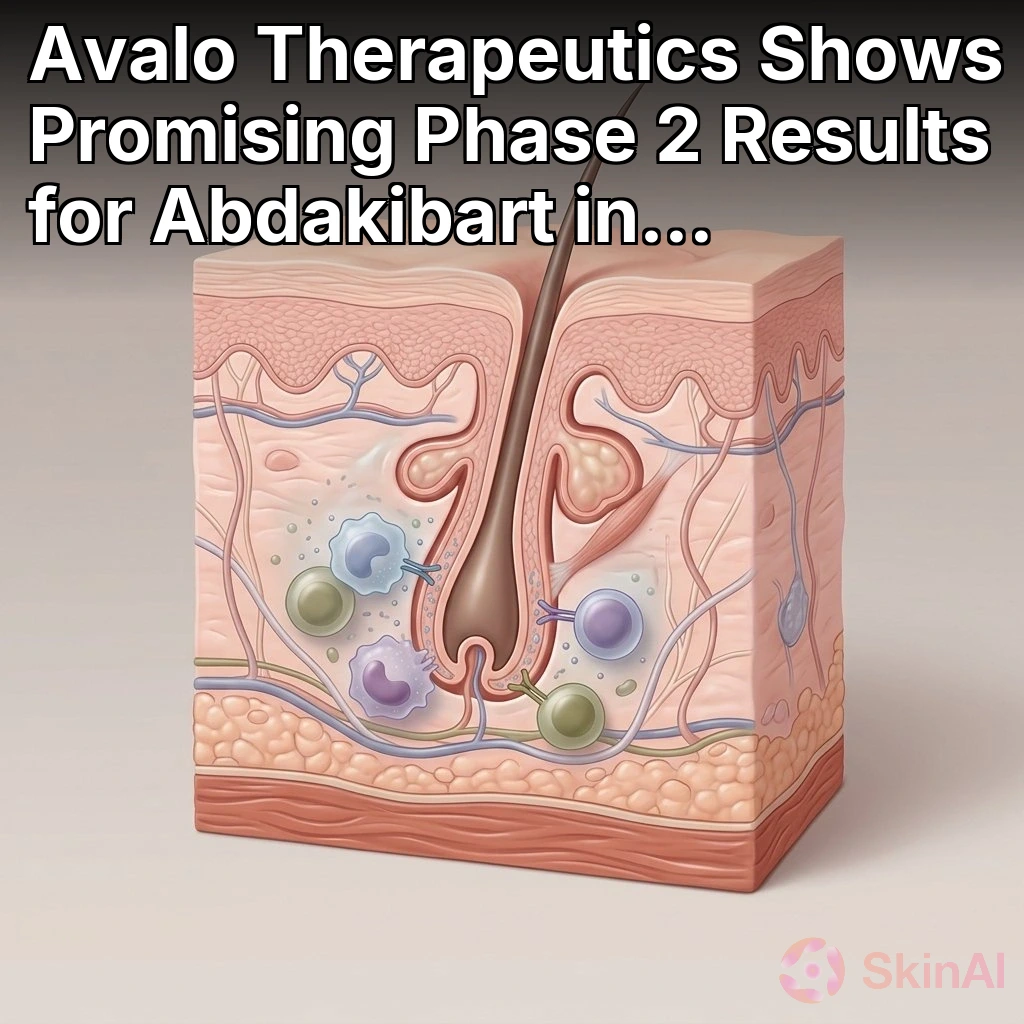
Abdakibart is a high-affinity monoclonal antibody designed to neutralize interleukin-1 beta (IL-1β), a pro-inflammatory molecule that helps drive the immune signals involved in HS lesions (Source: Avalo Therapeutics press release, Phase 2 LOTUS trial).
By binding to and blocking IL-1β, abdakibart may reduce downstream inflammation and the formation and persistence of abscesses, nodules, and fistulas that characterize HS. This represents a different mechanism from currently approved HS treatments and could fill an unmet need for some patients (Source: Avalo Therapeutics press release, Phase 2 LOTUS trial).
Expert perspective and clinical implications
John Frew, PhD, professor of dermatology at the University of New South Wales, said the phase 2 results are encouraging and suggested IL-1β inhibition with abdakibart could become a meaningful new option for people living with HS who have struggled with current therapies (Source: Avalo Therapeutics press release, Phase 2 LOTUS trial).
For clinicians and patients, these data signal a potentially useful addition to the HS treatment landscape — but confirmation in larger, longer trials is needed to define the drug’s place in therapy, long-term safety, and comparative effectiveness versus other options (Source: Avalo Therapeutics press release, Phase 2 LOTUS trial).
Next steps
Based on the LOTUS results, Avalo plans to advance abdakibart into a registrational phase 3 program; full trial data are expected to be presented at an upcoming medical congress (Source: Avalo Therapeutics press release, Phase 2 LOTUS trial).
Future studies will be important to confirm durability of response, longer-term safety, and whether the monthly dosing option under study can offer both convenience and sustained benefit for patients with HS (Source: Avalo Therapeutics press release, Phase 2 LOTUS trial).
Closing note
Avalo acknowledged the patients, caregivers, investigators, and study site teams for their role in making the phase 2 LOTUS trial possible, underscoring the collaborative effort behind clinical research in chronic skin disease (Source: Avalo Therapeutics press release, Phase 2 LOTUS trial).
Sources
- Avalo Therapeutics press release, “Avalo Therapeutics Achieves Positive Topline Results in Phase 2 LOTUS Trial of Abdakibart (AVTX-009) in Moderate to Severe Hidradenitis Suppurativa.” Published May 5, 2026. (Source: Avalo Therapeutics press release, Phase 2 LOTUS trial)
- Avalo Therapeutics press release, “Avalo Therapeutics announces completion of enrollment in phase 2 LOTUS trial of AVTX-009 for the treatment of hidradenitis suppurativa.” Published October 29, 2025. (Source: Avalo Therapeutics press release, enrollment announcement)
- ClinicalTrials.gov, NCT06603077 — Phase 2 LOTUS trial of AVTX-009 (abdakibart) for hidradenitis suppurativa. (Source: ClinicalTrials.gov, NCT06603077)