
Malassezia Folliculitis vs Acne: How to Spot and Treat the Difference
Why this matters
If you have red bumps or pimples on your face or upper chest and they won’t clear up, you might worry it’s acne. But there’s another condition that can look very similar: Malassezia folliculitis, sometimes called “fungal acne.” A recent interview with dermatologist Zoe Diana Draelos, MD, and a review she co-authored in the Journal of Drugs in Dermatology explain how to tell the two apart and why the difference matters for treatment.
A quick summary
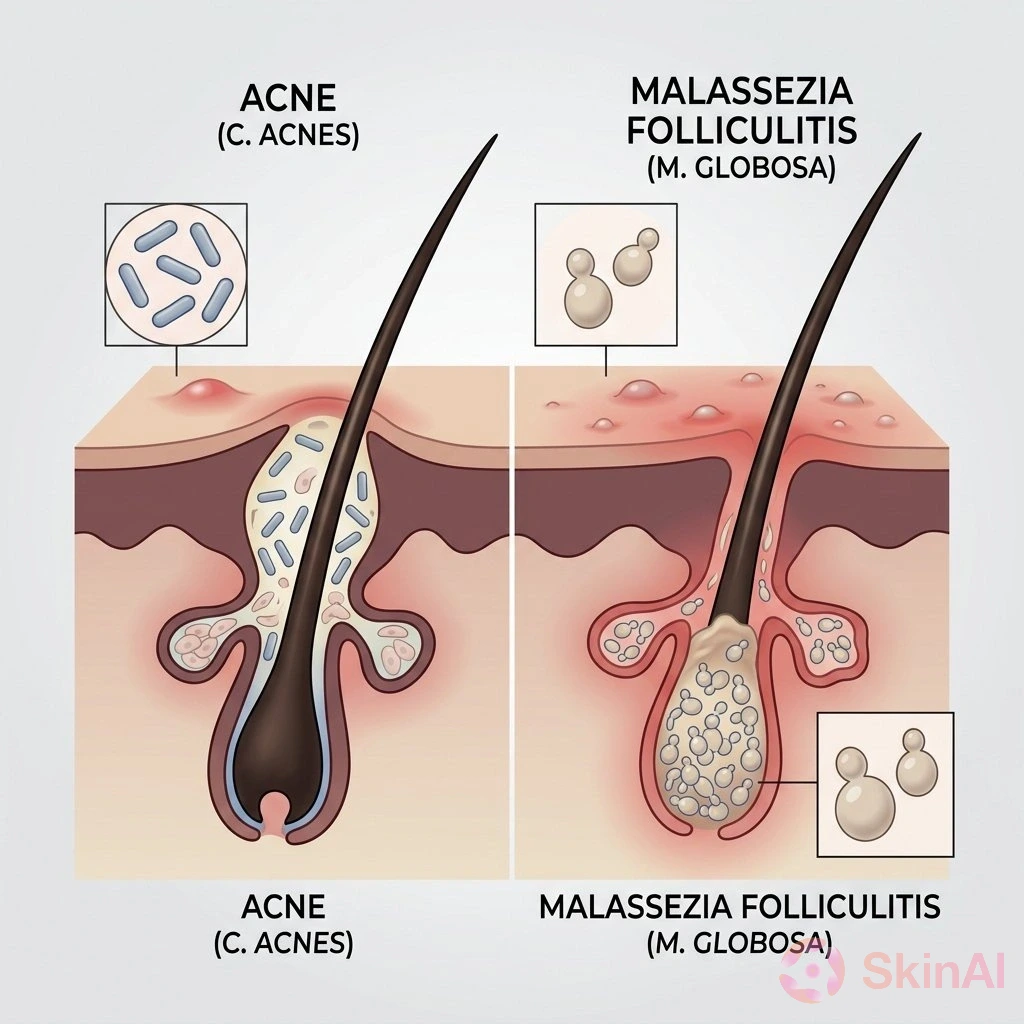
Both conditions can cause small, pimple-like bumps, but they have different causes and different clues on exam. Acne (acne vulgaris) is driven by bacteria and clogged pores, while Malassezia folliculitis is caused by a yeast (Malassezia). That means antibiotics that help acne usually won’t help fungal folliculitis, and antifungal medicines are needed for the fungal kind.
How the two look different
To most people the bumps can look the same. A dermatologist looks for a pattern that separates them.
- Malassezia folliculitis: The bumps tend to be monomorphous, meaning they look very similar to one another—mostly uniform pustules (small pus-filled bumps).
- Acne: You usually see a mix of lesion types: open comedones (blackheads), closed comedones (whiteheads), inflammatory red bumps, pustules, and sometimes deeper nodules or cysts. The lesions are polymorphous, meaning they vary in shape and size.
The absence of comedones (blackheads or whiteheads) and cysts is a helpful sign pointing away from acne and toward Malassezia folliculitis.
Where they appear on the body
Location gives another clue. Malassezia lives in high numbers on the scalp, so fungal folliculitis often shows up along the hairline and nearby areas. Malassezia is also linked to dandruff (seborrheic dermatitis), and the two conditions can occur together.
Why the cause changes treatment
The two conditions come from different organisms. Acne is driven by bacteria, while Malassezia folliculitis is caused by a yeast (Malassezia), which was previously called Pityrosporum.
Because one is bacterial and the other is fungal, the treatments are different. Antibiotics used for acne will usually not help fungal folliculitis, and antifungal creams or pills won’t treat bacterial acne. That’s why getting the diagnosis right matters.
When doctors consider antifungal treatment
Draelos says she has a low threshold for thinking about antifungals when the diagnosis isn’t clear. Topical antifungals such as clotrimazole and other established creams are commonly used and can be tried empirically (meaning the doctor might try them to see if they help).
If you’re seeing persistent, uniform pustules that do not improve with antibiotics, it’s reasonable to consider Malassezia folliculitis as a possible cause. In that situation, a clinician may switch to or add antifungal therapy.
Keeping an eye on skin changes
It can help to track how your skin responds to a treatment over a few weeks. If you’re using antibiotics for acne and the uniform pustules persist, make a note of that to share with your clinician. Documenting photos over time can be useful when you discuss next steps with a healthcare provider.
When to see a doctor
If bumps are painful, getting worse, bleeding, showing signs of infection, changing quickly, or simply not improving with treatment, see a healthcare professional. Only a clinician can examine the pattern of lesions and recommend the right tests or treatments.
Important note
This article summarizes an interview and a review article. It is not medical advice. If you’re concerned about your skin, speak with a dermatologist or your healthcare provider about diagnosis and treatment options.
Sources
- Interview with Zoe Diana Draelos, MD (discussion of differences between Malassezia folliculitis and acne vulgaris).
- Draelos ZD, Barbieri JS, Tanghetti EA, et al. Malassezia folliculitis presentation, diagnosis, and treatment: a review of “fungal acne”. Journal of Drugs in Dermatology. DOI:10.36849/JDD.9751