
Microneedling and Minoxidil Boost Hair Growth in Women with Pattern Hair Loss
Microneedling plus 5% Minoxidil Shows Promise for Women with Pattern Hair Loss
A retrospective study conducted at Hefei Second People’s Hospital in China reports that combining weekly microneedling with topical 5% minoxidil produced measurable hair growth in women with female pattern hair loss (FPHL). (Source: Hefei Second People’s Hospital, Yang et al.)
Who was studied and how the treatment was given
The analysis included 40 women aged 20 to 57 whose hair loss pattern was confirmed by dermoscopy.
Each participant received weekly clinic-based microneedling sessions using a 0.5 mm device, immediately followed by 1 mL of 5% minoxidil solution applied to the treated scalp area.
Participants were also instructed to continue self-applying 1 mL of 5% minoxidil once daily at home for the entire 12-week treatment period.
How results were measured
Investigators measured hair growth objectively by counting hairs in a fixed 1.2 cm² scalp area using dermoscopic imaging.
Global improvement was also graded using standardized photos evaluated by three blinded, board-certified dermatologists on a 7-point scale to capture visible change.
Clinical outcomes
After 12 weeks, the group experienced a statistically significant rise in mean hair count, from 76.7 ± 18.26 hairs/cm² at baseline to 98.67 ± 10.85 hairs/cm². (Source: Hefei Second People’s Hospital, Yang et al.)
On blinded global photographic review, 90% of women showed some degree of improvement: 32.5% had marked improvement, 42.5% moderate improvement, and 15% mild improvement; no patient worsened. (Source: Hefei Second People’s Hospital, Yang et al.)
Severity matters — and so might expectations
When participants were grouped by baseline severity, those with more severe FPHL had the largest absolute increases in hair count: from 57.65 ± 7.8 to 80.98 ± 9.42 hairs/cm² in the severe group, compared with increases in the mild group from 93.55 ± 10.21 to 109.35 ± 9.77 hairs/cm². Differences between groups reached statistical significance. (Source: Hefei Second People’s Hospital, Yang et al.)
The authors caution that this pattern could partly reflect regression to the mean, a statistical phenomenon where extreme baseline values tend to move closer to the average on subsequent measures, and note that controlled prospective trials are required to confirm the finding. (Source: Hefei Second People’s Hospital, Yang et al.)
Effect across age groups
Participants were also analyzed by age bracket (20s through 50s), and each age cohort showed statistically significant improvement from baseline.
No meaningful differences in response emerged between age groups, suggesting that age alone did not strongly predict short-term response to this combined regimen in this cohort. (Source: Hefei Second People’s Hospital, Yang et al.)
Safety and tolerability
The combination treatment was generally well tolerated during the 12-week study window.
Mean pain scores reported during the microneedling sessions were low, averaging 2.35 ± 0.57 on a 0–10 numerical rating scale with individual scores ranging from 1 to 3, and investigators noted that perceived pain tended to decline with repeated sessions. (Source: Hefei Second People’s Hospital, Yang et al.)
Adverse events were mild and manageable. Seven patients (17.5%) developed hypertrichosis—increased hair growth on the face or upper limbs—consistent with known effects of topical minoxidil, but none stopped treatment. (Source: Hefei Second People’s Hospital, Yang et al.; Müller Ramos et al.)
Three patients reported scalp pruritus, which was successfully treated with topical halcinonide solution, and no serious systemic adverse events were observed. (Source: Hefei Second People’s Hospital, Yang et al.)
Why microneedling might help minoxidil work better
Combining microneedling with topical therapy is supported by several plausible mechanisms.
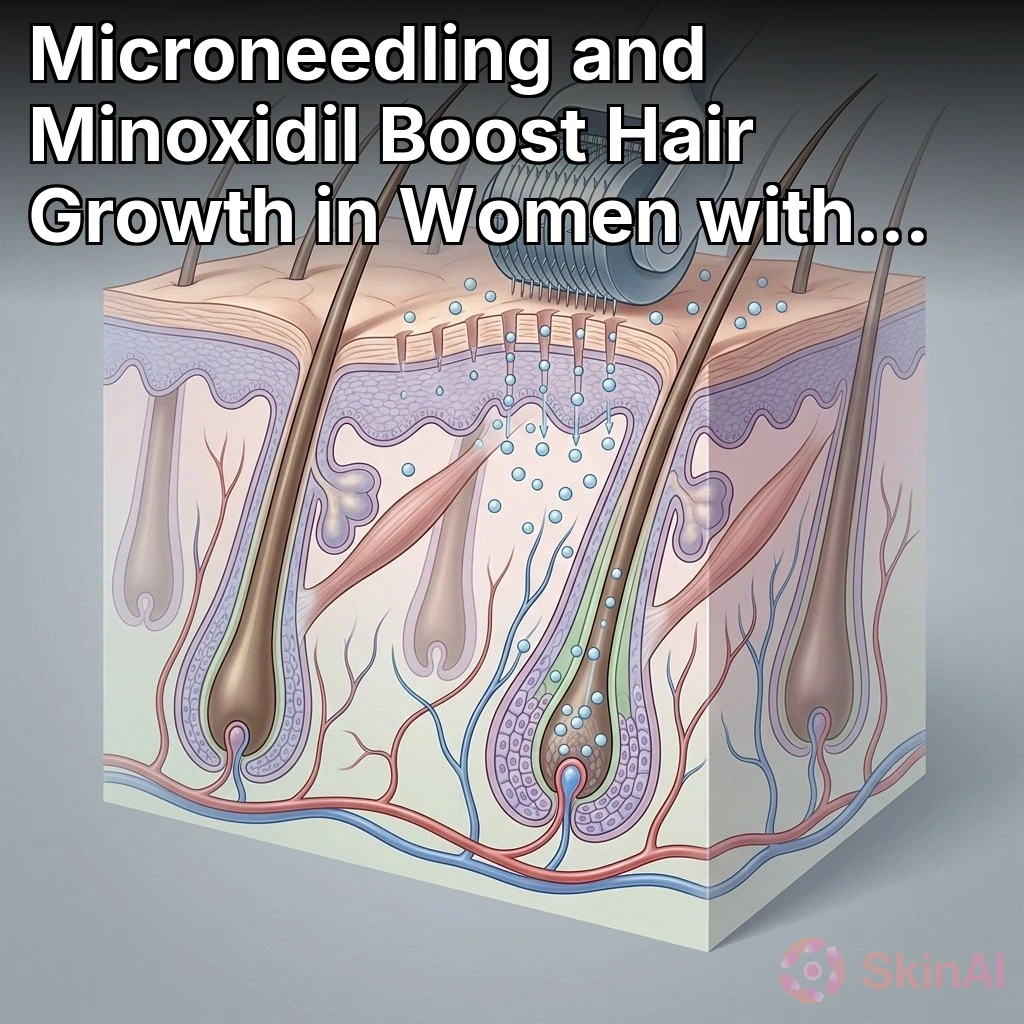
Microneedling creates tiny microchannels that can improve the cutaneous penetration of topical agents like minoxidil, which may increase local drug delivery to hair follicles. (Source: Müller Ramos et al.; Hefei Second People’s Hospital, Yang et al.)
Beyond enhanced penetration, microneedling is thought to stimulate a local wound-healing response that activates follicular stem cells and upregulates growth-promoting pathways such as VEGF and β-catenin, potentially encouraging hair regrowth. (Source: Müller Ramos et al.; Hefei Second People’s Hospital, Yang et al.)
There is also evidence that microneedling may increase follicular sulfotransferase activity — the enzyme involved in converting minoxidil to its active sulfated form — which could amplify minoxidil’s local effect. (Source: Müller Ramos et al.; Hefei Second People’s Hospital, Yang et al.)
Limitations and what to watch for
Although the findings are encouraging, the study has important limitations that affect how confidently we can apply the results to broader patient care.
The study used a retrospective, single-arm design without a minoxidil-only or placebo comparator, so it is difficult to isolate how much benefit microneedling itself contributed beyond the expected effect of topical minoxidil. (Source: Hefei Second People’s Hospital, Yang et al.)
The follow-up period was relatively short at 12 weeks; prior research suggests that improvements in FPHL can continue beyond three months and that assessments at 24 weeks or later may show larger or more durable benefits. (Source: Müller Ramos et al.)
The sample size was modest (40 participants), which limits generalizability and statistical power, particularly for subgroup analyses by severity and age. (Source: Hefei Second People’s Hospital, Yang et al.)
The authors recommend randomized controlled trials with larger cohorts, active comparator arms (for example, minoxidil alone), and longer follow-up — ideally at least one year — to better define the role of adjunctive microneedling in FPHL. (Source: Hefei Second People’s Hospital, Yang et al.)
What this means for people with female pattern hair loss
For women struggling with FPHL, this study adds to a growing body of evidence suggesting that microneedling may be a feasible and well-tolerated adjunct to topical minoxidil therapy. (Source: Hefei Second People’s Hospital, Yang et al.; Müller Ramos et al.)
Early improvements were seen across ages and severity levels in this cohort, and the procedure produced few serious side effects during the 12-week period, but more robust trials are needed before microneedling can be universally recommended as standard adjunct therapy. (Source: Hefei Second People’s Hospital, Yang et al.; Müller Ramos et al.)
Patients interested in microneedling should discuss the option with a board-certified dermatologist to weigh potential benefits, realistic expectations, and possible side effects as part of a comprehensive hair-loss treatment plan. (Source: Müller Ramos et al.)
Sources
- Yang L, Cui W, Lu Z. Microneedling combined with 5% minoxidil for female pattern hair loss: a retrospective study on efficacy and safety. Dermatology Research and Practice. doi:10.1155/dth/9148865. (Source: Hefei Second People’s Hospital, Yang et al.)
- Müller Ramos P, Melo DF, Radwanski H, de Almeida RFC, Miot HA. Female-pattern hair loss: therapeutic update. Anais Brasileiros de Dermatologia. doi:10.1016/j.abd.2022.09.006. (Source: Müller Ramos et al.)