
Folliculitis (ICD-10: L73) ⚠️
Folliculitis: Inflammation of the Hair Follicle
Folliculitis is inflammation of hair follicles. It appears as small red bumps or pustules, each one centred on a hair, and it can affect any part of the body that grows hair — most often the scalp, beard area, chest and back, armpits, buttocks and thighs.
The word describes a pattern, not a single disease. Folliculitis can be caused by bacteria, by yeast, by viruses, by mites, by medication, or by nothing infectious at all — simply friction, occlusion or the mechanical effect of shaving. That distinction is most of the clinical problem: the treatments differ, and a common error is treating a yeast-driven folliculitis with antibiotics, which will not clear it and, with prolonged or repeated courses, may allow it to persist or worsen.
Most cases are superficial, limited to the upper part of the follicle, and settle within days once the cause is removed. Deeper inflammation involves the whole follicle, is more painful, and can leave scarring and permanent hair loss where it is severe or repeated.
Predisposing Factors: Why Folliculitis Develops
- Bacteria: Staphylococcus aureus is the most frequent cause. Pseudomonas aeruginosa produces a characteristic form after exposure to inadequately treated hot tubs or pools, appearing a day or two later on skin that was under a swimsuit.
- Malassezia yeast: A cause that is regularly mistaken for acne, producing uniform itchy papules and pustules on the upper back, chest and shoulders, typically in younger adults and in warm humid conditions. It does not respond to antibacterial treatment.
- Shaving, waxing and plucking: Mechanical damage to the follicle. In tightly curled hair this produces pseudofolliculitis barbae, where the hair re-enters the skin and provokes inflammation without infection.
- Occlusion and friction: Tight clothing, sports equipment, prolonged sitting, adhesive dressings and heavy occlusive skin products.
- Heat and humidity, and prolonged sweating under clothing.
- Medication: Topical and systemic corticosteroids, lithium, and EGFR-inhibitor cancer therapies, which commonly produce a follicular eruption.
- Impaired immunity and diabetes, which make bacterial folliculitis more likely and more persistent.
- Demodex mites and, less commonly, herpes simplex, each producing their own recognisable variants.
Diagnostics: How Folliculitis Is Diagnosed
Recognising folliculitis is usually straightforward — pustules centred on hairs, in a hair-bearing area. Establishing the cause is the part that matters, and it is guided by the pattern, the site and the history.
A bacterial swab from a pustule identifies the organism and its sensitivities where bacterial infection is likely or treatment has failed. Direct microscopy of a skin scraping or a stained preparation can show abundant Malassezia yeast. Malassezia is a normal inhabitant of skin, so finding it does not by itself prove it is the cause; the diagnosis stays clinical, supported by the response to antifungal treatment or, in selected cases, by biopsy. The history frequently settles the question on its own: recent hot tub use, a new medication, a change in shaving routine, or a recent course of antibiotics that preceded the eruption.
Biopsy is reserved for deep, scarring or unexplained disease, particularly on the scalp, where distinguishing between the scarring folliculitides matters for treatment.
Symptoms: What Folliculitis Looks Like
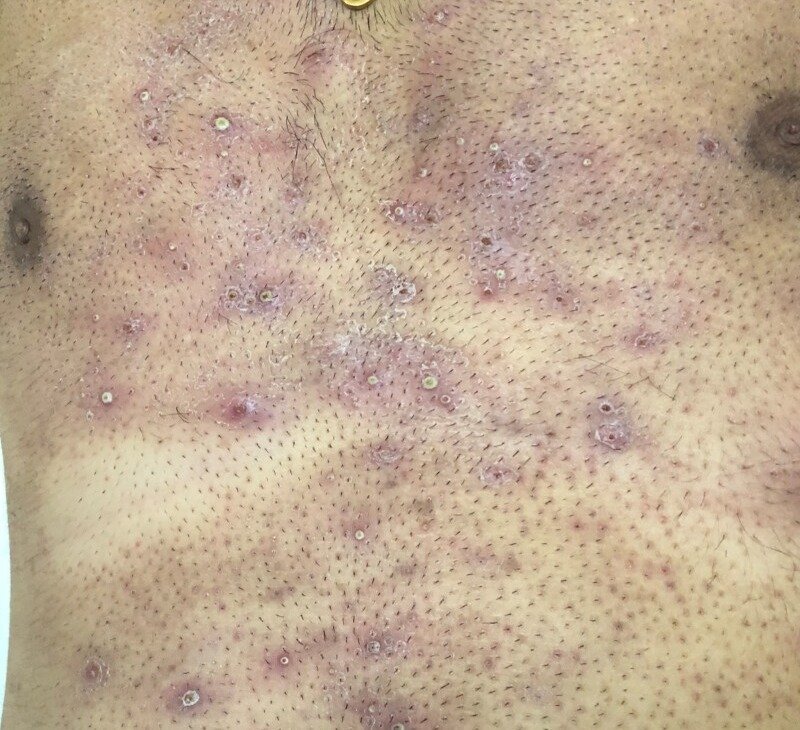
- Follicular papules and pustules: Small bumps, some topped with pus, each with a hair emerging from or trapped within it.
- A red ring around each lesion, more visible in lighter skin; in deeper skin tones the surrounding inflammation may appear darker brown or violet rather than red.
- Itch or mild soreness, with itch predominating in Malassezia folliculitis and tenderness in bacterial forms.
- Uniformity: Yeast-driven folliculitis tends to produce lesions of much the same size and stage, which points away from acne without settling it — the two can also occur together.
- Crusting where pustules have ruptured.
- Deeper nodules in more severe disease, which are painful and may leave scars.
- Post-inflammatory marks, which are common and fade slowly.
Differential Diagnosis: Ruling Out Other Conditions
- Acne vulgaris: Comedones — blackheads and whiteheads — are present in acne and absent in folliculitis, and acne favours the face and sebum-rich areas.
- Hidradenitis suppurativa: Deep painful nodules and tunnels confined to the skin folds, recurring in the same places, rather than superficial follicular pustules.
- Keratosis pilaris: Rough follicular bumps without inflammation, usually on the upper arms and thighs, present for years.
- Miliaria (heat rash): Tiny vesicles from blocked sweat ducts, not centred on hairs.
- Insect bites: Scattered rather than follicular, and usually on exposed skin.
- Furuncles and carbuncles: A boil is a deep, painful abscess arising from a follicle; a carbuncle involves several. Both are more than folliculitis and are managed differently.
Risks: Why Folliculitis Should Be Treated
Most folliculitis is self-limiting and leaves nothing behind. The reasons to treat it are the cases that do not follow that course.
Superficial bacterial folliculitis can progress to a furuncle or carbuncle, and in deeper or spreading infection to cellulitis. Repeated or deep inflammation, particularly on the scalp and beard, can destroy the follicle and cause scarring hair loss, which later treatment does not reliably reverse. On the neck and jawline, pseudofolliculitis barbae can leave firm raised scars.
Misdiagnosis carries its own cost. Malassezia folliculitis mistaken for bacterial acne does not respond to oral antibiotics and may continue for months while they are taken; a mechanism involving reduced bacterial competition has been proposed but is not established. When an acne-like eruption on the back and chest has not responded to antibiotics, that is a reason to revisit the diagnosis rather than to extend the course.
Tactics: When and How to Seek Treatment
Mild folliculitis after shaving or a hot day often settles within a week with no treatment beyond leaving the area alone. See a clinician if lesions are spreading, painful or deep, if the eruption keeps returning, if it does not settle within a week or two, if it affects the scalp or beard with any hair loss, or if an “acne” on the trunk has failed to respond to treatment.
Seek care promptly if an area becomes hot, swollen and increasingly painful, or if there is fever, since that suggests an abscess or cellulitis rather than folliculitis.
Do not squeeze the lesions. It spreads the organism into surrounding follicles, deepens the inflammation and increases the chance of scarring.
Treatment: Modern Strategies for Folliculitis
- Remove the cause first: Stopping shaving for a period, changing the shaving method, loosening clothing, showering promptly after sweating, or reviewing a causative medication. In many cases this alone is sufficient.
- Antiseptic washes: Preparations such as chlorhexidine or benzoyl peroxide reduce bacterial load and are often used for recurrent superficial disease.
- Topical antibiotics: Sometimes used for localised bacterial folliculitis, but not routinely and not for long periods, since they drive resistance and cause allergic contact dermatitis. Mupirocin in particular is reserved for specific indications under local guidance.
- Oral antibiotics: For extensive, deep or recurrent bacterial infection, guided by swab results and kept as short as is appropriate.
- Antifungal treatment: Topical or oral, for Malassezia folliculitis — the treatment the misdiagnosed cases actually need. An oral antifungal is a clinician’s decision: the regimens vary, and the drugs carry interactions and a risk of liver injury.
- Hot-tub folliculitis: Usually resolves without treatment within a week or two in otherwise healthy people; antibiotics are reserved for severe or persistent cases.
- Pseudofolliculitis barbae: Managed through shaving technique, growing the beard, or laser hair reduction, which can give longer-lasting relief. Antibiotics have little role, since it is not primarily an infection.
- Specialist care for scarring disease, particularly on the scalp, where the aim is to halt follicle destruction before hair loss becomes permanent.
Prevention: Reducing Recurrence
- Shower soon after sweating and change out of damp sports clothing.
- Wear looser, breathable fabrics in areas that are affected repeatedly.
- Adjust shaving: A clean sharp blade, shaving in the direction of hair growth, avoiding multiple passes, and not stretching the skin.
- Do not share razors or towels, and replace blades regularly.
- Use pools and hot tubs that are properly maintained, and shower afterwards.
- Avoid heavy occlusive products on the chest and back if these areas are prone.
- Treat the underlying condition — diabetes control, or review of a causative medication — where one is identified.
Folliculitis is usually straightforward to resolve once the cause is correctly identified, and much of the difficulty in practice comes from treating the wrong one — most often by reaching for an antibiotic when the problem is yeast. Causes can also coexist, and some follicular eruptions need a culture, a biopsy or a specialist opinion even when the first diagnosis was right.
Image: Dr. Shyam Verma, MBBS, DVD, FRCP, FAAD, CC BY 4.0, via Wikimedia Commons.

Medical review
Board-Certified Dermatologist · Fellow of the American Academy of Dermatology (FAAD)