
Red spots and dots on skin: pictures and possible causes
This tool is for informational purposes only and does not constitute medical advice. Always consult a qualified dermatologist.
The pictures and answers on this page are free. SkinAI Lab is a paid AI analysis; pricing is shown before you scan.
What causes red spots on the skin?
Many skin conditions can cause red spots, from hives and eczema to infections and some skin cancers. Pictures can help you describe what you see, but they cannot tell you which condition you have. First, how urgent is it?
- Call emergency services now for a rash that does not fade when you press the side of a clear glass firmly against it, sudden swelling of the lips, mouth, throat or tongue, or struggling to breathe. All warning signs
- See a GP about a new or changing mole, or a mole that is painful, itchy, inflamed, bleeding or crusty — don’t wait 4 weeks for these. Also see a GP about a growth on your skin that is getting bigger or has changed colour or texture, or a growth or area of skin that hurts, itches, bleeds, crusts or scabs for more than 4 weeks.
- Often harmless: heat rash usually gets better on its own after a few days, most insect bites get better in a few days, and cherry angiomas need no treatment. Check the warning signs first, and see a doctor if you are not sure what the spots are.
Call emergency services now — don’t wait for a photo check — if someone has:
- A rash that does not fade when you press the side of a clear glass firmly against it, in an adult or a child
- Sudden swelling of the lips, mouth, throat or tongue, a tight throat or trouble swallowing
- Struggling to breathe, or breathing very fast
- Skin, lips or tongue that turn blue, grey or pale
- Sudden confusion, drowsiness or dizziness, or fainting and being unable to wake the person
- A child who is limp, floppy or not responding as usual
Meningitis does not always cause a rash. Get help at once if someone is unwell and you think something is seriously wrong — do not wait for a rash, a glass test or an online check. On brown or black skin a meningitis rash can be harder to see; check paler areas such as the palms, the soles of the feet and the roof of the mouth.
Get urgent medical advice if a child has a rash you are worried about, or a temperature of 38°C or more under 3 months old or 39°C or more from 3 months — or if tiny pinpoint spots spread quickly or come with fever.
Sources: NHS — Meningitis · NHS — Rashes · NHS — Anaphylaxis · Cleveland Clinic — Petechiae
Tiny red dots
Two possible causes of small red dots, and what each usually means. This cannot identify a spot or replace a medical check.
Petechiae
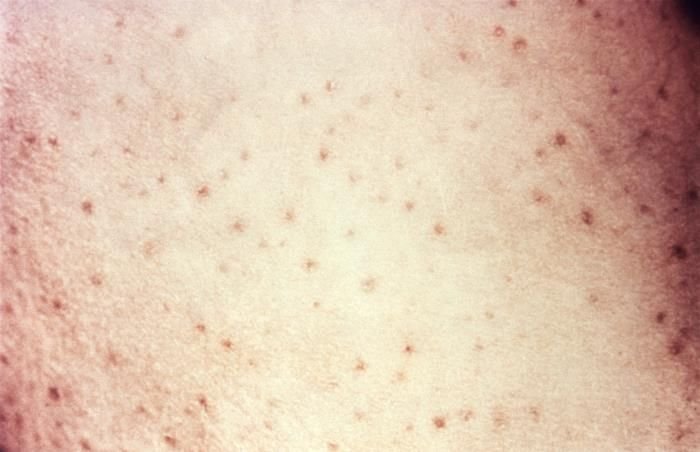
Pinpoint spots of bleeding under the skin. If any of the emergency signs is present, get emergency help immediately.
Cherry angiomas
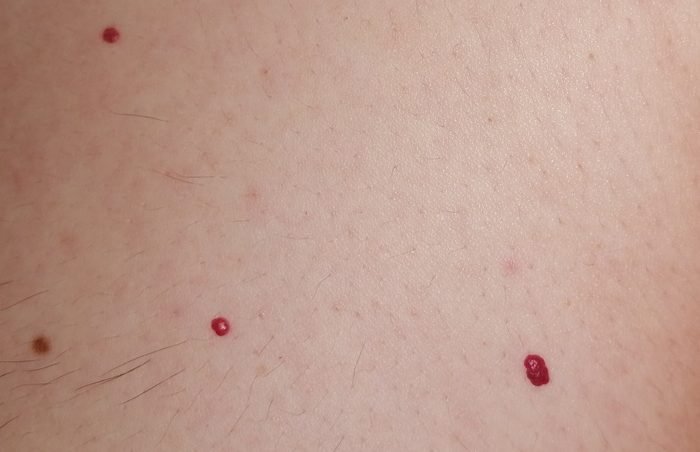
Small, harmless red bumps that are common after age 30.
| Petechiae | Cherry angiomas | |
|---|---|---|
| Raised? | No, flat | Yes, small round bumps |
| Size | Pinpoint | About 2 to 4 mm |
| When pressed | Keep their purple, red or brown colour | Pressing cannot confirm a cherry angioma or show that a spot is harmless |
| Itchy? | No | No |
| Who gets them | Causes include straining, a skin injury and serious illness | Common after age 30, often in groups |
| What to do | Call a doctor. Seek medical attention quickly if spots spread or come with fever. If they do not fade under a glass, or any warning sign is present, call emergency services now | Harmless, no treatment needed. Other growths can look similar, so see a doctor if you are unsure what a spot is, or if one bothers you or often bleeds |
Do not assume a spot that does not fade is a cherry angioma: if a rash does not fade under a glass, call emergency services now (warning signs).
Sources: Cleveland Clinic — Petechiae, Cleveland Clinic — Cherry angioma, StatPearls — Cherry hemangioma, NHS — meningitis symptoms
Red spots on brown and black skin
Some skin changes are harder to see on brown or black skin. Hives can be harder to see, heat rash may look grey or white, and skin cancer patches can be purple, brown or red and may look darker. An insect bite may be easier to feel than to see. Several of the photos below show darker skin for this reason. A rash that does not fade under a glass can also be harder to see: check paler areas such as the palms, the soles of the feet and the roof of the mouth, and if it does not fade, call emergency services now.
Sources: NHS — Hives · NHS — Heat rash · NHS — Insect bites and stings · NHS — skin cancer symptoms · NHS — meningitis symptoms
Possible causes: examples with pictures
Grouped by features mentioned in the atlas quotes, not by every way a condition can look. Groups overlap and cannot identify or rule out a condition, so look through all three. Each description is quoted word for word from the atlas article; open a card for the full article and all its photos.
Patches, often scaly
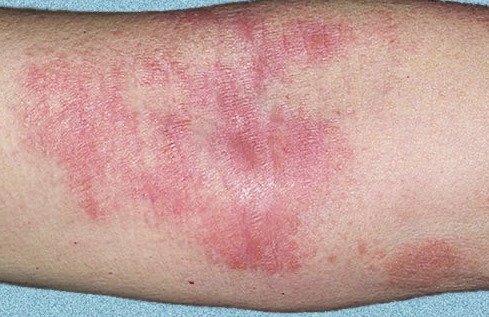 24 photos
Atopic dermatitis (atopic eczema)
“Erythematous patches and plaques with ill-defined borders”
Read the article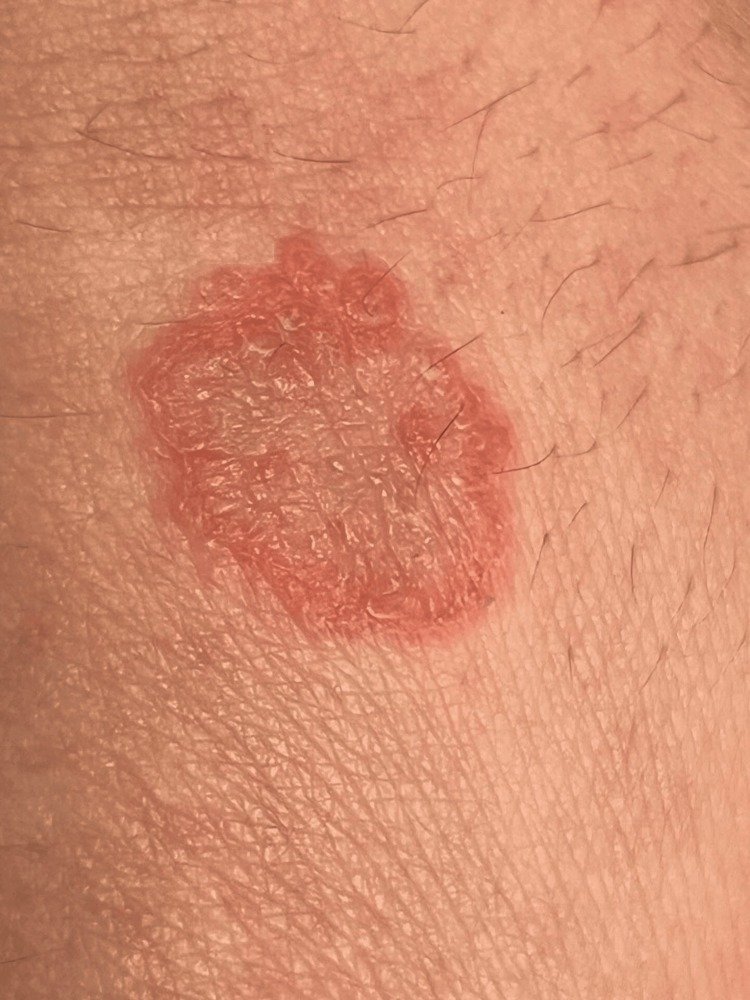
Nummular eczema (discoid eczema)
“Nummular eczema, also called discoid eczema, produces round or oval patches of inflamed skin with unusually sharp edges.”
“The patches are intensely itchy.”
Read the article 29 photos
Psoriasis (psoriasis vulgaris)
“Psoriasis vulgaris typically presents with erythematous plaques covered by thick, white or silvery scales.”
Read the article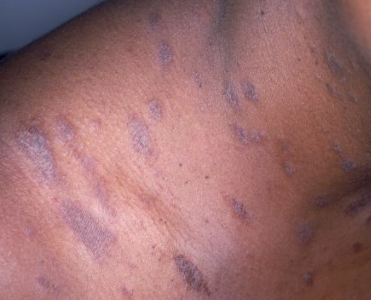 24 photos
Pityriasis rosea
“It typically begins with a solitary herald lesion (known as the “mother patch”) followed by a generalized eruption of scaly, oval pink patches on the trunk and limbs.”
Read the article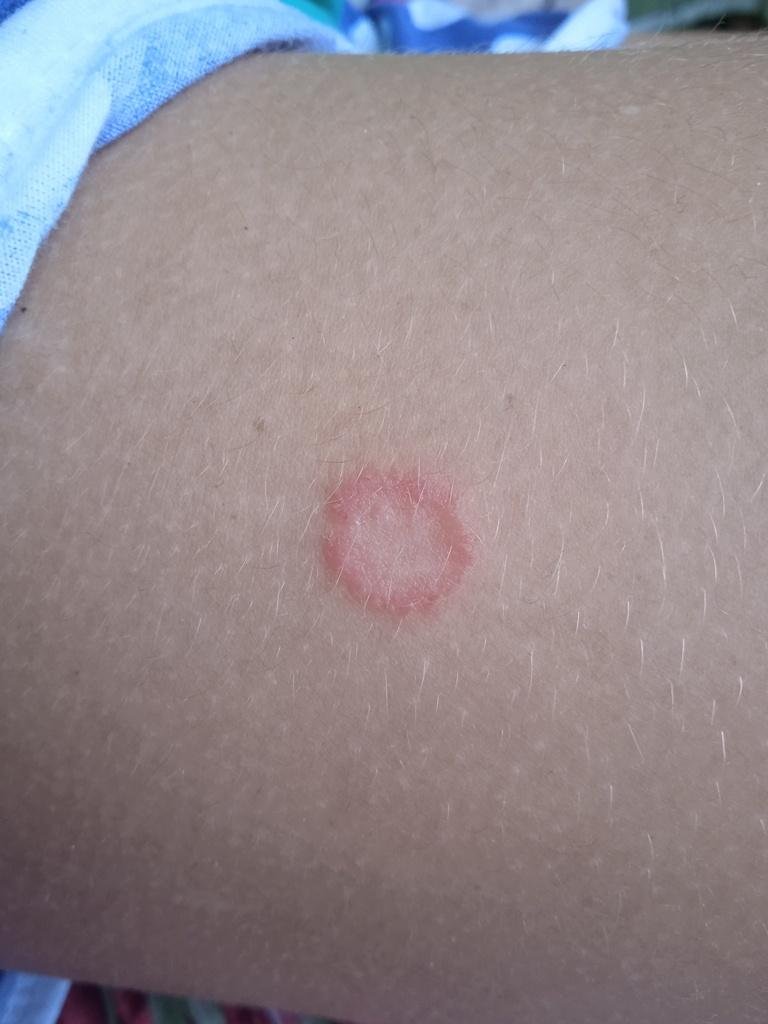 28 photos
Ringworm (tinea corporis)
“Ring-shaped erythematous patches with active, scaly, vesiculated borders and a central area that may be clear or slightly scaly.”
Read the article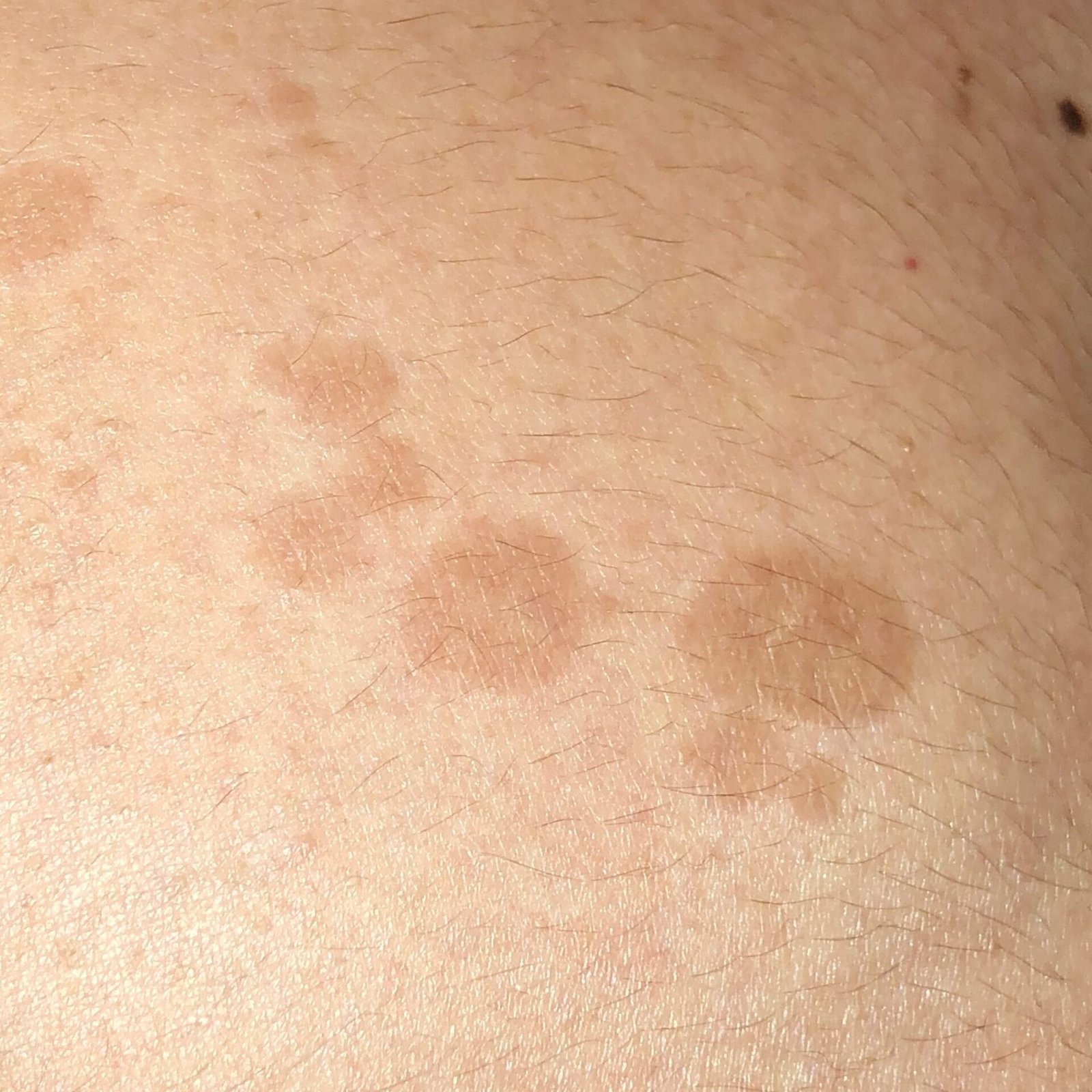 25 photos
Tinea versicolor (pityriasis versicolor)
“The hallmark of pityriasis versicolor is the development of well-demarcated, scaly, discolored patches that vary in hue—from pink, tan, and light brown to hypopigmented or chalky white, especially in darker-skinned individuals.”
Read the articleBlisters, weeping or crusts
Chickenpox (under Spots, bumps and welts) and ringworm (under Patches, often scaly) can also cause blisters.
 24 photos
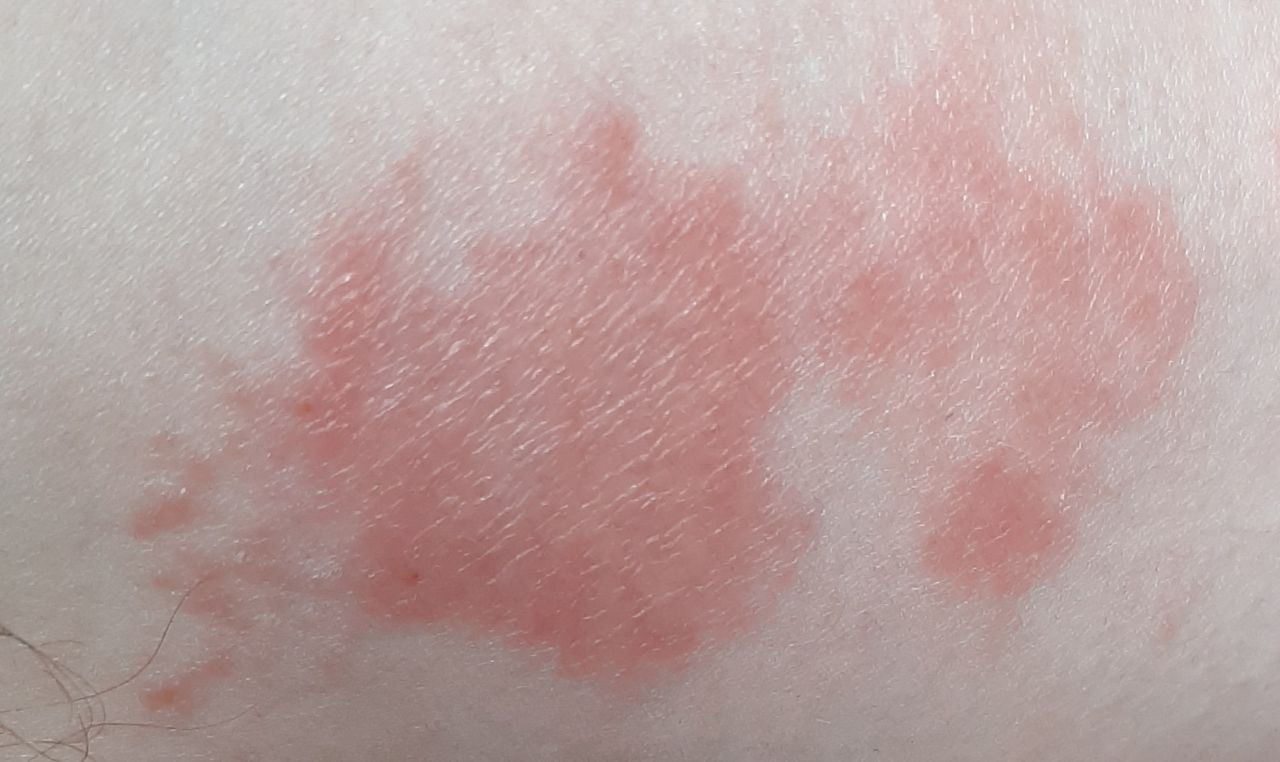
Contact dermatitis
“Acute phase: Erythema (redness), edema, vesicles or papules, weeping (exudation), crust formation, burning sensation, soreness, occasional itching”
Read the article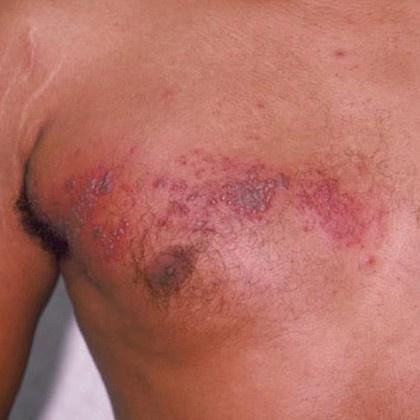 32 photos
Shingles (herpes zoster)
“The hallmark symptom of herpes zoster is a localized, painful vesicular rash that typically appears on one side of the body, following the distribution of a single dermatome—the area of skin supplied by one sensory nerve.”
Read the article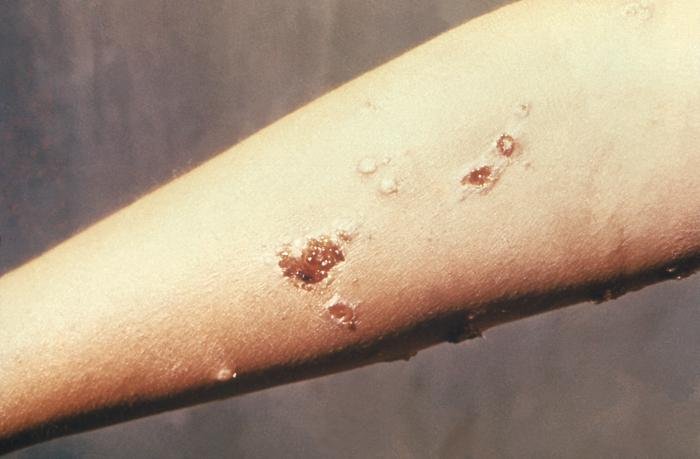
Impetigo (non-bullous)
“It begins as a small red spot or blister that ruptures within a day, leaving a shallow erosion that dries into the characteristic golden crust.”
Read the articleSpots, bumps and welts
 24 photos
Hives (urticaria)
“The rash typically presents as itchy, red or pink wheals (hives) with clear edges and no peeling.”
Read the article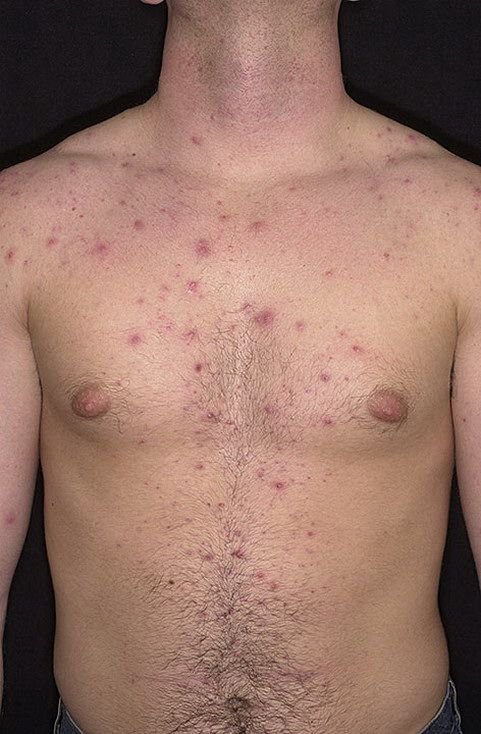 28 photos
Chickenpox
“Macules: Small, red, flat spots that mark the initial eruption.”
Read the article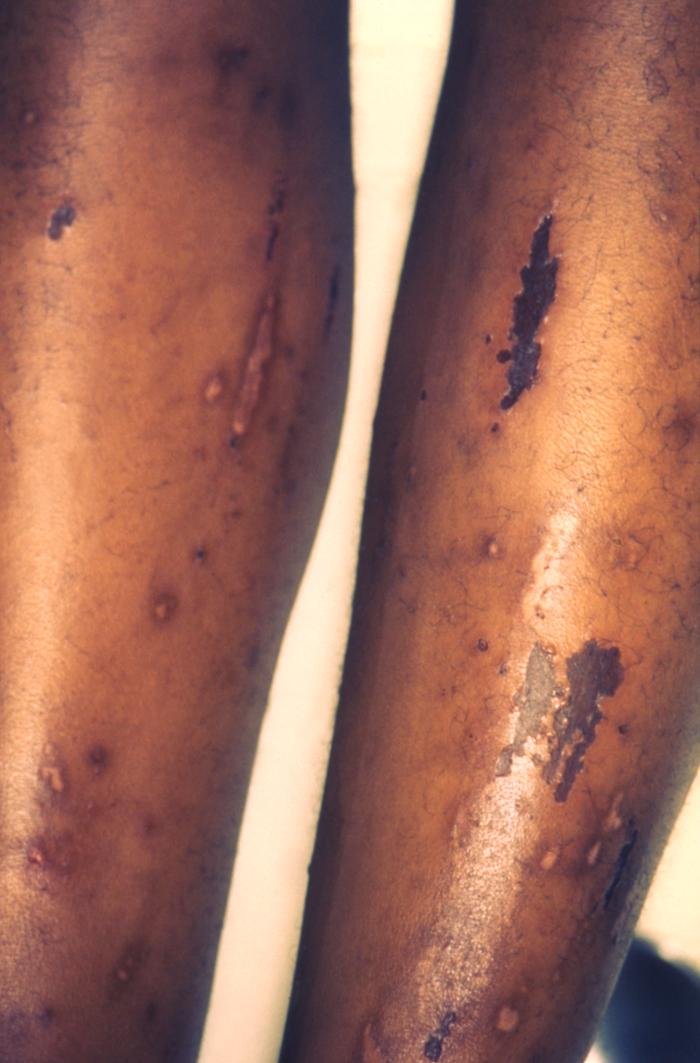
Scabies
“Small red papules and widespread scratch marks, which are often all that is visible.”
“Intense itch, characteristically worse at night and when warm in bed.”
Read the article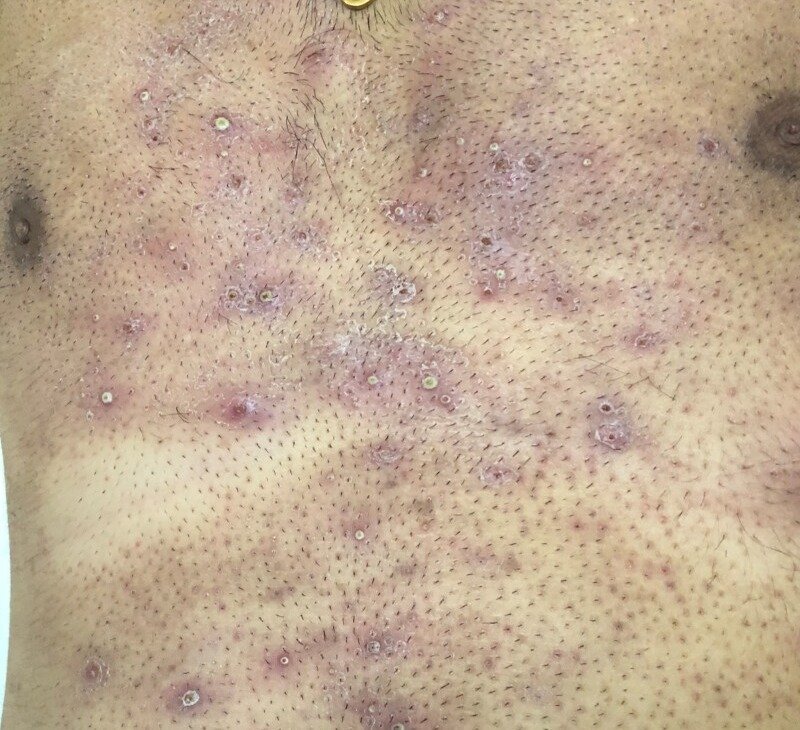
Folliculitis
“It appears as small red bumps or pustules, each one centred on a hair, and it can affect any part of the body that grows hair — most often the scalp, beard area, chest and back, armpits, buttocks and thighs.”
Read the article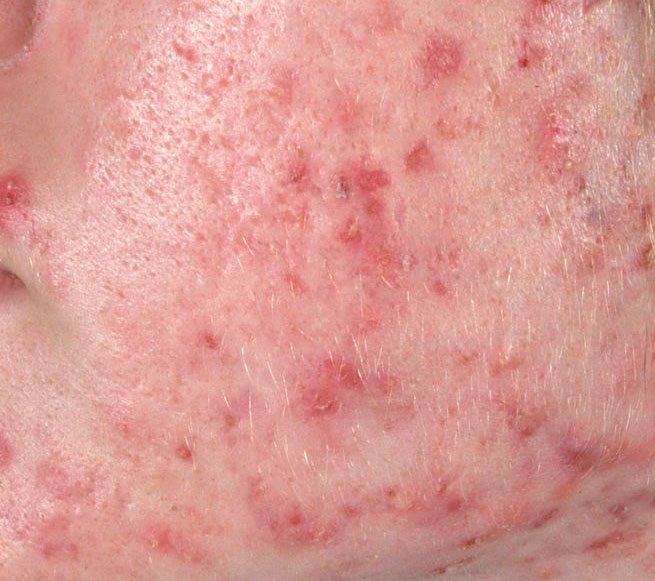 24 photos
Acne (acne vulgaris)
“Papules: These are inflamed, red or pink bumps without visible pus.”
Read the article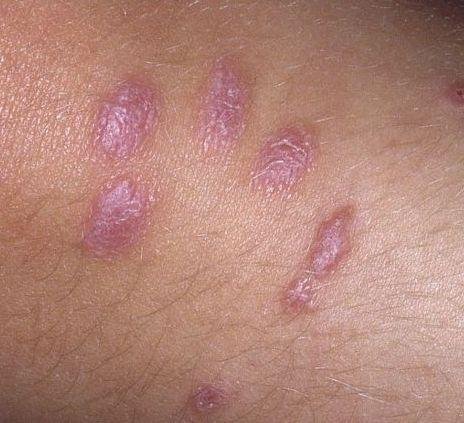 24 photos
Lichen planus
“Lichen planus (LP) is a chronic inflammatory skin and mucous membrane condition characterized by itchy, polygonal, flat-topped papules, typically violaceous or reddish-purple in color.”
Read the article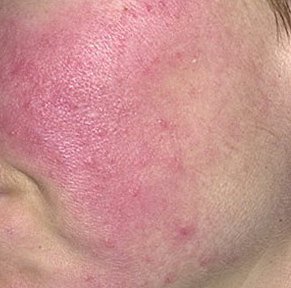 18 photos
Rosacea
“Patients should consult a dermatologist as soon as signs of chronic facial redness, flushing, or papulopustular lesions develop.”
Read the article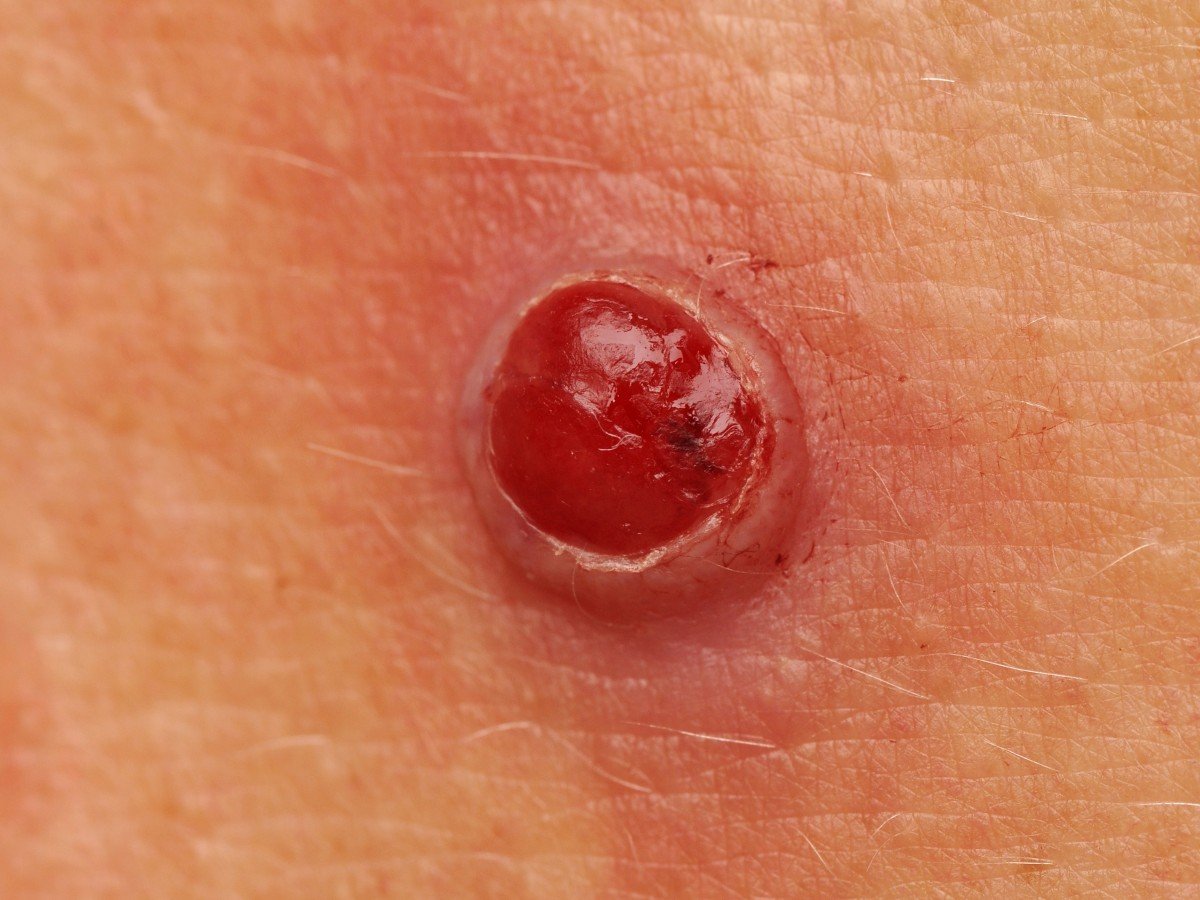 16 photos
Pyogenic granuloma
“Upon visual examination, pyogenic granulomas present as a hemispherical or dome-shaped growth that rises above the skin on a short, wide stalk (pedicle).”
“The color of the granuloma is often bright red…”
Read the articleHow the common causes differ
A summary of selected features described in our atlas articles and NHS pages. Many conditions overlap, so this table cannot tell you which one you have. Tap a condition to see its picture.
| Condition | What it usually looks like | Itch | Where it often appears |
|---|---|---|---|
| Hives | Raised red or pink bumps or patches with clear edges; each one usually fades within 24 hours | Itchy | Anywhere on the body |
| Heat rash | Small raised spots 2 to 4 mm across, some filled with fluid | Itchy, prickly | Anywhere on the body |
| Insect bites | A small swollen lump, sometimes several grouped together | May itch | Where you were bitten |
| Contact dermatitis | Redness and swelling, sometimes small blisters that weep and crust | Itching, burning or soreness | Where the skin touched the trigger |
| Atopic dermatitis | Dry skin with red patches that have ill-defined borders | Intense itch, often worse at night | Inner elbows, backs of the knees, neck, wrists |
| Nummular eczema | Round or oval coin-shaped patches with sharp edges, usually 1 to 5 cm | Intense itch | Lower legs, backs of the hands, forearms, trunk |
| Psoriasis | Raised red patches with clear edges, covered by thick white or silvery scales | In about 60% of people | Elbows, knees, scalp, lower back |
| Pityriasis rosea | One larger “herald patch”, then smaller oval pink scaly patches | In about half of people | Trunk, chest and arms; rarely the face |
| Ringworm | Ring-shaped red patches with a scaly edge; the centre may be clear or slightly scaly | Common | Trunk or limbs |
| Scabies | Small red bumps, scratch marks, and fine wavy lines (burrows) | Intense, worse at night | Finger webs, wrists, elbows, armpits, waistline |
| Folliculitis | Small red bumps or pus spots, each centred on a hair | Itch or mild soreness | Scalp, beard area, chest, back, buttocks, thighs |
| Lichen planus | Flat-topped, shiny pink, red or purple bumps 3 to 5 mm across | Mild to intense | Wrists, forearms, lower back, ankles, shins |
| Chickenpox | Spots that start on the chest and back and spread quickly, often after a mild fever | Severe | Chest and back first, then face, scalp, arms and legs |
| Shingles | A painful band of blisters on one side of the body | Pain, sometimes itching or tingling first | One side of the body, most often the chest |
Sources: the atlas articles linked in the cards above · NHS — Hives · NHS — Heat rash · NHS — Insect bites and stings
Other common causes
Not yet in our atlas, so described from NHS pages.
- Heat rash (prickly heat). Small raised spots with an itchy, prickly feeling. It looks red on white skin and may look grey or white on brown or black skin. It is usually harmless and gets better on its own after a few days. NHS — Heat rash
- Insect bites and stings. A small, swollen lump that may look red, sometimes several grouped together; mosquito bites are usually small, raised and itchy. Most get better in a few days, but some can become infected or cause a serious allergic reaction; if any warning sign is present, call emergency services now. NHS — Insect bites and stings
- Keratosis pilaris. Patches of small, painless bumps, usually on the arms, thighs or bottom. The bumps can look red on white skin or darker on brown or black skin. It is very common and harmless. NHS — Keratosis pilaris
Can a red spot be skin cancer?
Cancerous patches can be a range of colours, including purple, brown and red. See a GP if a growth on your skin is getting bigger or has changed colour or texture, or if a growth or area of skin hurts, itches, bleeds, crusts or scabs for more than 4 weeks.
Source: NHS — Non-melanoma skin cancer
 32 photos
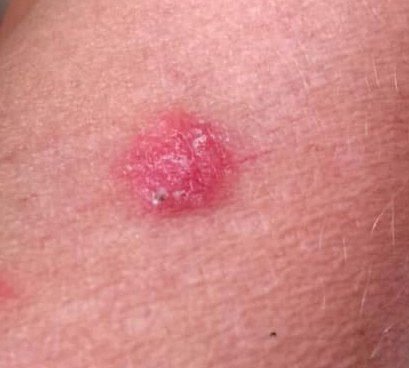
Basal cell carcinoma
“Basal cell carcinoma typically presents as a slowly enlarging, raised lesion or plaque that may appear pink, flesh-colored, or red.”
Read the article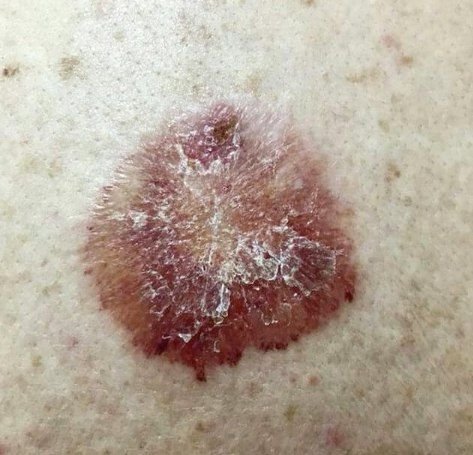 16 photos
Squamous cell carcinoma
“The tumor often appears as a persistent, thickened plaque or a nodule that protrudes from the surface of the skin.”
“The typical color is pink to reddish-pink…”
Read the article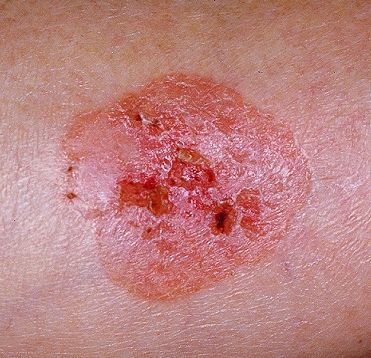 12 photos
Bowen’s disease
“It presents as a persistent red or pink patch or plaque with a rough, scaly surface.”
Read the article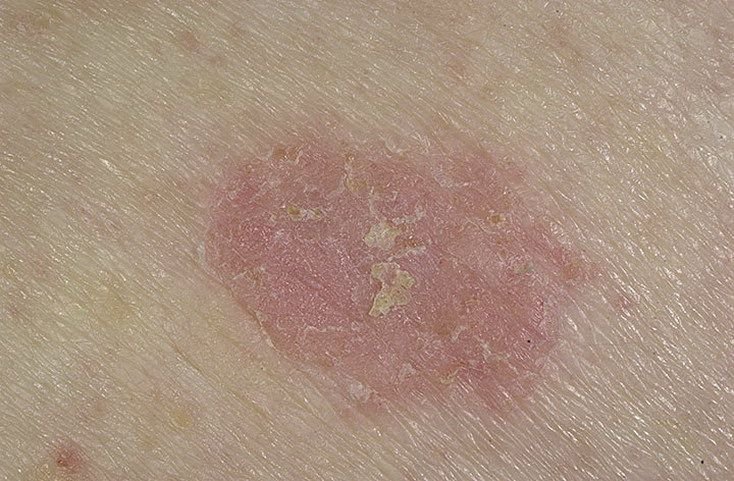 20 photos
Actinic keratosis (solar keratosis)
“Actinic Keratosis (also known as solar keratosis) is a premalignant skin lesion…”
“The color of the lesions varies, ranging from flesh-colored to gray, gray-brown, or pink.”
Read the article
Medical review of the atlas articles above
Board-Certified Dermatologist · Fellow of the American Academy of Dermatology (FAAD)
Terms used in the quotes
- Erythema, erythematous
- Redness of the skin.
- Edema
- Swelling caused by excess fluid in body tissues.
- Papule
- A small, solid, raised bump on the skin that has a border with edges that are easy to see.
- Plaque
- In medicine, a small, abnormal patch of tissue on a body part or an organ.
- Vesicle, vesicular, vesiculated
- A skin vesicle is a blister: a fluid-filled sac in the outer layer of skin.
- Pustule
- A pus-filled lesion.
- Nodule
- A growth or lump that may be malignant (cancer) or benign (not cancer).
- Lesion
- An area of abnormal or damaged tissue caused by injury, infection, or disease.
- Hypopigmented
- Lighter in colour than normal skin.
- Premalignant
- A condition that may (or is likely to) become cancer. Also called precancerous.
Sources: NCI Dictionary of Cancer Terms (all except pustule) · pustule: the atlas article on rosacea.
Red spots on skin: FAQ
Why do I have little red dots on my skin?
Tiny red dots have many causes; two described on this page are cherry angiomas and petechiae. Cherry angiomas are small, raised, round red bumps that often appear in groups; an estimated half of adults have them after age 30, and they are harmless. Petechiae are flat, pinpoint spots of bleeding under the skin that keep their colour when you press on them; their causes range from straining or a skin injury to serious illness, so call a doctor about them. A cherry angioma can be confused with a mole or melanoma, so have a doctor look at any spot you are unsure about. If a rash does not fade when you press a glass against it, call emergency services now (warning signs). Sources: Cleveland Clinic — Cherry angioma, Cleveland Clinic — Petechiae, NHS — meningitis symptoms.
What are small red spots on the skin that are not itchy?
Cherry angiomas and petechiae usually do not itch. Cherry angiomas are raised and become more common with age. Petechiae are flat and stay purple, red or brown when pressed; call a doctor about them, and get medical attention quickly if they spread or come with fever. If a rash does not fade when you press a glass against it, call emergency services now (warning signs). Sources: Cleveland Clinic — Cherry angioma, Cleveland Clinic — Petechiae, NHS — meningitis symptoms.
What are red spots on the skin called?
That depends on the cause. Pinpoint spots of bleeding under the skin are called petechiae. Cherry angiomas, also called Campbell de Morgan spots, are one possible cause of small, raised red bumps. The atlas describes the raised, itchy bumps of hives as wheals. The terms used in the atlas quotes are explained under the pictures. Sources: Cleveland Clinic — Petechiae, Cleveland Clinic — Cherry angioma.
What causes red itchy spots on the skin?
Among the conditions on this page, the atlas quotes describe hives as itchy wheals, scabies as an intense itch that is worse at night and when warm in bed, and contact dermatitis as occasionally itchy. Allergies, insect bites or stings and dry skin can also cause itchy spots. Get urgent medical advice if hives are spreading, keep coming back, do not improve after 2 days, or come with a high temperature and you feel unwell. Sudden swelling of the lips, mouth, throat or tongue, or trouble breathing, needs emergency help. Sources: NHS — Hives, Cleveland Clinic — Cherry angioma.
Can stress cause red spots on the skin?
Emotional stress is one of the possible triggers of hives, along with hot, sweaty skin from exercise, certain foods, medicines, insect bites or stings and infections. Hives usually get better within a few days. If hives keep coming back, get urgent medical advice: you may be allergic to something. Sudden swelling of the lips, mouth, throat or tongue, or trouble breathing, needs emergency help. Source: NHS — Hives.
Are red spots on the skin a sign of cancer?
Some skin cancers can appear as a red patch. See a GP about a new or changing mole, or a mole that is painful, itchy, inflamed, bleeding or crusty — don’t wait 4 weeks for these. Also see a GP if a growth on your skin is getting bigger or has changed colour or texture, or if a growth or area of skin hurts, itches, bleeds, crusts or scabs for more than 4 weeks. Cherry angiomas, a common cause of small red bumps, are not a sign of cancer. Sources: NHS — skin cancer symptoms, NHS — melanoma symptoms, Cleveland Clinic.
Can red spots be a sign of leukaemia or another serious illness?
Petechiae can have causes including straining, a skin injury, infections, a low platelet count and leukaemia; how they look cannot tell you the cause. Symptoms of acute myeloid leukaemia (AML) can include feeling very tired, looking paler than usual, bruising or bleeding easily, getting ill a lot and swollen glands. These symptoms can have many causes and do not necessarily mean leukaemia, but if you have them, ask for an urgent GP appointment. If a rash does not fade when you press a glass against it, or any warning sign is present, call emergency services now. Sources: Cleveland Clinic — Petechiae, NHS — leukaemia symptoms, NHS — meningitis symptoms.
Do red spots fade when you press them?
A rash usually turns paler when you press on it. Petechiae, pinpoint spots of bleeding under the skin, keep their purple, red or brown colour. If a rash does not fade when you press a glass against it, call emergency services now (warning signs). Sources: Cleveland Clinic — Petechiae, NHS — meningitis symptoms.
How do I do the glass test?
Press the side of a clear glass firmly against the skin and look at the rash through it. A rash that does not fade under the glass can be a sign of meningitis and needs emergency help, in adults and children. On brown or black skin, check paler areas such as the palms, the soles of the feet and the roof of the mouth. Not everyone with meningitis gets a rash: if someone is unwell, get help without waiting for the test. Source: NHS — meningitis symptoms.
How do I get rid of red spots on my skin?
Treatment depends on the cause; see a doctor if you are not sure what the spots are. Cherry angiomas need no treatment, but if one bothers you or often bleeds, a doctor can remove it, for example with an electric needle, liquid nitrogen or a laser. Do not try to remove one at home. Call a doctor about petechiae; their treatment depends on the cause. If a rash does not fade when you press a glass against it, call emergency services now (warning signs). For hives, a pharmacist can advise on antihistamines. Sudden swelling of the lips, mouth, throat or tongue, or trouble breathing, needs emergency help. Sources: Cleveland Clinic — Cherry angioma, Cleveland Clinic — Petechiae, NHS — Hives.
When should I worry about red spots on my skin?
Call emergency services now for a rash that does not fade when you press a glass against it, sudden swelling of the lips, mouth, throat or tongue, struggling to breathe, skin, lips or tongue turning blue, grey or pale, sudden confusion or drowsiness, fainting, or a child who is limp or unresponsive. Get medical help quickly if tiny spots spread fast or come with fever. See a GP about a new or changing mole, or a mole that is painful, itchy, inflamed, bleeding or crusty — don’t wait 4 weeks for these. Also see a GP if a growth on your skin is getting bigger or changes colour or texture, or if a growth or area of skin hurts, itches, bleeds, crusts or scabs for more than 4 weeks. Sources: NHS — meningitis symptoms, Cleveland Clinic — Petechiae, NHS — skin cancer symptoms, NHS — melanoma symptoms.
Spots that come and go may be gone by the time you see a doctor, so a photo can help: daylight, close and in focus, no filters. Upload a photo for an AI skin check. AI output is not a medical diagnosis. If you have any warning sign above, get medical help instead.
Check my skin ↑SkinAI Lab is a paid AI analysis; pricing is shown before you scan.


Prepared by the SkinAI Lab editorial team · Updated . Apart from the quoted atlas text, this page has not been reviewed by a doctor. It is general information, not medical advice.