
Impetigo (ICD-10: L01) ⚠️
Impetigo: A Superficial Bacterial Infection with Golden Crusts
Impetigo is a contagious bacterial infection of the outermost layer of the skin, caused by Staphylococcus aureus, Streptococcus pyogenes, or both together. Which predominates differs between populations and settings, so neither should be assumed. Its most recognisable feature is the crust: honey- or golden-coloured, sitting on a moist red base, most often around the nose and mouth.
It is the most common bacterial skin infection in children, with a peak between two and five years of age, and it spreads readily in households, nurseries and schools. Adults get it too, particularly where the skin is already broken.
Impetigo is superficial, which is what makes it both very contagious and rarely serious. Ordinary impetigo sits above the level where scarring occurs and generally heals without a mark, though a darker or lighter patch can remain for some weeks, and the deeper form described below can scar.
The Two Forms
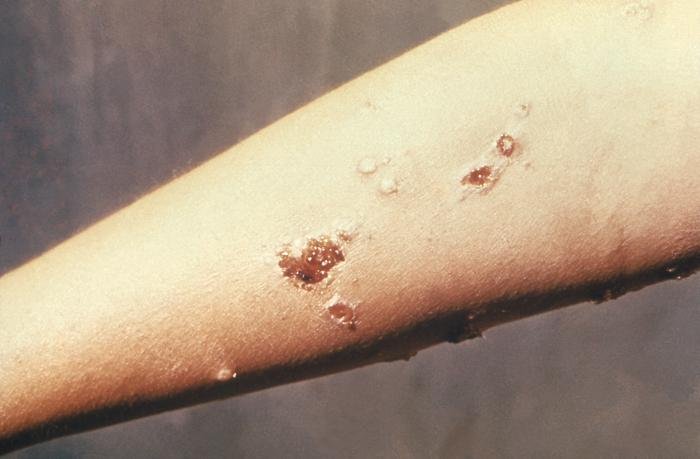
- Non-bullous impetigo, the more common of the two, though the proportion differs between populations and studies. It begins as a small red spot or blister that ruptures within a day, leaving a shallow erosion that dries into the characteristic golden crust. Lesions enlarge and multiply, often around the nostrils and mouth, and on the hands and limbs. Itch is mild, and children are usually otherwise well.
- Bullous impetigo, caused by S. aureus strains producing a toxin that splits the upper skin. It forms larger flaccid blisters filled with clear then cloudy fluid, which rupture to leave a collarette of scale and a shallow moist base. It affects younger children more often, including newborns, and favours the trunk, armpits and nappy area.
A third pattern, ecthyma, occurs when the infection extends deeper and forms a punched-out ulcer under a thick crust. It is slower to heal and can scar.
Predisposing Factors: Why Impetigo Develops
- Broken skin: The usual starting point. Eczema, insect bites, scratches, cold sores, chickenpox and scabies all provide it — infection arising on eczema is common enough to have its own name, impetiginised eczema.
- Close contact: Household members, classmates and contact sports such as wrestling.
- Shared items: Towels, flannels, bedding and clothing.
- Warm humid weather, which is why cases cluster in summer in temperate countries.
- Nasal carriage of S. aureus, which is common and is one route to recurrent infection.
- Close contact and shared items: Crowded households, shared towels, bedding and sports equipment all carry the bacteria from one person to the next.
Impetigo is not a marker of poor hygiene in a household, though hand washing and not sharing towels do limit its spread.
Diagnostics: How Impetigo Is Diagnosed
The diagnosis is clinical, from the golden crust and its distribution. Most cases need no investigation.
A swab is taken when the infection is widespread, recurrent, not responding to treatment, or where resistant organisms are a local concern, so that antibiotic choice can be guided rather than guessed. Recurrent impetigo may prompt a swab of the nostrils to look for carriage.
Where a rash is painful, grouped, or the child is unwell, the question to settle is whether this is herpes rather than impetigo — a distinction that changes treatment completely.
Symptoms: What Impetigo Looks Like
- Golden or honey-coloured crusts on a red, moist base.
- Small blisters that rupture quickly, often before anyone notices them.
- Lesions around the nose and mouth, and on exposed skin of the hands, arms and legs.
- Spread by scratching, producing satellite lesions along the line of a scratch.
- Larger flaccid blisters in the bullous form, leaving a ring of scale as they dry.
- Mild itch, little pain, and a child who is generally well.
- Swollen local lymph nodes, sometimes.
Differential Diagnosis: Ruling Out Other Conditions
- Herpes simplex: Grouped small blisters on a red base, painful or tingling, recurring in the same place. See herpes simplex.
- Eczema herpeticum: The diagnosis that must not be missed. Widespread punched-out erosions on eczematous skin in an unwell child, spreading rapidly. It needs urgent antiviral treatment, and treating it as impetigo loses time.
- Infected eczema: Frequently a combination rather than an alternative; the underlying eczema needs treating alongside the infection.
- Tinea: An advancing scaly edge with central clearing.
- Chickenpox: Crops of lesions at different stages, with fever. See chickenpox.
- Scabies, which is often the reason impetigo appeared in the first place.
Risks: Why Impetigo Should Be Treated
Untreated non-bullous impetigo generally clears on its own within two to three weeks. Treatment is worthwhile because it shortens that and reduces the spread to other people. Whether treating the skin prevents the rarer complications below is less well established.
Infection can extend deeper, producing ecthyma, cellulitis or an abscess. Bullous impetigo in a newborn can occasionally progress to staphylococcal scalded skin syndrome, which requires hospital care.
A rare but recognised complication of streptococcal impetigo is post-streptococcal glomerulonephritis, an inflammation of the kidneys appearing one to several weeks after the skin infection, with dark urine, reduced urine output or facial swelling. It is uncommon, the evidence that treating the skin prevents it is limited, and it is mentioned here because those symptoms after impetigo warrant prompt assessment rather than waiting — not because it should be expected. Current mainstream guidance links acute rheumatic fever to streptococcal throat infection rather than to impetigo.
Tactics: When and How to Seek Treatment
See a clinician if crusted lesions appear, particularly in a child, if they are spreading, if there are several of them, or if the skin was already affected by eczema. Seek care the same day if the surrounding skin becomes red, hot and tender, if there is fever, if a child seems unwell, or if the lesions are painful and grouped rather than crusted — which raises the question of herpes.
Do not use a topical corticosteroid on an undiagnosed crusted rash, and do not pick the crusts: it spreads the infection to adjacent skin and to other people.
Schools and nurseries usually ask that a child stay away until the lesions have crusted and dried over, or for a set period after antibiotic treatment starts — 48 hours in United Kingdom guidance, while other countries allow earlier return if the lesions are covered and treatment has begun. Check the policy that applies where you are.
Treatment: Modern Strategies for Impetigo
- Localised disease: A topical antiseptic — hydrogen peroxide cream, for example — is the recommended first step in some countries, including the United Kingdom, with a topical antibiotic such as fusidic acid or mupirocin reserved for selected cases where an antiseptic is unsuitable or has not worked. What is recommended, and which products are available, differs by country. Holding back topical antibiotics is deliberate, because resistance has followed heavy use, and local resistance patterns govern the choice.
- Widespread or bullous disease, or a systemically unwell patient: An oral antibiotic, chosen according to local resistance patterns.
- Gentle crust removal by soaking with warm water, so that topical treatment reaches the skin underneath.
- Treating the underlying skin condition, especially eczema or scabies, without which impetigo returns.
- Recurrent cases: Nasal carriage is worth considering, in the patient and sometimes the household, but not as a reflex — first confirm the diagnosis and look at eczema, scabies, household spread and previous antibiotic use.
- Simple hygiene measures while treating: separate towels, hand washing, short fingernails, and washing bedding and clothing.
Prevention
- Keep eczema well controlled, since broken skin is the usual entry point.
- Clean and cover cuts, bites and grazes.
- Do not share towels, flannels or bedding while anyone is affected.
- Wash hands after touching lesions or applying treatment.
- Keep nails short to limit spread by scratching.
- Treat scabies or head lice where they are driving the scratching.
- Follow the exclusion advice for nursery or school.
Impetigo is among the more straightforward skin infections to treat. Where it keeps returning, the answer is usually not a stronger antibiotic but the thing underneath it — eczema, scabies, or a reservoir of bacteria in the nose.
Image: CDC / Dr. Herman Miranda, Univ. of Trujillo, Peru; A. Chambers, Public Health Image Library #14927.

Medical review
Board-Certified Dermatologist · Fellow of the American Academy of Dermatology (FAAD)