
Cutaneous Syphilis (ICD-10: A51) 🚨
Cutaneous Syphilis: Skin Signs of a Treatable Infection
Syphilis is an infection caused by the bacterium Treponema pallidum, passed on through sexual contact and, during pregnancy, from a mother to her baby. It affects the whole body, but the skin is where it most often becomes visible, and recognising those signs is what usually leads to a diagnosis.
Syphilis has been called the great imitator, and the name is earned: its rash can resemble pityriasis rosea, guttate psoriasis, a viral exanthem or a drug reaction, and it is regularly mistaken for all of them. That matters because the infection is entirely curable with antibiotics, and because it does not resolve on its own even when the rash does.
Rates have risen substantially in many countries over the past decade, including among people who do not consider themselves at risk. This is a page about a common, treatable infection rather than a rare one, and nothing about acquiring it says anything about a person’s character or hygiene.
The Stages, and What the Skin Shows
Untreated syphilis moves through stages, and the skin signs differ at each.
- Primary syphilis: An ulcer — the chancre — appears where the bacterium entered, on average about three weeks after exposure, though the interval ranges from around ten days to three months. It is typically single and painless, but neither is invariable: chancres can be painful, atypical in appearance, or multiple, and a painful ulcer does not exclude syphilis. It is firm, round, with a clean base and raised indurated edge, most often on the genitals, anus or mouth. Because it does not hurt and may be internal, it is frequently missed. It heals on its own over a few weeks, which is not recovery: the infection continues.
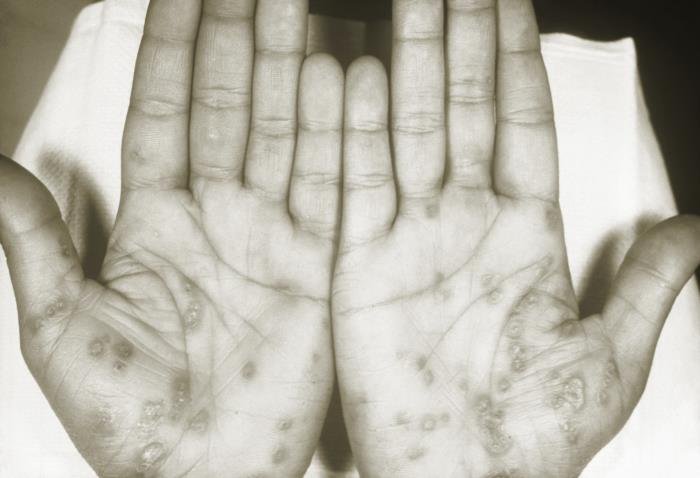
- Secondary syphilis: Weeks to a few months later, a widespread rash appears. It is usually not itchy, consists of coppery-red or brownish flat and slightly raised spots, and often involves the palms and soles — a distribution that is one of the more useful clues, though it is not present in every case and other rashes can affect these sites too. Moist wart-like plaques (condylomata lata) may appear in skin folds and around the genitals, along with painless mouth ulcers, swollen lymph nodes, fever and general malaise. Hair loss can occur, and when it takes the patchy “moth-eaten” form it is a useful diagnostic clue — but it is a clue rather than a feature to expect in every case. This stage is highly infectious.
- Latent syphilis: The signs settle and the infection becomes silent, detectable only by blood tests. It may stay this way for years.
- Tertiary syphilis: Now uncommon where testing and treatment are available. Years later it can damage the heart and blood vessels, the nervous system, and produce destructive skin and bone lesions called gummas.
Predisposing Factors: How Syphilis Is Transmitted
- Sexual contact with someone who has an infectious lesion, including vaginal, anal and oral sex. Condoms reduce the risk substantially but do not eliminate it, because lesions may sit outside the area they cover.
- Direct contact with a chancre or a secondary lesion, which is how the infection passes. It enters through mucous membranes or through breaks in the skin, which are often microscopic rather than anything visible.
- Pregnancy: The infection crosses to the baby and can cause congenital syphilis, miscarriage or stillbirth. This is why syphilis testing is part of routine antenatal care in most countries, and why treatment in pregnancy is urgent.
- Blood exposure, which is rare where blood products are screened.
- Co-infection with HIV, which is common enough that a diagnosis of either prompts testing for the other.
Syphilis is not caught from toilet seats, shared cutlery, swimming pools or casual contact.
Diagnostics: How Cutaneous Syphilis Is Diagnosed
The diagnosis rests on clinical assessment and serology together. Neither settles it alone: the rash is too variable to diagnose by appearance, and no single blood test is sufficient either. Two types of test are used together: a treponemal test, which detects antibodies to the organism and usually stays positive for life — so it does not distinguish a current infection from one treated years ago — and a non-treponemal test such as RPR or VDRL, whose level is expected to fall after treatment and is used to follow it. That fall can be slow, incomplete or absent in some people, so results are interpreted against the stage and the starting titre rather than by expecting the test to become negative.
Follow-up works the same way. The titre after treatment is compared with the baseline titre taken before it, and read in the light of the stage the infection was at; the intervals at which it is repeated follow current guidelines rather than a fixed schedule, and differ between early and latent disease.
Where a lesion is present, material from it can sometimes be examined directly by dark-field microscopy or tested by PCR, which can confirm the diagnosis before antibodies appear. Availability differs between services, dark-field microscopy is not used on mouth lesions because harmless treponemes live there, and a negative result does not exclude the infection. Testing for other sexually transmitted infections, HIV included, is offered at the same time.
One practical point deserves emphasis. A negative test very early in the infection does not exclude it, because antibodies take time to appear — which is why a repeat test is arranged when exposure is recent.
Symptoms: What Cutaneous Syphilis Looks Like
- A painless ulcer with a firm edge, on the genitals, anus or mouth, appearing a few weeks after exposure and healing by itself.
- A widespread rash that does not itch, coppery-red or brown, flat or slightly raised.
- Involvement of the palms and soles, a site most everyday rashes leave alone — useful as a clue rather than as proof.
- Moist raised plaques in warm skin folds and around the genitals and anus.
- Painless ulcers or grey patches inside the mouth.
- Patchy hair loss of the scalp, eyebrows or beard, described as moth-eaten.
- Swollen lymph nodes, fever, sore throat, headache and fatigue, accompanying the rash.
Differential Diagnosis: Ruling Out Other Conditions
- Pityriasis rosea: A herald patch followed by an oval rash along skin lines, sparing palms and soles. See pityriasis rosea.
- Guttate psoriasis: Small scaly drop-like plaques, often after a throat infection.
- Viral exanthem or HIV seroconversion illness: Both can look similar, and both are reasons to test rather than to assume.
- Drug eruption: Usually itchy, with a clear temporal link to a new medication.
- Lichen planus: Itchy violaceous flat-topped papules, often with white lacy lines. See lichen planus.
- Genital herpes: Painful grouped blisters and ulcers, unlike the painless chancre. See genital herpes.
Risks: Why Syphilis Must Be Treated
The central fact about syphilis is that the signs go away and the infection does not. A chancre heals, a secondary rash fades, and someone who has not been tested may reasonably conclude that whatever it was has passed. It has not.
Untreated, the infection can over years affect the heart and major blood vessels and the nervous system, where it may cause stroke, meningitis, hearing loss, visual loss and cognitive change. Neurological and eye involvement can also occur early rather than only in late disease, which is one reason new visual or hearing symptoms in someone with syphilis are assessed promptly.
In pregnancy the consequences are immediate. Congenital syphilis causes miscarriage, stillbirth, prematurity and serious harm to a newborn, and testing and treating the mother prevents the great majority of cases, provided treatment is given early enough in the pregnancy, is adequate for the stage, is followed up, and reinfection is avoided.
A person is infectious to sexual partners during the primary and secondary stages, and can remain so in early latent infection, particularly where mucocutaneous lesions are present or recent. Infectiousness falls substantially in later latent disease. This is why partner notification is part of treatment rather than an optional extra.
Tactics: When and How to Seek Care
Seek testing if you develop a painless genital, anal or oral ulcer; if a widespread rash appears that does not itch, particularly one involving the palms and soles; if a partner has been diagnosed; or simply if you want to know. Sexual health services test for syphilis routinely and treat the results confidentially; what they cost, whether testing can be anonymous and how partners are notified differ from country to country.
Do not wait for an ulcer or rash to disappear as a sign that things are resolving, and do not take leftover antibiotics: an inadequate course can suppress the signs without curing the infection and complicates later diagnosis.
Treatment: Modern Strategies for Syphilis
- Benzathine penicillin G by injection is the established treatment, with the number of doses depending on the stage. It is not adequate where the nervous system, the eyes or the ears are involved: those presentations need urgent specialist assessment, and examination of the cerebrospinal fluid where neurosyphilis is in question. Treatment is then directed at neurosyphilis, with intravenous aqueous crystalline penicillin G where it is indicated, rather than the regimen used for uncomplicated disease. No clinically significant resistance to penicillin has been established in this organism, unlike in several other infections. That does not make treatment failure impossible — reinfection, an inadequate course or unusual circumstances still need assessing.
- Alternatives for penicillin allergy, such as doxycycline, are used outside pregnancy. In pregnancy, penicillin is the only treatment with established efficacy for preventing congenital syphilis, so where there is a confirmed or strongly suspected allergy, desensitisation followed by penicillin is carried out under specialist supervision.
- The Jarisch–Herxheimer reaction: Fever, chills and aching within hours of the first dose are common and expected, caused by the rapid death of the organism rather than by an allergy to the drug. It usually begins within a few hours and settles within about a day, and is managed supportively. In pregnancy it can provoke contractions or fetal distress, so it is monitored — but it is not a reason to withhold or postpone treatment, and severe or unusual symptoms at any time need assessment. It should be explained in advance.
- Follow-up blood tests at set intervals track the serological response, which is how treatment failure or reinfection is picked up. No blood test proves directly that the organism has gone.
- Partner notification and testing, which services help with — in many places this can be done without naming you, though the arrangements vary.
- Testing for other sexually transmitted infections, HIV in particular.
Prevention
- Use condoms, understanding that they reduce rather than remove the risk.
- Test regularly if you have new or multiple partners; routine screening is the main reason cases are found early.
- Test in pregnancy, which is standard antenatal care in most countries.
- Notify and treat partners so that reinfection does not follow a successful course.
- Complete the full course and attend the follow-up tests.
- Remember that past infection gives no immunity — syphilis can be caught again after being cured.
Syphilis is among the more consequential infections that is also among the most straightforwardly curable. Almost all of the harm it causes comes from not knowing it is there.
Image: CDC, Public Health Image Library #25702.

Medical review
Board-Certified Dermatologist · Fellow of the American Academy of Dermatology (FAAD)