
Rash on face: causes, pictures and when to see a doctor
This tool is for informational purposes only and does not constitute medical advice. Always consult a qualified dermatologist.
What causes a rash on the face?
Common causes of a rash on the face include acne, rosacea, seborrheic dermatitis, contact dermatitis from make-up, skincare or other products, atopic eczema, a rash around the mouth (perioral dermatitis), cold sores, impetigo and hives. Some infections that cause a rash, such as measles and slapped cheek syndrome, show on the face too, and a rash across the cheeks and nose can be a sign of lupus. Pictures can help you describe a rash, but they cannot tell you which one you have. Some signs cannot wait for a photo check, such as sudden swelling of the lips, mouth or tongue, a shingles-type rash on the eye or nose, eye pain or a change in vision, or a rash that does not fade under a glass: all of them, and how soon to act on each, are in one place, the list of when to see a doctor below.
Sources: NHS — Acne · NHS — Rosacea · DermNet — Seborrhoeic dermatitis · NHS — Contact dermatitis · NHS — Atopic eczema · AAD — Perioral dermatitis · NHS — Cold sores · NHS — Impetigo · NHS — Hives · NHS — Measles · NHS — Slapped cheek syndrome · NHS — Lupus
When to see a doctor about a rash on the face
Most rashes on the face are not serious, but some signs need help quickly, and the eyes need extra care. This is the only place on the page where the signs and how soon to act are listed; the rest of the page links back here.
Call emergency services now — don’t wait for a photo check — for:
Trust your instincts: someone with sepsis or meningitis might not have every symptom listed, so get help if you think someone is seriously ill. For a serious allergic reaction, call for an ambulance and do not stand or walk. For every other item, do not drive yourself to A&E: ask someone to drive you or call for an ambulance, and bring any medicines you take.
- Signs of a serious allergic reaction: the lips, mouth, throat or tongue suddenly swell; breathing very fast or struggling to breathe (you may become very wheezy or feel like you are choking or gasping for air); the throat feels tight or it is hard to swallow; skin, tongue or lips turn blue, grey or pale (on brown or black skin this may be easier to see on the palms or soles); suddenly becoming very confused, drowsy or dizzy; someone faints and cannot be woken; or a child is limp, floppy or not responding as usual. Use an adrenaline auto-injector if you have one, even if the symptoms seem mild, call for an ambulance and say you think it is anaphylaxis, and lie down — you can raise your legs, and if you are struggling to breathe, raise your shoulders or sit up slowly (if you are pregnant, lie on your left side). If symptoms have not improved after 5 minutes, use a second auto-injector. Do not stand or walk at any time, even if you feel better
- A rash or spots that do not fade when you press the side of a clear glass firmly against the skin. A meningitis rash usually starts as small red pinpricks and spreads quickly into red or purple blotches, and can look like small bruises or bleeding under the skin; on brown or black skin check paler areas: the palms, the soles of the feet, the roof of the mouth, the whites of the eyes or inside the eyelids. Not everyone with meningitis or sepsis gets a rash, so the other signs below matter as much
- In an adult or a child aged 5 or over, signs that could be sepsis or meningitis: breathing very fast; being confused, slurred speech or not making sense; blue, pale or blotchy skin (on black or brown skin this may be easier to see on the palms or the soles of the feet); a very high or very low temperature, feeling hot or cold to the touch, or shivering; a very painful headache; a stiff neck and not being able to look at bright lights; a seizure (fit) for the first time; or symptoms you are worried might be sepsis or meningitis
- In a baby or child under 5, signs that could be sepsis or meningitis: breathing very fast or having difficulty breathing (grunting, or the tummy sucking in under the ribs); blue, grey, pale or blotchy skin, lips or tongue; a temperature of 38C or more under 3 months old or 39C or more at 3 to 6 months; a temperature below 36C, feeling cold to the touch or shivery; a weak, high-pitched or continuous cry; not responding as usual, not feeding, floppy, difficult to wake or more sleepy than usual; no pee for 12 hours; or symptoms you are worried about
- A child who is unwell with a rash and has a stiff neck, is bothered by light, seems confused, agitated or is not responding as usual, has difficulty breathing (grunting, the tummy sucking in under the ribs), is breathless or breathing very fast, or whose skin, lips or tongue look pale, blue, grey or blotchy
- Someone with measles who has a seizure (fit), severe difficulty breathing (gasping, choking or not able to get words out; babies may grunt or their tummy may suck in under the ribs), cannot stay awake, suddenly becomes confused, is limp, floppy or not responding normally, has a stiff neck, or finds light uncomfortable or painful
- A young baby who may have caught herpes — for example after being kissed by someone with a cold sore — and is lacking in energy, becoming floppy, not responding as usual, difficult to wake, breathing rapidly or with difficulty or grunting, has a seizure, is peeing less than normal, is crying constantly or with a cry that does not sound normal, or has a blue tongue or skin (on brown or black skin this may be easier to see on the lips, tongue and gums, under the nails and around the eyes). A baby with herpes often has no rash or blisters, but can become unwell very quickly
- Painful, hot, swollen skin, which can be cellulitis, together with a very high temperature or feeling hot, cold or shivery, a fast heartbeat or fast breathing, purple patches (less obvious on brown or black skin), feeling dizzy or faint, confusion, cold, clammy or pale skin, or not responding
- Red, hot, swollen skin where the pain is severe and much worse than the skin looks, the area spreads quickly over hours, the skin turns dusky or grey or forms blisters with dark fluid, or the area goes numb, or you feel very unwell, confused or faint — our atlas article on erysipelas says to seek emergency care for these
Same day — urgent medical advice
Get urgent medical advice the same day — an urgent GP appointment or NHS 111 in the UK — unless an emergency sign above applies, for:
- a shingles-type rash — painful blotches or blisters on one side only, which can appear on the face — if the rash is on your eye or nose, your vision has changed, you are pregnant, you are 17 or younger or you have a severely weakened immune system; antiviral medicine works best if you start it within 3 days of the rash appearing, but with shingles on or near the eye get help even if more than 3 days have passed. Shingles near the eye can affect your sight
- rosacea with an eye that is painful, red or feels gritty, blurred vision or sensitivity to light — these can be signs of keratitis (inflammation of the front of the eye), which can be serious if not treated quickly
- eczema that is blistered, crusty, leaking fluid or has spots filled with pus, is painful, swollen or feels warm, suddenly gets worse or bigger, or comes with a high temperature or feeling generally unwell — these can be signs that eczema is infected or of eczema herpeticum, a more serious condition that DermNet says is most often seen on the face and neck and calls one of the few skin emergencies: do not wait, and say if the blisters are on or around the eyelids or eye, because DermNet advises an eye specialist then
- skin that is painful, hot and swollen, which can be cellulitis — redness may be less obvious on brown or black skin; cellulitis in the eye is very serious, and the white of the eye may or may not turn red
- a part of the body that suddenly becomes swollen (angioedema), such as the eyelids, hands or feet — sudden swelling of the lips, mouth, throat or tongue is in the emergency list above
- hives that have not improved after 2 days, are spreading or keep coming back, come with a high temperature and feeling unwell or with swelling under the skin, or hives in a child you are worried about
- possible measles — a rash that starts on the face and behind the ears a few days after cold-like symptoms such as a high temperature, a runny nose and red, watery eyes; contact with someone who has measles if your baby is under 1, you are pregnant or have a weakened immune system, or you or your child have not had measles or 2 doses of the MMR or MMRV vaccine; or, with measles, a high temperature that has not come down with paracetamol or ibuprofen, difficulty breathing, a baby or young child feeding less, peeing less than usual, or feeling very unwell. Measles spreads easily, so call the GP surgery before you go in
- a young baby who is irritable and will not settle, is not feeding as well as usual, or has a rash or sores on the skin, eyes or inside the mouth — early warning signs of herpes in a baby, most at risk in the first 6 weeks: call a GP or NHS 111 straight away, do not wait until later in the day (a temperature of 38C or more in a baby under 3 months is in the emergency list above)
- crusted sores that could be impetigo if the skin around them becomes red, hot and tender, there is a fever or a child seems unwell; sores that are painful and grouped together rather than crusted, which can be herpes; or a puffy face, dark pee or peeing less in the weeks after impetigo — our atlas article on impetigo advises getting care the same day for the signs in the sores, and prompt care without waiting for the signs after impetigo
- chickenpox that is getting worse, such as red, hot or painful skin around the blisters (redness may be harder to see on brown or black skin), a child showing signs of dehydration such as fewer wet nappies, or being more short of breath than usual, or any other chickenpox symptoms you are worried about; a newborn baby who may have chickenpox or has been near someone with it; or contact with chickenpox if you are pregnant or have a weakened immune system — the NHS says to get help from NHS 111 now, because some people can take medicine to prevent complications that needs to be started within 24 hours of the spots appearing
- sunburn with blistered or swollen skin, a very high temperature or feeling hot, cold or shivery, feeling very tired, dizzy or sick, a headache or muscle cramps, or any sunburn in a baby or young child — severe sunburn can lead to heat exhaustion and heatstroke
- slapped cheek syndrome with very pale skin, shortness of breath, extreme tiredness or fainting, which can be signs of severe anaemia
- a child with a rash you are worried about and are not sure what to do; a child under 5 who feels hotter than usual when you touch their back or chest or feels sweaty; or a child aged 6 months or older with a temperature of 39C or higher — but a temperature of 38C or more under 3 months or 39C or more at 3 to 6 months, a very low temperature or shivering in any child, and a child aged 5 or over who has a very high or very low temperature, feels hot or cold to the touch or is shivery are in the emergency list above
Pharmacist first
A pharmacist can advise first — unless an emergency or same-day sign above, or a sign in the “See a GP” list below, applies — for:
- a painful rash of blotches or blisters on one side of the body, which can be shingles, if you are 18 or older and the rash is not on your eye or nose and your vision has not changed: try to see a pharmacist within 3 days of the rash appearing, because antiviral medicine works best when started early
- cold sores: a pharmacist can recommend creams to ease pain, antiviral creams to speed up healing and cold sore patches; if you get cold sores often, use antiviral cream as soon as you feel the early tingling, because it does not always work once blisters appear
- impetigo in anyone aged 12 months or over without the same-day signs above — a pharmacist can give the same medicines as a GP
- acne, sunburn without the same-day signs above, mild contact dermatitis that is troubling you, small areas of eczema that are dry and slightly itchy, hives without any of the signs above, and ringworm: a pharmacist can recommend treatment and tell you if you should see a GP
Book an appointment
See a GP — unless an emergency or same-day sign above applies — for:
- a cold sore that has not started to heal within 10 days, is very large or painful, or that you are worried about or think is something else; swollen, painful gums and sores in the mouth together with a cold sore; or cold sores when you have a weakened immune system, for example because of chemotherapy or diabetes
- acne you have tried treating yourself that is not getting better; lots of spots, or spots that are deep, painful or causing scars; acne with signs of a skin infection, such as hot, swollen and red skin (redness can be harder to see on brown and black skin); or acne that is affecting your mental health
- symptoms of rosacea, such as redness across the nose, cheeks, forehead and chin that comes and goes, or burning or stinging when you use water or skincare products — or, on brown or black skin, the signs listed under face rashes on brown and black skin
- seborrheic dermatitis that does not improve with proper skin care and pharmacy products, causes a lot of redness or swelling, shows signs of infection (oozing, pus or pain — if it is also blistered, swollen, warm or comes with a high temperature, see the same-day list above), is on the eyelids or is spreading quickly — our atlas article advises seeing a dermatologist then; and a rash around the mouth, nose or eyes (possible perioral dermatitis) that you are having trouble getting rid of — the AAD says some people need a dermatologist’s help
- a rash after being in the sun that is getting worse or has not got better after 1 week, is swollen, or comes with joint and muscle pain or extreme tiredness
- possible chickenpox if you are not sure it is chickenpox or you are breastfeeding — tell the GP surgery before you go in
- symptoms of lupus that you get often — joint and muscle pain, extreme tiredness that does not go away however much you rest, and rashes that usually come on after being in the sun, often over the nose and cheeks; lupus is better managed if it is found and treated early
- slapped cheek syndrome if you are pregnant, have a blood disorder such as sickle cell disease or thalassaemia, or have a weakened immune system; if you are pregnant or have a weakened immune system or blood disorder and have been near someone with slapped cheek syndrome, tell your midwife or a GP
- symptoms of scarlet fever — a high temperature, a sore throat and swollen neck glands, then a rash that feels rough, like sandpaper, and red cheeks; it spreads very easily, so check with the GP surgery before you go in
- impetigo in a child aged 11 months or younger, impetigo with a weakened immune system, impetigo that has changed or got worse after treatment, or impetigo that has come back within a year; impetigo is very infectious, so check with the GP surgery before you go in
- contact dermatitis that is persistent, keeps coming back or is severe; symptoms of atopic eczema, or eczema treatments that are not helping
- ringworm that has not improved after antifungal medicine recommended by a pharmacist, or ringworm when you have a weakened immune system (for example from chemotherapy, steroids or diabetes); fungal infection of the beard usually needs antifungal tablets, according to DermNet
- cellulitis that is not starting to feel better 2 to 3 days after starting antibiotics, or any other change to the skin of your face that worries you
Sources: NHS — Anaphylaxis · NHS — Angioedema · NHS — Meningitis · NHS — Sepsis · NHS — Rashes in babies and children · NHS — Measles · NHS — Neonatal herpes · NHS — Cellulitis · NHS — Shingles · NHS — Rosacea · NHS — Atopic eczema · DermNet — Eczema herpeticum · NHS — Hives · NHS — Slapped cheek syndrome · NHS — Cold sores · NHS — Impetigo · NHS — Acne · NHS — Contact dermatitis · NHS — Lupus · NHS — Scarlet fever · NHS — Ringworm · DermNet — Tinea barbae · Atlas — Erysipelas · Atlas — Impetigo · Atlas — Shingles · Atlas — Seborrheic dermatitis · AAD — Perioral dermatitis · NHS — Chickenpox · NHS — Sunburn · NHS — Polymorphic light eruption · AAD — Rosacea in darker skin tones
Why rashes often appear on the face
The face is exposed to sun, wind and everything you put on it, it has many oil glands, and it is touched and kissed more than most skin. These are the links the sources below describe; none of them tells you which rash you have.
-
Make-up, skincare and other products
The NHS says contact dermatitis most often affects the hands and face; allergic contact dermatitis can be triggered by products such as cosmetics, and some metals, including nickel. The AAD says a skincare product or toothpaste may irritate the skin around the mouth. Contact dermatitis.
-
Oil glands
Acne affects skin rich in oil (sebaceous) glands, especially the forehead, cheeks and chin, and products that make the skin greasy can cause it. Seborrheic dermatitis also mainly affects the oil-gland-rich skin of the scalp, face and trunk. See acne.
-
Sun
Sunlight is a common rosacea trigger, sunshine can set off a cold sore, lupus rashes usually come on after being in the sun, and DermNet says fungal infection of the face is often made worse by the sun.
-
Heat, alcohol, spicy food and stress
The NHS lists alcohol, spicy foods, hot drinks, sunlight, hot or cold temperatures, aerobic exercise and stress as common rosacea triggers. Hot, sweaty skin from exercise, emotional stress or spicy food can also trigger hives. See rosacea.
-
Steroid creams on the face
Using a corticosteroid cream on the skin for too long is a common cause of perioral dermatitis, according to the AAD, and our atlas warns that long use of steroid creams on the face risks steroid-induced rosacea or perioral dermatitis. Perioral dermatitis.
-
Touching, kissing and close contact
Cold sores spread easily to other people and other parts of the body, impetigo spreads through skin-to-skin contact and shared towels, and fungal infection of the beard most often comes from contact with an infected animal. See cold sores.
Sources: NHS — Contact dermatitis · AAD — Perioral dermatitis · Atlas — Acne · NHS — Acne · DermNet — Seborrhoeic dermatitis · NHS — Rosacea · NHS — Cold sores · NHS — Lupus · DermNet — Tinea faciei · NHS — Hives · Atlas — Seborrheic dermatitis · NHS — Impetigo · DermNet — Tinea barbae
Possible causes: examples with pictures
Grouped by how the rash looks, not by every way a condition can look. Groups overlap and cannot identify or rule out a condition, so look through all of them. All six photos are of the face, from our atlas. Each card description is quoted word for word from the atlas article, and the group notes come from the NHS, DermNet and atlas pages linked below the cards; open a card for the full article and all its photos.
Spots, bumps and redness
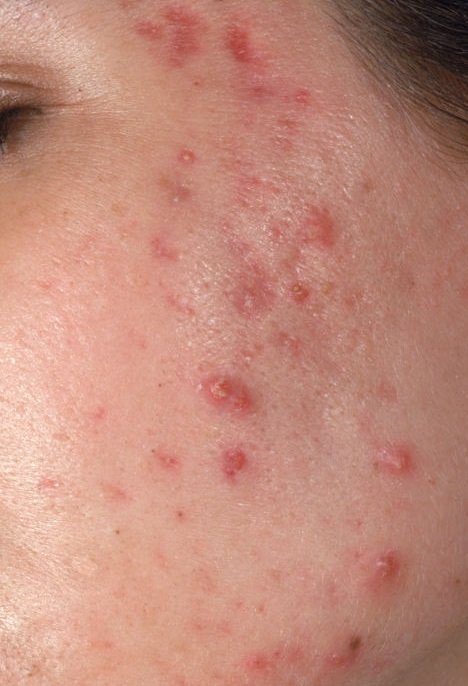
Acne usually affects the face, chest and back: whiteheads, blackheads, red or pink bumps (on brown and black skin they may look brown or purple), spots filled with pus and, in severe acne, deep painful lumps. Rosacea mainly affects the face: redness across the nose, cheeks, forehead and chin that comes and goes, then may stay, with tiny broken blood vessels and small bumps; it can look a lot like acne, but our atlas notes it has no blackheads or whiteheads. Words in the quotes: comedones are blackheads and whiteheads; erythema means redness; papules are small bumps; dermatosis means a skin condition.
 24 photos
Acne (acne vulgaris)
“The typical areas affected by acne vulgaris are those rich in sebaceous glands: the face (especially the forehead, cheeks, and chin), the upper chest, the upper back, and the shoulders.”
“Papules: These are inflamed, red or pink bumps without visible pus.”
Read the article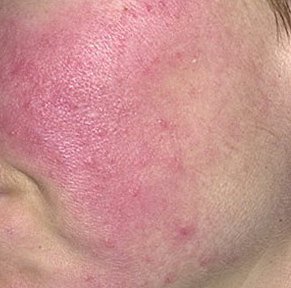 18 photos
Rosacea
“Rosacea is a chronic, relapsing inflammatory dermatosis that primarily affects the central region of the face.”
“The key distinguishing factors are the absence of comedones, the prominent flushing and background erythema, and the characteristic central facial involvement in middle-aged adults.”
Read the articleFlaky, scaly or ring-shaped patches
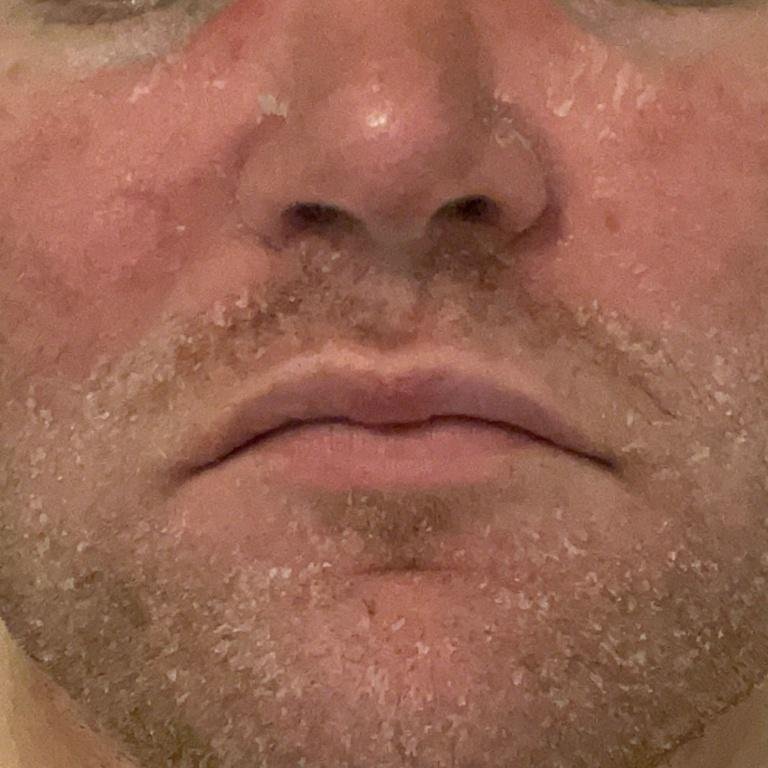
Seborrheic dermatitis (a type of eczema of oily skin; dandruff is a mild form of it on the scalp) mainly affects the scalp, face and trunk; DermNet describes thin, scaly, salmon-pink patches in the skin folds on both sides of the face, and on brown or black skin scaly patches that are paler than the skin around them, sometimes petal-shaped. Ringworm is usually ring-shaped, but the NHS says it may look different on the face, neck or scalp, and on the face or scalp it can cause patchy hair loss. On the face DermNet describes round or oval red, scaly patches, often clearer in the middle and often on one side only, which are often mistaken for other conditions such as eczema, rosacea or seborrheic dermatitis, especially after steroid creams. In the beard area DermNet describes a fungal infection with red, lumpy areas, pus spots and crusts around the hairs, which is not usually very itchy or painful. Words in the quotes: pruritus means itching; dermatophytes are the fungi that cause ringworm; dermatophytosis is infection with them; systemic treatment means medicine taken by mouth; topical agents are creams and other treatments put on the skin.
 24 photos
Seborrheic dermatitis
“It presents with symptoms such as redness, flaking, greasy scales, and mild pruritus.”
“It is not contagious, not dangerous, and not caused by poor hygiene or inadequate washing, yet it often causes significant cosmetic concern and emotional discomfort, particularly on the face or scalp.”
Read the article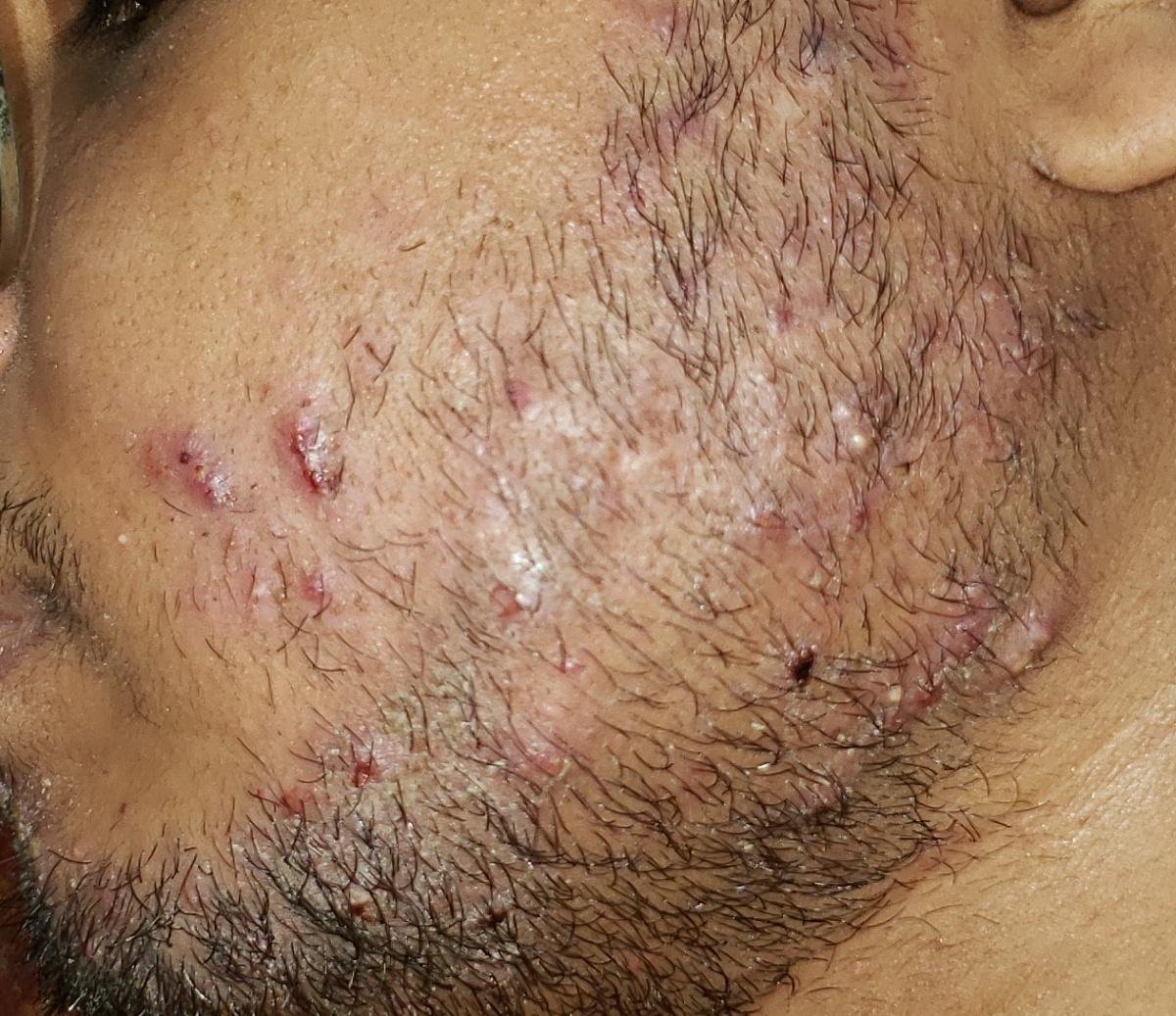 29 photos
Fungal skin infection (ringworm, tinea)
“Dermatophytes spread through direct contact with infected people, animals, or contaminated surfaces.”
“…scalp, beard and nail dermatophytosis generally need systemic treatment, while many uncomplicated infections of the skin respond to topical agents alone.”
Read the articleBlisters and crusts
A cold sore usually starts with tingling, itching or burning; one or more painful, fluid-filled blisters then appear on the face, burst and crust over. Cold sores are contagious from the first tingling until they have completely healed, and kissing a baby when you have one can give the baby herpes, which is very dangerous for newborns. Impetigo, which often affects the skin around the nose and mouth, starts as red sores or blisters that burst and leave crusty, golden-brown patches (see Impetigo under other causes below). Words in the quotes: vesicles are small blisters; HSV-1 is herpes simplex virus type 1; perioral means around the mouth; gingiva means the gums; the palate is the roof of the mouth.
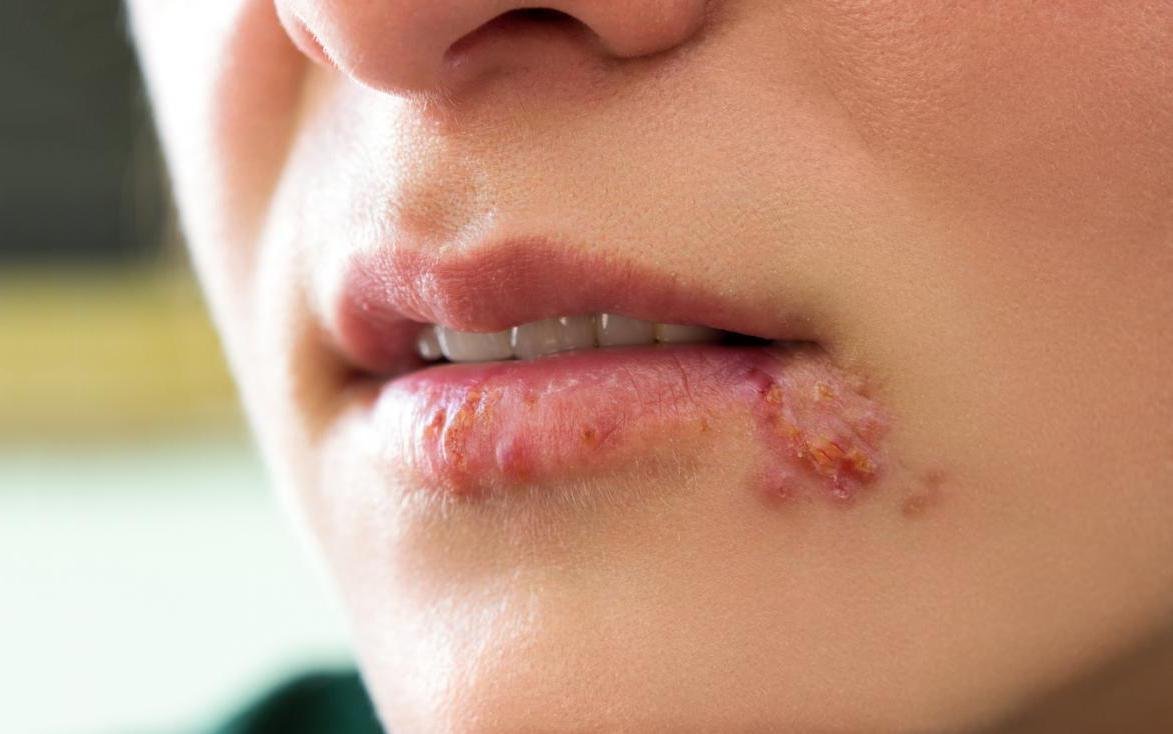 20 photos
Cold sores (herpes simplex)
“Herpes simplex infection typically presents as clusters of small, fluid-filled blisters (vesicles) on a red, swollen base.”
“HSV-1: Perioral region (lips, nose, cheeks), gingiva, palate, tongue, or facial skin…”
Read the articleRaised, itchy patches that come and go
Hives are raised bumps or patches in many shapes and sizes that can itch, sting or burn; they look pink or red on white skin, and the colour can be harder to see on brown and black skin. Hives can come with swelling under the skin (angioedema), which on the face often affects the lips, tongue and eyelids; for sudden swelling of the lips, mouth, throat or tongue, see the list of when to see a doctor. Our atlas article on this card covers hives caused by an allergy; much urticaria has no allergic cause. Words in the quotes: wheals (weals) are the raised bumps of hives.
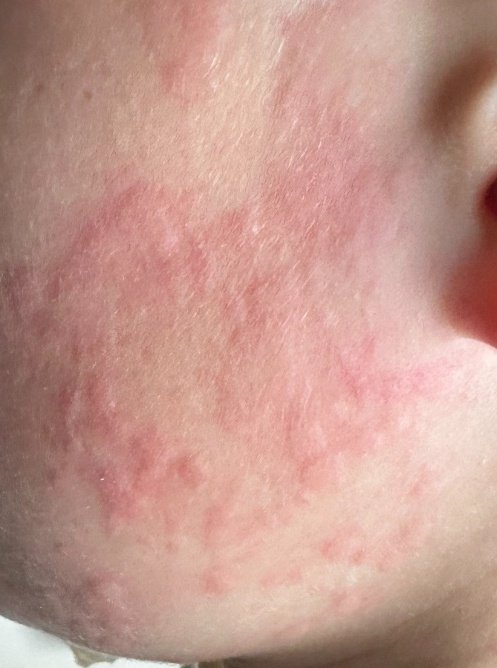 24 photos
Hives (allergic urticaria)
“The rash typically presents as itchy, red or pink wheals (hives) with clear edges and no peeling.”
“These weals may merge and move around, and an individual weal usually resolves within 24 hours, leaving no mark behind.”
Read the articleSources for the group notes: NHS — Acne · NHS — Rosacea · Atlas — Rosacea · DermNet — Seborrhoeic dermatitis · NHS — Ringworm · DermNet — Tinea faciei · DermNet — Tinea barbae · NHS — Cold sores · NHS — Neonatal herpes · NHS — Impetigo · NHS — Hives · NHS — Angioedema · Atlas — Allergic urticaria (hives)
Other causes of a rash on the face
Described from the linked NHS, DermNet and AAD pages. Contact dermatitis, atopic eczema, impetigo, erysipelas and shingles also have articles in our atlas, but their atlas photos show other parts of the body, so they have no picture here.
Perioral dermatitis
Around the mouth, nose or eyes
Small bumps around the mouth that often look like acne: red on light skin and skin-coloured on skin of colour. The skin is often dry and flaky, and the rash may itch or burn. It can also appear around the nose or eyes. It is not contagious. Using a corticosteroid cream for too long is a common cause, and DermNet says steroid inhalers and nasal sprays can be linked too: do not stop a prescribed inhaler or nasal spray, but rinsing the face and mouth after using it may help. A skincare product or toothpaste may also irritate the skin.
The AAD says to stop a hydrocortisone cream you are using on your face without your doctor’s knowledge, and to ask the doctor who prescribed a steroid cream before you stop it. The rash can flare when you stop and clears slowly. When to see a doctor.
AAD — Perioral dermatitis · DermNet — Periorificial dermatitis
Contact dermatitis
Eyelids, lips and anywhere a product touches
Skin that becomes itchy, blistered, dry and cracked a few hours or days after contact with an irritant or allergen: red on lighter skin, and dark brown, purple or grey on darker skin. Our atlas lists the eyelids (from make-up, eye drops and airborne irritants) and the lips (from habitual licking) among its sites. Atlas article and photos.
It usually clears if the cause is found and avoided. When to see a doctor.
Atopic eczema
Common on the face in babies and toddlers
Itchy, dry, cracked, crusty, scaly or thickened skin that can look red, white, purple or grey, or lighter or darker than the skin around it. It is common on the elbows, knees and hands, and in babies and toddlers also on the face. It is not contagious. Atlas article and photos.
Eczema that suddenly changes — for example blisters, crusts or weeps — can be infected or eczema herpeticum: when to see a doctor.
Impetigo
Around the nose and mouth
Red sores or blisters that quickly burst and leave crusty, golden-brown patches that can look like cornflakes stuck to the skin; the redness may be harder to see on brown and black skin. It is very contagious and more common in young children. Our atlas advises not to use a steroid cream on an undiagnosed crusted rash and not to pick the crusts. Atlas article and photo.
Do not share towels or flannels, wash your hands often, and stay off school, nursery or work until it is no longer contagious — 48 hours after starting treatment from a pharmacist or GP. When to see a doctor.
Shingles
One side of the face, sometimes the eye
Tingling or pain in one area of skin, then blotches that become itchy blisters that ooze and scab, on one side of the body only. It usually appears on the chest and tummy but can appear on the face and eyes, where it can affect your sight or hearing or make it hard to move one side of the face. Atlas article and photos.
How soon to act on a rash on the eye or nose: when to see a doctor.
Cellulitis and erysipelas
Painful, hot, swollen skin
Cellulitis is a skin infection that makes the skin painful, hot and swollen; it usually looks red, but this may be less obvious on brown or black skin, and you may feel unwell. Our atlas article on erysipelas, a bacterial infection of the upper layers of the skin with a bright red, hot, tender area, often with a raised border, notes that the face is affected less often than older accounts suggest. Atlas article on erysipelas.
Lupus
Across the nose and cheeks
A long-term condition that causes joint and muscle pain, extreme tiredness and rashes that usually come on after being in the sun, often over the nose and cheeks. It is not contagious, and it is more common in women. It is not always easy to diagnose, because the symptoms can be similar to other conditions; rosacea can look like lupus.
It is diagnosed with blood tests and your symptoms, not a photo: when to see a doctor.
Slapped cheek syndrome
Red cheeks in children
A virus that is common in children. It starts with feeling unwell, often with a high temperature, a runny nose and a sore throat; then a red rash may appear on one or both cheeks, which may be less obvious on brown and black skin, followed by a spotty rash on the body. Adults do not usually get the rash on their face. You can only spread it before the rash appears.
It is rarer in adults but can be more serious, and in pregnancy there is a very small risk of miscarriage or other complications: when to see a doctor.
Measles
Starts on the face and behind the ears
Cold-like symptoms come first — a high temperature, a runny or blocked nose, sneezing, a cough and red, sore, watery eyes — then a rash that starts on the face and behind the ears and spreads. It looks brown or red on white skin and may be harder to see on brown and black skin. It spreads very easily.
Scarlet fever
Red cheeks, rash on the body
Flu-like symptoms, then a rash of small, raised bumps that starts on the chest and tummy and feels rough, like sandpaper. The rash does not appear on the face, but the cheeks can look red; this may be harder to see on brown and black skin, though the bumps can still be felt. It mostly affects young children.
Eczema herpeticum
Most often the face and neck
A spreading herpes infection, most often a complication of atopic eczema, even when the eczema is mild or not active: clusters of itchy, painful blisters that look alike, often with a fever and feeling unwell. Older blisters crust over into sores. It often follows contact with someone who has a cold sore, though the cold sore may not be visible.
Chickenpox
Anywhere, including the face
An itchy, spotty rash that can be anywhere on the body, including the face; the spots fill with fluid and become very itchy blisters, then scab, and new spots can appear while others are scabbing. The spots can be red, pink, darker or the same colour as the skin around them, and harder to see on brown and black skin. It spreads easily and mostly affects children.
Stay off school, nursery or work until all the spots have formed a scab, and keep away from newborn babies and anyone who is pregnant or has a weakened immune system, as chickenpox can be dangerous for them. The NHS says not to use ibuprofen for chickenpox unless a doctor tells you to, as it may cause serious skin infections. When to see a doctor.
Sunburn
Sun-exposed skin
Skin that feels hot to touch, sore or painful, and flakes or peels a few days later; severe sunburn can blister. On white skin it is usually red or pink; on black or brown skin you may not notice a change in colour. Getting sunburnt can increase your risk of skin cancer.
Get out of the sun, cool the skin with a cool shower, bath or damp towel (take care not to let a baby or young child get too cold), and do not pop blisters. When to see a doctor.
Spots on a newborn baby’s face
The first weeks after birth
The NHS describes several common, harmless spots on a baby’s face: tiny spots called milia, usually on the nose, a few days after birth; raised red, yellow and white spots (erythema toxicum) in the first few weeks; spots on the cheeks, forehead and chin in the first weeks after birth, which could be baby acne; and yellow or white, greasy, scaly patches of cradle cap, mainly on the scalp. Milia and baby acne usually go away without treatment.
Blisters or sores on a young baby’s skin, eyes or inside the mouth, a baby who is unwell, irritable, not feeding or has a temperature, or a newborn who has been near someone with a cold sore or chickenpox are different: when to see a doctor.
Milia
Eyelids and cheeks
Tiny, harmless pearly-white bumps just under the skin, common at all ages, most often on the face and particularly on the eyelids and cheeks. They are small cysts, not a rash.
Face rashes on brown and black skin
Redness can be hard to see on darker skin, so face rashes may look purple, grey, brown or paler than the skin around them, and rosacea can be missed. The fungal card photo on this page shows brown skin.
-
Redness that is hard to see
The NHS says redness from rosacea, slapped cheek syndrome, cellulitis and impetigo may be harder to see on brown or black skin; contact dermatitis can turn dark brown, purple or grey, and acne bumps may look brown or purple.
-
Rosacea can be missed
The AAD lists signs in darker skin tones: a warm feeling most of the time, dry, swollen skin with darker patches, a dusky brown colour, acne-like breakouts that acne treatment will not clear, and yellowish-brown, hard bumps around the mouth or eyes. It can be mistaken for an allergic reaction or seborrheic dermatitis.
-
Paler patches and skin-coloured bumps
DermNet notes that seborrheic dermatitis is very common in people with darker skin and may show as scaly patches paler than the surrounding skin. The AAD says perioral dermatitis bumps can be skin-coloured rather than red.
-
Lupus
The NHS says lupus is more common in women with an African, Caribbean, Asian or Chinese background; its rash usually comes on after being in the sun, often over the nose and cheeks. Lupus.
-
Dark marks after a rash
After a rash heals, it can leave dark patches (postinflammatory hyperpigmentation), mostly seen in darker skin, from light brown to black; they may get darker in sunlight. A rash that does not fade under a glass can also be harder to see: check paler areas such as the palms and soles, and see when to see a doctor.
Sources: NHS — Rosacea · NHS — Slapped cheek syndrome · NHS — Cellulitis · NHS — Impetigo · NHS — Contact dermatitis · NHS — Acne · AAD — Rosacea in darker skin tones · DermNet — Seborrhoeic dermatitis · AAD — Perioral dermatitis · DermNet — Postinflammatory hyperpigmentation · NHS — Lupus · NHS — Meningitis
Rash on face: FAQ
What kind of rash starts on the face?
The measles rash starts on the face and behind the ears and then spreads, a few days after cold-like symptoms. Slapped cheek syndrome can cause a red rash on one or both cheeks before a spotty rash on the body, mostly in children. In scarlet fever the cheeks can look red, but the rash itself starts on the chest and tummy. Acne, rosacea, seborrheic dermatitis and perioral dermatitis mainly affect the face. How soon to act: when to see a doctor. Sources: NHS — Measles, NHS — Slapped cheek syndrome, NHS — Scarlet fever, NHS — Rosacea.
What does an allergy rash on the face look like?
Hives are raised, itchy bumps or patches that can sting or burn and look pink or red on white skin. They can come with swelling under the skin, often of the lips, tongue or eyelids. Contact dermatitis from a product makes the skin itchy, blistered, dry and cracked a few hours or days after contact. Sudden swelling of the lips, mouth, throat or tongue, or trouble breathing, can be a serious allergic reaction: see the list of when to see a doctor. Sources: NHS — Hives, NHS — Angioedema, NHS — Contact dermatitis.
Is it rosacea or acne?
They can look alike, and a photo cannot tell them apart for certain. Our atlas notes that rosacea has no blackheads or whiteheads, comes with flushing and redness, and affects the centre of the face, while acne often has blackheads and whiteheads and can affect the chest and back too — though the two can occur together. Rosacea redness comes and goes at first and is often set off by triggers such as alcohol, spicy food, heat or sunlight. How soon to see a doctor about it: when to see a doctor. Sources: Atlas — Rosacea, Atlas — Acne, NHS — Rosacea, NHS — Acne.
Why do I have a red rash around my mouth?
A common cause is perioral dermatitis: small bumps around the mouth, often with dry, flaky skin, linked to using steroid creams for too long and sometimes to skincare products or toothpaste. Other causes around the mouth include cold sores, impetigo, contact dermatitis (for example from licking the lips) and seborrheic dermatitis in the folds beside the nose. See perioral dermatitis and when to see a doctor. Sources: AAD — Perioral dermatitis, DermNet — Periorificial dermatitis, NHS — Cold sores, NHS — Impetigo, Atlas — Contact dermatitis, DermNet — Seborrhoeic dermatitis.
Is a rash on the face contagious?
Some are. Cold sores are contagious from the first tingling until they have healed, impetigo is very contagious, and measles and scarlet fever spread easily; slapped cheek syndrome can only be spread before the rash appears. Chickenpox spreads easily too, ringworm can be passed on through close contact with an infected person or animal or shared towels and combs, and you cannot catch shingles, but while a shingles rash oozes fluid, someone who has not had chickenpox or the vaccine can catch chickenpox from it. Rosacea, atopic eczema, seborrheic dermatitis, perioral dermatitis and lupus are not contagious, and you cannot catch cellulitis from another person. Sources: NHS — Cold sores, NHS — Impetigo, NHS — Measles, NHS — Scarlet fever, NHS — Slapped cheek syndrome, NHS — Chickenpox, NHS — Ringworm, NHS — Shingles, NHS — Rosacea, NHS — Atopic eczema, Atlas — Seborrheic dermatitis, AAD — Perioral dermatitis, NHS — Lupus, NHS — Cellulitis.
Can stress cause a rash on the face?
Stress can trigger or worsen several of them. The NHS lists being stressed among common rosacea triggers, emotional stress among the triggers of hives, and stress among the things that can make atopic eczema and lupus worse. Sources: NHS — Rosacea, NHS — Hives, NHS — Atopic eczema, NHS — Lupus.
What does a lupus rash look like?
The NHS describes rashes that usually come on after being in the sun, often over the nose and cheeks, together with joint and muscle pain and extreme tiredness that does not go away with rest. Rosacea and other conditions can look similar, and lupus is diagnosed with blood tests and your symptoms, not a photo. How soon to act: when to see a doctor. Sources: NHS — Lupus, NHS — Rosacea.
Can I put hydrocortisone cream on a rash on my face?
Ask a pharmacist or doctor first. Steroid creams used on the face for too long can cause perioral dermatitis, our atlas warns of steroid-induced rosacea, a steroid cream can hide a fungal infection and make it harder to recognise, and our atlas advises against a steroid cream on an undiagnosed crusted rash such as possible impetigo. Sources: AAD — Perioral dermatitis, Atlas — Seborrheic dermatitis, DermNet — Tinea faciei, Atlas — Impetigo.
Can a photo or an AI skin check tell me what my rash is?
No. Pictures show what rashes can look like, but many look alike, and the output of an AI skin check is not a medical diagnosis. It cannot tell you how soon to get help: if any sign in the list of when to see a doctor applies, get medical help instead.
For a clear photo of a rash: daylight, close and in focus, no filters or make-up on the area. AI output is not a medical diagnosis. If you have any of the signs in the list of when to see a doctor, get medical help instead.
Check my skin ↑SkinAI Lab is a paid AI analysis; pricing is shown before you scan.


Prepared by the SkinAI Lab editorial team · Updated . Apart from the quoted atlas text, this page has not been reviewed by a doctor. It is general information, not medical advice.