
Seborrheic Eczema (ICD-10: L21) ⚠️
Seborrheic Eczema: Where Seborrheic Dermatitis Sits Among the Eczemas
Seborrheic eczema and seborrheic dermatitis are two names for the same condition. Which one you meet depends on the tradition: dermatologists writing in English usually say seborrheic dermatitis, while “eczema” is the more common word in everyday use and in several European schools. Nothing clinical separates them.
This page exists to place the condition within this section. The other entries here — asteatotic, nummular, dyshidrotic, venous and microbial eczema — are grouped together because each involves inflammation of the skin, and in most of them a barrier that has been damaged in some way — though the mechanisms differ from one to the next. Seborrheic eczema belongs in the family but behaves differently from the others here, and telling it apart is what this page is for.
The full account of the condition, its causes and its treatment lives on the dedicated page: Seborrheic Dermatitis (ICD-10: L21), filed in the Dermatitis section. What follows is the comparison.
What Makes It Different from the Other Eczemas
Most eczemas in this section begin with a barrier that has dried out, been irritated or been broken. Seborrheic eczema is characterised differently. It occurs where the skin is oiliest, and the features that define it are the Malassezia yeasts that live on sebum, the activity of the sebaceous glands, and an individual susceptibility in how the skin reacts to both. Barrier dysfunction is part of the picture here too; what distinguishes this condition is the sebum-rich distribution and the yeast-associated inflammation rather than the absence of a barrier problem. It is not an infection, it is not caused by poor hygiene, and washing more does not resolve it.
Four practical differences follow.
- Distribution: Scalp, eyebrows, the creases beside the nose, behind the ears, the beard area, the central chest and the upper back. Compare this with palms and soles in dyshidrotic eczema, the lower legs in venous eczema, the shins in asteatotic eczema, and scattered discs on the limbs in nummular eczema.
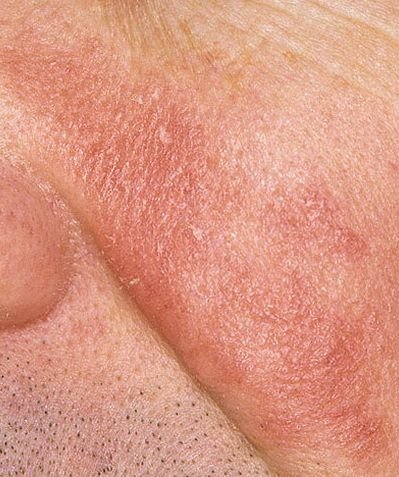
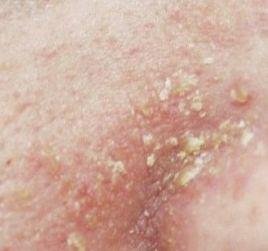
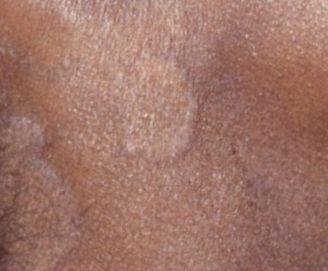
- The scale: Typically greasy, yellowish and soft, sitting on skin that is reddened or, in deeper skin tones, darker or violet, where the other eczemas here more often scale dry and white or crust over a weeping surface. These are tendencies rather than rules — seborrheic scale can be dry, and the others can look greasy.
- The itch: Usually mild to moderate, and often less than the appearance suggests, where dyshidrotic and nummular eczema tend to itch more. Itch varies from absent to marked in all of them, so it points a direction rather than settling the question.
- The course: Chronic and relapsing over years, with flares in winter and at times of stress. Individual flares often clear completely with treatment, and some people have persistent low-grade disease instead.
The Forms It Takes
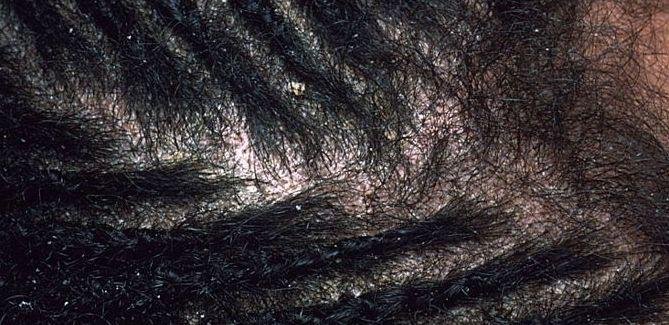
- Dandruff: The mildest and by far the most common form — fine scaling of the scalp without visible inflammation, generally regarded as the non-inflammatory end of the same spectrum. Having dandruff does not mean the rest of this list will follow.
- Scalp seborrheic eczema: Heavier scaling with redness, sometimes extending to the hairline, the ears and the neck.
- Facial seborrheic eczema: Redness and fine greasy scale in the nasolabial folds, eyebrows, glabella and beard area.
- Blepharitis: Involvement of the eyelid margins, with crusting and irritation of the lashes.
- Trunk involvement: Patches over the central chest and between the shoulder blades, sometimes ring-shaped.
- Infantile seborrheic eczema (cradle cap): Thick yellow scale on a baby’s scalp in the first months of life. Its course is quite unlike the adult condition — it is not itchy, the baby is untroubled by it, and it usually clears on its own within a few months.
Conditions It Is Confused With
- Scalp psoriasis: Thicker, drier, silvery scale with sharper borders that often crosses the hairline onto the forehead. The two overlap enough that the term sebopsoriasis exists for cases sitting between them.
- Rosacea: Affects the central face and can coexist; rosacea brings flushing, papules and pustules without greasy scale.
- Tinea capitis or tinea faciei: Fungal infection with an active scaly edge, and on the scalp usually with hair loss. Where the diagnosis is uncertain, microscopy, culture or dermoscopy settles it, and this matters because a corticosteroid applied to tinea lets it spread.
- Atopic dermatitis: Favours flexures rather than sebum-rich areas, and is far itchier. In infants the two can be difficult to separate early on.
- Allergic contact dermatitis: From hair products or cosmetics; distribution follows the exposure.
- Discoid lupus erythematosus: Considered for persistent scaly facial or scalp plaques that scar.
Risks: What Is Worth Knowing
Seborrheic eczema is not dangerous and it does not scar in its usual forms, but two things deserve attention.
The first is the eyes. Untreated blepharitis is uncomfortable, persistent and worth treating properly rather than tolerating.
The second is context. Severe or treatment-resistant seborrheic eczema is seen more often, and more severely, in people with Parkinson’s disease and in immunosuppression, including untreated HIV infection. This is an association, not a diagnostic implication. Both remain uncommon explanations for seborrheic eczema, severity or a sudden start is not by itself a sign of either, and ordinary dandruff and typical facial disease are not a reason to think about them. What it does mean is that disease which is severe, extensive, atypical or resistant to treatment is worth assessing in the round rather than only treating.
The burden most people actually report is visibility. Redness and scale on the face and scalp are hard to conceal, and the condition’s tendency to return makes that wearing over years.
Tactics: When to Seek Treatment
Dandruff and mild facial scaling can reasonably be managed with an antifungal shampoo bought over the counter. See a clinician if there is no improvement after a few weeks, if the eyelids are involved, if the scalp is losing hair, if the rash is spreading or unusually severe, or if a baby’s cradle cap becomes inflamed, weeping or widespread.
Treatment: The Short Version
Treatment targets the yeast and the inflammation together. Because recurrence is common, some form of maintenance is often continued after the skin clears, though plans differ and not everyone relapses as soon as treatment stops.
- Antifungal shampoos and creams, such as ketoconazole or ciclopirox, used regularly as the mainstay.
- Medicated shampoos containing selenium sulphide or, where it is available, zinc pyrithione — which ingredients are permitted differs between countries.
- Short courses of a mild topical corticosteroid for a flare, especially on the face, rather than continuous use.
- Topical calcineurin inhibitors for facial skin where repeated steroid use is unsuitable.
- Gentle eyelid hygiene where the lid margins are involved.
- For cradle cap: softening the scale with an emollient and gentle removal; most cases need nothing more.
The full treatment discussion, including what to do about recurrence, is on the seborrheic dermatitis page.
Medical review
Board-Certified Dermatologist · Fellow of the American Academy of Dermatology (FAAD)