
Scabies (ICD-10: B86) 🚨
Scabies: An Itch Caused by a Mite Burrowing in the Skin
Scabies is an infestation of the skin by Sarcoptes scabiei, a mite about a third of a millimetre long that tunnels into the outermost layer of the skin and lays its eggs there. The itch it causes is not from the burrowing itself but from an allergic reaction to the mite, its eggs and its waste — which explains the single most confusing thing about the condition.
On a first infestation, the itch does not begin for three to six weeks, because the immune system takes that long to become sensitised. A person can pass the mite on during that silent period, before any symptom appears — how readily depends on the number of mites and on how close and prolonged the contact is. On a repeat infestation, sensitisation already exists and the itch starts within a day or two.
Scabies is found worldwide, in every income group and every standard of housing. It is not a consequence of being unclean, and washing more does not prevent or treat it. It spreads through prolonged skin-to-skin contact — holding hands for a sustained period, sharing a bed, caring for someone — rather than through brief contact such as a handshake.
Predisposing Factors: How Scabies Spreads
- Prolonged skin-to-skin contact, which is the main route. Household members and sexual partners are at the highest risk.
- Crowded living and shared sleeping arrangements, which increase the amount of such contact.
- Care settings: Care homes, hospitals and childcare facilities see outbreaks because of the amount of close personal contact involved.
- Bedding and clothing, which play a modest role in ordinary scabies because the mite survives only two to three days away from skin. They matter considerably more in crusted scabies.
- Impaired immunity, advanced age or reduced sensation, which predispose to the crusted form.
The Crusted Form, and Why It Is Different
Crusted scabies, previously called Norwegian scabies, occurs when the immune response fails to keep mite numbers down — in people who are immunosuppressed, frail and elderly, neurologically impaired, or unable to scratch. Where ordinary scabies typically carries somewhere around a dozen mites — the number varies and is not a diagnostic threshold — crusted scabies carries thousands to millions.
It looks different: thick, warty, grey-white crusts, often on the hands, feet, elbows and scalp, with widespread scaling. Crucially, it may not itch much at all, which is why it is frequently mistaken for psoriasis or eczema and treated with corticosteroids for months. Some patients do itch substantially, particularly early, so a present itch does not rule it out either. It is extremely contagious, and a single unrecognised case is the usual source of an institutional outbreak.
Diagnostics: How Scabies Is Diagnosed
The diagnosis is made clinically, from the pattern of the itch, its distribution, and the presence of burrows. A history of other affected household members is strong supporting evidence and should always be asked for.
Dermoscopy can show the mite at the end of its burrow as a small dark triangle — the “delta-wing” or “jet with contrail” sign — and is a practical way to support the diagnosis at the bedside. Microscopy of skin scrapings from a burrow can demonstrate mites, eggs or faecal pellets; it confirms the diagnosis when positive but a negative result does not exclude it, since ordinary scabies carries so few mites.
Where the picture fits, treatment is often started without laboratory confirmation, because the consequences of waiting include continued transmission.
Symptoms: What Scabies Looks Like
- Intense itch, characteristically worse at night and when warm in bed. It is often the dominant complaint and disturbs sleep.
- Burrows: Fine, slightly raised, grey or skin-coloured wavy lines a few millimetres long, best seen in the finger webs, the sides of the fingers and the wrists.
- A characteristic distribution: Finger webs, wrists, elbows, armpits, waistline, buttocks, and the genitals in men and the breasts in women. In adults the head and neck are usually spared.
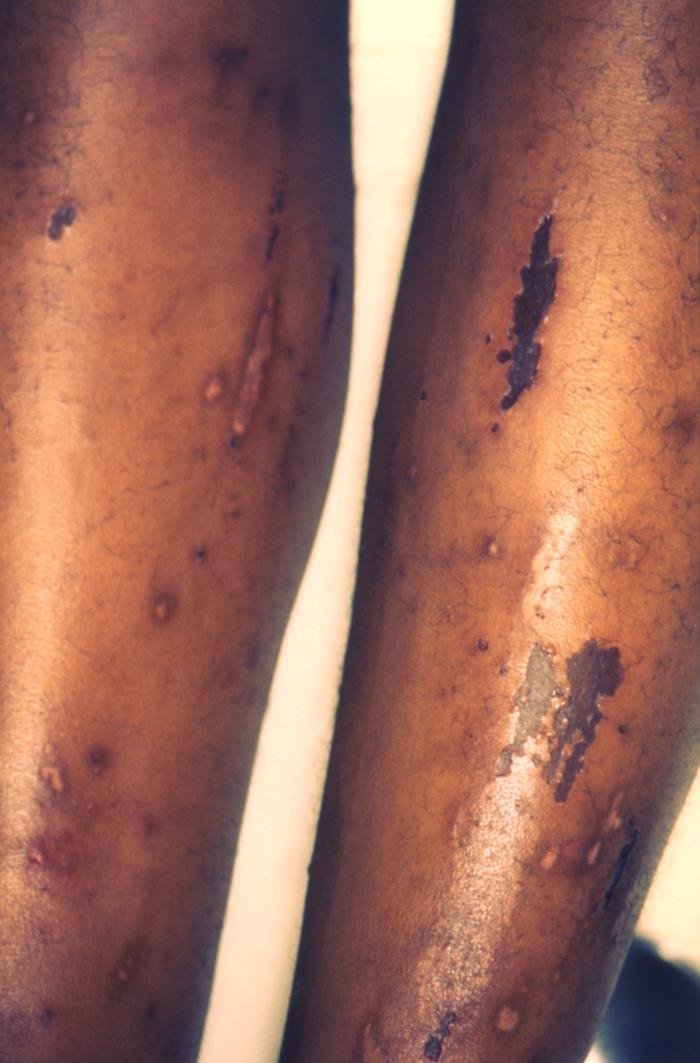
- Small red papules and widespread scratch marks, which are often all that is visible.
- Scabetic nodules: Firm, very itchy reddish-brown lumps on the genitals, groin or armpits, which can persist for weeks after successful treatment.
- A different pattern in infants and the elderly: palms, soles, scalp and face may be involved, which they are not in healthy adults.
- Crusting and scaling rather than itch, in the crusted form.
Differential Diagnosis: Ruling Out Other Conditions
- Eczema: The most frequent confusion, and the two coexist once scratching has damaged the skin. Distribution and a history of affected contacts separate them. See eczema.
- Insect bites and papular urticaria: Grouped lesions on exposed skin rather than in the finger webs and waistline.
- Dermatitis herpetiformis: Intensely itchy grouped blisters on elbows, knees and buttocks, associated with coeliac disease.
- Prurigo and other causes of generalised itch, including liver, kidney and thyroid disease and lymphoma, considered when there are no burrows and no affected contacts.
- Psoriasis or eczema, when crusted scabies is the real diagnosis — the error that matters most here, because corticosteroid treatment lets the infestation flourish.
Risks: Why Scabies Should Be Treated Promptly
Scabies is not dangerous in itself, but three consequences make prompt treatment worthwhile.
The first is secondary bacterial infection. Scratched skin becomes infected with staphylococci and streptococci, producing impetigo and occasionally deeper infection. In settings where this is common, streptococcal skin infection following scabies is recognised as a route to post-streptococcal kidney disease. A causal link with acute rheumatic fever is not established in the way it is for streptococcal throat infection.
The second is continued transmission. Someone who does not yet itch is still passing the mite on, and an untreated household member is a very likely source of reinfection for everyone else.
The third is the itch itself, which is severe enough to disturb sleep for weeks and is a genuine burden rather than an inconvenience.
Tactics: When and How to Seek Treatment
See a clinician if you have a persistent itch that is worse at night, particularly if others in the household itch too, or if you notice fine lines between the fingers. Do not wait to see whether it settles: scabies does not clear on its own.
Two points determine whether treatment works:
- Household members and anyone in prolonged skin-to-skin contact are treated at the same time, including those with no symptoms. Brief or casual contacts usually do not need treatment, and definitions differ between local public-health guidance. Treating only the person who itches is a very common reason scabies keeps coming back.
- The itch continues after successful treatment, commonly for two to four weeks and sometimes longer, because the allergic reaction outlasts the mite. New burrows, new lesions or an affected contact point to active infestation far more than continuing itch does. Continuing itch is not evidence that treatment failed, and repeating treatment unnecessarily irritates the skin. Ask before repeating.
Treatment: Modern Strategies for Scabies
- Topical permethrin 5%, applied to the entire skin surface according to age-specific instructions, left on for the recommended time and washed off, then repeated, usually after one to two weeks. The areas most often missed are the ones that matter: under the nails, between the toes, the navel, and the genital and perianal skin. In adults the application generally starts at the neck; in infants, young children and some older adults the scalp and face are included too, avoiding the eyes and mouth. Follow the instructions that come with the product and local guidance.
- Oral ivermectin, used where topical treatment is impractical, has failed, or in outbreaks and crusted scabies. It is dosed by weight and given as two doses, commonly one to two weeks apart. It is generally avoided in pregnancy and in children weighing under 15 kg. Licensing differs between countries, so it is prescribed only after checking current local guidance.
- Crusted scabies needs urgent specialist management, and it is a public-health matter as much as a clinical one. The mite burden runs to thousands rather than the ten or twenty of ordinary scabies, which makes the patient highly infectious and makes outbreaks in households and care settings likely. Treatment is intensive and clinician-directed: multiple doses of oral ivermectin with repeated topical treatment, keratolytics to lift the crusts so treatment can reach the mites, coordinated treatment of contacts, environmental measures, and contact precautions or isolation. Schedules vary with severity and local guidance.
- Treating all contacts simultaneously, which is part of the treatment rather than a precaution.
- Laundry: Bedding, towels and clothing used in the previous few days washed hot — commonly 60 °C or above — and tumble dried, or sealed in a bag for several days; exact temperatures and intervals differ between national guidance. Items that have not been against the skin do not need special treatment, and fumigating a house is not recommended.
- Managing the residual itch with emollients, a mild topical corticosteroid and antihistamines at night, rather than with repeated antiparasitic courses.
Prevention
- Treat contacts at the same time, which prevents the cycle restarting.
- Tell people you have been in close contact with, awkward as it is, so they can be treated before they pass it on.
- Follow the laundry advice once, rather than repeatedly deep-cleaning the home.
- Consider scabies early in care settings, where a single crusted case can affect many people.
- Do not treat an undiagnosed itchy rash with corticosteroids where scabies is possible — they mask it and let it spread. Once scabies has been treated, a corticosteroid is a reasonable way to settle the dermatitis and itch left behind.
Scabies is straightforward to cure and straightforward to get wrong. The two explanations to consider first in a case that will not settle are an untreated contact and treatment repeated for an itch that was always going to take a few weeks to fade. Others follow: the wrong diagnosis, an unrecognised crusted case, treatment applied incompletely, reinfestation from outside the household, or an eczema left behind by all the scratching.
Image: CDC / Susan Lindsley, Public Health Image Library #15385.

Medical review
Board-Certified Dermatologist · Fellow of the American Academy of Dermatology (FAAD)